

Court’s decision
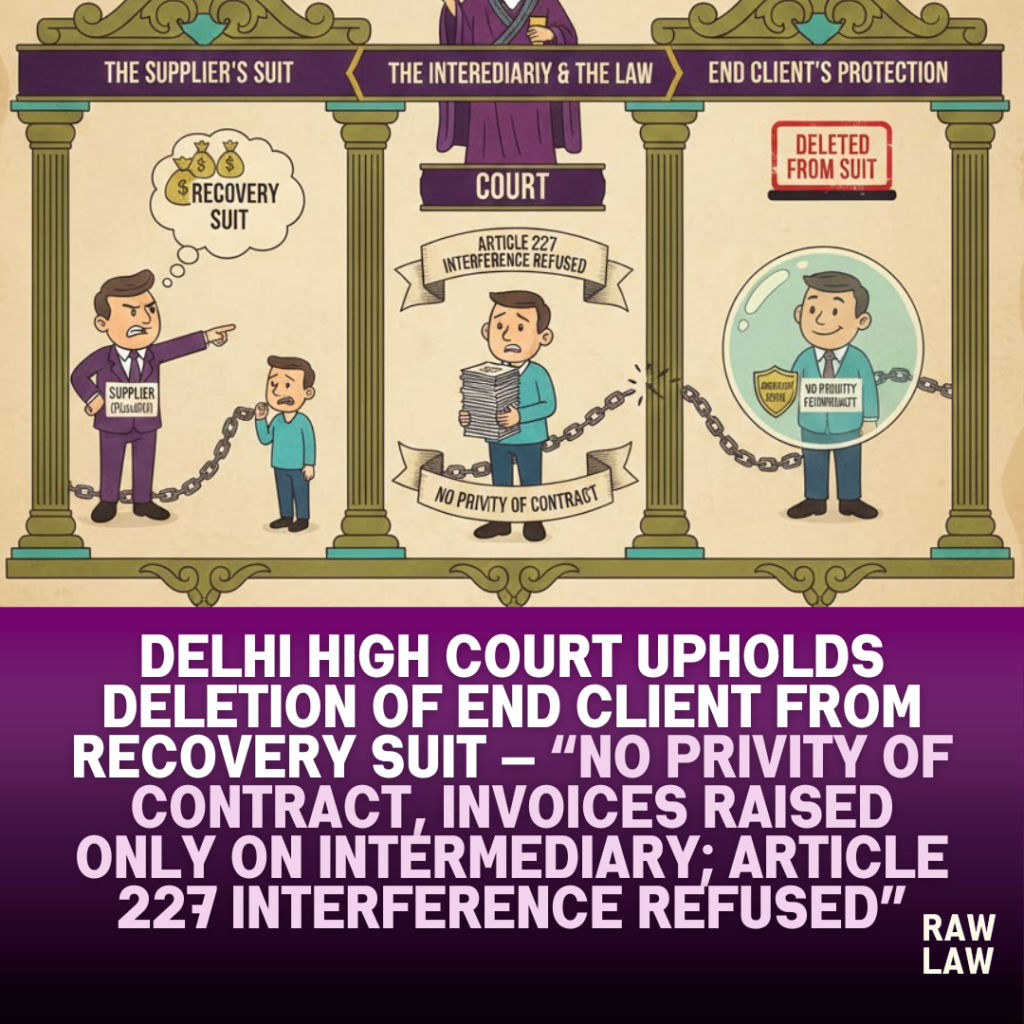
The Delhi High Court dismissed a supervisory petition under Article 227 challenging an order that deleted the end client from a money recovery suit, holding that in the absence of privity of contract and any pleaded or proven liability, the client was neither a necessary nor a proper party. The Court ruled that where invoices are raised exclusively on an intermediary and payments flow through it, impleadment of the client cannot be sustained — reasoned trial court order upheld; petition dismissed.
Court’s decision
Justice Rajneesh Kumar Gupta affirmed the trial court’s order dated 05 January 2022 allowing an application under Order I Rule 10 of the Code of Civil Procedure to delete respondent no. 2 from the array of parties. The Court held that the supervisory jurisdiction under Article 227 is narrow and does not permit re-appreciation of pleadings when the impugned order reflects correct application of law to admitted facts.
Facts
The petitioner instituted a civil suit seeking recovery of ₹2,96,631 with interest, asserting that she provided housekeeping services and supplied materials/tools. According to the plaint, respondent no. 1 approached the petitioner in April 2017 to provide services and supply materials to corporate/partner units, particularly respondent no. 2.
The petitioner supplied materials to respondent no. 2 as per demands routed through respondent no. 1, raised periodic invoices on respondent no. 1, and received part-payments. An amount of ₹2,48,227 allegedly remained outstanding despite demands. Respondent no. 2 applied under Order I Rule 10 CPC for deletion, contending lack of privity and liability, which the trial court allowed. The petitioner invoked Article 227 to assail that order.
Issues
The central issue was whether respondent no. 2 was a necessary or proper party to the recovery suit within the meaning of Order I Rule 10(2) CPC. A connected issue was whether the trial court’s deletion order suffered from jurisdictional error or perversity warranting interference under Article 227.
Petitioner’s arguments
The petitioner argued that respondent no. 2 actually received the housekeeping services and materials, making its presence necessary for effective adjudication. It was submitted that deletion would prejudice the petitioner’s ability to recover dues for services rendered to respondent no. 2, and that the trial court acted on surmises by ignoring the factual receipt of services.
Respondent’s arguments
Respondent no. 2 opposed the petition, submitting that there was no privity of contract with the petitioner. It contended that respondent no. 1 introduced the petitioner as a vendor/sub-contractor; invoices were raised solely on respondent no. 1; payments were made only to respondent no. 1; and no agreement, correspondence, invoice, signature, or stamp linked respondent no. 2 to any payment obligation. It was also argued that impleadment was an attempt to create territorial jurisdiction.
Analysis of the law
The Court analysed Order I Rule 10(2) CPC, which empowers courts to strike out improperly joined parties and add only those whose presence is necessary to “effectually and completely” adjudicate the questions involved. Relying on Supreme Court guidance, the Court reiterated that impleadment is procedural, discretionary, and contingent on necessity, not convenience. The inquiry focuses on pleaded liability and contractual nexus, not merely on who benefitted from services.
Precedent analysis
The Court referred to the Supreme Court’s exposition in Anil Kumar Singh v. Shivnath Mishra on the scope of Order I Rule 10(2), emphasising that the object is to avoid multiplicity while ensuring only necessary parties are before the court. Applying this standard, the Court assessed whether the plaint disclosed any enforceable obligation against respondent no. 2.
Court’s reasoning
On a close reading of the plaint and documents, the Court found that no specific relief was claimed against respondent no. 2; the plaint itself recorded that payments were made by respondent no. 2 to respondent no. 1 and that default, if any, lay with respondent no. 1. Crucially, all invoices were raised on respondent no. 1 and bore no endorsement of respondent no. 2, and no agreement or correspondence established liability of respondent no. 2.
Given the absence of privity of contract and pleaded liability, the cause of action lay only against respondent no. 1. The Court held that respondent no. 2’s presence was unnecessary for complete adjudication and that the trial court’s order was reasoned and lawful, meriting no Article 227 interference.
Conclusion
The Delhi High Court dismissed the petition, upheld the deletion of respondent no. 2 from the suit, and confirmed that the recovery claim must proceed, if at all, against respondent no. 1 alone. Pending applications were disposed of.
Implications
The ruling reinforces that end clients cannot be impleaded in recovery suits absent privity of contract or pleaded liability, even if they received the benefit of services. It underscores disciplined use of Order I Rule 10 and the limited scope of Article 227 review. For vendors operating through intermediaries, the judgment highlights the importance of clear contracting and invoicing if liability is intended to extend beyond the intermediary.
Case law references
- Order I Rule 10 CPC: Only necessary/proper parties may be impleaded; necessity turns on pleaded liability and contractual nexus. Applied to uphold deletion.
- Anil Kumar Singh v. Shivnath Mishra: Discretionary impleadment to ensure complete adjudication without multiplicity. Applied to test necessity.
- Article 227 limits: Supervisory jurisdiction does not permit re-appreciation of facts absent perversity. Applied to refuse interference.
FAQs
1. Can an end client be sued for recovery if invoices were raised on an intermediary?
Generally no, unless privity of contract or specific liability is pleaded and proved against the end client.
2. What makes a party “necessary” under Order I Rule 10 CPC?
A party whose presence is required to effectively and completely adjudicate the issues, typically because a relief or liability is claimed against it.
3. When will the High Court interfere under Article 227?
Only for jurisdictional errors, perversity, or patent illegality—not to re-assess pleadings or evidence.


