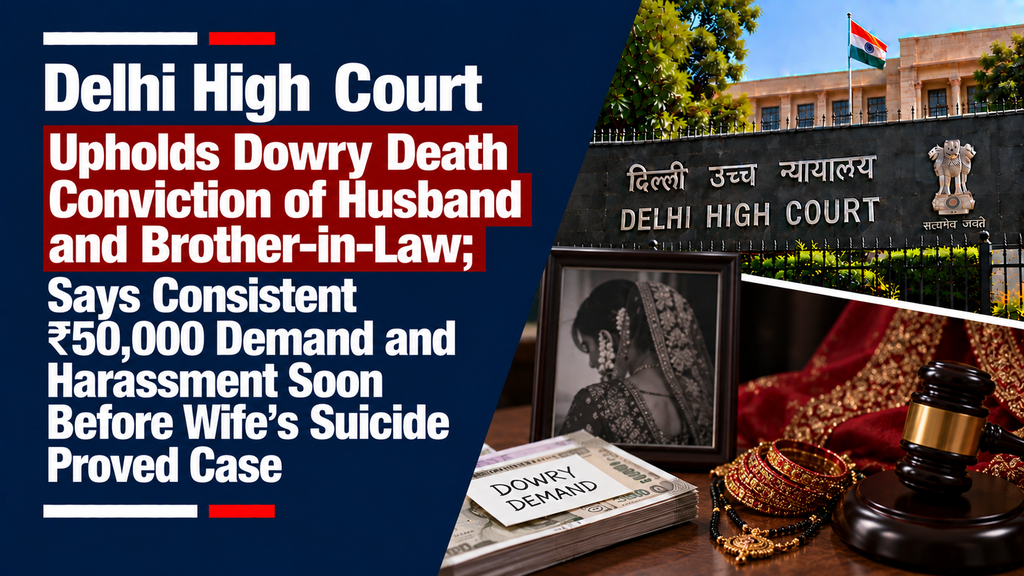
Delhi High Court Upholds Dowry Death Conviction of Husband and Brother-in-Law; Says Consistent ₹50,000 Demand and Harassment Soon Before Wife’s Suicide Proved Case

Wife Dies by Suicide Four Months After Marriage: Delhi High Court Upholds Husband and Brother-in-Law’s Dowry Death Conviction
Facts
The appeal arose from the death of Vinita @ Kamlesh, who was found hanging from a ceiling fan at her matrimonial home in Tughlakabad, New Delhi, on 10 April 2003. She had married appellant Naveen Kumar Verma on 29 November 2002—barely four and a half months before her death.
Her father stated before the SDM that Naveen and his brother Ajay Kumar Verma used to beat Vinita and demand ₹50,000 as dowry. Her mother similarly alleged harassment, beating and a ₹50,000 demand and additionally alleged that Ajay wanted to establish illicit relations with Vinita. FIR No. 208/2003 was consequently registered under Sections 304-B, 498-A and 34 IPC.
The Trial Court convicted Naveen and Ajay under Sections 304-B and 498-A IPC. They were sentenced to 10 years’ rigorous imprisonment for dowry death and three years’ rigorous imprisonment with ₹5,000 fine for cruelty, with the sentences running concurrently.
Their mother, Kaushalya Devi, who was tried for the same offences, was acquitted on benefit of doubt. The State did not challenge her acquittal, which therefore attained finality.
Issues
The principal question before the Delhi High Court was whether the prosecution had proved beyond reasonable doubt that Vinita was subjected to cruelty or harassment in connection with a dowry demand “soon before her death”, thereby satisfying Section 304-B IPC.
The Court also examined whether the testimony of the deceased’s relatives could safely sustain the conviction; whether variations regarding a telephone call shortly before the death materially damaged the prosecution case; whether absence of physical injuries undermined allegations of cruelty; and whether the accused had rebutted the statutory presumption under Section 113-B of the Evidence Act.
Appellants’ Arguments
The appellants attacked the prosecution case principally on the ground that PW-1 to PW-5 were close relatives of the deceased and therefore interested witnesses. No independent witness had been examined. They also complained that the Trial Court had not accorded equal weight to defence witnesses.
They emphasised that despite numerous interactions between the two families during the short marriage, nobody had observed injuries upon Vinita. There was also no medical evidence of beating, no prior police complaint or panchayat, and no evidence that the accused had directly demanded ₹50,000 from her parents.
A major defence argument concerned the alleged telephone call of 8 April 2003, two days before Vinita’s death, during which she allegedly asked her mother to come with money. The appellants argued that this allegation appeared for the first time during trial and was absent from the earlier statements before the SDM and police, making it a material improvement.
They also argued that the allegations were vague and lacked specific dates, and that the same evidence could not logically result in their conviction while their mother was acquitted.
Respondent’s Arguments
The State maintained that the testimony of PW-1 to PW-5 remained consistent on the central allegation: Vinita was beaten and subjected to a specific demand for ₹50,000.
It argued that merely because these witnesses were relatives did not render them unreliable. Matrimonial cruelty ordinarily occurs within the privacy of the matrimonial home, making family members natural recipients of a victim’s complaints.
The State further emphasised that Vinita died only four and a half months after marriage, thereby satisfying the necessary proximity for invoking Section 113-B once the foundational facts of dowry-related cruelty were established.
Analysis of the Law
The High Court reiterated the essential ingredients of dowry death under Section 304-B IPC: the woman’s death must occur otherwise than under normal circumstances within seven years of marriage; she must have been subjected to cruelty or harassment by her husband or his relative; that cruelty must have been for or in connection with dowry; and it must have occurred soon before her death.
The Court stressed that the presumption under Section 113-B of the Evidence Act does not arise automatically merely because a married woman dies unnaturally within seven years of marriage.
The prosecution must first prove the foundational facts—dowry-linked cruelty or harassment and its proximity to the death—beyond reasonable doubt. Only thereafter does the statutory presumption operate against the accused.
Related Witnesses Are Not Automatically “Interested Witnesses”
The Court rejected the argument that the deceased’s parents, siblings and uncle should be discarded merely because they were related to her.
Relying on Rajesh Yadav v. State of U.P., it distinguished a related witness from an interested witness. In matrimonial offences occurring within the privacy of a home, relatives may naturally be the persons to whom the victim communicates her difficulties. Their relationship with the victim does not by itself destroy otherwise credible evidence.
Minor Discrepancies Do Not Destroy the Core Case
The Court acknowledged variations concerning the alleged telephone call of 8 April 2003. However, it found that the central prosecution allegation remained consistent throughout: Naveen and Ajay beat Vinita and demanded ₹50,000.
The Court held that witnesses cannot be expected to reproduce events with mechanical precision. Normal differences arising from memory, trauma and the passage of time cannot be equated with material contradictions that strike at the root of the prosecution case.
Absence of Injuries Does Not Automatically Negate Cruelty
The Court also rejected the argument that absence of visible injuries in the post-mortem necessarily disproved cruelty.
While absence of injuries may be relevant when assessing an allegation of physical assault, it does not by itself exclude mental cruelty, harassment or dowry-related pressure falling within Sections 498-A and 304-B IPC.
Precedent Analysis
The Court relied upon Gurdip Singh v. State of Punjab for the essential ingredients of Section 304-B IPC and the statutory framework governing dowry death.
Rajesh Yadav v. State of U.P., (2022) 12 SCC 200 was relied upon to hold that a related witness cannot automatically be treated as an interested witness and that family members can be natural witnesses depending upon the circumstances.
The Court relied upon Goverdhan v. State of Chhattisgarh, (2025) 3 SCC 378, referring to Bharwada Bhoginbhai Hirjibhai v. State of Gujarat, (1983) 3 SCC 217, for the proposition that excessive importance should not be attached to ordinary discrepancies arising from memory, perception or passage of time.
On the absence of physical injuries, the Court referred to Sukh Chand & Anr. v. State of NCT of Delhi, 2026 SCC OnLine Del 6287, observing that absence of injury marks does not by itself negate dowry-related cruelty or harassment.
The appellants relied upon Manohar Lal v. State of Haryana and Shobhit Kumar Mittal v. State of Uttar Pradesh, but the Court distinguished both. Unlike those cases, the present matter involved a specific ₹50,000 cash demand consistently spoken to by five witnesses.
For the meaning of “soon before death,” the Court relied upon State of Madhya Pradesh v. Jogendra, (2022) 5 SCC 401, which in turn referred to Kans Raj v. State of Punjab, (2000) 5 SCC 207. The expression does not mean “immediately before”; what is necessary is a proximate and live link between dowry-related cruelty and the death.
Court’s Reasoning
The Court found the ₹50,000 demand to be particularly significant because it was specific both in amount and nature—it was a demand for ₹50,000 in cash.
PW-1 to PW-5 consistently spoke about that demand, accompanied by beating, taunting and harassment. The Court therefore concluded that harassment arising from non-fulfilment of the dowry demand stood proved.
The Court also rejected the argument that a demand for money to establish a business could not constitute dowry. It held that a demand connected with the marital relationship does not cease to be a dowry demand merely because the money is allegedly required for “business” rather than personal expenditure.
On the crucial “soon before death” requirement, the Court noted that the entire marriage lasted only about four and a half months. Even assuming harassment commenced only in January 2003, merely a little over three months separated its commencement from Vinita’s death on 10 April 2003.
Since the evidence indicated that the demand and harassment persisted during this short period, the Court found the required proximate and live link and held that invocation of Section 113-B was justified.
The accused also failed to rebut the statutory presumption. Their plea that they were absent from the house was unsupported by reliable independent evidence. The allegation that Vinita was distressed because of an illicit relationship with a man named Rakesh was found to be an afterthought and unsupported even by the defence’s own evidence.
The Court also considered the conduct of the appellants’ brother Pankaj, who went to Vinita’s parental home on the date of the incident and merely informed her father that she was “unwell,” rather than disclosing that she had died. This circumstance remained unexplained and was treated as operating against the defence.
Conclusion
The Delhi High Court upheld the conviction of Naveen Kumar Verma and Ajay Kumar Verma under Sections 304-B and 498-A IPC.
It held that the prosecution had established the foundational facts of dowry death: Vinita died an unnatural death within four and a half months of marriage; a specific ₹50,000 dowry demand and associated harassment were proved; and the continuing conduct was sufficiently proximate to her death to satisfy the “soon before death” requirement.
The statutory presumption under Section 113-B therefore arose, and the appellants failed to rebut it. Their explanations were found false or unsupported.
The appeal was accordingly dismissed, and both appellants were directed to surrender forthwith to undergo the remaining sentence, with the benefit of set-off under Section 428 CrPC.
Case Details
Case: Naveen Kumar Verma & Anr. v. State
Court: High Court of Delhi at New Delhi
Case No.: CRL.A. 677/2004
Judge: Justice Vimal Kumar Yadav
Reserved: 6 May 2026
Decision: 15 September 2026
Offences: Sections 304-B and 498-A IPC
Sentence: 10 years’ rigorous imprisonment under Section 304-B; three years’ rigorous imprisonment and ₹5,000 fine under Section 498-A; sentences concurrent.
Result: Appeal dismissed; conviction and sentence maintained; appellants directed to surrender forthwith.