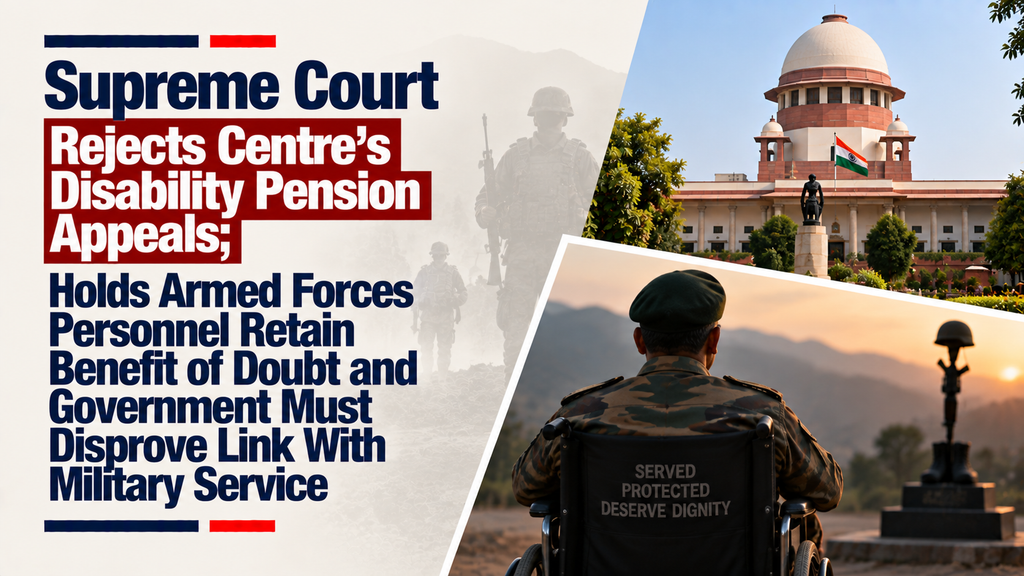
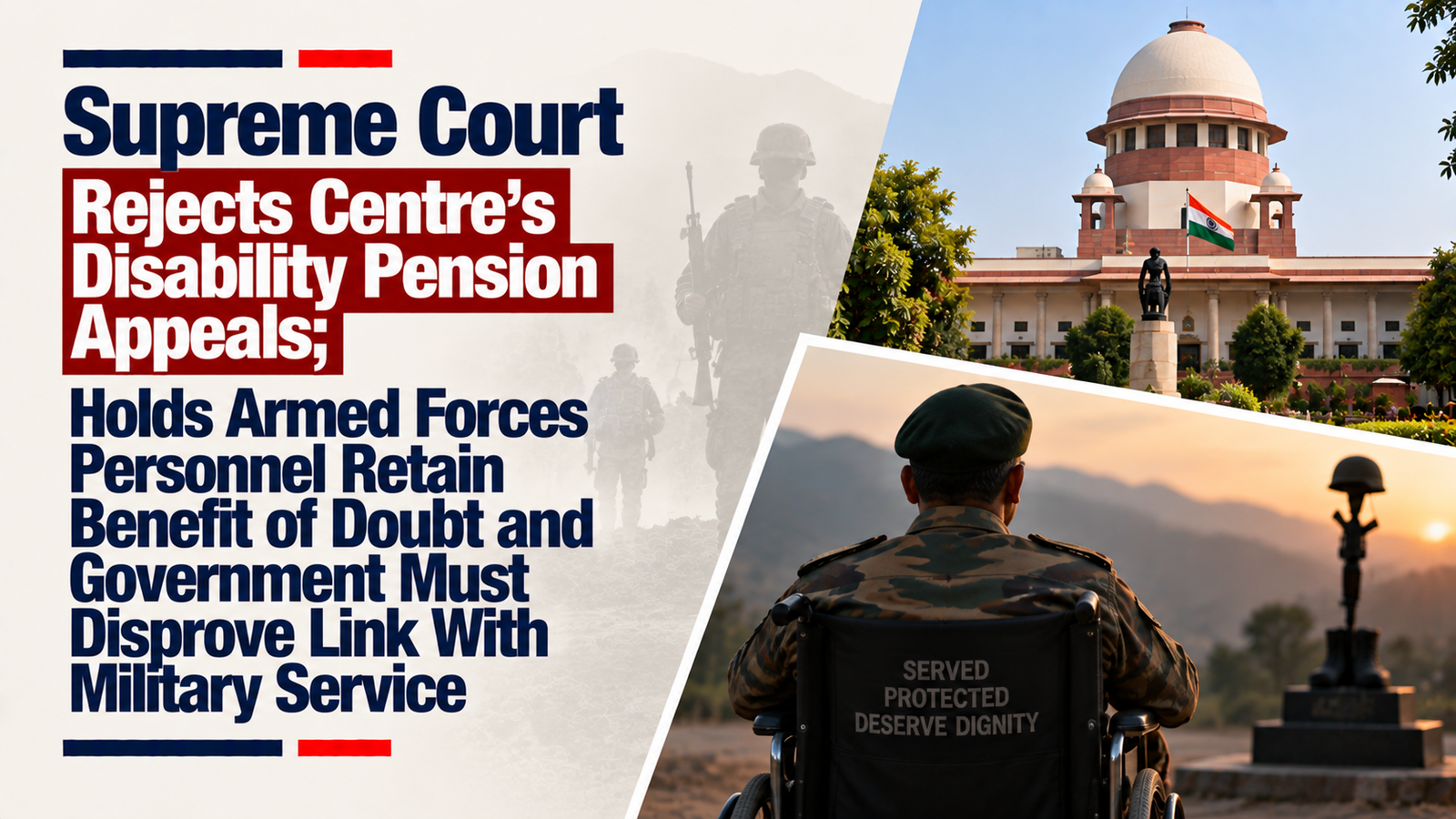
Supreme Court Rejects Centre’s Disability Pension Appeals; Holds Armed Forces Personnel Retain Benefit of Doubt and Government Must Disprove Link With Military Service

Disability Pension Cannot Be Denied on Hyper-Technical Grounds: Supreme Court Dismisses Centre’s Appeals Against Ex-Servicemen
Facts
The Supreme Court dealt with a large batch of Civil Appeals and Special Leave Petitions filed by the Union of India concerning disability pension claims of retired Armed Forces personnel, with the lead matter being Union of India & Ors. v. Col. NC Isaac (Retd.).
In each of these cases, the Release Medical Board (RMB) had initially classified the ex-serviceman’s disability as “Neither Attributable Nor Aggravated” (NANA) by military service. Their departmental appeals were consequently rejected.
The Armed Forces Tribunal or the respective High Courts subsequently interfered and granted disability pension by treating the disability as attributable to or aggravated by military service. The Union challenged those decisions before the Supreme Court.
The Supreme Court noted at the outset that it had been confronted with numerous similar appeals, many filed after enormous delay, despite an earlier authoritative pronouncement governing disability pension claims.
Issues
The principal controversy was whether the Entitlement Rules for Casualty Pensionary Awards, 2008 materially changed the beneficial disability-pension regime that existed under the 1982 Entitlement Rules, particularly after the Supreme Court’s decision in Dharamvir Singh v. Union of India.
The Court examined:
- who bears the burden of proving whether a disability is attributable to or aggravated by military service;
- whether the 2008 Rules removed the earlier presumption in favour of soldiers;
- the evidentiary value of Release Medical Board findings;
- the extent to which the AFT or courts can interfere with medical opinions; and
- the effect of filing a disability-pension claim more than 15 years after discharge or retirement.
Union of India’s Arguments
The Attorney General argued that disability pension requires two separate conditions: the disability must be attributable to or aggravated by military service, and the accepted disability must meet the required percentage threshold.
Merely satisfying the percentage requirement does not establish the necessary causal connection with military service.
The Union further argued that the 2008 Rules differed materially from the 1982 regime.
According to it, the mere fact that a disease first manifested while the person was serving in the Armed Forces could not automatically establish that military service caused or aggravated it.
The Union particularly relied upon conditions such as hypertension, diabetes mellitus and ischaemic heart disease, arguing that such diseases require an individual and disease-specific assessment rather than an automatic service connection.
It also emphasised that Medical Boards are expert bodies and their medical conclusions should receive substantial judicial deference.
Ex-Servicemen’s Arguments
The ex-servicemen contended that the Armed Forces Tribunal is legally empowered to examine disputed questions of fact and is not bound to mechanically accept the conclusions of a Release Medical Board.
Their broader case was that the disability-pension framework is beneficial in nature and that the 2008 Rules did not fundamentally dismantle the protections recognised in earlier law and in Dharamvir Singh.
Analysis of the Law
2008 Rules Changed the Presumption — But Not the Entire Beneficial Scheme
This is the most important nuance in the judgment.
Under Rule 5 of the 1982 Rules, a person entering military service was presumed to be physically and mentally sound except for conditions recorded at entry. The framework consequently operated strongly in favour of attributability where disability subsequently arose.
The 2008 Rules removed that specific automatic presumption and expressly stated that the mere manifestation of a disease during military service does not, by itself, establish attributability or aggravation.
But the Supreme Court held that this amendment did not fundamentally reverse the entire disability-pension framework.
Crucially, Rule 7 of the 2008 Rules continued broadly to place the onus of proof upon the employer/Union, subject to the specific 15-year exception.
Government Generally Bears the Burden
The Court held that despite the changes introduced in 2008, the core beneficial structure remained substantially intact.
The Court specifically concluded that:
the burden of establishing that the serviceman’s disability is not attributable to military service continues to lie upon the employer.
This makes the judgment considerably more significant than merely another batch dismissal.
The removal of the earlier entry-stage presumption does not automatically shift the entire evidentiary burden onto every retired soldier seeking disability pension.
Unknown Cause of Disease
The Court also examined situations where the precise cause of a disability is medically uncertain.
It found continuity between the 1982 and 2008 frameworks.
Where the cause remains unknown, the rules continue to contemplate attributability based upon the clinical picture and prevailing scientific medical understanding, rather than permitting rejection merely because a precise cause cannot be identified.
Aggravation by Military Service
The Court separately emphasised the concept of aggravation.
A disability need not necessarily have been originally caused by military service for disability benefits to arise.
Under the 2008 Rules, a disability may still be treated as aggravated by service where its onset is hastened or its subsequent course is worsened by specific service conditions. The Court found this broadly consistent with the earlier 1982 regime.
Thus, the inquiry cannot stop merely because the underlying disease may have constitutional, degenerative or other non-service origins.
The separate question remains whether military service aggravated its course or severity.
Medical Board Opinion Deserves Weight — But Is Not Untouchable
The Supreme Court did not hold that every NANA finding by a Medical Board should simply be discarded.
On the contrary, it accepted an important part of the Union’s argument:
Medical Board opinions deserve due weight because they involve expert medical assessment.
A Tribunal or Court should not substitute its own view merely because another medical conclusion appears possible.
However, judicial scrutiny remains available where the opinion suffers from defects such as:
- failure to consider relevant material;
- reliance upon irrelevant considerations;
- absence of discernible reasons; or
- other material defects in the decision-making process.
The jurisprudence examined by the Court also recognised that ordinarily, where a medical opinion is unsustainable, reconsideration by an appropriate Medical Board may be preferable to a court itself making a medical determination.
The Crucial 15-Year Exception
The Supreme Court carved out an important qualification.
Where the claimant approaches the relevant forum after 15 years from discharge, retirement, invalidment or release, Rule 7 of the 2008 Rules changes the position.
In such cases:
the burden shifts to the claimant, who must establish the conditions necessary for entitlement.
This is therefore a significant limitation on the otherwise beneficial burden-of-proof framework.
Precedent Analysis
Dharamvir Singh v. Union of India
A major controversy was whether Dharamvir Singh continued to govern cases arising under the 2008 Rules.
The Union argued that Dharamvir concerned the 1982 Rules and could not simply be mechanically transplanted into the 2008 framework.
The Supreme Court accepted that there were textual differences between the two regimes, including removal of the earlier automatic presumption arising from sound health at entry.
However, after comparing the provisions in detail, it concluded that the core beneficial architecture remained substantially unchanged, particularly because the burden generally continued to rest on the employer.
Bhaskaran N.
The judgment also examined Union of India v. Bhaskaran N., where the Kerala High Court recognised that the 2008 Rules altered certain presumptions but continued to place the burden upon the establishment where the disability-pension claim was brought within the prescribed period.
Court’s Concern Over Repeated Litigation Against Disabled Soldiers
One of the strongest parts of the judgment comes at its conclusion.
The Supreme Court referred to the Raksha Mantri Committee Report, 2015, which had noted that disabled soldiers were still being denied disability benefits on hyper-technical grounds and recognised the inherent stress and strain associated with military service.
The Report had recommended immediate withdrawal of appeals of this nature against disabled soldiers.
The Court recorded that the recommendation had not been faithfully implemented, despite the Ministry of Defence having accepted the recommendation for withdrawal of this class of litigation.
The scale of rejection was also noted. According to information obtained under the Right to Information Act referred to in the judgment, out of 2,997 first departmental appeals, 2,855 were rejected and only 142 accepted. At the second appellate stage, 439 out of 456 were rejected, with only 17 accepted.
Conclusion
The Supreme Court ultimately found no ground to interfere with the disability-pension relief granted to the ex-servicemen.
The batch of Special Leave Petitions and Civil Appeals filed by the Union was dismissed both on delay and on merits.
At the same time, the Court clarified two important safeguards for future cases:
Medical Board opinions must receive due weight and must be carefully scrutinised by the Tribunal rather than casually substituted by judicial opinion.
And:
where a disability-pension claim is brought more than 15 years after discharge, retirement, invalidment or release, the burden shifts to the claimant to prove entitlement.
The judgment therefore preserves the beneficial character of disability-pension law for Armed Forces personnel, while maintaining the role of expert medical assessment and creating a distinct evidentiary rule for claims initiated after 15 years.
Case Details
Case: Union of India & Ors. v. Col. NC Isaac (Retd.) & Connected Matters
Citation: 2026 INSC 993
Court: Supreme Court of India
Jurisdiction: Civil Appellate Jurisdiction
Judges: Justice Pamidighantam Sri Narasimha and Justice Alok Aradhe
Date: 15 September 2026
Subject: Armed Forces disability pension; attributability/aggravation; Entitlement Rules 1982 and 2008; Medical Board findings; burden of proof
Result: Union’s batch of appeals/SLPs dismissed on delay as well as merits; no order as to costs.