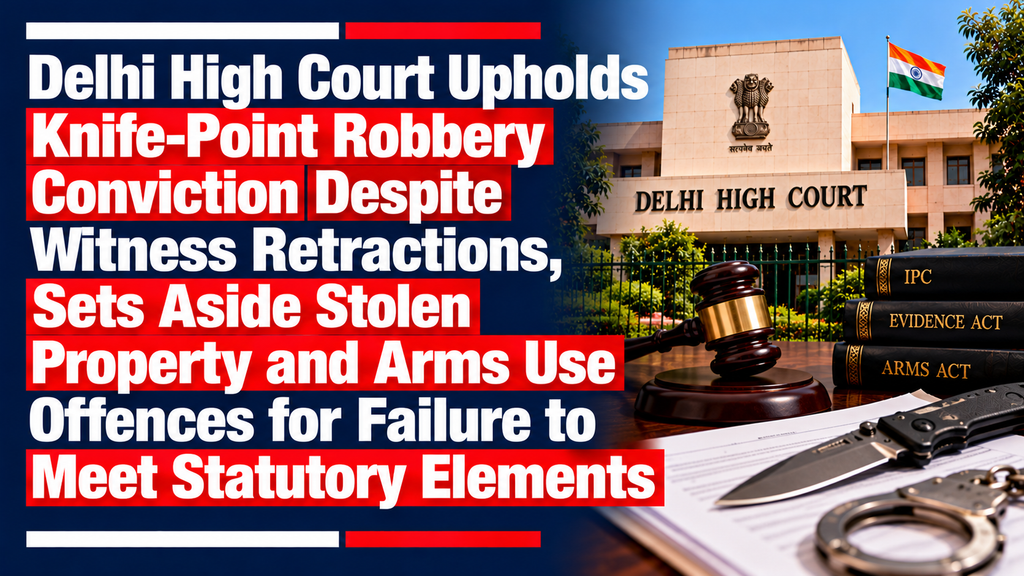
Delhi High Court Upholds Knife-Point Robbery Conviction Despite Witness Retractions, Sets Aside Stolen Property and Arms Use Offences for Failure to Meet Statutory Elements

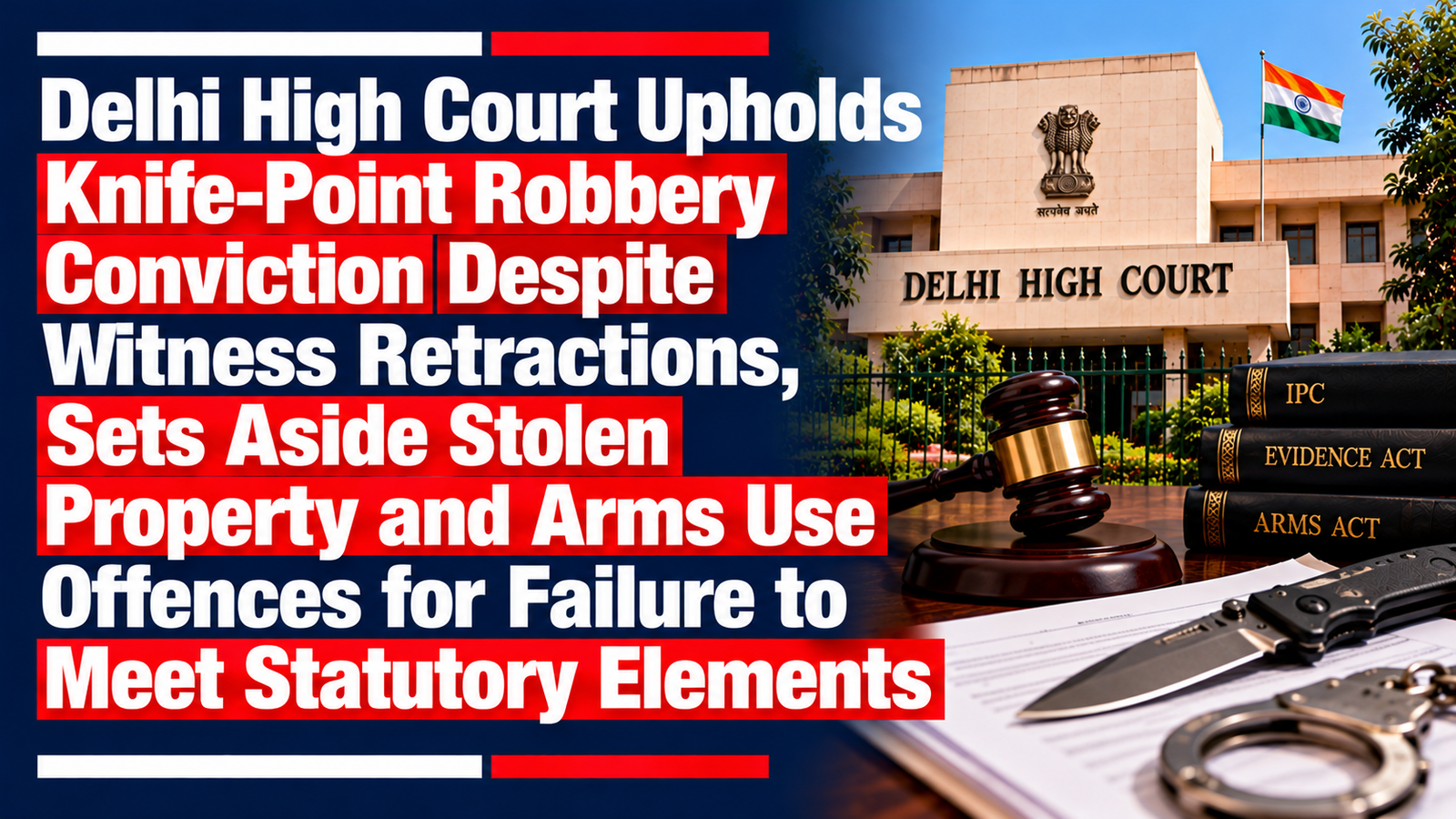
Delhi High Court Rules Later Witness Retractions Do Not Erase Corroborated Testimony, Upholds Robbery Sentence But Sets Aside IPC 411 and Arms Act 27 Convictions
Facts
On 13 July 2012, student Nitin Shukla reported that his Nokia mobile phone disappeared while he travelled in a Delhi bus with friends. The prosecution alleged that its ringtone sounded from Pramod Kumar’s pocket and that he threatened a companion with a button-operated knife when asked to return it. Public passengers allegedly apprehended him, and police seized the phone and knife. The trial court convicted him in December 2015 under Sections 392, 397 and 411 IPC and Sections 25 and 27 of the Arms Act, imposing concurrent substantive sentences, including seven years for Section 397. Two eyewitnesses later retracted important portions of their original testimony.
Issues
Whether the substantial changes in prosecution witnesses’ cross-examinations undermined proof of robbery, use of a knife, identification and recovery; whether the principal robber could separately be convicted under Section 411 IPC for the same stolen phone; and whether Section 27 of the Arms Act applied when only a Section 4 notification violation was established.
Petitioner’s Arguments
The appellant argued that the complainant (PW-2) and Mohit (PW-3) contradicted their examinations-in-chief during delayed cross-examination. PW-2 claimed identification was prompted by the investigating officer and denied on-the-spot arrest and recovery; PW-3 likewise challenged those events. Tanmay (PW-4) and independent witness PW-6 did not support essential prosecution particulars. Counsel submitted that the trial court improperly preferred isolated chief-examination passages despite these contradictions and that proof beyond reasonable doubt was lacking.
Respondent’s Arguments
The State sought to sustain the convictions, relying on the eyewitnesses’ initial sworn accounts, their identification of the appellant and articles, the recovered phone and knife, and contemporaneous police records. It contended that subsequent contradictory statements did not automatically nullify reliable earlier evidence, particularly where the prosecution account was independently corroborated by the PCR official and investigating officer.
Analysis of the Law
Sections 137, 138 and 154 of the Evidence Act require a witness’s full deposition to be assessed; later hostility does not erase credible examination-in-chief. Police statements under Section 161 CrPC are not substantive evidence and ordinarily serve only for contradiction under Section 162 CrPC. Section 309 CrPC discourages prolonged interruptions in recording evidence. Distinct offence elements also matter: Section 411 IPC punishes receivers rather than the principal robber; Section 27 of the Arms Act requires violation of Sections 5 or 7, whereas unlawful possession of a notified knife may attract Section 25(1B)(b).
Precedent Analysis
Vinod Kumar v. State of Punjab, (2015) 3 SCC 220; Rajesh Yadav v. State of U.P., (2022) 12 SCC 200; Selvamani v. State of T.N., (2024) 19 SCC 112; and Babu Ram v. CBI, 2014 SCC OnLine Del 2838, support reliance on trustworthy, corroborated testimony despite later retraction. Mir Nagvi Askari v. CBI, (2009) 15 SCC 643, excludes the principal offender from Section 411 IPC. Surinder Singh v. State (UT of Chandigarh), (2021) 20 SCC 24, requires proof of breach of Section 5 or 7 for Section 27 Arms Act.
Court’s Reasoning
Justice Madhu Jain found the retractions by PW-2 and PW-3—approximately eleven and fourteen months after their examinations-in-chief—internally inconsistent and insufficient to displace their earlier evidence. A recorded proposal to seek FIR quashing was an intervening circumstance, not proof of inducement. PCR officer PW-5, the evidence of PW-6, contemporaneous DD/PCR messages and the investigating officer corroborated apprehension, the phone and knife recoveries, and the knife threat. This sustained Sections 392 and 397 IPC and Section 25(1B)(b) Arms Act. But Section 411 was inapplicable to the robber himself, and Section 27 lacked proof of contravention of Sections 5 or 7.
Conclusion
The Delhi High Court partly allowed the criminal appeal: convictions under Section 411 IPC and Section 27 of the Arms Act were set aside, while convictions and sentences under Sections 392 and 397 IPC and Section 25(1B)(b) Arms Act were affirmed. The seven-year substantive term under Section 397 continues; remaining substantive sentences run concurrently with Section 428 CrPC set-off. Because the sentence had been suspended in 2017, the appellant was directed to surrender within two weeks to serve the remainder. The ruling distinguishes credible hostile-witness evidence from unsupported, legally defective additional counts.
Case: Pramod Kumar v. State
Court: High Court of Delhi at New Delhi
Case Number: CRL.A. 98/2016; arising from Sessions Case 88/2015, FIR 115/2012, PS Ranjit Nagar
Judge: Justice Madhu Jain
Date: 29 October 2026 (reserved on 14 October 2026)
Result: Appeal partly allowed; IPC 411 and Arms Act 27 convictions set aside; IPC 392/397 and Arms Act 25 convictions and sentences affirmed; surrender in two weeks.