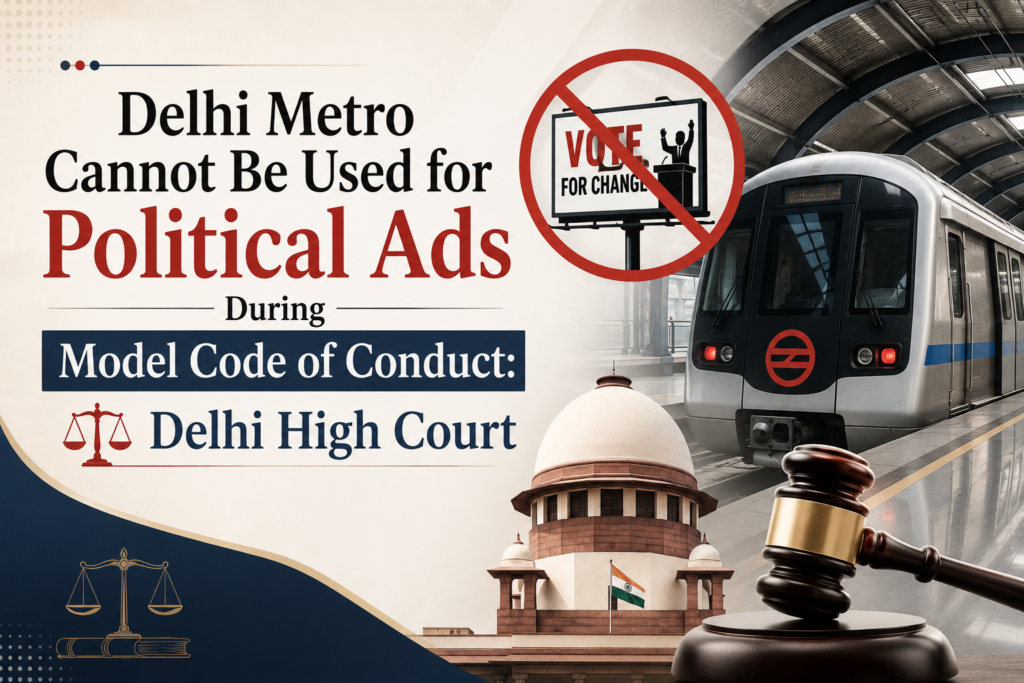
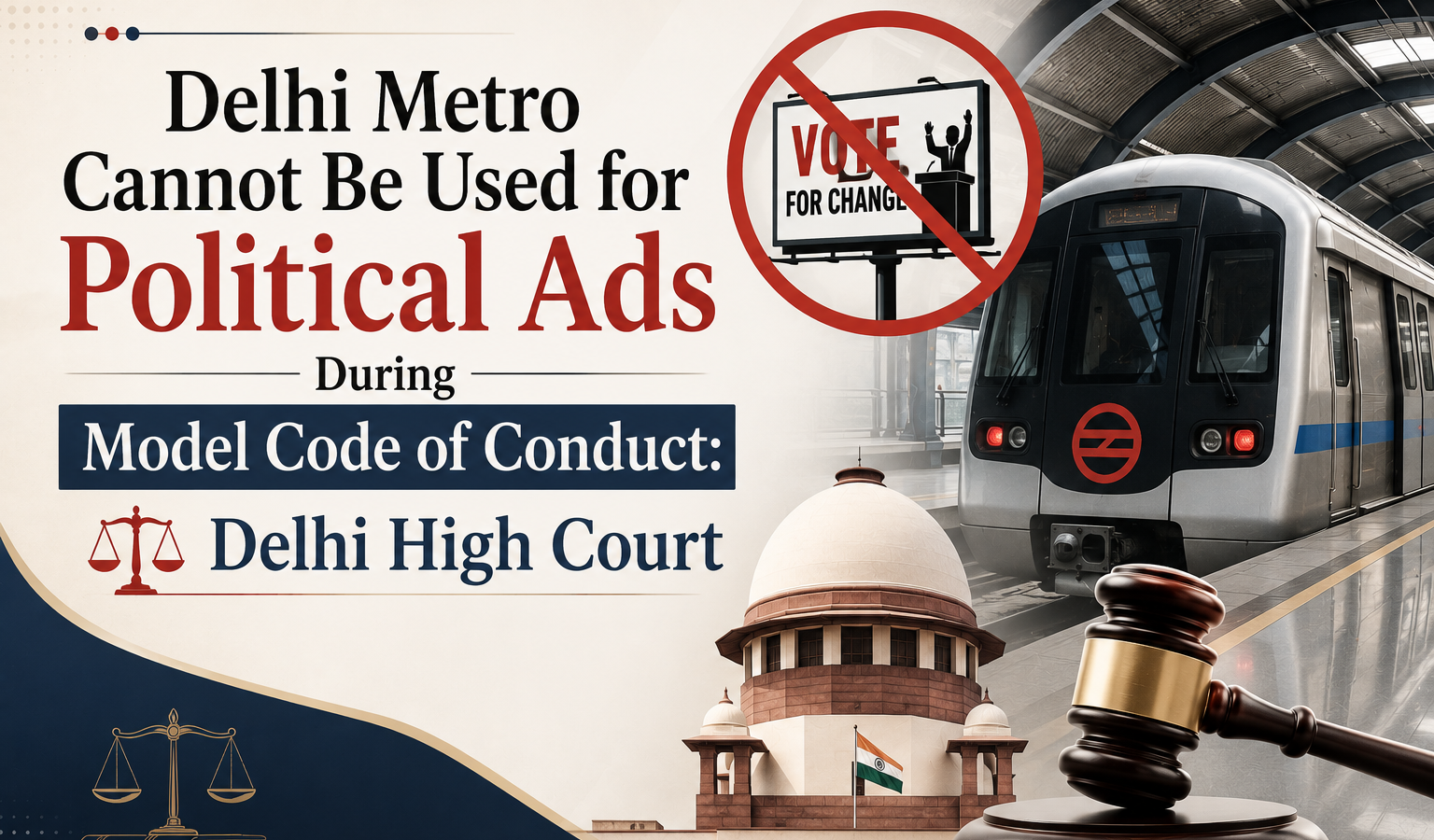
Delhi Metro Cannot Be Used for Political Ads During Model Code of Conduct: Delhi High Court

Election Commission’s Directions Under Article 324 Have Binding Force; Temporary Restriction Does Not Violate Advertising Agencies’ Fundamental or Business Rights
The Delhi High Court has upheld the Election Commission of India’s decision prohibiting political advertisements inside Delhi Metro trains and stations during the operation of the Model Code of Conduct.
A Division Bench comprising Justice V. Kameswar Rao and Justice Manmeet Pritam Singh Arora held that the temporary prohibition was intended to preserve the neutrality of government-associated public infrastructure and ensure free, fair and transparent elections.
The Court rejected the contention that the restriction was discriminatory merely because political advertisements were allegedly permitted at bus queue shelters and certain other commercially authorised locations.
It further held that the Election Commission possesses plenary powers under Article 324 of the Constitution to issue binding directions in election-related matters where no specific legislation occupies the field.
Accordingly, the Court dismissed the Letters Patent Appeal filed by advertising concessionaires holding long-term advertising licences from the Delhi Metro Rail Corporation.
Background
The appellants were companies awarded advertising rights by the Delhi Metro Rail Corporation through tender processes.
Their contracts permitted them to display different kinds of advertisements inside and outside metro trains, at stations and on other structures controlled by the DMRC.
The advertising agencies claimed that the licence agreements also permitted political advertisements, subject to compliance with the Model Code of Conduct and other applicable requirements.
The Election Commission’s earlier guidelines had recognised that political parties could access commercially authorised advertising spaces during elections, provided that all parties were given an equitable opportunity.
The Chief Electoral Officer, Delhi, had also previously clarified that political advertisements could be displayed at commercially authorised sites and that political parties would be required to maintain proper expenditure records.
However, in December 2015, the Election Commission issued instructions concerning political advertisements on public and civil structures belonging to public sector undertakings.
Thereafter, by a communication dated 13 June 2019, the Election Commission directed that an appropriate clause be inserted into the advertising contracts of the DMRC prohibiting political advertisements during the period in which the Model Code of Conduct remained in force.
The proposed clause stated that no political advertisement could be displayed in leased commercial advertising spaces during the Model Code of Conduct period and that existing political advertisements must be removed immediately upon enforcement of the Code.
Acting on these directions, the DMRC inserted the restriction into its licence agreements in August 2019.
Advertising Agencies Challenge the New Restriction
The advertising agencies argued that the clause had been inserted unilaterally and substantially altered the financial basis on which they had submitted their bids.
They claimed that the licences had generally been granted for ten years and that the expected revenue from political advertisements during multiple elections had been factored into their financial calculations.
According to them, the subsequent prohibition deprived them of an important source of revenue and amounted to an impermissible alteration of the licence agreements.
The agencies also alleged discrimination under Article 14 of the Constitution.
They pointed out that the Election Commission had clarified in October 2019 that political advertisements could be displayed at bus queue shelters and other earmarked commercial advertising spaces during the Model Code of Conduct period.
They argued that there was no reasonable basis for prohibiting political advertisements inside metro trains and stations while allowing them at bus shelters, billboards and other outdoor advertising sites.
The appellants further contended that their right to carry on trade and business under Article 19(1)(g) had been affected.
They submitted that restrictions on fundamental rights must be imposed through legislation having statutory force and not merely through executive or departmental instructions.
Since the impugned prohibition had originated from an Election Commission letter, they argued that it could not legally curtail their constitutional rights.
Election Commission Defends the Ban
The Election Commission argued that the prohibition was narrow, temporary and intended to maintain a level playing field during elections.
It submitted that the restriction applied only during the period in which the Model Code of Conduct was operational.
The agencies remained free to display all forms of non-political commercial advertisements during that period. Therefore, their advertising business had not been completely prohibited.
The Election Commission also argued that metro stations and trains were closely identified by the public with the Government and public authorities.
Displaying political advertisements within such spaces during elections could create an impression of governmental association, support or endorsement.
The Commission maintained that its directions were issued under Article 324 of the Constitution, which gives it plenary powers of superintendence, direction and control over elections.
Where Parliament or a State Legislature has not enacted a specific law governing a particular election-related issue, the Election Commission may issue appropriate directions to ensure free and fair elections.
The DMRC stated that although it had expressed reservations regarding the distinction between metro spaces and other commercial advertising sites, it was bound as a public sector undertaking to comply with the Election Commission’s directions.
Metro Trains and Stations Are Closely Associated With Government
The High Court rejected the appellants’ comparison between Delhi Metro premises and bus queue shelters.
It accepted the Election Commission’s submission that metro trains and stations are exclusively and directly identified by the public with the Government and public authorities.
The prohibition was intended to ensure that political advertisements displayed in such locations were not perceived as carrying governmental support or approval.
By contrast, bus queue shelters located on public roads were comparable to outdoor billboards and other commercial hoarding spaces.
The Court therefore found that metro premises and bus queue shelters did not necessarily belong to the same category for the purpose of regulating election advertisements.
No Right to Claim “Negative Equality”
The Court also held that even assuming that political advertisements had been improperly permitted at bus shelters or other public spaces, the appellants could not demand similar treatment.
The Model Code of Conduct itself restricted political advertisements on public properties, including bus stands.
Therefore, relying on an alleged relaxation or irregularity at another location amounted to seeking “negative equality.”
Article 14 does not require a public authority to repeat an illegality or extend an improper benefit merely because it may have been granted elsewhere.
The alleged permission concerning bus shelters consequently did not create an enforceable right in favour of the advertising agencies to display political advertisements within Delhi Metro premises.
Temporary Ban Does Not Violate Freedom of Trade
The Court rejected the challenge under Article 19(1)(g).
It observed that the agencies had not been completely prevented from conducting their advertising business.
They remained free to display commercial and non-political advertisements even while the Model Code of Conduct was in force.
Only political advertisements were restricted, and that too for a limited election-related period.
The earlier Single Judge had noted that the Model Code of Conduct ordinarily remained in operation for approximately one month during an election.
Even if four or five elections occurred during a ten-year licence period, the restriction would apply only for a relatively limited portion of the entire contractual term.
The Court held that such a temporary and narrowly tailored restriction could not be treated as an unreasonable prohibition on the appellants’ business.
The agencies’ interest was primarily commercial, whereas the restriction sought to protect the larger public interest in free, fair and transparent elections.
The balance therefore favoured the public interest.
No Independent Free Speech Right of Advertising Contractors
The Court also agreed with the Single Judge’s conclusion that the appellants were advertising service providers who had taken commercial spaces from the DMRC for displaying advertisements on behalf of third parties.
The restriction did not directly suppress any political opinion or personal expression of the advertising agencies themselves.
Their grievance arose principally from the loss of potential commercial revenue from political advertising.
Accordingly, no substantial violation of their freedom of speech and expression was established.
Election Commission’s Article 324 Directions Have Force of Law
A significant issue before the Court was whether the Election Commission could impose the restriction through instructions rather than a specific statute.
The appellants argued that restrictions affecting rights under Article 19 must be imposed by “law” and not through executive correspondence.
The Court accepted the Election Commission’s response that Article 324 confers plenary and sui generis constitutional powers upon it.
The Commission may issue binding instructions on election-related matters where the field is not already occupied by legislation.
Relying on the constitutional position recognised by the Supreme Court, the High Court held that directions issued by the Election Commission under Article 324 to secure a level playing field and preserve electoral fairness have binding force.
Since there was no specific statute comprehensively governing political advertisements in metro premises during the election period, the Election Commission was competent to issue the impugned directions.
The Court therefore rejected the argument that the instructions lacked legal authority.
Contractual Dispute Could Not Override Electoral Regulation
The agencies had also argued that the restriction amounted to a unilateral modification of their licence agreements.
However, the Election Commission was not a party to those contracts, and the agreements themselves required compliance with applicable laws and the Model Code of Conduct.
To the extent that the appellants claimed financial loss or breach of contractual expectations, such disputes could be pursued through contractual remedies, including arbitration where applicable.
Commercial expectations under a licence agreement could not invalidate a lawful election-related direction issued in the larger public interest.
Court Notes Status of the Licence Agreements
The Court also noted that the ten-year licence agreements of two appellants had already expired.
The remaining agreements were due to expire in October 2028 and March 2029.
It was not shown that any election in Delhi was expected before those expiry dates in which the appellants would commercially benefit if the directions were set aside.
This was an additional circumstance considered by the Court while declining interference.
Decision
The Delhi High Court held that:
- the Election Commission was competent under Article 324 to regulate political advertisements during elections;
- metro trains and stations could be treated differently from bus queue shelters and roadside advertising spaces;
- political advertisements in metro premises could create an impression of governmental association;
- the prohibition was temporary and did not prevent the agencies from displaying non-political advertisements;
- no violation of Articles 14, 19(1)(a) or 19(1)(g) was established; and
- commercial interests under the advertising contracts could not outweigh the public interest in free and fair elections.
The Court consequently dismissed the appeal and upheld the judgment of the Single Judge.
Key Legal Principle
The Election Commission may exercise its plenary powers under Article 324 to prohibit political advertisements on government-associated public infrastructure during the Model Code of Conduct period where no specific legislation governs the issue.
A temporary restriction limited to political advertisements does not violate the right to carry on business when advertising agencies remain free to display all other commercial advertisements.
Why the Judgment Matters
The ruling clarifies the extent of the Election Commission’s authority to regulate political advertising on public infrastructure.
It recognises that advertisements displayed inside government-associated spaces may carry a different public perception from advertisements displayed on ordinary commercial hoardings.
The judgment also distinguishes between a restriction on political expression and the commercial interest of an intermediary that earns revenue by displaying political advertisements.
Advertising concessionaires cannot claim an unrestricted right to monetise public infrastructure during elections where the Election Commission considers a temporary prohibition necessary to preserve institutional neutrality and electoral fairness.
Case: M/s EG Communications Pvt. Ltd. & Others v. Election Commission of India & Others
Court: High Court of Delhi
Case Number: LPA 16/2020
Bench: Justice V. Kameswar Rao and Justice Manmeet Pritam Singh Arora
Date of Judgment: 19 June 2026
Result: Appeal dismissed; prohibition on political advertisements in Delhi Metro during the Model Code of Conduct upheld