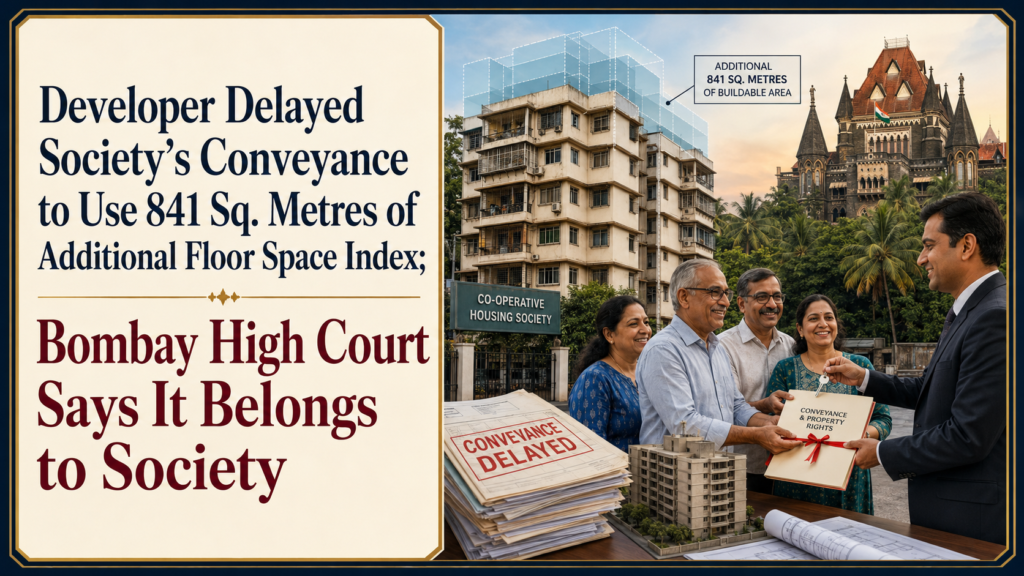
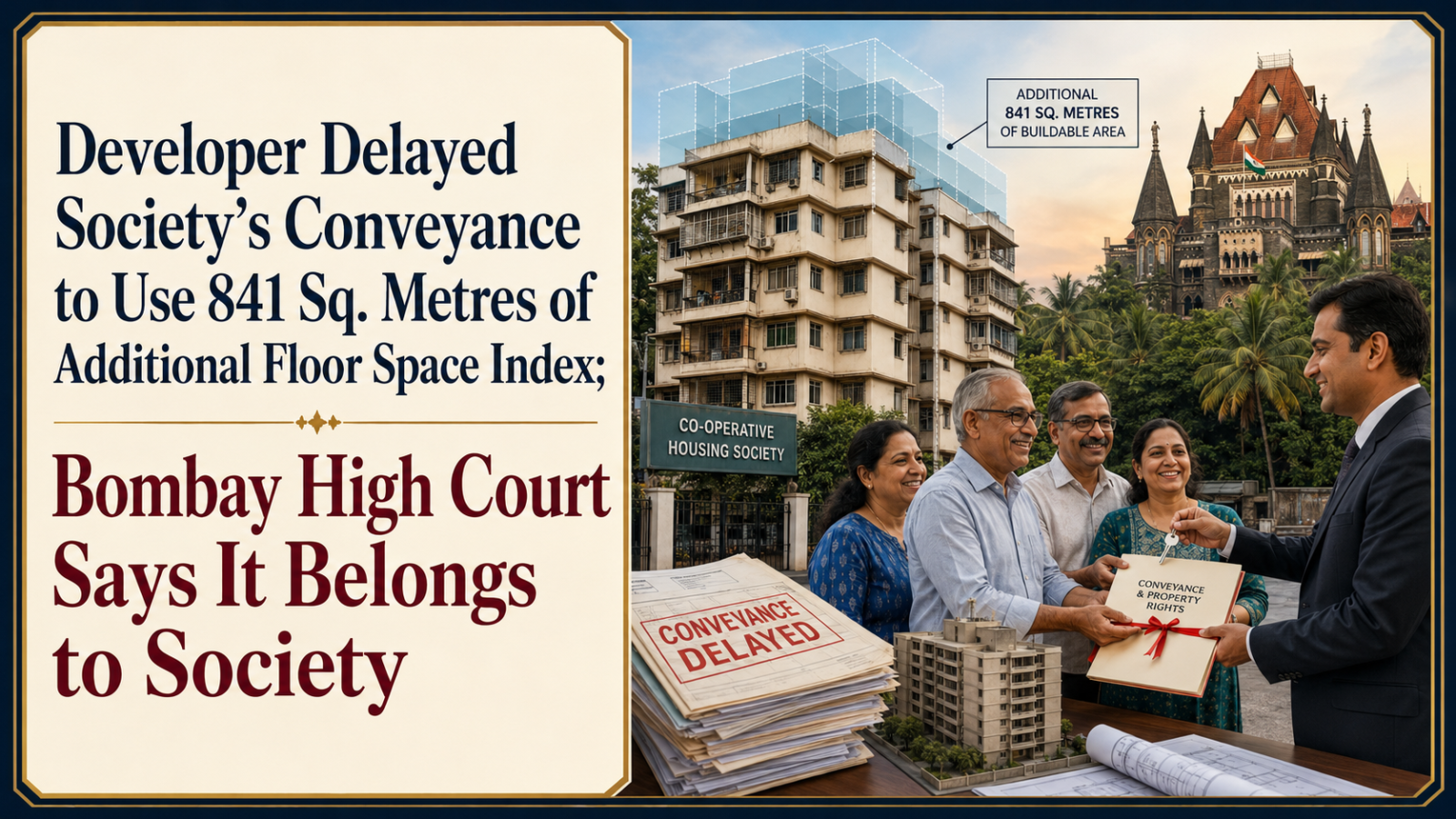
Developer Delayed Society’s Conveyance to Use 841 Sq. Metres of Additional Floor Space Index; Bombay High Court Says It Belongs to Society

Developer Cannot Retain Land Indefinitely to Profit From Future Floor Space Index: Bombay High Court
Facts
Ariisto Realtors Private Limited obtained development rights over land situated at S.V. Road, Vile Parle West, Mumbai, under a Development Agreement and Supplementary Deed dated 3 March 2010.
The developer constructed a building known as “Ariisto Cloud,” comprising a ground floor, nine upper floors, 12 residential flats, one commercial unit and two commercial shops.
The flat purchasers formed Ariisto Cloud Cooperative Housing Society Limited, the second respondent.
Another building had already been constructed on part of the larger land, and Kum Kum Apartments Cooperative Housing Society Limited had been formed for that building.
Under the Development Agreement, future additional FSI and TDR belonged to the landowners. However, Ariisto Realtors was given an option to use such additional development potential by paying the landowners ₹51,000 per square metre.
After the Development Control and Promotion Regulations, 2034 came into force, Ariisto Realtors claimed that an additional FSI of 841.16 square metres became available. It applied to the Municipal Corporation in October 2024 for permission to use this additional FSI.
The Society demanded conveyance of the land and building and subsequently filed Application No. 179 of 2024 under Section 11(3) of the Maharashtra Ownership Flats Act, 1963, seeking unilateral deemed conveyance.
On 10 March 2025, the Competent Authority rejected the first application as premature. It relied upon three circumstances:
- Construction work on parts of the ground and first floors was allegedly incomplete;
- Approximately 81.03 square metres of sanctioned FSI remained unutilised; and
- The developer claimed a right to use additional FSI by paying the stipulated consideration to the landowners.
The Society was granted liberty to submit a fresh application.
The landowners thereafter entered into consent terms with the Society on 16 June 2025 and expressed their willingness to convey the property.
The Society filed a second application for deemed conveyance. It contended that construction had been completed, the building had received a completion certificate and only 3.25 square metres of sanctioned FSI remained unused.
On 14 July 2025, the Competent Authority allowed the second application and granted unilateral deemed conveyance of approximately 1,241.65 square metres of land, together with the Ariisto Cloud building, in favour of the Society.
Ariisto Realtors challenged that order before the Bombay High Court. It alleged that the Competent Authority had impermissibly reviewed its earlier order and that the second application was barred by res judicata.
Issues
- Whether the Competent Authority had jurisdiction to entertain the Society’s second application for deemed conveyance.
- Whether allowing the second application amounted to an impermissible review of the earlier order dated 10 March 2025.
- Whether the liberty granted in the first order could be exercised only after the developer had used the existing and future additional FSI.
- Whether a developer can indefinitely delay conveyance to a housing society to exploit additional FSI created by a subsequent change in development regulations.
- Whether additional FSI arising under DCPR 2034 belonged to the developer, landowners or housing society.
- Whether a private Development Agreement could override the developer’s statutory obligation under MOFA to convey the land and building.
- Whether the High Court should interfere under Article 227 where setting aside the deemed conveyance would permit the developer to obtain an unjust commercial advantage.
Petitioner’s Arguments
Ariisto Realtors argued that the Competent Authority had no power to review its earlier quasi-judicial order.
The first deemed conveyance application had been rejected after findings that:
- Construction remained incomplete;
- Unutilised FSI of 81.03 square metres remained available; and
- The developer was entitled to exploit future additional FSI by paying ₹51,000 per square metre to the landowners.
According to Ariisto Realtors, the Society could file a fresh application only after all three circumstances ceased to exist. The Society filed its second application within three months, even though the developer had not been allowed to use the additional FSI of 841.16 square metres.
It argued that the second order effectively reversed the findings in the first order and therefore amounted to an unauthorised review.
The developer also alleged collusion between the Society and the landowners. It argued that the consent terms had been executed to defeat the contractual rights granted under the Development Agreement.
It further contended that it had not received proper notice of the second application and that the order was passed in violation of natural justice.
Ariisto Realtors relied on the principle that a quasi-judicial authority cannot review its own decision unless the statute expressly grants that power.
Respondent’s Arguments
The Society and landowners argued that Ariisto Realtors had been duly served in the second deemed conveyance proceedings. They relied upon postal acknowledgements and published notices in the Competent Authority’s record.
They submitted that the second application was filed in accordance with the express liberty granted in the first order.
The building’s construction had been completed according to the sanctioned plans, and the Municipal Corporation had issued a building completion certificate. Only approximately 3.25 square metres of sanctioned FSI remained unused.
The Society argued that the first order permitted a fresh application after completion of the existing building. It did not require the Society to wait until the developer had exhausted every future increase in FSI.
The agreements for sale with flat purchasers did not disclose any plan for further construction by using future FSI.
The Society further argued that the private arrangement between the developer and landowners was not binding upon the flat purchasers and could not override their statutory rights under MOFA.
The developer had not exercised the option under the Development Agreement by paying the agreed amount to the landowners. In any event, an increase in FSI caused by a later change in regulations could not justify withholding conveyance indefinitely.
The Society relied upon Rule 9 of the MOFA Rules, which requires conveyance within four months of the Society’s registration.
Analysis of the Law
Statutory Duty to Convey Under MOFA
Section 11 of MOFA places a statutory obligation upon the promoter to transfer its right, title and interest in the land and building to the organisation of flat purchasers.
Under Rule 9 of the MOFA Rules, conveyance must ordinarily be completed within four months after the Society is registered, unless a valid alternative period is prescribed.
The expression “period” means a fixed and definite span of time. It cannot be converted into an uncertain future event, such as completion of every possible construction that may become permissible under future regulations.
Effect of Selling All Flats
With each sale of a flat, the rights of the promoter and landowner in the property are progressively diluted.
After all flats are sold and the Society is formed, the promoter is required to complete the formal act of conveyance. It cannot retain ownership indefinitely in anticipation that additional development potential may become available in the future.
Future Additional FSI
A developer who has completed the disclosed project and exhausted the development potential available under the sanctioned plans cannot delay conveyance merely because a later change in regulations creates additional FSI.
Otherwise, developers could indefinitely retain land and repeatedly claim every future increase in development potential.
The Court held that additional FSI arising under DCPR 2034 belonged to the Society and not to Ariisto Realtors.
Private Agreement Versus Statutory Obligation
The developer relied upon Clause 12 of the Development Agreement, which permitted it to use future FSI by paying additional consideration to the landowners.
However, a private agreement between the developer and landowners cannot override the statutory rights of flat purchasers under MOFA.
Once the statutory duty to convey arises, the developer cannot rely upon a private contractual clause to postpone that obligation indefinitely.
Second Application and Power of Review
A quasi-judicial authority cannot review its concluded decision unless the governing statute expressly confers that power.
However, entertaining a second application does not amount to review where the earlier order itself grants liberty to file a fresh application after a specified event.
The question is whether the event contemplated by the earlier order has occurred.
The Court interpreted the first order as permitting a fresh application after completion of construction of the Society’s existing building. Since that construction had been completed, the Society was entitled to invoke the liberty.
Precedent Analysis
Faime Makers Pvt. Ltd. v. District Deputy Registrar, Cooperative Societies
The Supreme Court held that the Competent Authority under MOFA cannot review its own order.
In that case, the first application had been rejected because disputes concerning the identity and legal status of the property had to be resolved by a civil court. The Society was permitted to apply again only after obtaining that adjudication.
Since no civil proceedings were undertaken before the second application, the Competent Authority could not grant deemed conveyance contrary to its earlier conclusion.
The Bombay High Court distinguished that decision. In the present case, no civil court adjudication was required, and the first order had allowed a fresh application after completion of construction.
B.K. Corporation v. State of Maharashtra
In B.K. Corporation, the first deemed conveyance application had been rejected with liberty to apply again after the decision of a pending civil suit.
The second application was filed while the suit was still pending. It was therefore not maintainable.
The Court held that the present case was different because the Society’s liberty was not dependent upon the outcome of any civil litigation.
State of West Bengal v. Jai Hind Pvt. Ltd.
The Supreme Court held that the power of review is not inherent and must be expressly conferred by statute.
A quasi-judicial executive authority cannot sit in review over its own final order without statutory authorisation.
The Court accepted this legal principle but held that no review had occurred in the present case because the earlier order expressly permitted a fresh application.
Lakeview Developers v. Eternia Cooperative Housing Society Ltd.
The Bombay High Court held that a developer cannot continuously exploit a property’s development potential without conveying the land to the Society.
Once the disclosed development potential is exhausted and the obligation to convey arises, future additional FSI or TDR cannot be used to delay conveyance.
Kiran Builders Pvt. Ltd. v. Kalpita Enclave Cooperative Housing Society Ltd.
The Court applied the principle that a developer cannot withhold conveyance to take advantage of development potential created by later regulatory changes.
Flagship Infrastructure Ltd. v. Competent Authority
The Bombay High Court held that the four-month period prescribed under Rule 9 of the MOFA Rules is definite and cannot be replaced by an uncertain future event.
A clause allowing the developer to defer conveyance until completion of an entire project cannot override the statutory protection given to flat purchasers.
Gadde Venkateswara Rao v. Government of Andhra Pradesh
The Supreme Court held that a High Court may decline to set aside an order on a technical ground when doing so would revive an illegal or unjust position.
The Bombay High Court relied upon this principle to hold that even if some technical objection existed, it would not set aside the deemed conveyance and thereby permit the developer to exploit FSI belonging to the Society.
Garment Craft v. Prakash Chand Goel
The Supreme Court held that supervisory jurisdiction under Article 227 is not intended to correct every factual or legal error.
Interference is warranted only in cases involving grave dereliction, perversity or violation of fundamental principles of law and justice.
M.P. Mittal v. State of Haryana
The Supreme Court held that writ relief may be refused where granting it would enable a petitioner to secure an unjust or dishonest advantage.
The High Court applied this principle because Ariisto Realtors sought to use writ jurisdiction to retain the Society’s land and commercially exploit future FSI.
Court’s Reasoning
The Court held that the Competent Authority had not reviewed its earlier order.
The first application was not finally rejected without qualification. The Society was expressly granted liberty to file a fresh application.
Although the first order referred to additional and unutilised FSI, its ultimate conclusion was that deemed conveyance could be granted after completion of construction of the Society’s building.
The construction had been completed. The developer’s architect had submitted a completion certificate to the Municipal Corporation, and Ariisto Realtors did not seriously dispute that fact.
The sanctioned FSI had also been substantially consumed, with only approximately 3.25 square metres remaining.
The developer’s principal objective was to use an additional 841.16 square metres of FSI created by DCPR 2034. However, that development potential arose after the Society had already been formed and after the developer’s statutory obligation to convey the property had arisen.
The Society was registered on 28 June 2016. Ariisto Realtors was required to convey the land and building within four months. DCPR 2034 came into force later, in 2018.
Therefore, the additional FSI belonged to the Society and could not be claimed by the developer through a private contractual arrangement with the landowners.
The Court strongly disapproved of the attempt to retain the land indefinitely for further commercial gain. It observed that allowing such a claim would enable every developer to avoid conveyance by waiting for future regulatory increases in FSI.
The Court also found no justification for exercising its discretionary jurisdiction under Article 227. Setting aside the deemed conveyance would permit the developer to profit from its failure to fulfil its statutory obligation.
Conclusion
The Bombay High Court dismissed Ariisto Realtors’ writ petition.
It upheld the Competent Authority’s order dated 14 July 2025 granting unilateral deemed conveyance of approximately 1,241.65 square metres of land and the Ariisto Cloud building to the Society.
The Court held that:
- The second application did not amount to an unauthorised review;
- The Society filed it under liberty granted in the first order;
- Construction of the existing building had been completed;
- A developer cannot indefinitely delay conveyance to exploit future FSI;
- The additional FSI created under DCPR 2034 belonged to the Society; and
- Article 227 could not be used to secure an unjust commercial advantage.
No order as to costs was passed.
Case Details
Case: Ariisto Realtors Private Limited v. District Deputy Registrar, Cooperative Societies, Mumbai & Others
Court: High Court of Judicature at Bombay, Civil Appellate Jurisdiction
Case Number: Writ Petition No. 12863 of 2025; CNR No. HCBM010504642025
Judge: Justice Sandeep V. Marne
Reserved On: 9 July 2026
Date: 17 July 2026
Result: Writ petition dismissed. The unilateral deemed conveyance granted to Ariisto Cloud Cooperative Housing Society was upheld, and the additional FSI arising under DCPR 2034 was held to belong to the Society rather than the developer.