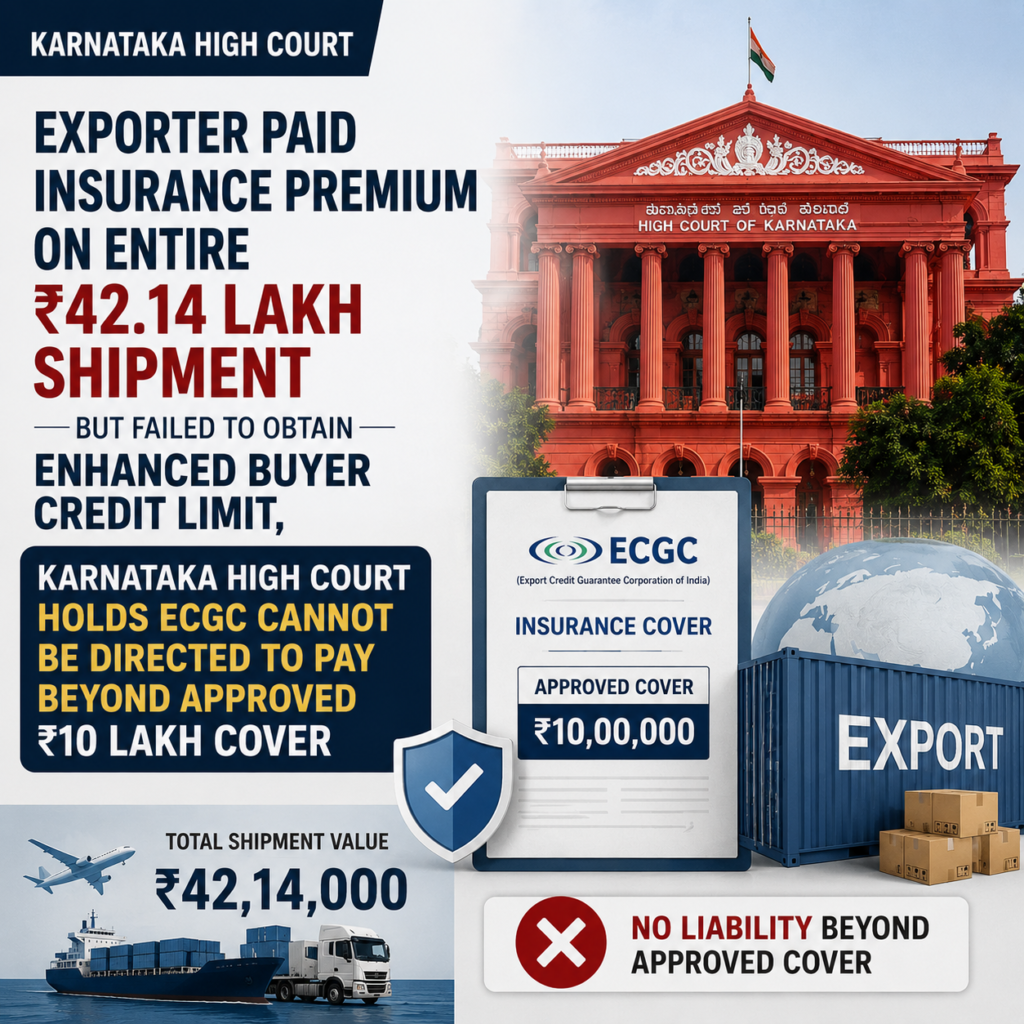
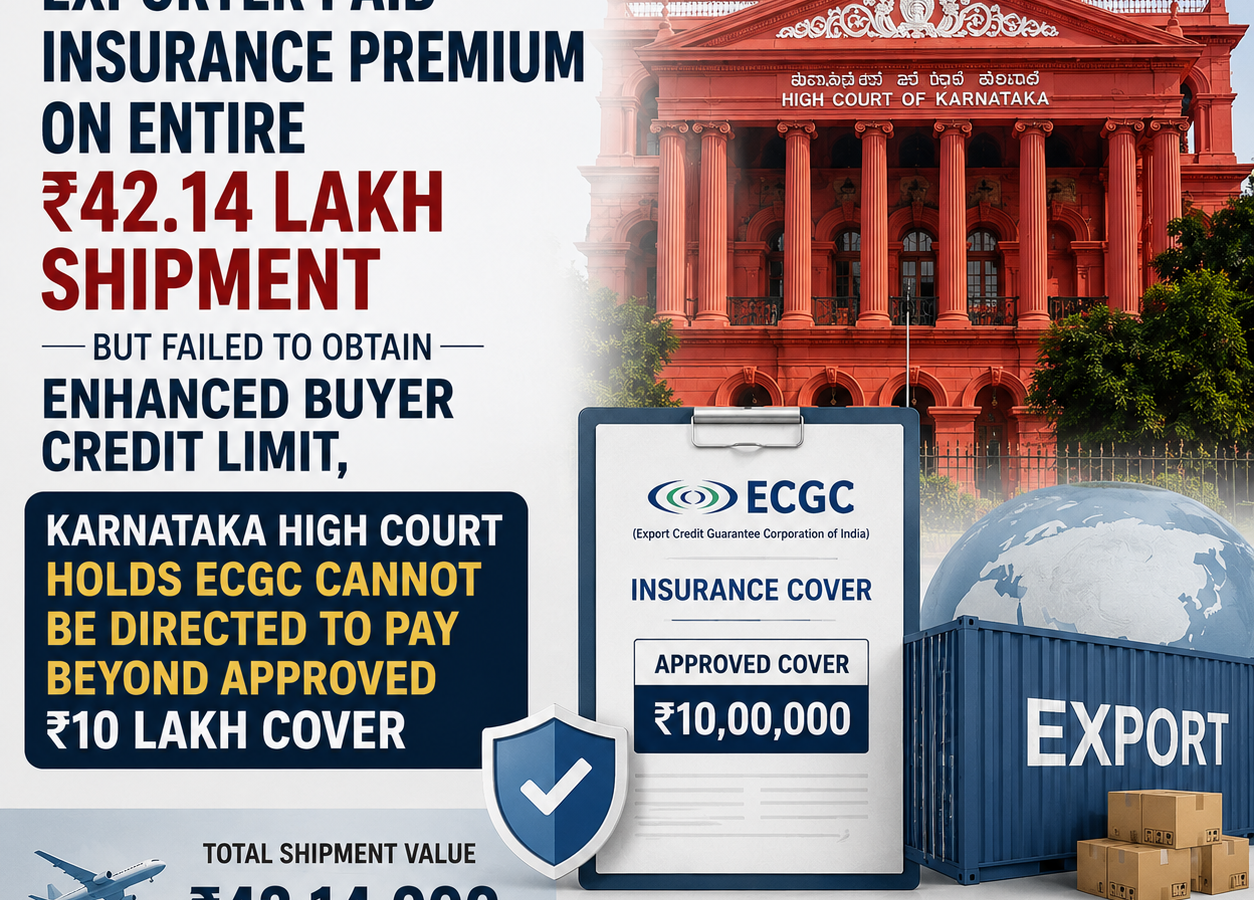
Exporter Paid Insurance Premium on Entire ₹42.14 Lakh Shipment but Failed to Obtain Enhanced Buyer Credit Limit, Karnataka High Court Holds ECGC Cannot Be Directed to Pay Beyond Approved ₹10 Lakh Cover

₹5 Crore Overall Policy Cover Does Not Mean Every Buyer Is Covered Up to That Amount: Karnataka High Court Rejects Exporter’s Appeal
Facts
Prakruthi Products Private Limited is engaged in manufacturing and exporting standardised herbal extracts and nutraceutical ingredients. It had been obtaining export-credit insurance from the Export Credit Guarantee Corporation of India Limited since 2009.
On 28 May 2018, ECGC issued a Shipment Comprehensive Risk Policy covering the period from 1 May 2018 to 30 April 2019. The policy was a whole-turnover, declaration-based policy covering shipments to overseas buyers against specified commercial and political risks. Its aggregate maximum liability was ₹5 crore.
For a United Kingdom buyer, The Herbs in a Bottle Company, ECGC had approved a buyer-specific credit limit of ₹10 lakh.
The appellant exported organic curcumin extract to that buyer under an invoice valued at ₹42.14 lakh. The goods were shipped on 6 September 2018 with a credit period of 45 days, and the buyer acknowledged receiving them.
The appellant declared the full shipment value of ₹42.14 lakh to ECGC. ECGC deducted a premium of ₹18,267.69 calculated on the entire invoice value.
However, the appellant never applied for enhancement of the buyer-specific credit limit from ₹10 lakh to ₹42.14 lakh, either before or after the shipment.
The overseas buyer failed to make payment. The appellant reported the default and later lodged an insurance claim for the full invoice amount.
ECGC accepted the claim only to the extent of ₹10 lakh, corresponding to the approved credit limit for that buyer. It rejected the balance claim of ₹32.14 lakh, relying upon the policy provision limiting its liability for shipments to a particular buyer to the approved credit limit.
In its representation to ECGC, the appellant admitted that its staff had forgotten to submit the application for enhancement of the credit limit and described the omission as a clerical mistake.
After several representations were rejected, the appellant filed a commercial suit seeking recovery of ₹32.14 lakh with interest at 18% per annum. The Commercial Court dismissed the suit on 16 June 2025.
Prakruthi Products then filed the present commercial appeal before the Karnataka High Court.
Issues
- Whether ECGC’s collection of premium on the entire shipment value of ₹42.14 lakh implied that the full shipment was insured.
- Whether ECGC’s liability could exceed the approved buyer-specific credit limit of ₹10 lakh merely because the policy had an overall maximum liability of ₹5 crore.
- Whether the failure to apply for enhancement of the credit limit was only a clerical or technical omission that could be overlooked.
- Whether ECGC’s acceptance of the shipment declaration and deduction of premium amounted to waiver or estoppel against relying on the approved credit limit.
- Whether equitable considerations could be invoked to enlarge ECGC’s liability beyond the express terms of the written insurance policy.
- Whether the Commercial Court was correct in dismissing the recovery suit for the balance ₹32.14 lakh.
Petitioner’s Arguments
The appellant argued that ECGC had collected and retained premium calculated on the entire shipment value of ₹42.14 lakh.
It submitted that if ECGC intended to cover only ₹10 lakh, the premium should also have been calculated only on that amount. According to the appellant, collecting premium on the full invoice value implied that ECGC had accepted the risk for the entire shipment.
The appellant further contended that ECGC did not inform it, while accepting the shipment declaration and deducting the premium, that a separate application for enhancement of the credit limit was required.
It argued that ECGC’s conduct amounted to waiver and estoppel and that ECGC should not subsequently be permitted to restrict its liability to ₹10 lakh.
The appellant also relied on the evidence of ECGC’s witness, who accepted that the premium was deducted on the declared shipment value and that the amount collected was sufficient to cover the risk for the full shipment.
Lastly, the appellant characterised its failure to apply for enhancement as a clerical oversight. It argued that such a technical omission should not defeat an otherwise genuine insurance claim, especially after ECGC had accepted premium on the full shipment value.
Respondent’s Arguments
ECGC submitted that its liability under the policy was expressly limited to the approved credit limit for the particular buyer.
It distinguished between:
- The policy’s aggregate maximum liability of ₹5 crore; and
- The buyer-specific credit limit of ₹10 lakh.
According to ECGC, the ₹5 crore limit represented the maximum aggregate liability under the policy across all buyers during the policy period. It did not automatically provide ₹5 crore of coverage for each individual buyer.
ECGC argued that the credit-limit mechanism was fundamental to assessing and underwriting the commercial risk associated with each overseas buyer.
It submitted that the appellant was an experienced exporter and longstanding policyholder that fully understood the requirement of obtaining an appropriate credit limit before making a shipment. The appellant had previously applied for and obtained enhanced limits for other buyers.
ECGC relied on the appellant’s own admission that it had failed to submit the enhancement application because of an internal clerical mistake.
It further relied on the policy clauses providing that:
- Premium could be collected on all declared shipments;
- Acceptance of a shipment declaration or premium did not create liability beyond policy limits; and
- Approval and written communication of the buyer-specific credit limit were conditions precedent to liability.
ECGC therefore argued that collection of premium on the full invoice value did not amount to an implied enhancement of the credit limit.
Analysis of the Law
Maximum liability and buyer-specific credit limit
The Court identified a fundamental distinction between the policy’s maximum liability and the credit limit applicable to an individual buyer.
The ₹5 crore maximum liability was the overall ceiling on ECGC’s aggregate liability under the policy for all buyers during the policy period.
The buyer-specific credit limit, on the other hand, represented the maximum exposure that ECGC had agreed to accept for commercial risks arising from shipments to a particular overseas buyer.
Therefore, an overall policy cover of ₹5 crore did not mean that every individual shipment or every individual buyer was covered up to that amount.
Contractual limit under Clause 20
Clause 20 of the policy expressly limited ECGC’s liability for losses arising from shipments to any one buyer to the approved credit limit for that buyer.
In the present case, the only approved and communicated credit limit for The Herbs in a Bottle Company was ₹10 lakh.
Consequently, ECGC’s liability could not exceed ₹10 lakh merely because the shipment value was ₹42.14 lakh.
Enhancement under Clause 21
Clause 21 required the insured exporter to apply for a suitable buyer-specific credit limit in the prescribed form.
An enhanced limit became operational only after ECGC:
- Considered the application;
- Approved the proposed limit; and
- Communicated the approval in writing.
The Court rejected the argument that enhancement of the credit limit was merely a ministerial or automatic act.
The process involved ECGC’s assessment and acceptance of increased commercial risk. Therefore, the insured exporter could not unilaterally assume that the limit stood enhanced.
Even if the process were regarded as simple or ministerial, the undisputed position remained that no application or communication seeking enhancement had been made.
Collection of premium on full shipment value
The Court acknowledged that the premium deducted from the appellant’s account was calculated on the full shipment value and was sufficient to cover a risk of that amount.
However, it held that this circumstance could not override the express buyer-specific limit under the policy.
The policy itself contemplated the declaration of shipments and collection of premium while separately limiting ECGC’s liability according to the approved credit limit.
The cover letter also specifically warned policyholders that payment of premium would not result in admission of a claim where a suitable credit limit had not been obtained.
Accordingly, acceptance of the premium did not operate as an implied enhancement of the credit limit.
Waiver and estoppel
The appellant’s plea of waiver and estoppel was rejected because ECGC’s liability arose from a written insurance contract containing express limitations and conditions.
Acceptance of a declaration or deduction of premium could not create an obligation contrary to the written policy terms.
An insurer’s contractual liability cannot be enlarged by estoppel where the policy expressly restricts the extent of coverage.
Equity cannot rewrite an insurance contract
The Court held that ECGC’s liability had to be determined strictly according to the written terms of the insurance policy.
Equitable considerations could not be invoked to convert a ₹10 lakh approved credit exposure into coverage for ₹42.14 lakh.
The appellant’s failure to obtain an enhanced credit limit could not be cured by asking the Court to impose a liability that ECGC had never contractually accepted.
Precedent Analysis
The Commercial Court had referred to the following decisions:
Vikram Greentech India Limited v. New India Assurance Company Limited, (2009) 5 SCC 599
This decision supports the principle that an insurance contract must be interpreted according to its express terms. Courts cannot add to, modify or rewrite the conditions of coverage on equitable considerations.
The Karnataka High Court’s reasoning was consistent with this principle because it confined ECGC’s liability to the approved buyer-specific credit limit.
Bajaj Allianz General Insurance Company Limited v. State of Madhya Pradesh, (2020) 18 SCC 376
This precedent was referred to for the broader principle that the insurer’s liability must be assessed according to the contractual scope of the policy and cannot be extended beyond the agreed cover.
Payment of premium cannot, by itself, create liability contrary to an express limitation in the policy.
M/s BHS Industries v. Export Credit Guarantee Corporation of India & Another, Civil Appeal No. 2729 of 2009
This case concerned ECGC insurance and the relationship between premium payments and liability under the applicable policy conditions.
It supported the conclusion that collection of premium alone does not make ECGC liable where the insured has failed to satisfy a contractual requirement governing coverage.
The High Court did not undertake an extended independent discussion of these precedents. It primarily applied the settled rule emerging from them: insurance liability is contractual and cannot be enlarged beyond the policy’s express terms merely because premium was collected.
Court’s Reasoning
The Court found that the relevant facts were substantially undisputed:
- The approved credit limit for the UK buyer was ₹10 lakh;
- The shipment was worth ₹42.14 lakh;
- The appellant declared the entire shipment and paid premium on that amount;
- No application for enhancement was submitted;
- ECGC never approved or communicated an enhanced credit limit; and
- The appellant itself admitted that the enhancement application had not been filed.
The Court held that the appellant’s case confused two distinct concepts: the aggregate maximum liability under the policy and the specific limit applicable to an individual buyer.
The overall maximum liability of ₹5 crore did not remove the requirement of obtaining an appropriate credit limit for each buyer.
The Court also found that enhancement could not be inferred merely because ECGC accepted premium on the declared shipment. The policy documents expressly informed the appellant that a suitable credit limit was essential and that payment of premium would not, by itself, result in admission of a claim.
The appellant was an experienced exporter and had obtained enhanced limits for other buyers on previous occasions. It could not therefore claim ignorance of the requirement.
The Court concluded that the omission was not a harmless technicality. It directly affected the extent of commercial risk accepted by ECGC.
Since the written policy limited ECGC’s liability to ₹10 lakh, no legal or equitable basis existed to direct payment of the remaining ₹32.14 lakh.
Conclusion
The Karnataka High Court dismissed the commercial appeal and upheld the Commercial Court’s decision rejecting Prakruthi Products’ recovery suit.
The Court held that:
- ECGC’s aggregate maximum liability of ₹5 crore was distinct from the buyer-specific credit limit;
- ECGC’s liability for the UK buyer was restricted to the approved limit of ₹10 lakh;
- No application for enhancement to ₹42.14 lakh had been submitted or approved;
- Collection of premium on the full shipment value did not imply enhancement of the credit limit;
- Acceptance of premium did not create waiver or estoppel against ECGC;
- The appellant’s admitted clerical omission could not expand the insurer’s contractual liability; and
- Equity could not be invoked to rewrite the express terms of the insurance policy.
Accordingly, the appellant was not entitled to recover the balance amount of ₹32.14 lakh from ECGC.
Case Details
Case: Prakruthi Products Pvt. Ltd. v. Export Credit Guarantee Corporation of India Ltd.
Court: High Court of Karnataka at Bengaluru
Case Number: Commercial Appeal No. 426 of 2025
Judge: Chief Justice Vibhu Bakhru and Justice C.M. Poonacha
Date: 25 June 2026
Result: Commercial appeal dismissed; ECGC’s liability held limited to the approved buyer-specific credit limit of ₹10 lakh, and the exporter’s claim for the remaining ₹32.14 lakh rejected.