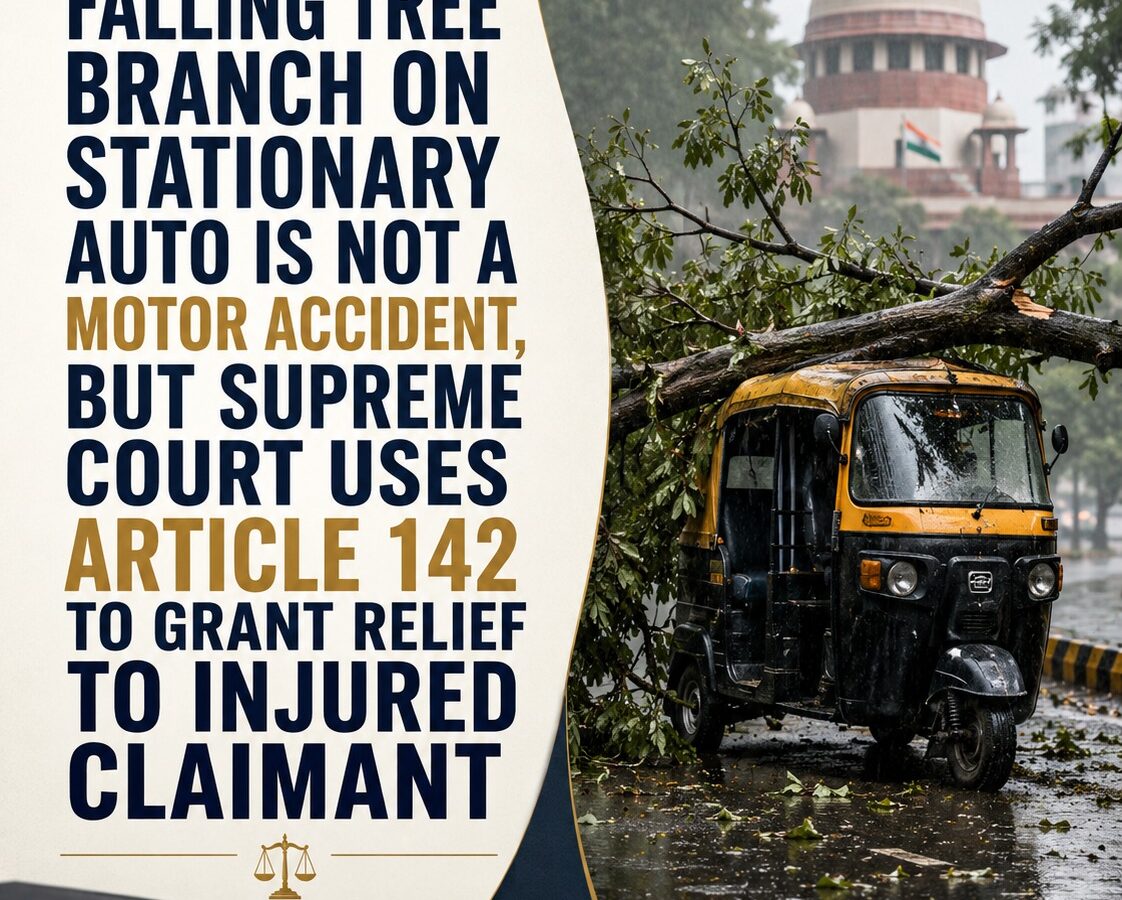
Falling Tree Branch On Stationary Auto Is Not A Motor Accident, But Supreme Court Uses Article 142 To Grant Relief To Injured Claimant

Court
Supreme Court of India
Coram: Justice Sanjay Karol and Justice Nongmeikapam Kotiswar Singh
Case: The Commissioner, Bruhat Bangalore Mahanagara Palike v. K.K. Umesh Kumar & Ors.
Citation: 2026 INSC 637
Case No.: Civil Appeal arising out of SLP (C) No. 1039 of 2021
Date of Judgment: 11 June 2026
Court’s Decision
The Supreme Court held that a claim under Section 166 of the Motor Vehicles Act, 1988 may not be appropriate where a tree branch falls on a stationary autorickshaw and the motor vehicle itself does not play an active or proximate role in causing the accident.
The Court observed that although the word “use” of a motor vehicle is interpreted broadly under motor accident law, there must still be a causal connection between the use of the vehicle and the injury. In the present case, the injury was caused by the falling of a tree branch during heavy rain, and the autorickshaw was not the proximate cause of the accident.
However, considering the serious and life-altering injuries suffered by the claimant, the Supreme Court exercised its powers under Article 142 of the Constitution and enhanced the total compensation from ₹17,10,500 to ₹25,00,000, along with interest as determined by the High Court from the date of filing of the claim petition.
The earlier apportionment of liability was left undisturbed: 25% by BBMP, 50% by the insurer of the autorickshaw, and 25% by the Horticulture Department, Government of Karnataka. The amount was directed to be paid within four weeks.
Facts
Respondent No. 1 was travelling in an autorickshaw on 23 June 2007 from Queens Road to Chinnaswamy Stadium. Due to heavy rain, he requested that the autorickshaw be pulled to the side of the road so that they could wait for the rain to subside.
The vehicle stopped under an old roadside tree. The judgment records that some of the trees along the road were very old, even around hundred years old. While the autorickshaw was stationary under the tree, a branch got detached and fell on the vehicle, causing injuries to Respondent No. 1.
He was admitted to Mallya Hospital and received treatment. Thereafter, a claim petition was filed before the Motor Accidents Claims Tribunal, Bangalore, seeking compensation of ₹50 lakh.
The Claims Tribunal dismissed the claim on 10 April 2013 on the ground that the incident was a natural calamity. The Karnataka High Court initially dismissed the matter on the point of delay. The Supreme Court, in the first round, remanded the matter on the issue of non-condonation of delay.
In the second round, the High Court allowed the appeal and awarded compensation of ₹17,10,500. The High Court apportioned liability as follows: 25% on BBMP, 50% on the insurer of the autorickshaw, and 25% on the Horticulture Department, Government of Karnataka.
BBMP challenged the fastening of liability upon it before the Supreme Court.
Issues
- Whether BBMP could be held liable under the Motor Vehicles Act, 1988 for injuries caused by a roadside tree branch falling on a stationary autorickshaw.
- Whether such an accident could be treated as one “arising out of the use of a motor vehicle” under Sections 165 and 166 of the Motor Vehicles Act.
- Whether the incident could be treated as an “Act of God” or natural occurrence.
- Whether the claimant should be left to pursue another round of litigation despite suffering grievous, life-altering injuries.
Appellant’s Arguments
BBMP contended that it bore no responsibility for the unfortunate incident. It argued that the falling of the tree branch was a natural occurrence and not something over which the municipal authority had direct control.
The appellant relied upon the doctrine of “Act of God” and submitted that liability could not be fastened upon it for an incident caused by heavy rain and sudden falling of a branch.
It was further submitted that the incident did not arise out of the use of a motor vehicle in the sense required under the Motor Vehicles Act.
Respondent’s Position
The claimant had suffered serious injuries after the branch fell on the autorickshaw in which he was sitting. He had pursued compensation through the MACT proceedings and appellate proceedings.
The High Court had already granted compensation and apportioned liability between BBMP, the insurer of the autorickshaw, and the Horticulture Department.
Analysis
The Supreme Court examined the doctrine of “Act of God” or “Vis Major” by referring to earlier common law authorities including Nichols v. Marsland, Greenock Corporation v. Caledonian Railway Co., and The Majestic.
The Court noted that an Act of God refers to an inevitable accident caused by natural forces without human intervention, and which could not have been prevented by human prudence.
The Court then referred to Indian precedents including S. Vedantacharya v. Highways Department of South Arcot, Vohra Sadikbhai Rajakbhai v. State of Gujarat, and Rajkot Municipal Corporation v. Manjulben Jayantilal Nakum.
The Court acknowledged that municipal authorities do have a duty to maintain trees in the city. It observed that trees must be kept healthy and periodic maintenance must be undertaken to prevent unfortunate incidents.
At the same time, the Court cautioned that it would be unrealistic to expect municipal authorities to maintain constant vigil over every tree and shrub in an expanding city. The Court also noted that the solution cannot be to cut all old branches merely because an old branch may fall at some point.
The Court emphasised the importance of trees and green cover in expanding urban spaces, stating that public authorities have a duty to increase green cover with expert consultation so that trees and plants survive in the long term.
The Supreme Court clarified that it was not trivialising the claimant’s injuries and was not giving authorities an escape from their duty to maintain trees. However, on the facts of this case, neither taking shelter under a tree during rain nor the falling of the branch was something within the specific contemplation of the authorities or the autorickshaw driver.
Precedent
The Supreme Court relied upon the following principles and precedents:
- Nichols v. Marsland — recognised “Act of God” or “Vis Major” as a defence where damage was caused by extraordinary rainfall not reasonably foreseeable.
- Greenock Corporation v. Caledonian Railway Co. — distinguished situations where human alteration of natural conditions contributes to damage.
- The Majestic — discussed the meaning of Act of God as an inevitable accident without human agency.
- S. Vedantacharya v. Highways Department of South Arcot — held that heavy rain or flood may be foreseeable in relation to bridges and culverts where authorities fail to take preventive action.
- Vohra Sadikbhai Rajakbhai v. State of Gujarat — explained that an Act of God must be direct, violent, sudden, irresistible, and not reasonably anticipated.
- Rajkot Municipal Corporation v. Manjulben Jayantilal Nakum — discussed negligence and municipal duty where a tree falls and causes injury or death.
- Shivaji Dayanu Patil v. Vatschala Uttam More — interpreted the expression “use of motor vehicle” broadly, including situations where a vehicle is stationary, but still requiring causal connection between the use of the vehicle and the injury.
Reasoning
The Court held that Section 166 of the Motor Vehicles Act permits claims for compensation in respect of accidents involving death or bodily injury arising out of the use of motor vehicles.
The Court accepted that the expression “use of motor vehicle” has a broad meaning and can include a vehicle even when it is stationary. However, the Court held that the motor vehicle must still have some causal or proximate connection with the injury.
The Court gave an example: if the claimant had been a pedestrian standing under the same tree to take shelter from rain and the branch had fallen on him, the cause of injury would have remained the same. This showed that the autorickshaw itself did not play an active role in the accident.
The Court concluded that the motor vehicle was not part of the proximate cause of the accident. Therefore, a claim specifically under Section 166 of the Motor Vehicles Act may not be appropriate in such facts.
However, the Court then considered the serious condition of the claimant. The High Court had recorded that he suffered total paraplegia of both lower limbs with bladder and bowel incontinence. The Court observed that forcing such a person to undergo another round of litigation for compensation would not serve the interests of justice.
The Supreme Court held that as the final court of the country, it must ensure that the law is implemented in a humane manner, especially in cases involving life-altering grievous injuries.
The Court also observed that the compensation awarded by the High Court was insufficient as per settled principles of law and appeared to have been determined on a somewhat technical approach.
Conclusion
The Supreme Court settled the legal position that where a tree branch falls on a stationary autorickshaw and the vehicle itself has no active or proximate role in causing the injury, a claim under Section 166 of the Motor Vehicles Act may not be appropriate.
At the same time, the Court exercised Article 142 powers to do complete justice and enhanced the total compensation to ₹25,00,000 along with interest as determined by the High Court, calculated from the date of filing of the claim petition.
The Court did not disturb the High Court’s apportionment of liability. Accordingly, 25% was to be paid by BBMP, 50% by the insurer of the autorickshaw, and 25% by the Horticulture Department, Government of Karnataka.
The compensation was directed to be deposited directly into the claimant’s bank account within four weeks from the pronouncement of the judgment.
Implications
This judgment is important because it clarifies that not every injury suffered while sitting inside or upon a motor vehicle will automatically become a motor accident claim under Section 166 of the Motor Vehicles Act.
The Court has drawn a distinction between the mere presence of a person in a vehicle and an accident actually arising out of the use of that vehicle.
The ruling also balances legal principle with humanitarian justice. While the Supreme Court held that the Motor Vehicles Act claim may not strictly fit the facts, it still ensured that the injured claimant was not left remediless after years of litigation.
The judgment is also significant for municipal liability cases involving falling trees, natural calamities, and civic maintenance duties. It recognises the duty of authorities to maintain trees but also cautions against imposing unrealistic standards of constant surveillance over every tree in an expanding city.