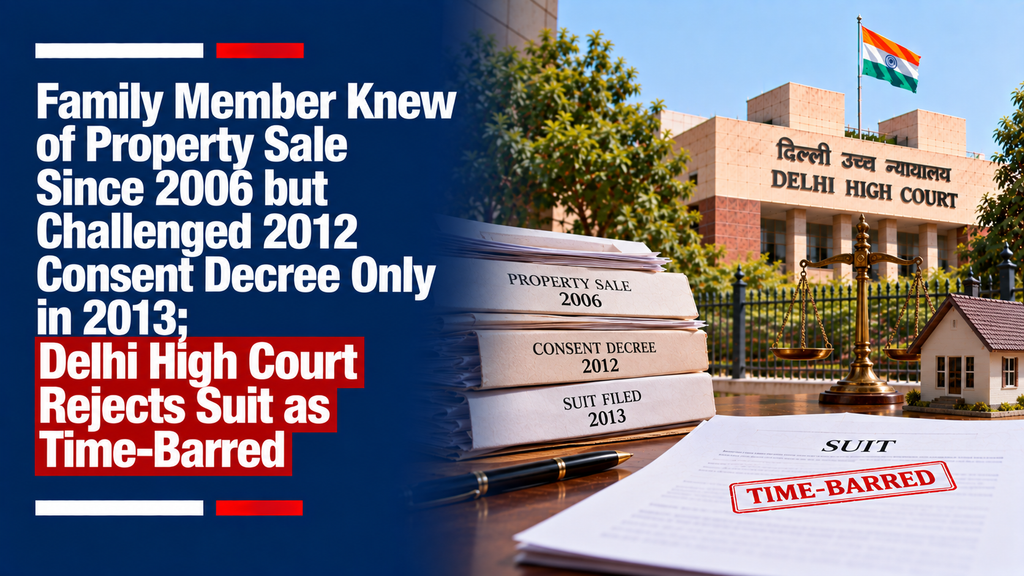
Family Member Knew of Property Sale Since 2006 but Challenged 2012 Consent Decree Only in 2013; Delhi High Court Rejects Suit as Time-Barred

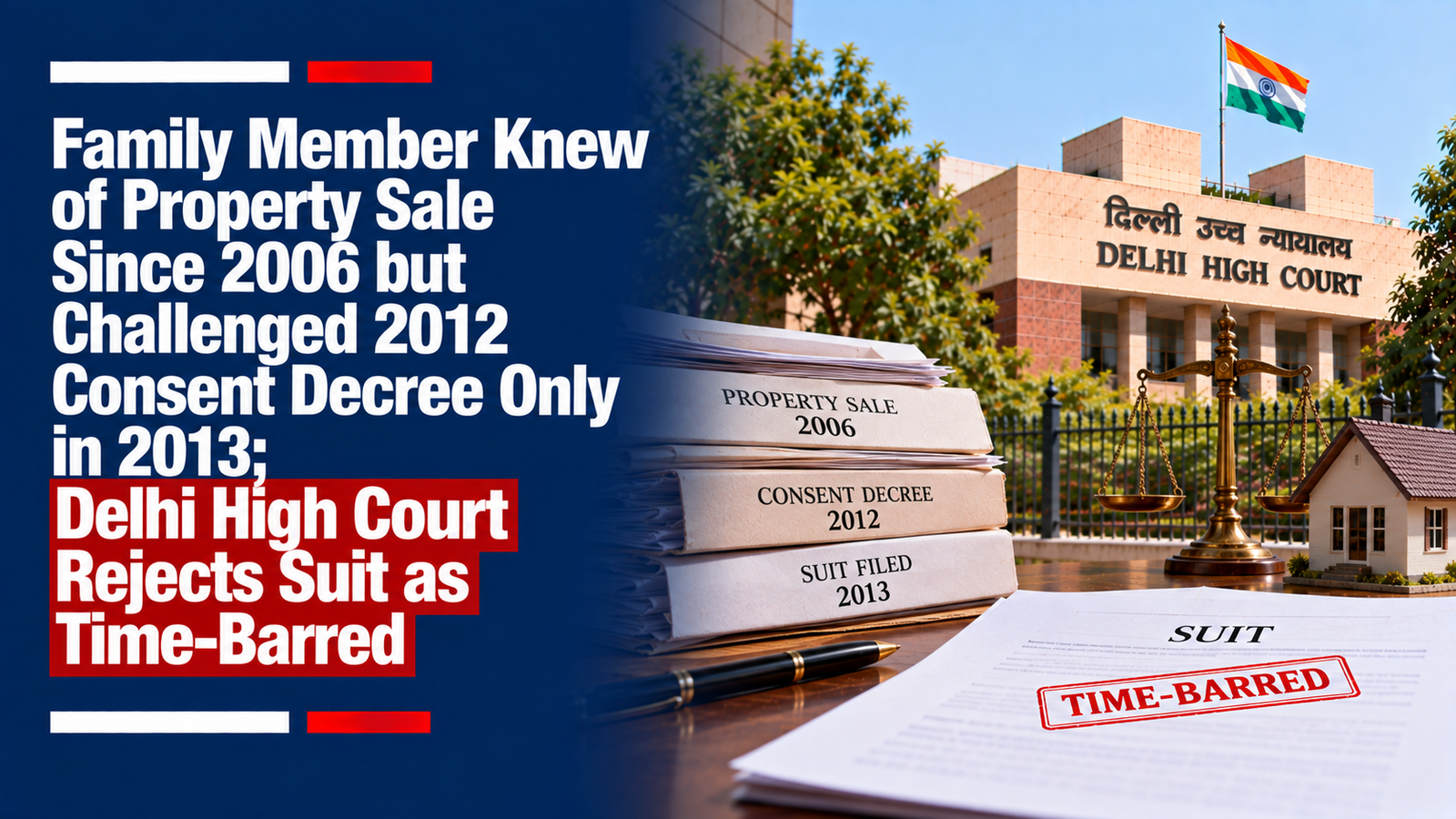
Knowledge of Property Sale in 2006 but Suit Filed Only After 2012 Consent Decree; Delhi High Court Upholds Rejection Under Order VII Rule 11
Facts
The dispute concerned a 302.22 sq. metre property at D-150, Okhla Industrial Area, Phase-I, New Delhi, whose leasehold rights had been acquired in 1986 by the partnership firm M/s Dayal Sales Corporation (DSC). The dispute arose among members of the Mehani family and subsequent purchasers.
A family settlement dated 8 July 2001 distributed and demarcated properties amongst members of the Mehani family. The appellants claimed that under this settlement and subsequent oral arrangements, appellant Prem Mehani acquired a 25% interest in the Okhla property.
On 8 May 2006, DSC, acting through two of its partners, entered into an Agreement to Sell (ATS) with Harish Batra and another for sale of the property. The purchasers subsequently filed a suit for specific performance in 2008.
On 7 December 2012, a consent decree was passed in the specific-performance suit. It provided for payment of ₹1.90 crore within three months and, in default, entitled the purchasers to specific performance and execution of the sale deed upon payment of the balance consideration.
The appellants then filed a separate suit in 2013 seeking a declaration that the consent decree was a nullity allegedly obtained through fraud, collusion and concealment of material facts, along with an injunction concerning the property. The Trial Court rejected their plaint under Order VII Rule 11(a) and (d) CPC on 14 March 2019.
Issues
The principal questions before the Delhi High Court were:
- whether the 2013 suit challenging the consent decree disclosed a valid and subsisting cause of action;
- whether the challenge was barred by limitation because the appellants already knew about the Agreement to Sell in 2006 and the specific-performance litigation in 2008;
- whether the 2012 consent decree could provide a fresh cause of action to revive the earlier property claim; and
- whether the appellants could raise substantially the same ownership objections at the stage of execution after rejection of their civil suit.
Appellants’ Arguments
The appellants contended that their suit was not principally directed against the 2006 Agreement to Sell but against the consent decree dated 7 December 2012, which they alleged had been procured through fraud and concealment.
Accordingly, they argued that limitation began when the consent decree was passed, making the 2013 suit timely. They further contended that questions concerning when they discovered the alleged fraud required evidence and could not properly be decided at the threshold under Order VII Rule 11.
They relied on the 2001 family settlement and subsequent arrangements to assert a 25% interest in the property and emphasised that appellant no.1 had remained in physical possession and conducted his business from the premises.
Respondents’ Arguments
The respondents argued that the appellants had admittedly known about the Agreement to Sell since at least 29 September/5 October 2006. Indeed, appellant no.1 had expressly responded to the purchasers stating that he was not bound by the ATS.
They also pointed out that appellant no.1 admittedly knew about the specific-performance suit by 2008 and had responded to correspondence concerning those proceedings, yet never sought impleadment in that suit and never independently enforced his alleged rights under the family settlement.
Accordingly, the respondents characterised the subsequent challenge to the consent decree as an attempt to defeat rights that had crystallised after years of inaction.
Analysis of the Law
The High Court examined the plaint as a whole rather than merely accepting its description of the 2012 consent decree as the source of the cause of action.
The plaint itself disclosed several earlier events forming the foundation of the appellants’ claim: the 2001 family settlement, the allegedly offending partnership arrangements in 2006, the Agreement to Sell dated 8 May 2006, and the specific-performance proceedings instituted in 2008.
Most importantly, the appellants had actual knowledge of the Agreement to Sell in 2006 and of the specific-performance litigation by 2008. Yet they did not institute proceedings to establish their alleged ownership rights under the family settlement.
The Court therefore rejected the attempt to treat the consent decree as an independent event capable of resetting limitation.
Precedent Analysis
The Court relied on the Supreme Court decision in T. Arivandandam v. T.V. Satyapal, (1977) 4 SCC 467, which requires a meaningful rather than merely formal reading of a plaint. Where clever drafting creates only an illusion of a cause of action, the Court can reject the plaint at the threshold under Order VII Rule 11.
It also relied upon Dahiben v. Arvindbhai Kalyanji Bhanusali, (2020) 7 SCC 366, reiterating that while considering Order VII Rule 11, the plaint and documents relied upon must be examined in their entirety. If a meaningful reading demonstrates that the suit is manifestly without merit or barred by law, rejection is mandatory.
The Court further noted the principle that a plaint must be considered in substance, without artificially isolating individual sentences or passages.
Court’s Reasoning
The Court found that the appellants’ 2013 suit was “nothing but a case of clever drafting.”
Although framed as a challenge to the 2012 consent decree, the real object was to assert the appellants’ alleged rights in the Okhla property arising from the much earlier family settlement.
The Court held that the real cause of action to challenge the Agreement to Sell had arisen in 2006, and again when the appellants became aware of the specific-performance proceedings in 2008. They nevertheless took no legal action.
The Court laid down the critical proposition:
A subsequent consent decree cannot furnish a fresh cause of action so as to revive an earlier claim that had already accrued but was not pursued.
Thus, filing a suit in 2013 by framing it as a challenge to the consent decree could not circumvent the limitation applicable to the underlying cause of action.
The Court also observed that the suit property belonged to the partnership firm, of which appellant no.1 was not a partner. His claimed interest rested upon the family settlement, but he had never initiated proceedings to enforce that alleged right.
Accordingly, the Court found no infirmity in the Trial Court’s conclusion that the suit was completely barred by limitation and that the plaint was liable to rejection under Order VII Rule 11 CPC.
Execution Proceedings
The connected appeal arose from rejection of the appellants’ attempt to be impleaded in the execution proceedings and object to execution of the consent decree.
The High Court held that once their underlying civil suit asserting substantially the same property rights had been validly rejected, they could not resurrect the same claim at the execution stage.
The interim protection was consequently vacated and the Executing Court was directed to proceed with execution in accordance with law.
Conclusion
The Delhi High Court dismissed both appeals.
It upheld rejection of the appellants’ plaint under Order VII Rule 11 CPC, holding that their challenge to the 2012 consent decree was effectively a circuitous attempt to revive an underlying property claim which had accrued years earlier and had become barred by limitation.
It also rejected their attempt to raise substantially the same claim during execution and directed the Executing Court to proceed with execution of the consent decree.
Case Details
Case: Prem Mehani & Anr. v. Harish Batra & Ors.
Court: Delhi High Court
Cases: RFA 277/2019 and EX.F.A. 12/2019 & CM APPL. 14756/2019
Judge: Justice Amit Bansal
Reserved: 20 August 2026
Pronounced: 17 September 2026
Result: Both appeals dismissed; rejection of plaint upheld; execution of consent decree permitted to proceed.