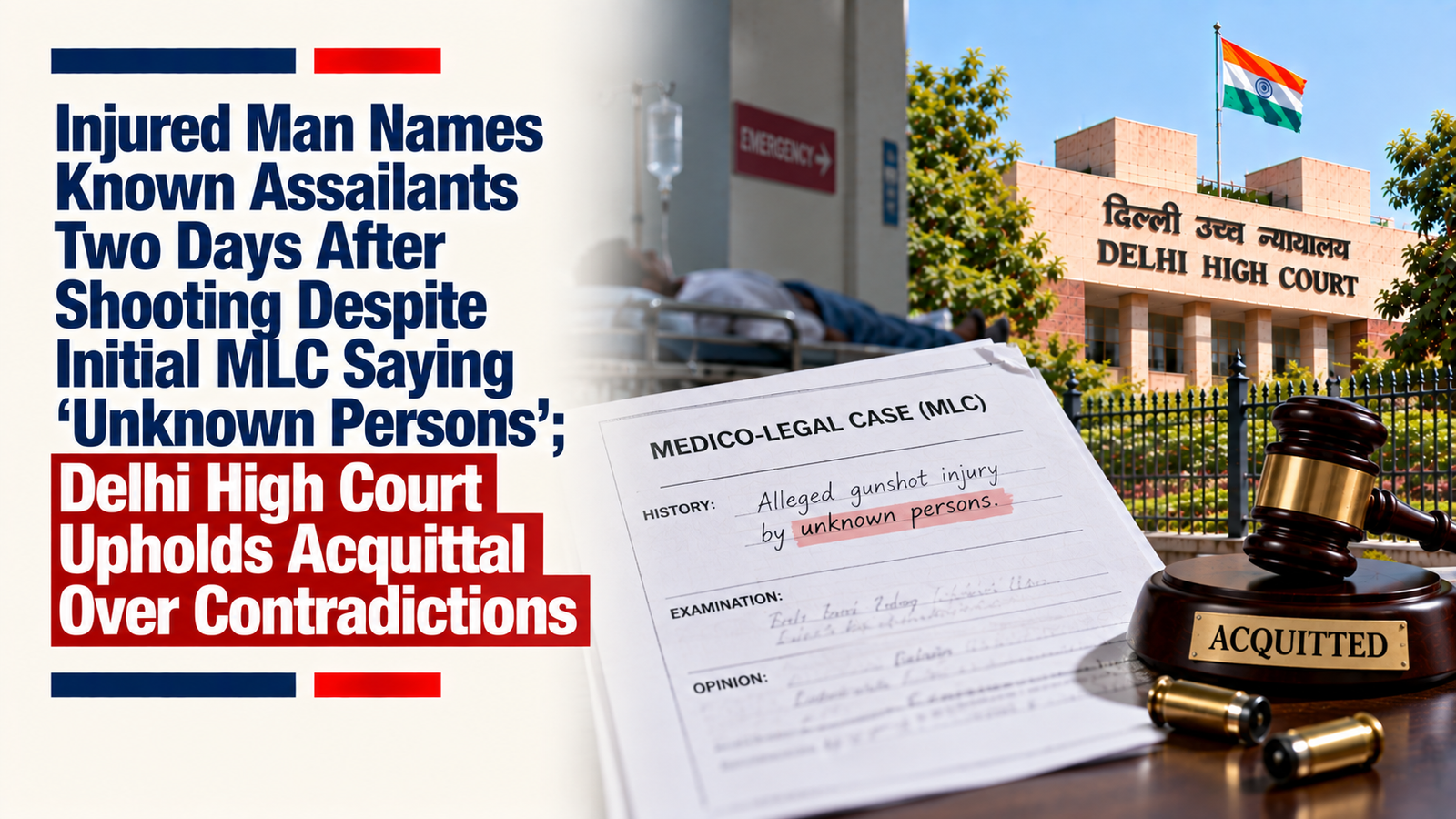
Injured Man Names Known Assailants Two Days After Shooting Despite Initial MLC Saying “Unknown Persons”; Delhi High Court Upholds Acquittal Over Contradictions

Three Bullet Injuries Cannot Establish Identity of Assailants: Delhi High Court Upholds Acquittal Where Witnesses and Forensic Evidence Raised Doubts
Facts
The case arose from a shooting on 12 January 2005 at the shop of Rakesh Kumar Gupta in New Kondli, Delhi. Two persons allegedly entered the shop, fired at him and fled, leaving behind a country-made pistol. The injured suffered three gunshot injuries, including injuries near his left cheek, left upper arm and right forearm.
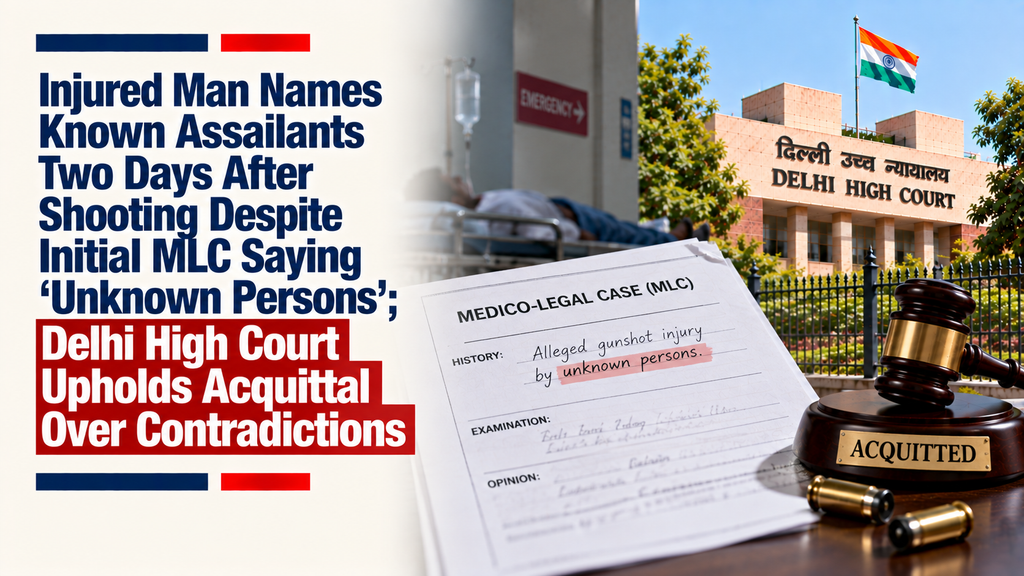
The crucial feature was that the initial MLC at Metro Hospital recorded the history as:
“Fired by some unknown persons.”
The Delhi High Court noted that the injured had been accompanied to the hospital by his brother and driver and that the names of the respondents did not appear as the assailants in this first MLC.
Two days later, on 14 January 2005, the injured gave his statement under Section 161 CrPC, following which Rajender Singh and Virender Singh Rawat, both known to him, were arrested. They were ultimately charged under Sections 307/452/34 IPC and provisions of the Arms Act.
The prosecution examined 26 witnesses, including the injured as PW-2 and persons claimed to be eyewitnesses. However, the Trial Court found substantial contradictions and improvements in the injured’s successive versions and acquitted both accused on 19 July 2017.
The State challenged that acquittal before the Delhi High Court under Section 378(1) CrPC. The appeal was reserved on 3 August 2026 and pronounced on 17 September 2026.
Issues
The principal issues were whether the prosecution evidence proved beyond reasonable doubt that the respondents were the persons who shot the injured, and whether the Trial Court’s assessment of the contradictory eyewitness, medical and forensic evidence was so perverse as to justify interference with an acquittal.
A further issue concerned the governing threshold in a State appeal against acquittal: whether the existence of another possible interpretation of the evidence was sufficient to reverse the Trial Court.
Appellant – State’s Arguments
The State stressed that the shooting itself was unquestionable. The injured had suffered three bullet injuries, and his evidence consistently maintained that he had been fired upon.
According to the State, notwithstanding differences in the successive statements, the essential prosecution case remained that Virender Singh Rawat and Rajender Singh were the assailants. The injured attributed the first two shots to the respondents, though his versions differed as to precisely who fired which shot and he later stated that he could not identify the person who fired the third.
The State also relied upon PW-14, the injured’s driver, who claimed to have seen the two assailants fleeing and a country-made pistol being dropped, as well as PW-7, a neighbouring salesman who saw two persons coming out of the shop.
Respondents’ Arguments
The respondents argued that they had been falsely implicated and that the prosecution had produced no reliable independent evidence connecting them with the shooting.
They stressed that the principal witnesses were the injured, his brother and his driver, while no truly independent public witness from the busy commercial locality had been examined.
They further relied upon deficiencies in the forensic evidence and the investigation and submitted that the Trial Court’s acquittal was based upon a detailed appreciation of the evidence and therefore warranted no appellate interference.
Analysis of the Law
1. Shooting Was Proved; Identity of Shooters Was the Problem
The High Court drew an important distinction.
There was no real dispute that a shooting had occurred and that the complainant had sustained three gunshot injuries. The medical evidence proved those injuries.
But proving that a person was shot is different from proving who shot him.
It was on the latter question that the prosecution evidence failed to remove reasonable doubt.
2. Initial MLC Said “Unknown Persons”
The first Metro Hospital MLC assumed considerable significance.
The Court noted that the MLC was prepared immediately following the occurrence and recorded that the firing had been committed by “some unknown persons.” The respondents were not named.
The injured nevertheless claimed that the respondents were already known to him.
More unusually, another MLC was obtained from Lal Bahadur Shastri Hospital on 7 March 2005, almost two months after the incident. This second MLC specifically named both respondents and characterised the injuries as “Dangerous.”
The High Court observed that when an initial MLC had already been prepared at Metro Hospital, there was no apparent need to obtain this second MLC nearly two months later, and held that sufficient doubt arose regarding this evidence.
3. Injured Witness Gave Materially Changing Versions
The Court independently compared the injured’s statements of:
- 14 January 2005;
- 2 June 2005;
- 20 September 2005; and
- his testimony before the Trial Court.
The versions varied materially regarding who fired which shot, the alleged motive, previous enmity, demands for ₹12 lakh/₹20 lakh, and circumstances surrounding the earlier murder case.
For example, in his first version, Virender was said to have fired two shots and Rajender the third. In the later court testimony, Virender was attributed the first shot, Rajender the second, while PW-2 said he did not know who fired the third.
The High Court therefore agreed with the Trial Court that these were not insignificant discrepancies and that the injured’s changing stand affected his credibility.
4. Claimed Eyewitnesses Did Not Reliably Identify the Shooters
PW-7, a neighbouring salesman, claimed to have seen two persons coming out after hearing the firing and later identified the respondents in Court.
But during cross-examination, he admitted that he could not see anything from his office towards the injured’s shop, had earlier said that he had not fully seen the assailants’ faces, and identified the respondents for the first time during examination-in-chief.
PW-14, the injured’s driver, also described two assailants wearing monkey caps and fleeing on a motorcycle.
Another witness, PW-8, expressly stated in his Section 164 statement that because it was evening and dark, he could not see the faces of the persons fleeing on the motorcycle.
The High Court concluded that none of the purported eyewitnesses appeared actually to have reliably seen the assailants. The incident occurred around 8 p.m., and the evidence concerning monkey caps further complicated identification.
5. Forensic Evidence Also Raised Serious Doubts
The FSL evidence did establish that a country-made pistol was functional and that an empty cartridge and one bullet corresponded with it.
However, the defence exposed discrepancies regarding three live cartridges used in the forensic process.
The FSL register contained an entry numbered “8(a)”, which was alleged to have been inserted subsequently. The defence witness from the FSL also testified about white-fluid corrections and stated that she did not know what had happened to the remaining two cartridges out of three received by the laboratory.
The High Court found that these discrepancies and the apparent insertion in the FSL register raised “enormous doubts” regarding the credibility of the forensic material.
6. No Independent Witness From a Busy Commercial Area
The incident had taken place in a busy commercial locality.
Yet the prosecution failed to produce an independent public witness capable of reliably identifying the respondents as the shooters.
Taken together with the contradictory injured-witness testimony and forensic discrepancies, the Court held that the prosecution had failed to establish guilt beyond reasonable doubt.
Precedent Analysis
Mohan v. State of Karnataka, (2022) 12 SCC 619
The Supreme Court explained that an acquittal strengthens the existing presumption of innocence, creating what is often described as a double presumption of innocence at the appellate stage.
Where two reasonable views are possible, the view supporting acquittal ordinarily prevails.
Bhupatbhai Bachubhai Chavda v. State of Gujarat, 2024 SCC OnLine SC 523
The High Court relied on this judgment for the proposition that an appellate court must first ask whether the Trial Court’s view was a plausible view based on the evidence.
An acquittal cannot be overturned merely because another view is possible. Interference is warranted where, after reappreciation, guilt beyond reasonable doubt is the only possible conclusion and the acquittal is perverse.
Jafarudheen v. State of Kerala, (2022) 8 SCC 440
An acquittal further strengthens the presumption of innocence. Therefore, appellate reversal requires careful scrutiny on established legal parameters.
State of Goa v. Sanjay Thakran, (2007) 3 SCC 755
The appellate court possesses the power to review evidence, but ordinarily should not interfere unless the Trial Court’s approach suffers from manifest illegality, ignores material evidence or results in a conclusion no reasonable person could reach.
The Delhi High Court distilled the authorities to hold that another possible view is not enough; the acquittal must be shown to be perverse before appellate interference is justified.
Court’s Reasoning
The High Court found a combination of deficiencies:
the injured’s materially changing versions + initial MLC referring to unknown assailants + doubtful subsequent MLC + unreliable identification by purported eyewitnesses + FSL discrepancies + absence of credible independent witnesses.
The Trial Court had considered these deficiencies and concluded that the prosecution had not proved that the respondents were the shooters beyond reasonable doubt.
The High Court held that this was, at the minimum, a possible and plausible view of the evidence.
Therefore, even if another view could theoretically be taken, the State had not demonstrated the perversity necessary to displace the respondents’ strengthened presumption of innocence following acquittal.
Conclusion
The Delhi High Court dismissed the State’s appeal and upheld the acquittal of Rajender Singh and Virender Singh Rawat.
The Court concluded that the prosecution had failed to establish their guilt beyond reasonable doubt and that the Trial Court’s acquittal represented a possible view on the evidence.
Accordingly, the Court refused to reverse the acquittal and discharged the respondents’ personal/bail bonds and sureties.
Case Details
Case: The State NCT of Delhi v. Rajender Singh & Anr.
Court: Delhi High Court
Case No.: CRL.A. 461/2018 & CRL.M.A. 14242/2024
Coram: Justice Prathiba M. Singh and Justice Vikas Mahajan
Reserved: 3 August 2026
Pronounced: 17 September 2026
Result: State’s appeal dismissed; acquittal of both respondents upheld; bail/personal bonds and sureties discharged.