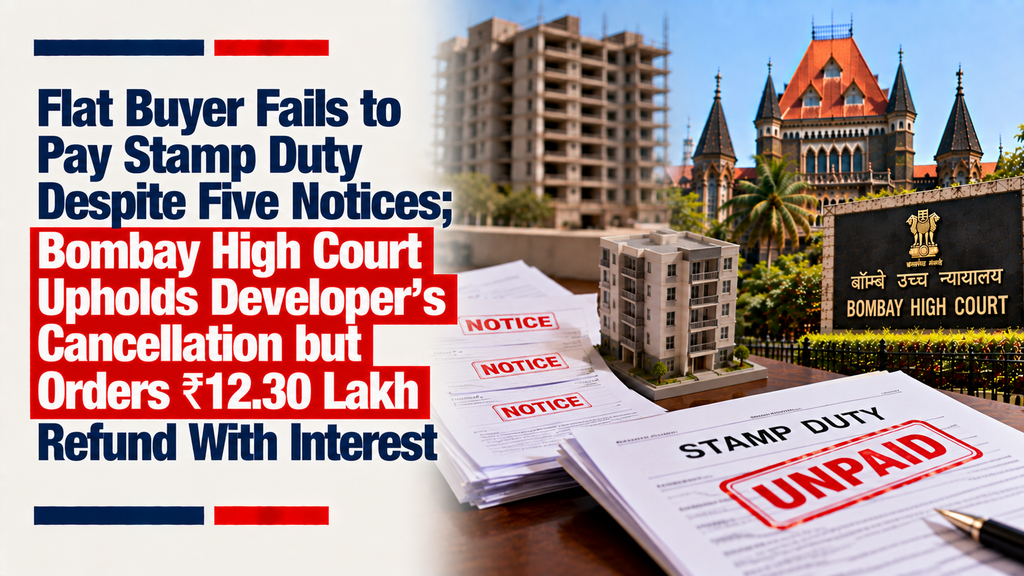
Flat Buyer Fails to Pay Stamp Duty Despite Five Notices; Bombay High Court Upholds Developer’s Cancellation but Orders ₹12.30 Lakh Refund With Interest

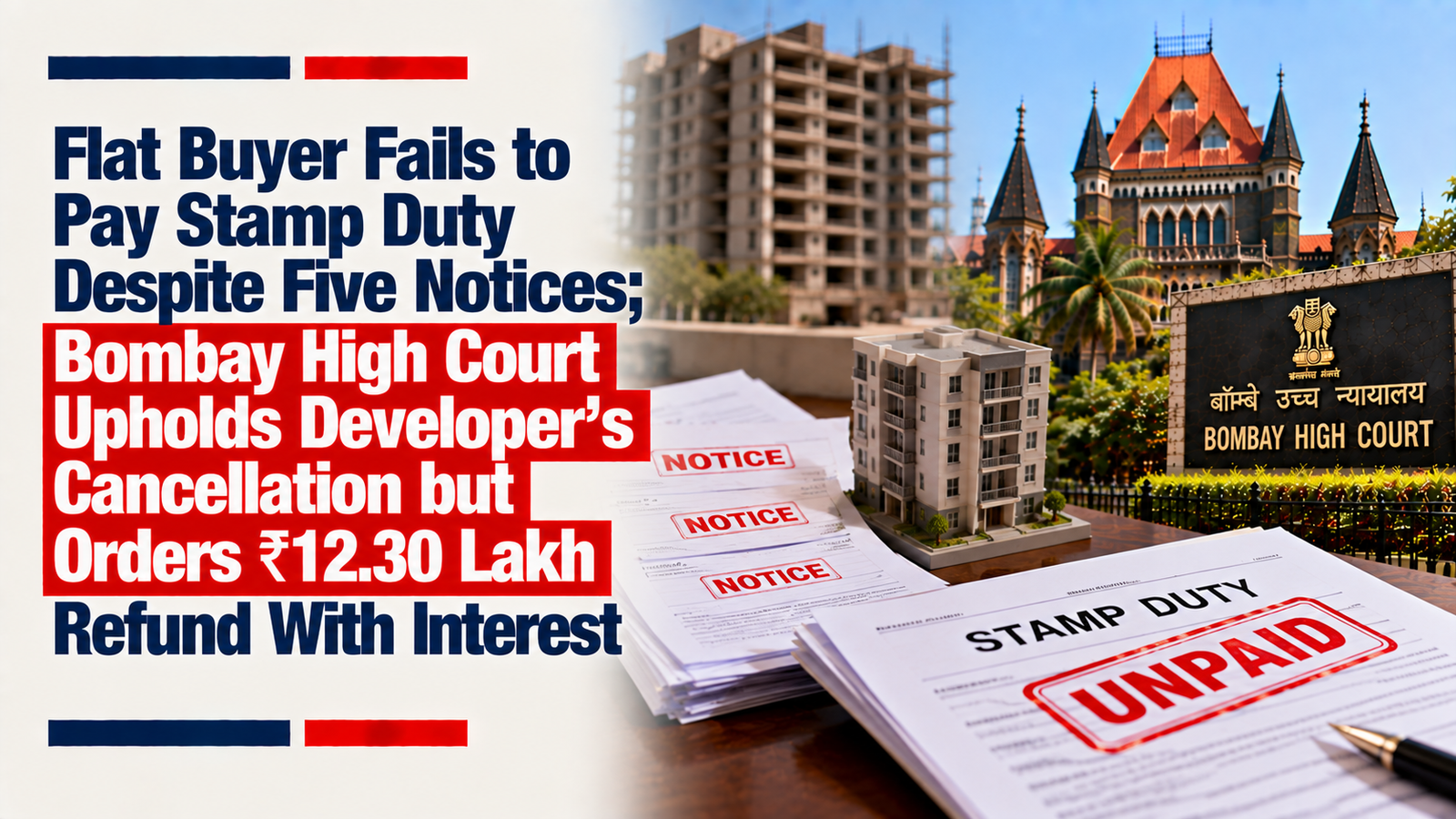
Buyer Transfers ₹4.65 Lakh to Bank but No Stamp Duty Challan Is Generated; Bombay High Court Says This Is Not Payment
Facts
The dispute arose between JP Builders and Developers and allottee Santosh Amarsingh Sandhu concerning a flat in a project at Airoli, Navi Mumbai. The Bombay High Court was deciding cross-second appeals against the Maharashtra Real Estate Appellate Tribunal’s judgment dated 22 October 2024.
The project land was originally leased by CIDCO to Airoli Cooperative Housing Society. The developer initially contemplated construction based on additional FSI, but litigation concerning that FSI delayed the project and ultimately resulted in the proposed building being scaled down.
The original purchasers, the Kharatmols, had booked Flat A-502 for ₹48.75 lakh and paid ₹12.30 lakh. Their booking was subsequently transferred, through a private arrangement, to Santosh Sandhu, and the developer issued him a fresh allotment letter dated 11 July 2013.
After revised plans were sanctioned in 2019, the originally contemplated Flat A-502 could not be constructed. Sandhu selected Flat No. 1208 on the 12th floor as an alternative. The developer repeatedly asked him to pay stamp duty and registration charges so that the Agreement for Sale could be executed.
The transaction was ultimately terminated by the developer on 30 July 2019.
MahaRERA nevertheless directed the developer to execute a registered Agreement for Sale. The Appellate Tribunal substantially affirmed that direction and additionally awarded interest on ₹12.30 lakh at SBI MCLR + 2% from 12 July 2016 until possession.
Issues
The High Court framed five principal questions: whether the allottee had actually paid stamp duty and registration charges; whether the developer validly terminated the allotment; whether MahaRERA could direct execution of an Agreement for Sale for an alternative flat; whether interest on ₹12.30 lakh was justified; and whether the earlier purchasers’ ₹12.30 lakh payment could also be credited to Sandhu.
Promoter’s Arguments
The developer argued that it was always willing to execute the Agreement for Sale, but Sandhu repeatedly failed to pay the necessary stamp duty and registration charges.
It relied particularly upon Sandhu’s email dated 30 June 2019, in which he acknowledged financial difficulty and sought either three months to arrange the money or requested the developer to initially bear the stamp duty from funds eventually to be disbursed through his home loan.
The promoter contended that the transaction was therefore validly terminated and that MahaRERA and the Appellate Tribunal wrongly blamed the developer for non-execution of the Agreement for Sale.
Allottee’s Arguments
Sandhu contended that he had paid ₹4.35 lakh towards stamp duty and ₹30,000 towards registration charges and had forwarded the payment receipts to the promoter through an email dated 9 July 2019. Therefore, according to him, the subsequent cancellation was illegal.
He further contended that he had entered into an MOU with the original allottees and had paid them substantial amounts. Consequently, their earlier ₹12.30 lakh payment to the promoter should also have been adjusted in his favour.
Analysis of the Law
1. Transfer to the bank was not payment of stamp duty
This became the decisive factual issue.
Bank records showed that Sandhu had transferred ₹4.65 lakh to a Punjab National Bank account intended for processing stamp duty and registration charges. However, the money never reached the Stamp Authority or Registration Authority.
Most importantly, Sandhu himself wrote to the bank on 18 January 2020 admitting that he had not generated the necessary challan/e-SBTR and asking the bank to return ₹4.65 lakh to him. The bank thereafter reversed the transaction.
The High Court therefore held that merely setting aside or transferring money to a banker for the purpose of paying stamp duty does not establish that stamp duty was actually paid. There was no government challan or proof that ₹4.65 lakh ever reached the concerned authorities.
Accordingly, the Court specifically answered the first question by holding that Sandhu had not paid stamp duty and registration charges before the transaction was terminated on 30 July 2019.
2. Section 13 RERA could not mechanically be applied against the developer
MahaRERA had reasoned that because the allottee had paid more than 10% of the consideration, Section 13 of RERA required the promoter to execute a registered Agreement for Sale.
The High Court found that this reasoning overlooked the actual chronology.
Once revised plans were sanctioned on 26 April 2019, the developer wrote to Sandhu on 3 May, 28 May and 24 June 2019, asking him to complete the registration process. Sandhu then expressly stated that he did not presently possess sufficient funds to pay stamp duty.
Further opportunities were given on 2 July and 9 July. Yet the stamp duty remained unpaid.
The High Court therefore held that MahaRERA and the Appellate Tribunal had wrongly applied Section 13 while ignoring the fact that the developer was willing to execute the Agreement for Sale and it was the allottee who failed to complete the necessary registration formalities.
3. Developer was justified in cancelling the allotment
The Court placed considerable emphasis on Sandhu’s conduct. Even after receiving the termination notice, he did not immediately establish payment of stamp duty. Months later, he approached the bank and obtained return of the ₹4.65 lakh.
The Court held that the developer could not be expected to “wait endlessly” when the allottee failed to complete the transaction despite repeated opportunities.
Consequently, the High Court held that the 30 July 2019 termination was valid, and MahaRERA and the Appellate Tribunal had erred in directing the promoter to execute an Agreement for Sale.
Precedent Analysis
The allottee relied upon the Supreme Court judgment in Laureate Buildwell Private Limited v. Charanjeet Singh to contend that, having stepped into the shoes of the original allottees, he should receive the benefit of payments made by them.
However, on the facts, the High Court found that Sandhu’s fresh allotment letter dated 11 July 2013 recorded consideration of ₹48.75 lakh and acknowledged only ₹12.30 lakh paid by Sandhu. It did not record any additional credit for the original purchasers’ earlier payment.
The Court therefore declined to treat the earlier purchasers’ ₹12.30 lakh as an additional payment by Sandhu.
Court’s Reasoning
The Court drew an important distinction between valid cancellation of an allotment and the developer’s right to retain the buyer’s money.
Although Sandhu was responsible for the failure to complete registration and the developer was justified in terminating the transaction, the developer was not entitled to retain or forfeit the ₹12.30 lakh booking amount.
The Court therefore directed refund of the full ₹12.30 lakh. It also maintained interest at SBI MCLR + 2% from 12 July 2016 until the booking amount is actually returned, taking into consideration that Sandhu had nevertheless waited for several years for the project to materialise.
This makes the judgment significant on two separate propositions: an allottee’s failure to pay stamp duty can justify cancellation where the promoter repeatedly offers registration, but valid cancellation does not by itself permit the promoter to retain the allottee’s entire booking amount.
Conclusion
The Bombay High Court essentially ruled in favour of the developer on the core dispute. It held that Sandhu had not actually paid stamp duty or registration charges, despite representing that he had done so; the developer had repeatedly called upon him to complete registration; and the termination dated 30 July 2019 was valid.
Accordingly, the directions requiring the developer to execute an Agreement for Sale and provide the allottee a flat could not survive.
At the same time, the Court protected the allottee financially by holding that the developer could not retain the ₹12.30 lakh booking amount, and interest at SBI MCLR + 2% from 12 July 2016 until actual refund remained payable.
Case: JP Builders and Developers v. Santosh Amarsingh Sandhu — with cross-appeal
Court: Bombay High Court, Civil Appellate Jurisdiction
Case Nos.: Second Appeal No. 116 of 2025 with Second Appeal No. 603 of 2025
Judge: Justice Sandeep V. Marne
Reserved: 16 September 2026
Pronounced: 23 September 2026
Citation: 2026:BHC-AS:38974
Result: Developer’s cancellation upheld; direction to execute sale agreement set aside; allottee entitled to refund of ₹12.30 lakh with SBI MCLR + 2% interest from 12 July 2016 until actual refund.