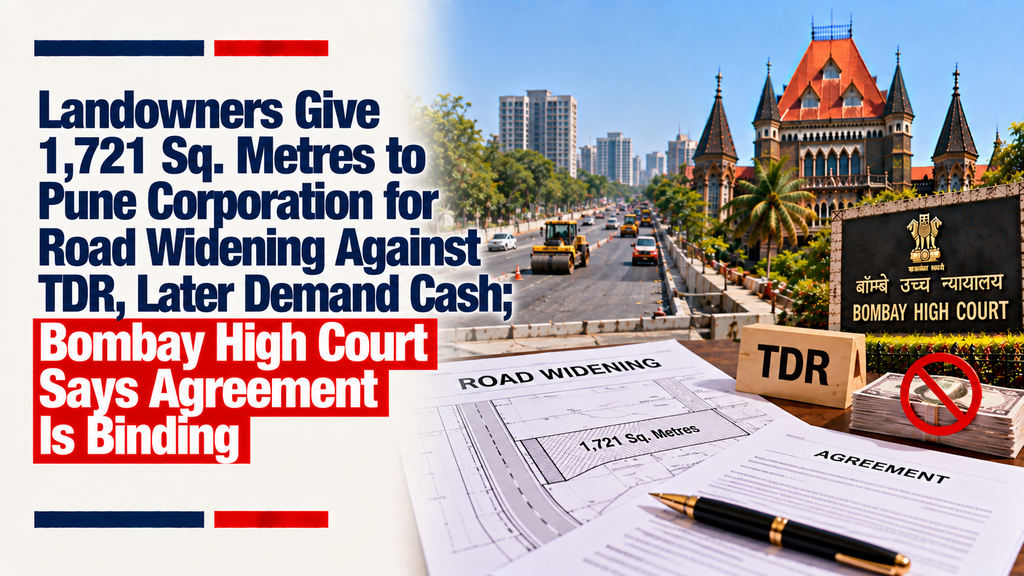
Landowners Give 1,721 Sq. Metres to Pune Corporation for Road Widening Against TDR, Later Demand Cash; Bombay High Court Says Agreement Is Binding

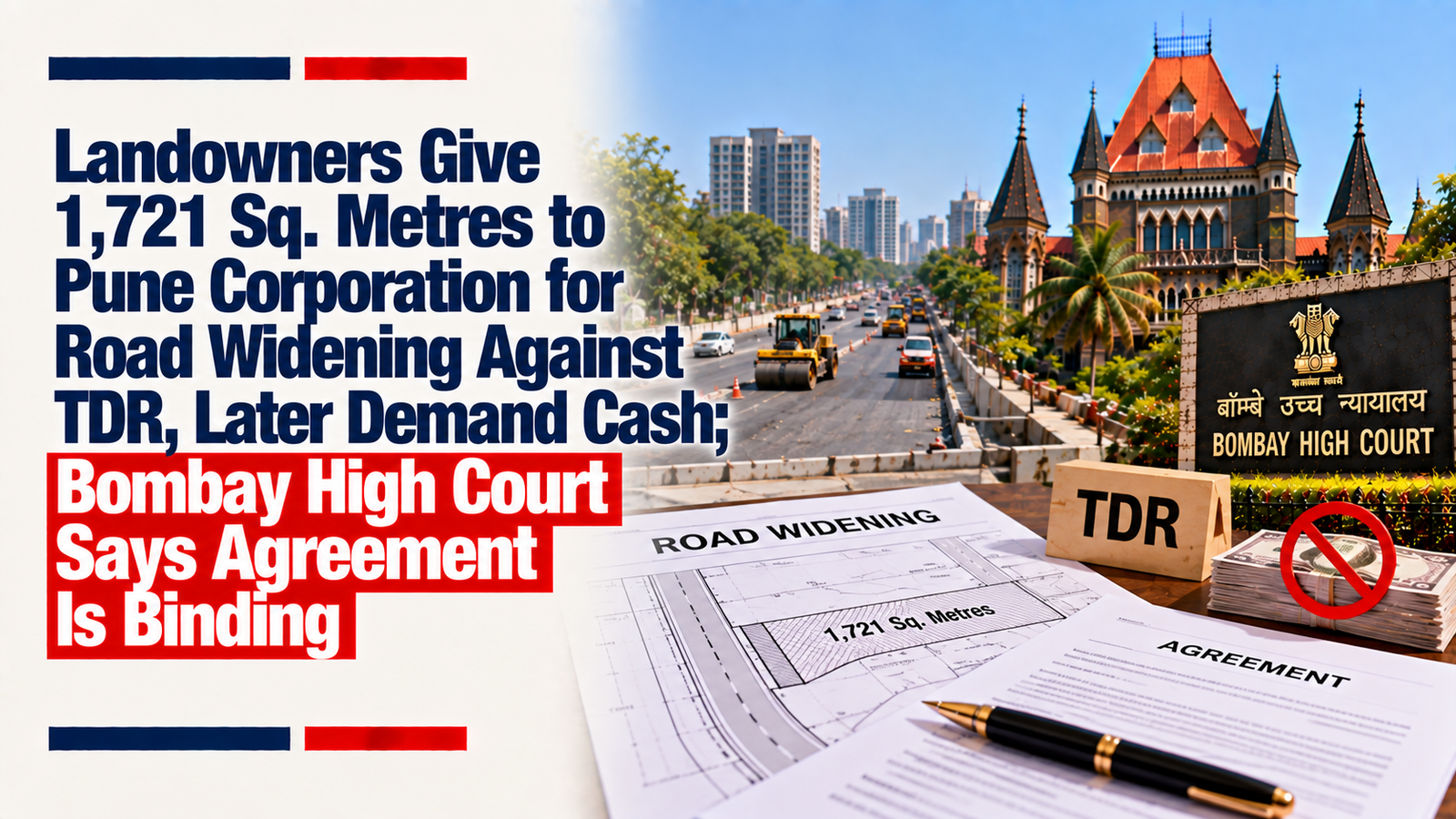
Pune Corporation Takes 1,721 Sq. Metres for D.P. Road After Owners Accept TDR; Bombay High Court Says They Cannot Later Demand Cash
Facts
M/s L.B. Kunjir and its partners claimed ownership of 1,721.03 sq. metres of land at Kharadi, Pune, reserved for widening an 18-metre Development Plan Road. They approached the Bombay High Court seeking acquisition and monetary compensation with statutory benefits, alleging that Pune Municipal Corporation had constructed the road over their land without following lawful acquisition procedure.
The history, however, became decisive.
On 29 August 2013, PMC asked the landowners to hand over possession and stated that compensation could be provided in the form of additional Floor Space Index (FSI), Transferable Development Rights (TDR), or cash compensation.
Thereafter, on 9 June 2016, the landowners executed a possession receipt and handed over approximately 1,721 sq. metres to PMC. The receipt specifically recorded that admissible consideration would be granted in the form of FSI/TDR under the prevailing rules and policy.
Almost ten years later, on 10 February 2026, the petitioners informed PMC that they were no longer interested in TDR and demanded monetary compensation. PMC rejected that demand, maintaining that the petitioners had already agreed to FSI/TDR compensation.
Issues
The central question was straightforward but legally significant:
Can landowners who voluntarily surrender land to a municipal corporation after agreeing in writing to receive FSI/TDR later withdraw from that arrangement and insist upon monetary compensation?
The Court also examined whether the 2013 PMC communication and 2016 possession receipt together constituted a concluded contract, and how Section 126(1) of the Maharashtra Regional and Town Planning Act, 1966 operated in such circumstances.
Petitioners’ Arguments
The petitioners contended that their valuable property had been taken in violation of Articles 14 and 300-A of the Constitution.
They argued that PMC was required to acquire the property in accordance with Section 126 of the MRTP Act and could not compel them to accept FSI/TDR instead of monetary compensation.
They further argued that the 9 June 2016 possession receipt did not amount to a concluded contract. According to them, acquisition by agreement requires genuine consensus and cannot be based upon a unilateral offer by the acquiring authority.
Relying principally on the Full Bench judgment in Shree Vinayak Builders and Developers v. State of Maharashtra, they submitted that an offer of FSI/TDR cannot ordinarily be forced upon a landowner.
They also sought the benefits available under the Right to Fair Compensation and Transparency in Land Acquisition, Rehabilitation and Resettlement Act, 2013, including 80% advance compensation and additional compensation.
Respondent-PMC’s Arguments
PMC contended that this was not a case of compulsory imposition of TDR.
Its 2013 communication constituted an offer. The petitioners subsequently accepted that offer through the 9 June 2016 possession receipt, expressly agreeing that consideration would be provided in the form of FSI/TDR.
PMC therefore argued that a concluded contract existed and that the petitioners could not, almost ten years later, unilaterally change the agreed mode of compensation from TDR to cash.
Analysis of the Law
2013 offer + 2016 acceptance = concluded contract
The High Court treated the two documents together.
PMC’s letter dated 29 August 2013 proposed taking possession by mutual arrangement and stated that compensation could take the form of additional FSI/TDR/cash.
But the later possession receipt was more specific. In it, the petitioners voluntarily handed over possession and recorded that:
“admissible consideration in the form of F.S.I./T.D.R.” would be granted according to prevailing rules and policy.
The High Court held that the 2013 communication was an offer and the 2016 possession receipt constituted its acceptance. The landowners’ voluntary surrender of possession supplied the necessary contractual foundation.
Applying Sections 2(a), 2(b), 2(d) and 10 of the Indian Contract Act, 1872, the Court held that the arrangement constituted a legally binding contract.
Landowners could not change their position ten years later
The petitioners first stated in February 2026 that they were no longer interested in accepting TDR.
The Court characterised this as a “complete change of stance” and an attempt to resile from mutually agreed contractual terms.
Once the petitioners had consciously elected FSI/TDR and surrendered possession on that basis, directing PMC to pay monetary compensation would effectively amount to the Court rewriting the agreement.
That was impermissible.
Precedent Analysis
Shree Vinayak Builders and Developers
The petitioners’ principal authority ultimately worked against them.
The Full Bench in Shree Vinayak Builders and Developers, Nagpur v. State of Maharashtra had recognised that authorities ordinarily cannot unilaterally compel a landowner to accept FSI/TDR.
But the Full Bench also specifically recognised the importance of a concluded contract. Where such a contract exists, the landowner cannot subsequently withdraw the agreed mode of compensation or refuse to surrender land; whether a concluded contract exists is a question of fact in each case.
Here, the High Court found precisely such a concluded agreement.
Courts cannot rewrite contracts
The Court relied on State of Haryana v. Jai Durgaa Finvest Pvt. Ltd., reiterating that where parties freely accept unambiguous contractual terms, courts must enforce those terms rather than substitute a more favourable arrangement merely because the original bargain later becomes onerous.
It also referred to General Assurance Society Ltd. v. Chandumull Jain, Rajasthan State Industrial Development & Investment Corporation v. Diamond & Gem Development Corporation, Shree Ambica Medical Stores v. Surat People’s Cooperative Bank, GMR Warora Energy Ltd. v. CERC, and Venkataraman Krishnamurthy v. Lodha Crown Buildmart.
The common principle was that courts interpret and enforce contracts; they do not make a new contract for the parties.
Other land acquisition judgments distinguished
The petitioners also relied upon Makarand Sharad Pande, Lata Balaso Patil, Sushant Sureshrao Charjan and Minakshi Pramod Sonar.
The High Court distinguished them because those cases did not involve a comparable concluded contract accepting TDR compensation.
Interestingly, the Court acknowledged that if no concluded contract existed, the petitioners’ claim for monetary compensation might have had substance.
Court’s Reasoning
The Court found that the acquisition was not a unilateral taking by PMC.
Section 126(1) MRTP Act permits acquisition through agreement, FSI/TDR, or acquisition proceedings under the 2013 Land Acquisition Act. On these facts, the Court found that the requirements of Section 126(1)(b) were fulfilled through consensus between the landowners and PMC.
The petitioners had voluntarily handed over possession after expressly agreeing to receive FSI/TDR. Therefore, this was fundamentally different from a case where a public authority occupies private property and then unilaterally forces TDR upon an unwilling owner.
Their 2026 demand for cash would alter the very bargain under which possession had been surrendered.
The Court also rejected reliance on Tukaram Kana Joshi and Sukh Dutt Ratra concerning continuing causes of action and delay in compensation claims. Those principles were not disputed, but they did not assist landowners already bound by a concluded agreement regarding the mode of compensation.
Conclusion
The Bombay High Court dismissed the writ petition, holding that the landowners had entered into a binding arrangement with Pune Municipal Corporation to receive compensation in the form of FSI/TDR.
They could therefore not withdraw from that agreement almost ten years after surrendering possession and compel PMC to substitute cash compensation.
However, the Court clarified that the petitioners remained free to submit a proposal for FSI/TDR compensation, which PMC was directed to consider expeditiously in accordance with law, subject to there being no other impediment.
Case: M/s L.B. Kunjir & Ors. v. State of Maharashtra & Ors.
Court: Bombay High Court, Civil Appellate Jurisdiction
Case No.: Writ Petition No. 5159 of 2026
Coram: Chief Justice Mahesh Chandra Tripathi & Justice Advait M. Sethna
Reserved: 10 September 2026
Pronounced: 24 September 2026
Citation: 2026:BHC-AS:39178-DB
Result: Petition dismissed; claim for monetary compensation rejected; landowners permitted to apply for FSI/TDR compensation under the agreed arrangement.