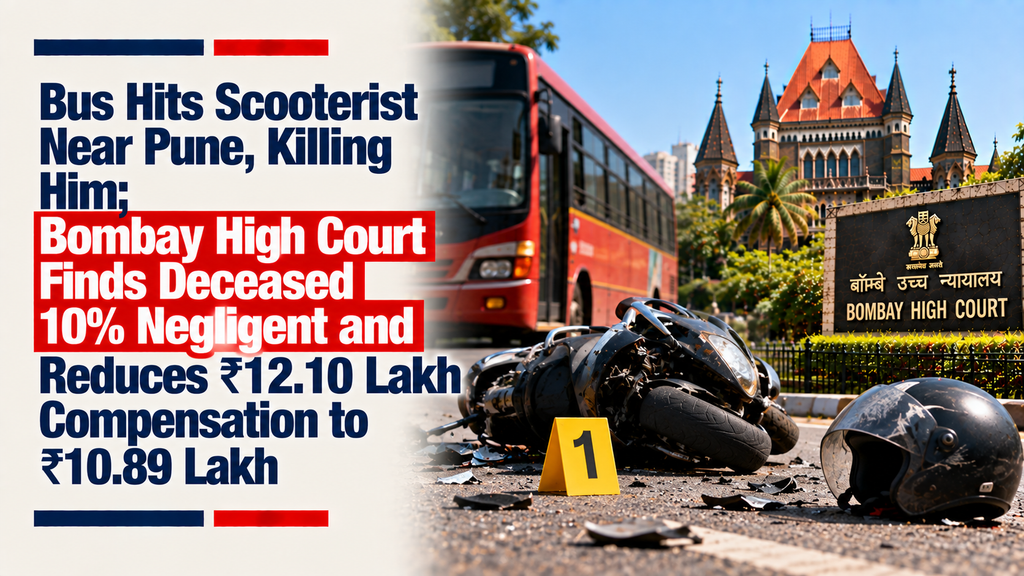
Bus Hits Scooterist Near Pune, Killing Him; Bombay High Court Finds Deceased 10% Negligent and Reduces ₹12.10 Lakh Compensation to ₹10.89 Lakh

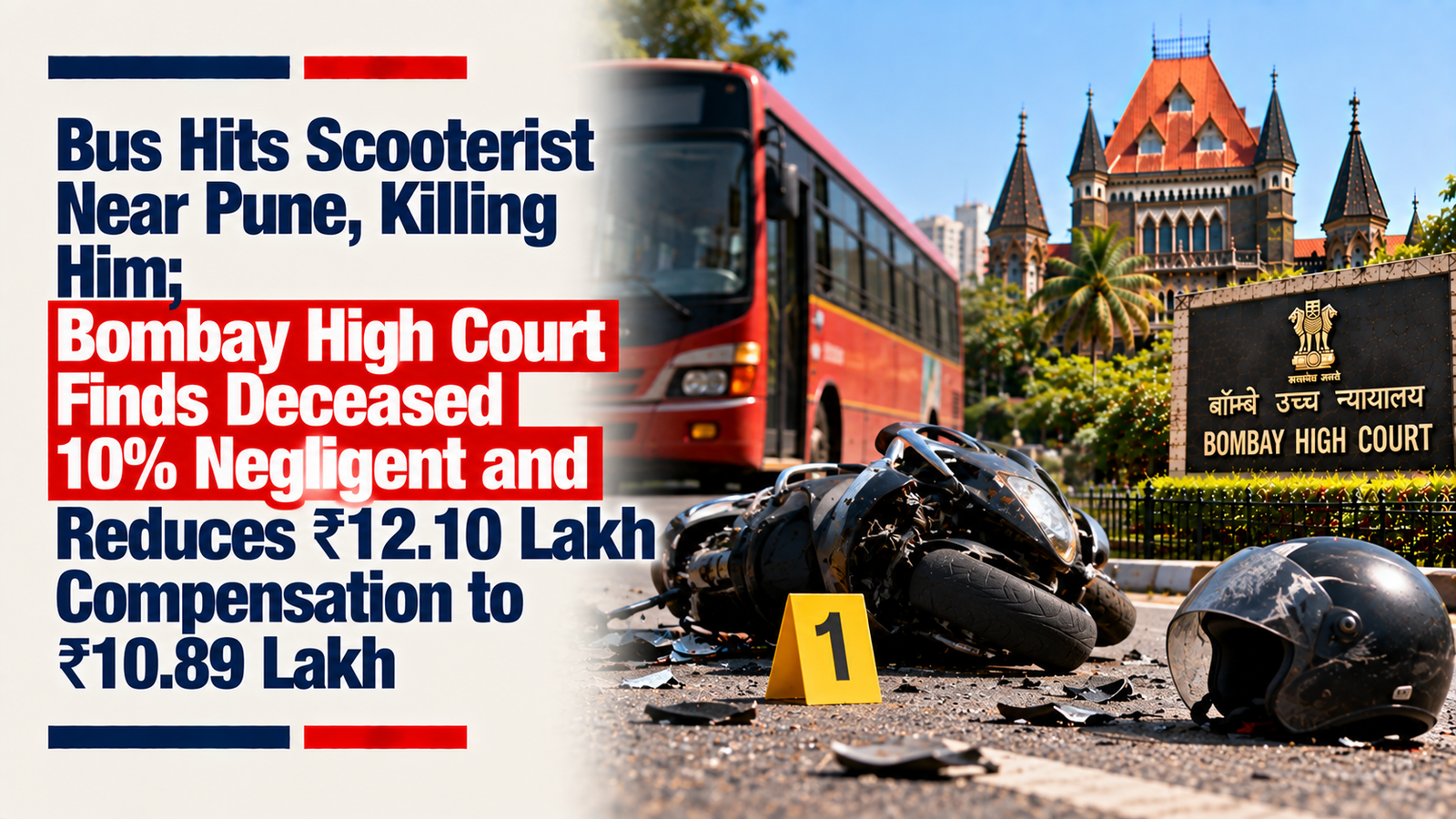
Eyewitness Says Bus Hit Scooter, Bus Passengers Give Different Version; Bombay High Court Apportions Negligence 90:10
Facts
The appeal was filed by Pune Municipal Transport challenging a Motor Accident Claims Tribunal award dated 19 April 2005. The accident involved Ashok Dhumal, who was riding a Bajaj scooter on Pune-Nagar Road when an accident involving a Pune Municipal Transport bus resulted in injuries leading to his death. The Tribunal held the bus driver responsible and awarded the claimants ₹12.10 lakh.
The deceased’s widow, children and mother were the claimants. The claimants examined Wilson Samson Hire, an eyewitness and first informant. The transport undertaking examined the bus conductor, two passengers and the bus driver.
The two sides gave materially different versions of the accident. The claimants alleged that the bus struck the scooter from the rear. The transport undertaking pleaded that the deceased was following the bus, slipped from his scooter and fell. At trial, however, its witnesses introduced another version—that there had been a collision between a bicycle and the scooter.
Issues
The principal question before the High Court was whether the Tribunal had correctly appreciated the evidence concerning how the accident occurred and whose negligence caused it.
More specifically, the Court had to determine whether the bus driver was entirely responsible, as the Tribunal held, or whether the deceased scooterist also contributed to the accident.
Appellant’s Arguments
Pune Municipal Transport denied negligence by its driver.
Its pleaded case was that the deceased was travelling behind the bus, slipped from his scooter and fell. Its witnesses, however, testified that a bicycle and scooter travelling on the left side of the bus collided, causing the scooterist to fall.
The transport undertaking therefore sought reversal or modification of the Tribunal’s finding that its bus driver was solely responsible.
Respondents’ Arguments
The claimants relied substantially upon eyewitness Wilson Hire, who stated that the bus had struck the scooter.
They also pointed out that the transport undertaking’s bicycle-scooter collision theory had never been pleaded in its written statement and emerged only during oral evidence. The claimants therefore argued that this subsequent version should not be accepted.
Analysis of the Law
The High Court emphasised that appreciation of evidence requires the Court to consider the evidence of both sides together and reconstruct the probable manner in which the accident occurred, rather than simply accepting one isolated version.
The physical evidence was significant. The spot panchnama showed damage to the scooter’s stepney and tyre, damage to the bus’s left headlight, tyre marks near the headlight and a pool of blood near the scooter.
The High Court found difficulty in accepting the Tribunal’s conclusion that the bus had struck the scooter directly from behind. If a heavy bus had hit the scooter squarely from behind, the Court reasoned that greater damage to the scooter would ordinarily have been expected.
At the same time, the Court did not absolve the bus driver. On its assessment of the evidence, there was reason to believe that the rear portion of the bus had hit the scooterist.
Precedent Analysis
The claimants relied upon Srinivas Raghavendrarao Desai (Dead) by LRs v. V. Kumar Vamanrao @ Alok and Others for the principle concerning the relationship between pleadings and evidence.
This was relevant because the transport undertaking’s witnesses introduced a bicycle-scooter collision theory that was absent from its written statement. The High Court acknowledged that evidence is required to be based on pleadings and noted the inconsistency.
The Tribunal itself had rejected this version because it was introduced for the first time during evidence and had neither been pleaded nor stated before the police.
Court’s Reasoning
The High Court disagreed with the Tribunal’s imposition of 100% responsibility on the bus driver.
It concluded that the bus driver ought to have maintained sufficient distance and driven at a moderate speed, which could have prevented the accident. However, on the overall evidence, the deceased scooterist could not be completely absolved.
Accordingly, Justice S.M. Modak apportioned negligence as:
Bus driver – 90%
Deceased scooterist – 10%
Since the Tribunal had awarded ₹12.10 lakh on the basis of full liability, the High Court deducted 10%—₹1.21 lakh—and fixed Pune Municipal Transport’s liability at ₹10.89 lakh.
Conclusion
The Bombay High Court partly allowed the transport undertaking’s challenge by modifying the finding on negligence and the quantum of compensation.
Pune Municipal Transport was directed to pay ₹10.89 lakh with 9% annual interest within eight weeks. If the claimants had already withdrawn the entire original award, they were directed to refund the excess amount within six weeks with 6% interest.
Case: Pune Municipal Transport v. Smt. Suchitra Ashok Dhumal & Others
Court: Bombay High Court, Civil Appellate Jurisdiction
Case No.: First Appeal No. 1944 of 2005
Judge: Justice S.M. Modak
Reserved: 27 August 2026
Pronounced: 23 September 2026
Citation: 2026:BHC-AS:39077
Result: Appeal partly allowed; bus driver held 90% responsible and deceased scooterist 10% responsible; compensation reduced from ₹12.10 lakh to ₹10.89 lakh with 9% interest.