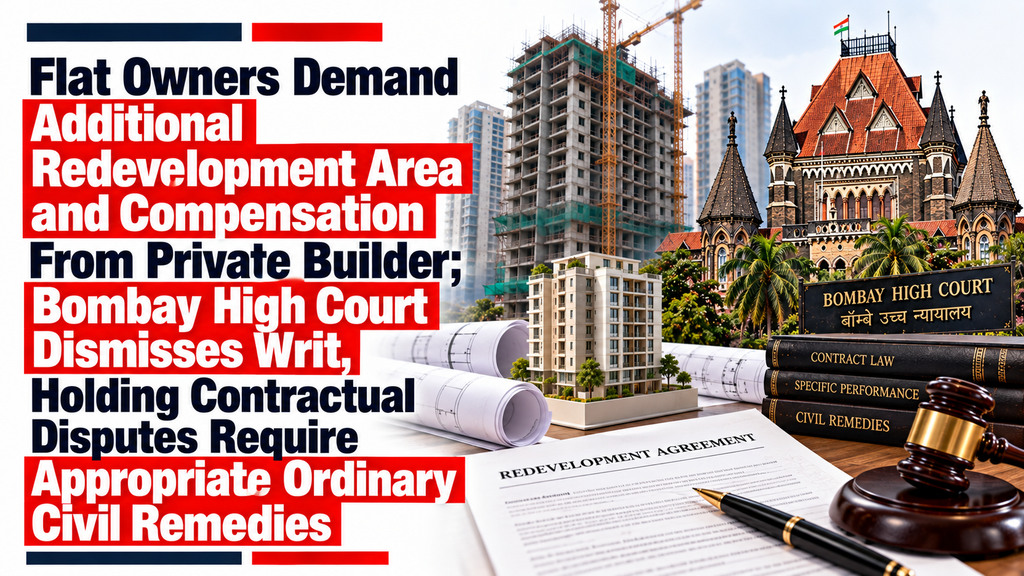
Flat Owners Demand Additional Redevelopment Area and Compensation From Private Builder; Bombay High Court Dismisses Writ, Holding Contractual Disputes Require Appropriate Ordinary Civil Remedies

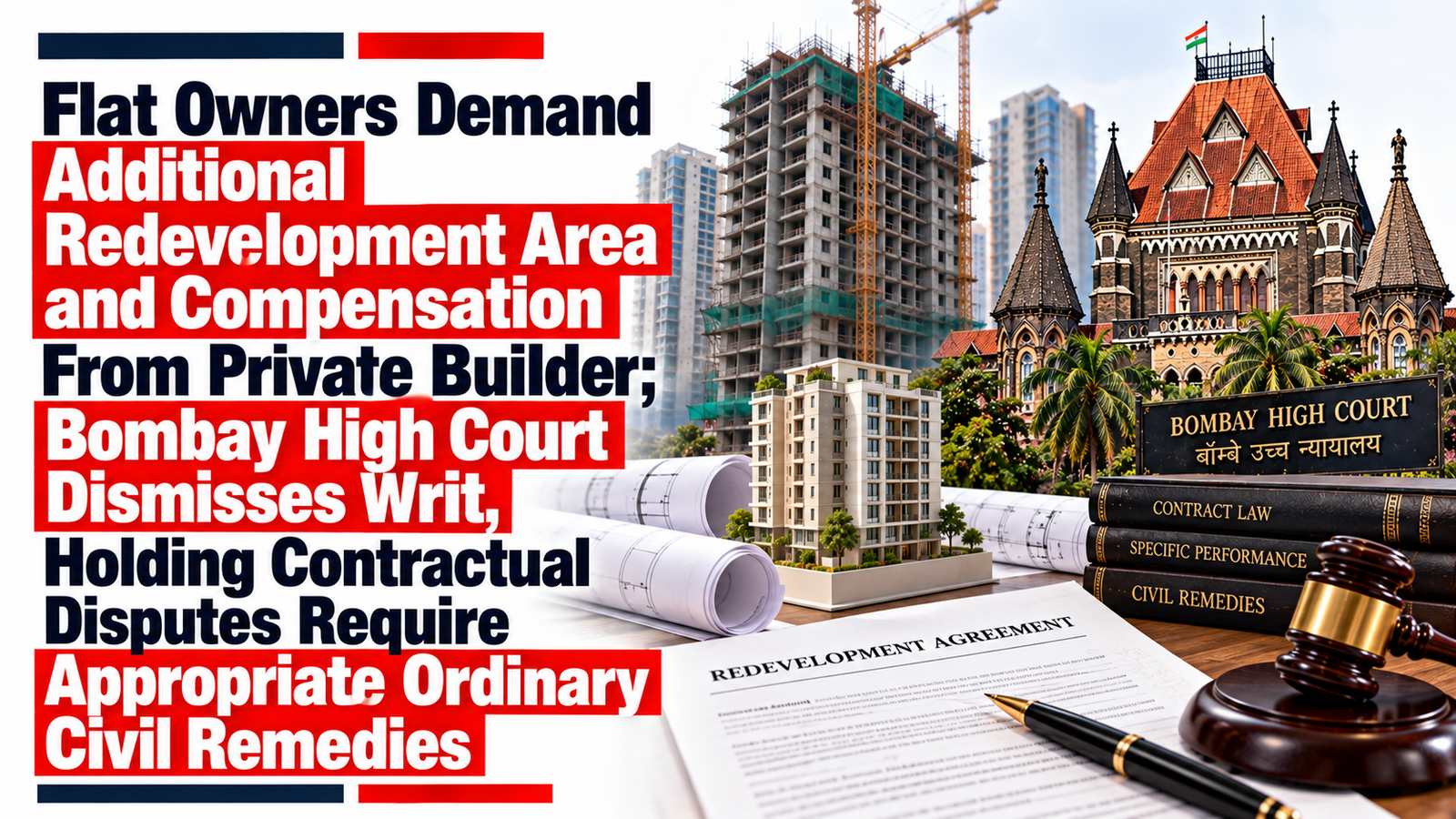
Couple Alleges Reduced Flat Area, Missing Amenities and Parking After Society Redevelopment; Bombay High Court Rejects Writ Against Developer for Absence of Any Public Duty
Facts
Ashwin Ashara and Daksha Ashwin Ashara, husband and wife, owned Flats B-19 and B-20 in Bhanujyoti Co-operative Housing Society, Malad (East), Mumbai. On 16 September 2021, Namo Realty Ventures LLP, the Society and 46 of its 48 members executed a registered redevelopment agreement. The two petitioners were the only members who opposed the redevelopment.
As the petitioners did not vacate, the developer secured an order dated 21 March 2022 under Section 9 of the Arbitration and Conciliation Act, 1996, directing them to hand over possession. Their Section 37 appeal was withdrawn on 21 April 2022. Redevelopment was completed on 28 October 2024; an Occupation Certificate was issued and all other members took possession of their new units.
The petitioners filed Writ Petition No. 1251 of 2024 seeking additional area allegedly promised in the redeveloped premises and compensation/damages. They also complained about the carpet area, amenities and parking arrangements.
Issues
Whether Article 226 jurisdiction may be invoked to obtain additional flat area, parking, amenities and damages from a private developer arising out of a society redevelopment agreement.
Whether joining municipal authorities as respondents creates a public-law element where no violation of a statutory provision or duty is alleged against them; and whether the precedents invoked by the petitioners warranted writ intervention.
Petitioner’s Arguments
The petitioners alleged large-scale fraud and misappropriation of redevelopment funds and non-disclosure of relevant records by the developer and society. They claimed to have learnt from other members that newly constructed flats had less carpet area than promised, and that amenities and parking spaces did not conform to the agreement.
They sought additional area and compensation and relied upon Hari Krishna Mandir Trust v. State of Maharashtra, (2020) 9 SCC 356, and Rajani Dattaram Tanawade v. Municipal Corporation of Greater Mumbai, 2023 SCC OnLine Bom 2313, including arguments relating to 35% fungible FSI.
Respondent’s Arguments
The developer argued that the claim was purely contractual and could not be converted into a constitutional writ merely by impleading municipal authorities. The petitioners had challenged neither the redevelopment agreement nor the society’s general-body resolutions, and alleged no breach of statutory duty by the municipal respondents.
The developer also stated that transit-rent cheques had been issued but not encashed. It relied on Praga Tools Corporation v. C.A. Imanual, (1969) 1 SCC 585. The municipal authorities and society adopted the developer’s submissions.
Analysis of the Law
Article 226 confers broad jurisdiction, but the nature of the right asserted and the duty sought to be enforced remain decisive. Mandamus cannot ordinarily be directed against a private person who performs no public duty. A private claim for contractual performance or damages does not become a public-law controversy merely because municipal authorities are added as parties.
The Court distinguished the existence of writ jurisdiction from the propriety of exercising it. The availability of ordinary civil remedies and the absence of any alleged statutory default weighed against entertaining this petition.
Precedent Analysis
Praga Tools Corporation v. C.A. Imanual, (1969) 1 SCC 585: Applied. A dispute rooted in a private contract without a public-law element must be pursued through ordinary civil remedies rather than writ jurisdiction.
Hari Krishna Mandir Trust v. State of Maharashtra, (2020) 9 SCC 356: Distinguished. Although disputed facts do not invariably bar Article 226 relief, the Court must examine the right, duty, dispute and available remedy. Here, the claim was for damages against a private developer.
Rajani Dattaram Tanawade v. Municipal Corporation of Greater Mumbai, 2023 SCC OnLine Bom 2313: Distinguished. That case concerned appropriation of fungible FSI towards common areas; here the redevelopment agreement and society resolutions remained unchallenged, and construction was complete.
Court’s Reasoning
The Bench held that neither certiorari nor any other writ was maintainable on the pleaded facts. The substantive relief was directed solely against the private developer, which was not shown to discharge a public duty. The municipal respondents’ presence did not supply the missing public-law element, particularly because no breach of a statutory obligation was pleaded against them.
The petitioners had not challenged the registered redevelopment agreement or general-body resolutions. The redevelopment had already been acted upon, the building completed, an Occupation Certificate issued, and other members had taken possession. The Court also noted the petitioners’ earlier suggestion of alternative builders and the absence of an explanation for not pursuing civil remedies.
Conclusion
The Bombay High Court dismissed the writ petition as a private redevelopment dispute unsuited to Article 226 adjudication. Rule was discharged and there was no order as to costs. The Court did not adjudicate the underlying contractual entitlement to additional area or damages on merits; such private claims must be pursued in an appropriate ordinary forum.
Case Details
Case: Ashwin Ashara & Anr. v. Municipal Corporation of Greater Mumbai & Ors.
Court: High Court of Judicature at Bombay, Ordinary Original Civil Jurisdiction
Case Number: Writ Petition No. 1251 of 2024; 2026:BHC-OS:22124-DB
Judges: Justice Suman Shyam and Justice Gautam A. Ankhad (Judgment authored by Justice Gautam A. Ankhad)
Reserved On: 5 October 2026
Date: 9 October 2026
Result: Writ petition dismissed as not maintainable; Rule discharged; no order as to costs.