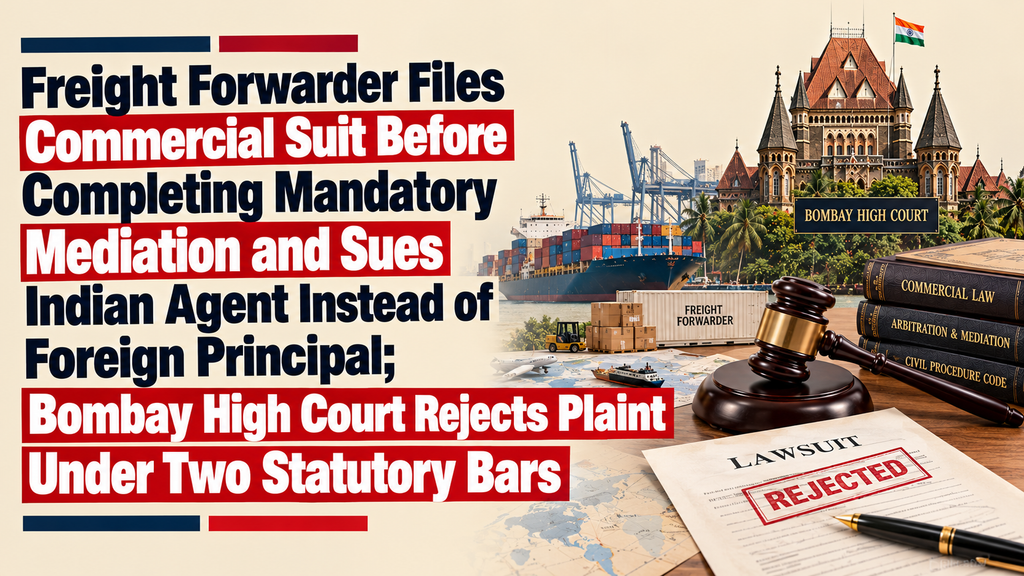
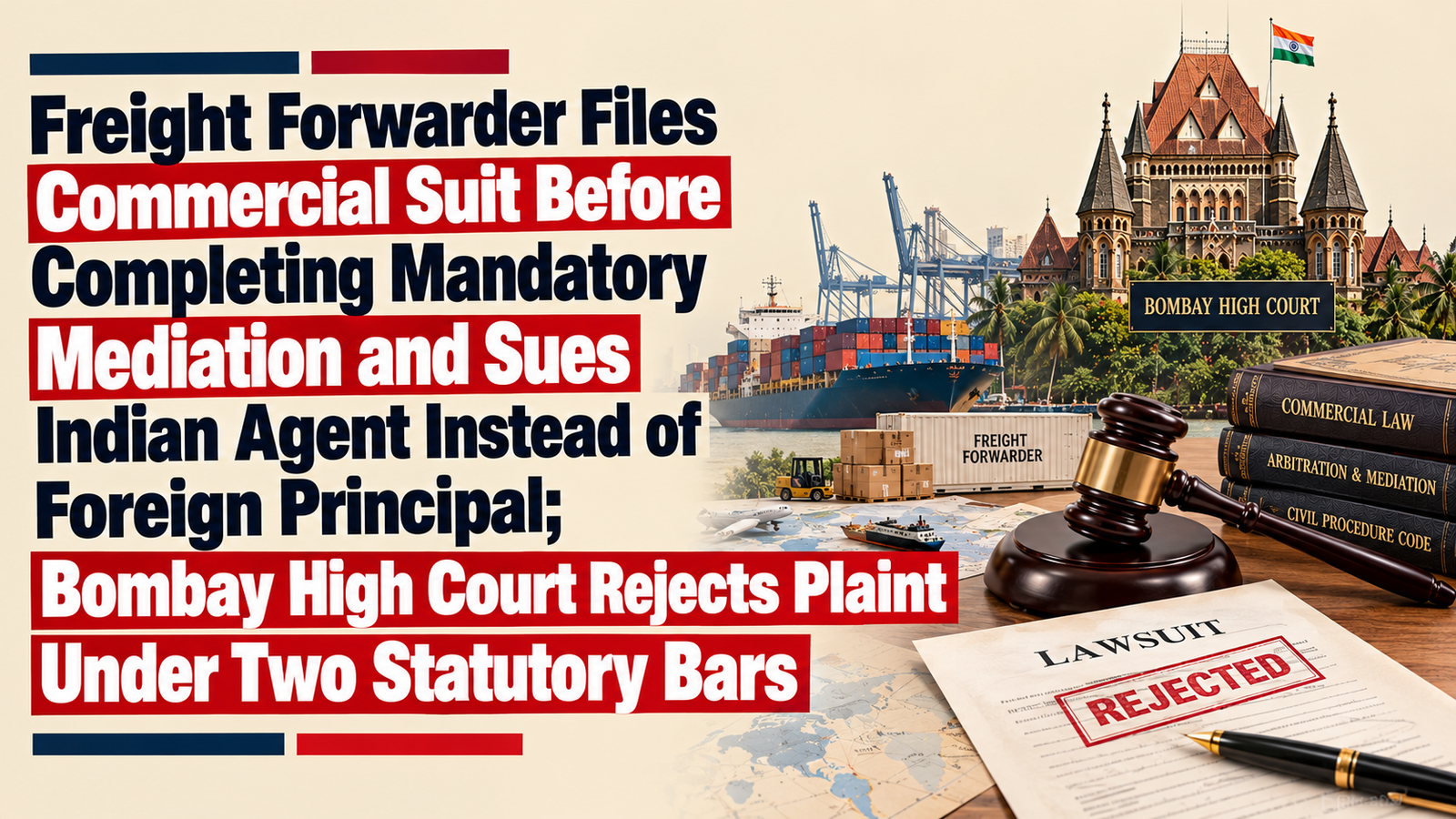
Freight Forwarder Files Commercial Suit Before Completing Mandatory Mediation and Sues Indian Agent Instead of Foreign Principal; Bombay High Court Rejects Plaint Under Two Statutory Bars

Shipping Bookings Cancelled Due to System Error; Bombay High Court Rejects Multi-Million-Dollar Damages Suit Against Hapag-Lloyd’s Indian Agent
Facts
In Rushabh Sealink and Logistic Private Limited v. Hapag-Lloyd (India) Private Limited, Hapag-Lloyd India sought rejection of the plaint under Order VII Rule 11 CPC, alternatively return of the plaint under Order VII Rule 10. Three objections were raised: non-compliance with Section 12A of the Commercial Courts Act, 2015; bar under Section 230 of the Contract Act, 1872 because the defendant was allegedly merely the Indian agent of a disclosed foreign principal; and an alleged exclusive jurisdiction clause favouring the Courts at Hamburg, Germany. Rushabh Sealink
Rushabh Sealink is an Indian freight forwarder. Hapag-Lloyd India is a wholly owned subsidiary of Hapag-Lloyd AG, Germany. According to the defendant, the Indian company acted merely as the Indian agent of its German parent. Rushabh Sealink
In February 2022, Rushabh received customer inquiries for export of goods to Djibouti, East Africa. It sought quotations from Hapag-Lloyd AG for three routes, including Nhava Sheva–Djibouti and Mundra–Djibouti. Hapag-Lloyd AG issued quotations on 21 February 2022, which Rushabh accepted, leading to bookings for 510 containers. Rushabh Sealink
On 23 February 2022, the booking confirmations were cancelled on the ground that they had been generated because of an internal system error. Rushabh thereafter corresponded with Hapag-Lloyd India and claimed that its own onward bookings with customers had to be cancelled. Rushabh Sealink
Rushabh instituted a substantial damages action claiming, among other amounts:
- USD 200,600 for actual loss of profits;
- USD 6,690,250 for loss of business opportunities; and
- USD 20,000,000 pleaded as loss of reputation. Rushabh Sealink
The central procedural difficulty was that Rushabh applied for pre-institution mediation only on 21 February 2025 but instituted the commercial suit just five days later, on 26 February 2025, without waiting for the mediation process to conclude. Rushabh Sealink
The mediation subsequently ended in a non-starter report dated 9 May 2025 because Hapag-Lloyd India did not participate. Rushabh Sealink
Issues
The Court considered four principal questions:
- Whether an Order VII Rule 11 application should be decided before the plaintiff’s subsequently filed amendment application.
- Whether merely initiating pre-institution mediation satisfies Section 12A, or whether the mediation remedy must actually be exhausted before institution of the suit.
- Whether a non-starter report obtained after institution of the suit could retrospectively cure non-compliance existing on the filing date.
- Whether Hapag-Lloyd India could be sued for the alleged contractual breach of Hapag-Lloyd AG, its disclosed foreign principal, in view of Section 230 of the Contract Act.
The Court ultimately did not decide the Hamburg jurisdiction objection because its findings on Sections 12A and 230 were sufficient to dispose of the suit.
Plaintiff’s Arguments
Rushabh argued that the mediation objection had become academic because the process had ultimately resulted in a non-starter report after Hapag-Lloyd India failed to participate. Requiring it to undertake mediation again would therefore be an empty formality. Rushabh Sealink
It also contended that its suit contemplated genuine urgent interim relief, including disclosure and attachment of the defendant’s assets and security for its monetary claim. According to Rushabh, commencement of mediation did not prevent it from subsequently instituting a suit seeking urgent interim protection. Rushabh Sealink
On Section 230, Rushabh argued that Hapag-Lloyd India was not being sued merely in its capacity as an agent. It further invoked the statutory exception relating to a principal residing abroad and relied upon Cochin Frozen Foods Exports (P) Ltd. v. Vanchinad Agencies, among other authorities. Rushabh Sealink
Rushabh also argued that the alleged Hamburg jurisdiction clause arose from Bill of Lading terms, whereas no Bill of Lading had actually been issued for the cancelled bookings. Rushabh Sealink
Defendant’s Arguments
Hapag-Lloyd India argued that Section 12A is mandatory. The plaintiff could not satisfy the provision merely by lodging a mediation application and filing the suit five days later.
The defendant emphasised the statutory word “exhausts”, contending that the plaintiff had to await completion of the mediation process through settlement, non-settlement or a non-starter report before instituting the suit. Rushabh Sealink
It further argued that the actual transaction was with Hapag-Lloyd AG. The quotations and booking confirmations emanated from the German company, whereas Hapag-Lloyd India was merely the agent of that disclosed principal. Section 230 therefore barred the suit against the Indian agent. Rushabh Sealink
Finally, Hapag-Lloyd India relied upon contractual terms allegedly conferring exclusive jurisdiction upon Hamburg, Germany. Rushabh Sealink
Analysis of the Law
1. Order VII Rule 11 Had to Be Decided Before Amendment
Rushabh had sought amendment of the plaint after Hapag-Lloyd India filed its rejection application.
The Court held that the rejection application had to be decided first because the objections under Section 12A of the Commercial Courts Act and Section 230 of the Contract Act went to the very root of maintainability.
If the suit itself was legally non-maintainable, there was no occasion first to permit amendment of the plaint. Rushabh Sealink
The Court relied on, inter alia, Prakash G. Goyal v. Sayyed Ayaz Ali, Hal Offshore Ltd., and Saurer Technologies GMBH & Co KG.
2. Section 12A Requires “Exhaustion”, Not Mere “Initiation”
This is one of the most important holdings of the judgment.
Section 12A states that a commercial suit not contemplating urgent interim relief cannot be instituted unless the plaintiff “exhausts” the remedy of pre-institution mediation. Rushabh Sealink
The Court drew a sharp distinction between:
filing an application for mediation and exhausting the mediation process.
Under Rule 3 of the Pre-Institution Mediation Rules, filing the application is merely the beginning. The statutory process is exhausted only upon one of three outcomes:
settlement, a report of non-settlement, or a non-starter report. Rushabh Sealink
Therefore:
A plaintiff cannot merely file a mediation application and immediately rush to the Commercial Court.
Rushabh filed for mediation on 21 February 2025 and instituted the suit on 26 February 2025. That was not compliance with Section 12A. Rushabh Sealink
3. Subsequent Non-Starter Report Cannot Cure the Defect
Rushabh’s stronger argument was that mediation ultimately failed anyway because Hapag-Lloyd India did not participate.
The Court rejected this.
Compliance with Section 12A must exist on the date on which the suit is instituted. Rushabh’s rights and the maintainability of its action crystallised on 26 February 2025.
The later non-starter report of 9 May 2025 could not retrospectively validate a suit that was defective when instituted. Rushabh Sealink
This makes the judgment significant procedurally: subsequent completion or failure of mediation does not cure the original Section 12A defect.
4. When Can a Plaintiff Abandon Ongoing Mediation and File Suit?
The Court nevertheless recognised an important exception.
It held that commencement of mediation does not create an absolute prohibition against filing a suit before mediation concludes.
If a new event creating genuine urgency occurs after mediation has commenced, the plaintiff may abandon mediation and approach the Commercial Court for urgent interim relief.
For example, if after mediation starts the defendant attempts to dispose of property so as to frustrate the claim, the plaintiff may immediately seek an injunction.
But that was not Rushabh’s case.
There was no intervening event between 21 February 2025 and 26 February 2025 creating fresh urgency. Rushabh conceded that no such new event had arisen.
The Court therefore drew an important distinction:
Pre-existing urgency → plaintiff must decide at the outset whether to bypass mediation.
Fresh urgency arising after mediation begins → plaintiff may abandon mediation and institute the suit.
5. Monetary Claim After Three Years Did Not Demonstrate Genuine Urgency
The original booking cancellations occurred on 23 February 2022. The last correspondence relied upon was in March 2022.
The suit was instituted only in February 2025.
The principal reliefs were monetary damages, while the interim prayers sought disclosure and attachment of assets and security.
Against that chronology, the Court found no genuine urgent interim relief justifying abandonment of mediation.
Accordingly, the plaint had to be rejected under Order VII Rule 11 for violation of mandatory Section 12A.
The Court relied heavily upon the Supreme Court’s decisions in Patil Automation Pvt. Ltd. v. Rakheja Engineers Pvt. Ltd. and Dhanbad Fuels Pvt. Ltd. v. Union of India, which treat Section 12A compliance as mandatory for suits not contemplating urgent interim relief. Rushabh Sealink
6. Section 230 Contract Act — Suit Against Indian Agent
The second independent ground was Section 230 of the Contract Act.
The Court noted that Rushabh’s own case showed that:
- quotations came from Hapag-Lloyd AG;
- booking confirmations were issued by Hapag-Lloyd AG;
- the bookings were cancelled by Hapag-Lloyd AG; and
- the Indian defendant was the agent of the disclosed German principal.
The Court therefore held that the damages action arising from cancellation of those bookings essentially lay against the foreign principal, Hapag-Lloyd AG, rather than its Indian agent.
Importantly, the Court distinguished Cochin Frozen Foods Exports (P) Ltd. v. Vanchinad Agencies. That case involved the statutory exception under Section 230 concerning a contract made by an agent for the sale or purchase of goods for a merchant residing abroad.
The present shipping/container-booking transaction did not fall within that exception.
Consequently, the Court held that the suit against Hapag-Lloyd India, merely as the Indian agent of a disclosed foreign principal, was barred by Section 230.
Thus, there were two independent grounds for rejection:
Section 12A, Commercial Courts Act — premature institution without exhausting mediation; and
Section 230, Contract Act — suit against the agent of a disclosed principal.
Precedent Analysis
Patil Automation Pvt. Ltd. v. Rakheja Engineers Pvt. Ltd.
The Supreme Court established the mandatory character of Section 12A. A commercial suit instituted after 20 August 2022 without satisfying Section 12A, where no urgent interim relief is contemplated, is liable to rejection under Order VII Rule 11. Rushabh Sealink
Dhanbad Fuels Pvt. Ltd. v. Union of India
The Court relied upon this judgment for the test of whether a suit genuinely “contemplates urgent interim relief.” The inquiry is made from the plaintiff’s standpoint but courts must ensure that urgency is not merely an artificial device to circumvent Section 12A. Rushabh Sealink
Phoenix ARC Pvt. Ltd. v. Future Brands Ltd.
This authority supported the proposition that commencing mediation does not permanently deprive a plaintiff of the ability to approach court where fresh circumstances subsequently create genuine urgency.
Cochin Frozen Foods Exports (P) Ltd. v. Vanchinad Agencies
The plaintiff relied on this Supreme Court authority to contend that an Indian agent of a foreign principal could be sued.
The Court distinguished it because that matter involved the sale/purchase-of-goods exception under Section 230. It did not establish a universal proposition that every Indian agent of every foreign principal can be sued.
Midland Overseas v. M.V. CMBT Tana
The Court treated Midland Overseas as continuing to govern situations outside the statutory exception and rejected the suggestion that Cochin Frozen Foods had impliedly overruled it.
Court’s Reasoning
The judgment effectively rests on two independent legal defects.
First, Rushabh itself invoked Section 12A mediation, thereby proceeding on the footing that immediate institution of the suit was unnecessary. Having made that choice, it could not abandon mediation five days later without any new event creating urgency.
More fundamentally, Section 12A uses the expression “exhausts”. The statutory requirement is therefore not fulfilled merely by filing Form I or commencing mediation. The plaintiff must await its legally recognised conclusion unless genuine fresh urgency intervenes.
Second, the underlying booking confirmations and their cancellation were acts of Hapag-Lloyd AG. The Indian company could not be made contractually liable merely because it was the local agent of that disclosed foreign principal when the applicable Section 230 exception was unavailable.
On either ground, the suit could not survive.
Hamburg Jurisdiction Issue Left Open
Interestingly, the Court did not decide whether Hamburg, Germany had exclusive jurisdiction.
Once it concluded that Rushabh had sued the wrong entity and that any substantive damages action would have to be brought against Hapag-Lloyd AG, the jurisdiction issue became academic in the present suit.
The Court held that when Rushabh chooses to sue Hapag-Lloyd AG, the competent court can determine the effect of the contractual arrangement concerning governing law and jurisdiction.
Therefore, the judgment should not be cited as holding that Hamburg has exclusive jurisdiction. That question was expressly left open.
Conclusion
The Bombay High Court allowed Hapag-Lloyd India’s Interim Application and rejected the plaint in Commercial Suit No. 59 of 2025 under Order VII Rule 11 CPC.
The suit was consequently dismissed.
The Court found two separate statutory bars:
(1) Section 12A, Commercial Courts Act: Rushabh merely initiated mediation and filed the suit five days later instead of exhausting the process. The subsequent non-starter report could not cure that defect.
(2) Section 230, Contract Act: Hapag-Lloyd India was merely the Indian agent of the disclosed foreign principal, Hapag-Lloyd AG, and the relevant statutory exception did not apply.
The question of exclusive jurisdiction of the Hamburg Courts was left open.
Case Details
Case: Rushabh Sealink and Logistic Private Limited v. Hapag-Lloyd (India) Private Limited
Court: High Court of Judicature at Bombay, Ordinary Original Civil Jurisdiction
Case No.: Commercial Suit No. 59 of 2025 with Interim Application No. 2847 of 2026 and connected applications Rushabh Sealink
Neutral Citation: 2026:BHC-OS:21317
Judge: Justice Sandeep V. Marne Rushabh Sealink
Reserved: 17 September 2026
Pronounced: 29 September 2026
Result: Plaint rejected under Order VII Rule 11 CPC; Commercial Suit No. 59 of 2025 dismissed; IA No. 2847 of 2026 allowed; no order as to costs.