Gold Exporters Fail to Return 24 Kilograms Entrusted by MMTC; Delhi High Court Quashes Three-Decade Criminal Case After Full Settlement and Release of Securities

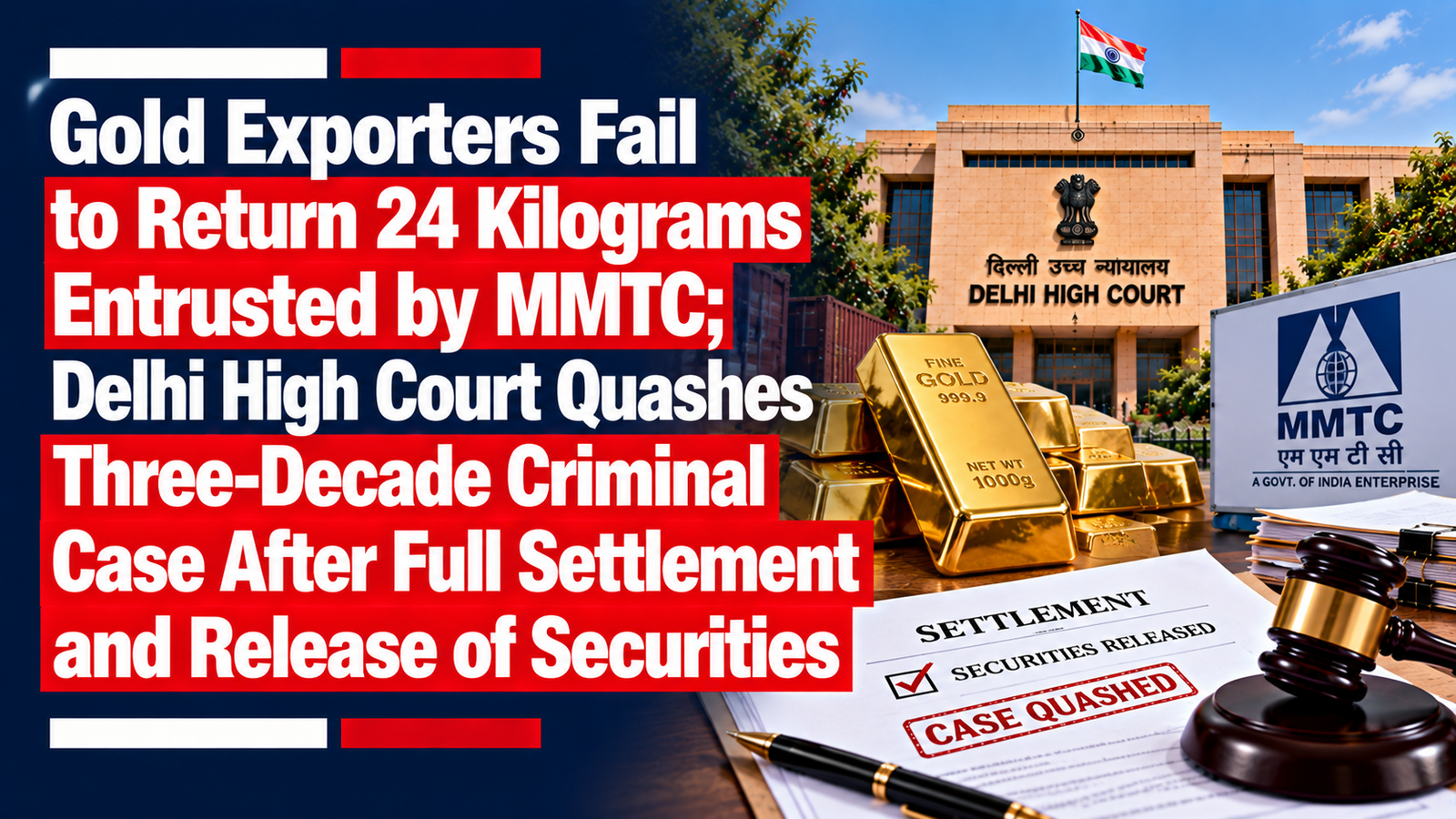
CBI Prosecutes Exporters for Unreturned MMTC Gold Since 1997; Delhi High Court Quashes Case After Settlement and Nearly Three Decades of Proceedings
Facts
The Delhi High Court decided two connected petitions filed by Akshay Jha and Vijay Kumar Jha under Section 482 CrPC, arising from the same CBI case, RC No. 2(A)/97-ACU.X, concerning transactions under MMTC’s Domestic Tariff Area Scheme. AKSHAY JHA
Under the applicable Exim Policy, MMTC and SBI could supply gold on loan to DTA associates for manufacture and export of jewellery. Firms belonging to the Balaji Group, including M/s Kamayani International and M/s Balaji Exports, entered into such arrangements with MMTC. AKSHAY JHA
Akshay Jha was proprietor of M/s Kamayani International. MMTC supplied it 51 kg of gold between April 1993 and June 1994. Of this, 43 kg was exported, while 8 kg remained unexported and was not returned. AKSHAY JHA
Vijay Kumar Jha was proprietor of M/s Balaji Exports. His firm received 105 kg of gold, of which 89 kg was exported and 16 kg remained unexported and unreturned. AKSHAY JHA
The CBI registered the RC on 18 November 1997, alleging criminal conspiracy and dishonest misappropriation of gold entrusted by MMTC. Separate charge-sheets were filed on 23 December 1999. AKSHAY JHA
Charges under Section 409 IPC, including Section 120B IPC, were ultimately framed/amended against the petitioners. AKSHAY JHA
Meanwhile, MMTC pursued contractual recovery proceedings, including arbitration. Eventually, MMTC’s Dispute Resolution Committee recommended ₹5,30,08,842 as full and final settlement of dues concerning four firms, including those of the petitioners. After an initial ₹50 lakh deposit, the balance ₹4,80,08,842 was paid. MMTC acknowledged full payment and released the security documents. AKSHAY JHA
Issues
The principal issue was whether continuation of the criminal prosecution for offences under Sections 409 and 120B IPC, arising from commercial transactions dating back to 1992–94, would serve any meaningful purpose after:
- MMTC had accepted full and final settlement;
- the entire settlement amount had been paid;
- collateral securities had been released;
- MMTC had no surviving monetary claim; and
- almost three decades had elapsed.
The Court also considered whether non-compoundable criminal proceedings could nevertheless be quashed under Section 482 CrPC following settlement of the underlying commercial dispute.
Petitioners’ Arguments
The petitioners emphasised that substantial quantities of the gold had actually been exported. Akshay Jha’s firm exported 43 out of 51 kg, while Vijay Kumar Jha’s firm exported 89 out of 105 kg. They argued that this conduct was inconsistent with a dishonest intention from inception. AKSHAY JHA
They also relied on the fact that the export period was reduced from 120 days to 45 days, after which requests for extension were repeatedly made to MMTC. Akshay Jha specifically relied upon correspondence dated 26 September 1995, 10 October 1995, 20 January 1996 and 3 March 1996. AKSHAY JHA
They contended that entrustment alone was insufficient for Section 409 IPC; there must also be material establishing dishonest misappropriation.
Similarly, the Section 120B allegation was challenged on the ground that there was no specific material showing an agreement or meeting of minds between the accused to commit an illegal act. AKSHAY JHA
The petitioners further argued that the dispute was fundamentally contractual and commercial. MMTC itself invoked arbitration and other contractual recovery mechanisms. AKSHAY JHA
Most importantly, the entire liability had subsequently been settled. MMTC accepted ₹5,30,08,842 as full and final settlement, released the collateral documents and recorded that nothing remained due. AKSHAY JHA
CBI’s Arguments
The CBI argued that the case was not merely a contractual dispute. Gold had been entrusted by MMTC for a specific purpose and part of it was neither exported nor returned.
It submitted that oral and documentary evidence had been collected, charge-sheets filed and charges framed. Whether the petitioners dishonestly misappropriated the gold and participated in a criminal conspiracy were questions for trial rather than adjudication under Section 482 CrPC. AKSHAY JHA
The CBI accepted that the entire monetary dispute was settled for ₹5.30 crore, but argued that settlement could not erase an alleged criminal offence, particularly where the offences were non-compoundable and concerned property of MMTC, a Government company. AKSHAY JHA
It also relied on a 2010 Delhi High Court order in a connected matter, where quashing had been refused despite repayment, considering the involvement of a Government company and public funds. AKSHAY JHA
Analysis of the Law
1. Section 482 Is Not a Mini-Trial
The High Court reiterated that Section 482 jurisdiction cannot ordinarily be used to appreciate evidence or conduct a mini-trial.
However, inherent jurisdiction remains available where, considering both the prosecution material and subsequent developments, continuation of proceedings would serve no useful purpose and would constitute an abuse of process. AKSHAY JHA
2. Substantial Performance Was Relevant
The Court carefully noted that this was not a case where the entire gold supplied by MMTC had allegedly disappeared.
Akshay Jha’s firm exported 43 of 51 kg, while Vijay Kumar Jha’s firm exported 89 of 105 kg. The Court clarified that this fact did not conclusively negate dishonest intention, but it remained relevant when examining the overall character of the transaction. AKSHAY JHA
The petitioners’ correspondence seeking extension after the export period was reduced from 120 to 45 days was also relevant to the allegation of dishonest intention, though the Court declined to adjudicate its evidentiary weight as if conducting a trial. AKSHAY JHA
3. Complete Settlement Was a Major Subsequent Development
The Court treated the subsequent settlement as particularly significant.
MMTC accepted ₹5,30,08,842 in full and final settlement, released the securities and specifically recorded, in relation to Balaji Exports, that nothing remained due. The CBI itself did not dispute the settlement. AKSHAY JHA
However, the Court did not formulate a rule that repayment automatically extinguishes criminal liability.
Rather, settlement was one factor in a cumulative assessment.
4. Quashing Is Different From Compounding
This is an important proposition from the judgment.
The Court held that the fact that an offence is non-compoundable does not by itself prevent the High Court from exercising Section 482 jurisdiction.
Compounding under Section 320 CrPC and quashing under Section 482 operate on conceptually distinct principles. AKSHAY JHA
Relying on Anand Kumar @ Sanjay Lalwani, the Court stated that in settlement cases the relevant questions include whether there remains a real likelihood of conviction and whether continuing the prosecution would constitute an abuse of process. AKSHAY JHA
5. Commercial and Financial Disputes Stand on a Different Footing
The entity allegedly suffering the monetary loss was MMTC.
Its relationship with the petitioners’ firms was governed by a commercial DTA arrangement containing dispute-resolution mechanisms. MMTC invoked those mechanisms, pursued arbitration and ultimately accepted full and final settlement of its claims. AKSHAY JHA
The Court relied upon Suresh C. Singal for the principle that criminal proceedings arising from transactions having an overwhelmingly civil or commercial character may be quashed where the underlying dispute has been completely resolved and continuing prosecution serves no useful purpose. AKSHAY JHA
6. Earlier Refusal to Quash Was Not an Absolute Bar
The CBI relied heavily on the Delhi High Court’s 15 March 2010 order refusing quashing in proceedings arising from the same RC.
The Court distinguished that order.
It held that the 2010 decision could not establish an absolute proposition that proceedings arising from this RC could never be quashed irrespective of later developments. The present petitions had to be considered in light of subsequent Supreme Court jurisprudence and the factual position existing in 2026. AKSHAY JHA
7. Government Company/Public Funds Do Not Create an Absolute Bar
The Court acknowledged that allegations involving public funds warrant greater caution.
But the mere fact that MMTC is a Government company does not make Section 482 jurisdiction unavailable.
The proper enquiry remains whether, considering the nature of the transaction, allegations, settlement, subsequent conduct and present prospects of meaningful prosecution, continuing the criminal case advances the administration of justice. AKSHAY JHA
8. Nearly Three Decades of Delay Became Material
The transactions dated from 1992–94, the RC was registered in 1997 and the charge-sheets were filed in 1999.
The Court expressly clarified that delay alone does not justify quashing a prosecution involving serious offences.
But an extraordinary lapse of almost three decades became relevant when combined with complete settlement and the absence of any surviving financial claim by MMTC. AKSHAY JHA
Precedent Analysis
Anand Kumar @ Sanjay Lalwani v. State of Madhya Pradesh
The Court treated this Supreme Court decision as particularly instructive. It distinguished statutory compounding from inherent quashing jurisdiction and focused on whether, after settlement, there remained a meaningful likelihood of conviction and whether continuing prosecution would amount to abuse of process. AKSHAY JHA
Suresh C. Singal v. State of Gujarat
Relied upon for the treatment of criminal proceedings arising from predominantly civil, commercial or financial transactions after settlement of the underlying liability.
The High Court did not mechanically apply Suresh C. Singal; it expressly recognised factual differences while adopting its broader principle concerning settlement, the character of the transaction, position of the aggrieved entity and likelihood of conviction. AKSHAY JHA
State of Haryana v. Bhajan Lal
Relied upon for the established principles governing exercise of inherent jurisdiction where continuation of criminal proceedings constitutes abuse of process.
Zandu Pharmaceutical Works Ltd. v. Mohd. Sharaful Haque
Relied upon alongside Bhajan Lal for the proposition that Section 482 jurisdiction may be exercised where allegations fail to disclose the necessary offence or continuation of proceedings becomes abusive. AKSHAY JHA
Court’s Reasoning
The Court did not quash the case merely because the petitioners paid MMTC.
Its reasoning was cumulative:
- substantial quantities of gold had actually been used for the intended export purpose;
- contemporaneous requests for extension were relevant to dishonest intention;
- the transactions were fundamentally commercial;
- MMTC pursued contractual remedies, including arbitration;
- the entire ₹5.30 crore settlement was paid;
- MMTC accepted the payment in full and final satisfaction;
- collateral securities were released;
- MMTC had no surviving monetary claim;
- the alleged transactions were more than three decades old; and
- continuing the prosecution was unlikely to serve a meaningful criminal-justice purpose.
The Court specifically held that this was not a case where an accused was simply attempting to “wash away” a criminal offence by making payment. The settlement was only one among several circumstances that materially altered the position since commencement of prosecution. AKSHAY JHA
Ultimately, continuation of proceedings after complete resolution of the MMTC dispute and almost three decades of delay was held to serve “little useful purpose.” AKSHAY JHA
Conclusion
The Delhi High Court allowed both petitions.
In Akshay Jha’s case, RC No. 2(A)/97-ACU.X, Charge Sheet No. 03/99 dated 23 December 1999 and all consequential proceedings were quashed.
Likewise, in Vijay Kumar Jha’s case, the same RC, Charge Sheet No. 02/99 and all consequential proceedings were quashed. AKSHAY JHA
Importantly, the Court expressly confined the relief to these petitioners and their particular circumstances, including the settlement and subsequent developments. AKSHAY JHA
Case Details
Case: Akshay Jha v. Central Bureau of Investigation & Anr. with Vijay Kumar Jha v. Central Bureau of Investigation & Anr.
Court: High Court of Delhi at New Delhi
Case Nos.: CRL.M.C. 3375/2023 and CRL.M.C. 3707/2023 AKSHAY JHA
Judge: Justice Madhu Jain AKSHAY JHA
Reserved: 14 September 2026
Pronounced: 29 September 2026 AKSHAY JHA
Result: Both petitions allowed; CBI RC, respective charge-sheets and all consequential criminal proceedings against Akshay Jha and Vijay Kumar Jha quashed.