Himachal Pradesh High Court Quashes FIR Against Protesters Who Tried to Save Teachers From Mob; Holds Mere Presence Cannot Establish Unlawful Assembly Liability

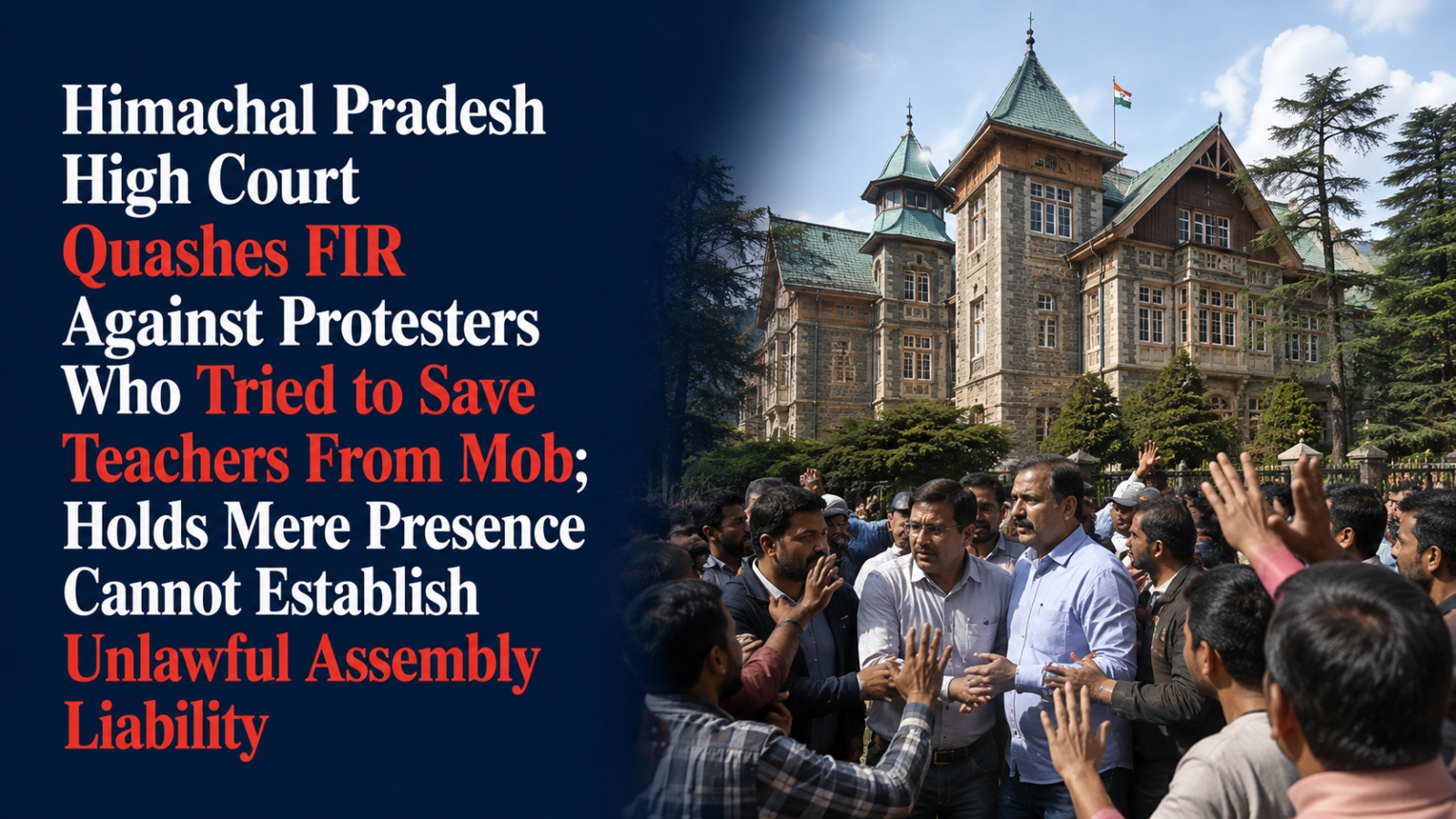
Himachal Pradesh High Court Says Bystanders Cannot Face Section 149 Liability Without Common Object; Quashes FIR Where Petitioners Helped Assaulted Teachers
Facts
The Himachal Pradesh High Court considered a petition filed by Dildar Ali Batt and others under Section 528 of the Bharatiya Nagarik Suraksha Sanhita, 2023, seeking quashing of FIR No. 82 of 2017 dated 29 July 2017, registered at Police Station Tissa, District Chamba, under Sections 452, 353, 332, 143, 147, 149, 504 and 506 IPC, along with the consequential criminal proceedings.
The controversy arose after allegations of sexual harassment of a female student by a teacher, Tek Chand, who had been taken into police custody. Residents of the area organised a protest march and proceeded towards Government Senior Secondary School, Khushinagar, Churah. Some members of the gathering subsequently became violent and allegedly assaulted teachers including Bhawani Sharma, Kesari Singh, Chatar Singh and Asha Kumari.
After investigation, the police filed a challan against several persons, including the petitioners. The petitioners admitted participating in the protest but maintained that they never assaulted the teachers and, in fact, attempted to save them from the violent members of the mob.
Issues
The principal issues before the Court were:
- Whether mere participation in a protest march was sufficient to make the petitioners members of an unlawful assembly under Sections 141 and 149 IPC.
- Whether the petitioners shared the common object of those members of the gathering who subsequently assaulted the teachers.
- Whether vicarious liability under Section 149 IPC could be imposed merely because the petitioners were present at the scene.
- Whether the complaint, statements under Section 161 CrPC and medical material disclosed any specific assault or overt conduct by the petitioners.
- Whether continuation of criminal proceedings despite the absence of material connecting the petitioners with the violence would amount to an abuse of process.
Petitioners’ Arguments
The petitioners argued that although Dildar Ali Batt and Parvej Ali Batt participated in the protest, the complainant’s own version showed that they were standing near the Sub-Divisional Magistrate and attempted to save the teachers from the mob.
As regards petitioner No. 3, Hasan Mohammad @ Harun, it was submitted that neither the original complaint nor the statements of the assaulted teachers attributed any role to him.
The petitioners also relied upon the medical material. According to them, the victims specifically identified persons who had assaulted them but did not name the petitioners as their assailants. They therefore argued that continuation of the prosecution would subject them to a prolonged trial despite extremely bleak prospects of conviction.
Respondent’s Arguments
The State opposed quashing.
It argued that the petitioners were admittedly participants in the protest march which ultimately resulted in violence and assaults upon the teachers. Therefore, according to the prosecution, their precise involvement and responsibility should be determined at trial.
The State further contended that deciding whether the petitioners themselves administered injuries would require appreciation of evidence and that quashing the proceedings at this stage would prematurely prevent the prosecution from establishing its case.
Analysis of the Law
Scope of Quashing Criminal Proceedings
The Court examined the principles governing the High Court’s inherent jurisdiction to quash criminal proceedings.
It referred to State of Karnataka v. L. Muniswamy for the principle that proceedings can be quashed where allowing them to continue would constitute an abuse of process or where quashing is necessary to secure the ends of justice.
The Court also considered State of Haryana v. Bhajan Lal and subsequent Supreme Court authorities concerning circumstances where criminal proceedings can legitimately be terminated at the threshold. The judgment reiterated that proceedings may be quashed where the allegations and supporting material do not disclose an offence or where continuation would amount to abuse of criminal process.
At the same time, the Court acknowledged the settled limitation that quashing jurisdiction must be exercised sparingly and ordinarily cannot become a substitute for a criminal trial.
Section 149 IPC: Mere Presence Is Insufficient
The central legal issue concerned constructive or vicarious liability under Section 149 IPC.
The High Court held that mere presence at the scene of an offence does not ipso facto make a person a member of an unlawful assembly.
For Section 149 liability to arise, the prosecution must establish that the person shared the unlawful assembly’s common object, or possessed the requisite knowledge that the offence was likely to be committed in prosecution of that object.
Thus, the crucial distinction was between:
- a participant sharing the unlawful common object; and
- a bystander, spectator or participant in an initially lawful gathering who did not associate himself with the subsequent violence.
Protest March and Violent Mob Were Not Automatically the Same
The Court considered this distinction particularly important because the gathering originated as a protest against the alleged sexual assault of a school-going girl.
Some members subsequently became violent and assaulted teachers.
However, that subsequent conduct could not automatically be attributed to every person who had originally participated in the protest.
The Court found no material showing that the petitioners knew that certain protesters intended to assault the school staff.
It stressed that the expression “knew” in the second limb of Section 149 requires something more than a possibility that violence might occur. Positive knowledge is necessary.
Petitioners’ Conduct Negated Common Object
The petitioners’ actual conduct was decisive.
The complaint itself recorded that Dildar Ali Batt and Parvej Ali Batt were standing near the Sub-Divisional Magistrate and attempted to save Bhawani Sharma and Kesari Singh from the persons assaulting them.
Rather than joining the violent elements, the Court found that the petitioners distanced themselves from the unruly mob and attempted to protect the school staff.
This conduct was fundamentally inconsistent with the allegation that they shared the common object of assaulting the teachers.
Victims Named Other Assailants
The Court also attached importance to the documentary and medical material.
The MLCs showed that the assaulted teachers specifically disclosed the names of persons who had allegedly beaten them. However, the petitioners were not identified as those assailants.
More significantly, Hasan Mohammad @ Harun was neither named in the complaint nor accused by any of the assaulted teachers of having beaten them.
Thus, the prosecution material itself did not provide a factual foundation for attributing the assaults to the petitioners.
Precedent Analysis
Zainul v. State of Bihar
The High Court placed substantial reliance upon the Supreme Court’s decision in Zainul v. State of Bihar.
The precedent reiterates that Section 149 creates constructive liability only where an offence is committed in prosecution of the common object of an unlawful assembly or where its members knew that such an offence was likely to be committed.
Importantly, it recognises the distinction between innocent bystanders/passive onlookers and actual members of an unlawful assembly. Mere presence does not establish membership unless the common object is shared.
Charan Singh v. State of U.P.
The Court relied upon Charan Singh and Others v. State of U.P., (2004) 4 SCC 205.
The Supreme Court held that Section 149 is founded upon constructive liability, but mere presence in an unlawful assembly does not make a person liable unless the common object is established and the accused was actuated by that object.
The common object must be inferred from matters such as the nature of the assembly, conduct of its members, surrounding circumstances and their behaviour at or near the scene.
Muthu Naicker v. State of Tamil Nadu
The judgment also referred to Muthu Naicker v. State of T.N. for the important caution that when large gatherings assemble during unusual incidents, some persons may be curious spectators rather than participants in an unlawful assembly.
Consequently, courts must exercise care before fastening collective criminal liability merely because an individual happened to be present in a crowd.
Masalti v. State of Uttar Pradesh
Masalti was considered for the rule of prudence applicable where a large number of persons are implicated in an incident involving a crowd.
The Court recognised the danger of innocent persons being swept into criminal prosecution merely because of their presence when numerous offenders and witnesses are involved.
Amerika Rai v. State of Bihar
The High Court also considered Amerika Rai and Others v. State of Bihar, (2011) 4 SCC 677.
That decision demonstrates that presence coupled with an active mind directed towards achieving the common object can attract Section 149 liability.
The High Court effectively contrasted that situation with the present case: here, the petitioners’ conduct—attempting to save the victims—pointed away from, rather than towards, participation in the violent common object.
Court’s Reasoning
The High Court found a fundamental disconnect between the admitted participation of the petitioners in the original protest and the prosecution’s attempt to make them vicariously liable for the violence that subsequently occurred.
The original object of the gathering was to protest against the alleged sexual assault of a school student. Some individuals subsequently became violent.
But the evidence did not show that the petitioners:
- shared the object of assaulting teachers;
- knew that such assaults were likely to occur;
- themselves assaulted any teacher; or
- encouraged or assisted the violent members.
To the contrary, the complainant’s own account showed Dildar Ali Batt and Parvej Ali Batt attempting to save the teachers.
The Court therefore concluded that their mere participation in the earlier protest could not justify fastening Section 149 IPC liability upon them.
Conclusion
The High Court found that the chances of conviction were very bleak and that no useful purpose would be served by permitting the prosecution to continue.
It specifically observed that although the petitioners had participated in the protest march, once the mob became unruly they distanced themselves from it and started helping the teachers and staff who were being assaulted.
Accordingly, FIR No. 82 of 2017 dated 29 July 2017, registered at Police Station Tissa, District Chamba under Sections 452, 353, 332, 143, 147, 149, 504 and 506 IPC, together with all consequential proceedings, was quashed and set aside qua the petitioners.
The petitioners were also acquitted of the charges framed against them, and the petition was allowed.
Case Details
Case: Dildar Ali Batt and Others v. State of H.P. and Another
Court: High Court of Himachal Pradesh, Shimla
Case Number: Cr.MMO No. 1092 of 2024
Judge: Justice Sandeep Sharma
Date: 20 July 2026
Result: Petition allowed; FIR and consequential proceedings quashed qua the petitioners; petitioners acquitted of the charges framed against them.