

Court’s decision
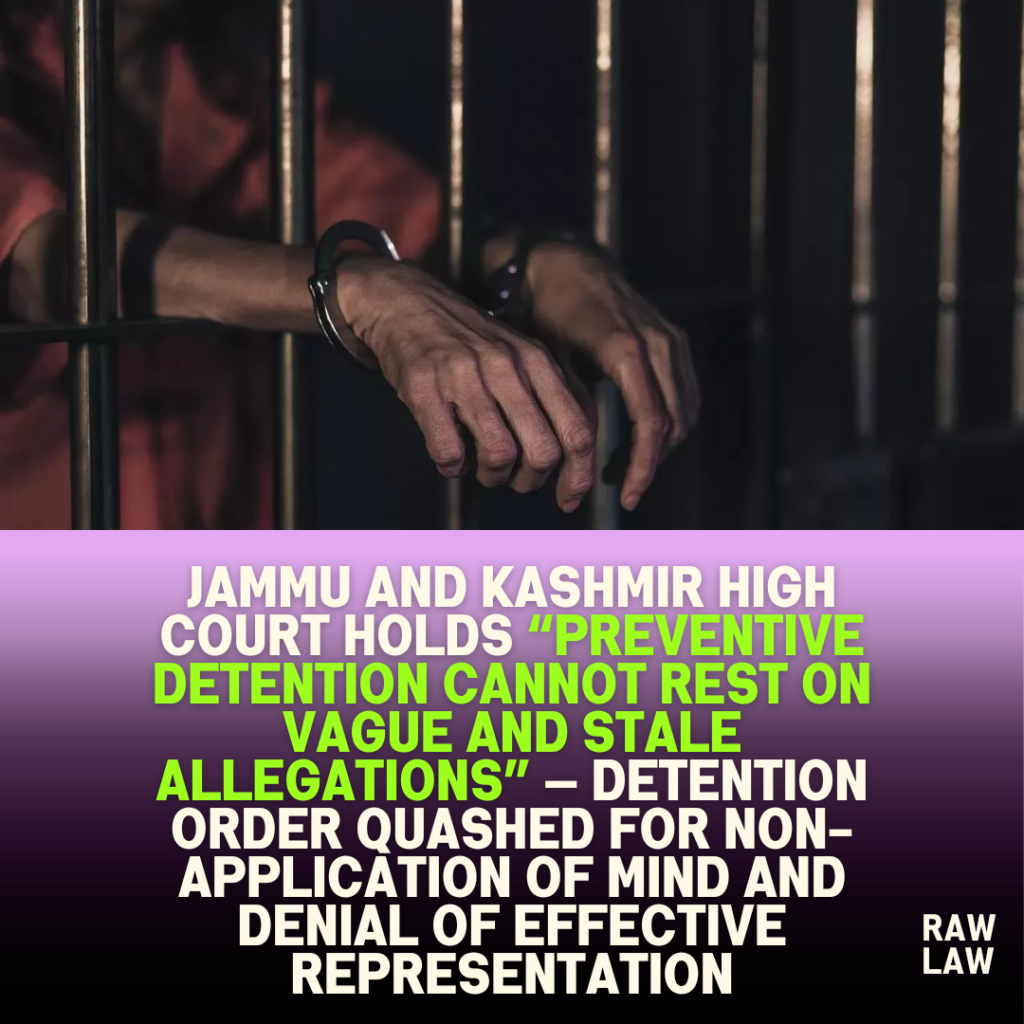
The Jammu and Kashmir High Court allowed the writ petition and quashed the preventive detention order, holding that the detaining authority failed to meet the constitutional and statutory safeguards governing preventive detention. The Court found that the grounds of detention were vague, relied on stale material, and did not disclose a live and proximate link between the alleged activities and the necessity for detention.
The Court further held that the detenue was denied an effective opportunity to make a meaningful representation, as the relied-upon material was either not supplied or supplied in an unintelligible manner. Such lapses, the Court held, strike at the root of the detention order. Consequently, the detention was declared illegal and the detenue was directed to be released forthwith, unless required in any other case.
Facts
The detenue was placed under preventive detention pursuant to an order issued by the competent authority on the premise that his activities were allegedly prejudicial to public order and security. The detention order was founded on past incidents and generalized allegations recorded in the grounds of detention.
Upon execution of the order, the detenue challenged the detention before the High Court, contending that the grounds were vague, that relevant documents relied upon by the detaining authority were not furnished, and that the allegations were stale and unrelated to any immediate necessity for preventive detention.
It was further contended that ordinary law was sufficient to address the alleged conduct and that preventive detention was resorted to mechanically, without application of mind to less intrusive alternatives.
Issues
Whether a preventive detention order can be sustained on vague and stale allegations.
Whether failure to supply relied-upon material vitiates the right to make an effective representation.
Whether absence of a live and proximate link between past conduct and detention invalidates the order.
Whether non-application of mind by the detaining authority renders detention unconstitutional.
Petitioner’s Arguments
The petitioner contended that the grounds of detention were couched in generic language and failed to specify concrete acts necessitating preventive detention. It was argued that the alleged incidents were old and did not establish any immediate threat warranting detention.
The petitioner further submitted that vital documents and materials referred to in the grounds were not supplied, thereby depriving the detenue of the constitutional right to make an effective representation. It was argued that such non-supply vitiates the detention order in its entirety.
It was also contended that the detaining authority failed to consider whether ordinary criminal law could adequately address the allegations, demonstrating clear non-application of mind.
Respondent’s Arguments
The State contended that the detention order was passed after due consideration of material placed before the detaining authority and that preventive detention was necessary to prevent future prejudicial activities.
It was argued that minor omissions in supply of documents do not automatically vitiate the detention, particularly when the detenue was aware of the allegations. The State further contended that subjective satisfaction of the detaining authority should not be lightly interfered with by the Court.
Analysis of the law
The High Court examined the constitutional framework governing preventive detention and reiterated that such laws, being an exception to personal liberty, must be strictly construed. The Court emphasised that the detaining authority must demonstrate a live and proximate link between the alleged activities and the necessity for detention.
The Court further held that supply of relied-upon material is not a procedural formality but a substantive safeguard ensuring the detenue’s right to representation. Any failure in this regard renders the detention unconstitutional.
The Court also underscored that preventive detention cannot be used as a substitute for ordinary criminal process, and authorities must demonstrate why less restrictive measures are inadequate.
Precedent Analysis
The Court relied on Supreme Court and High Court precedents holding that vague grounds and stale incidents cannot sustain preventive detention. It applied established jurisprudence that denial of relied-upon documents vitiates detention.
Judgments emphasising strict scrutiny of subjective satisfaction and the requirement of a live link were relied upon to invalidate the impugned order.
Court’s Reasoning
The Court found that the grounds of detention lacked specificity and were based on incidents too remote in time to justify preventive detention. It noted that the detaining authority failed to explain why ordinary law was insufficient.
The Court further held that non-supply of material documents deprived the detenue of an effective opportunity to make a representation, violating constitutional safeguards. These infirmities, the Court held, were fatal to the detention order.
Conclusion
The High Court quashed the preventive detention order and directed immediate release of the detenue, subject to lawful custody in any other case.
Implications
This judgment reinforces the high threshold required for preventive detention and reiterates judicial vigilance in protecting personal liberty. It sends a clear message that preventive detention cannot be sustained on vague allegations or procedural shortcuts.


