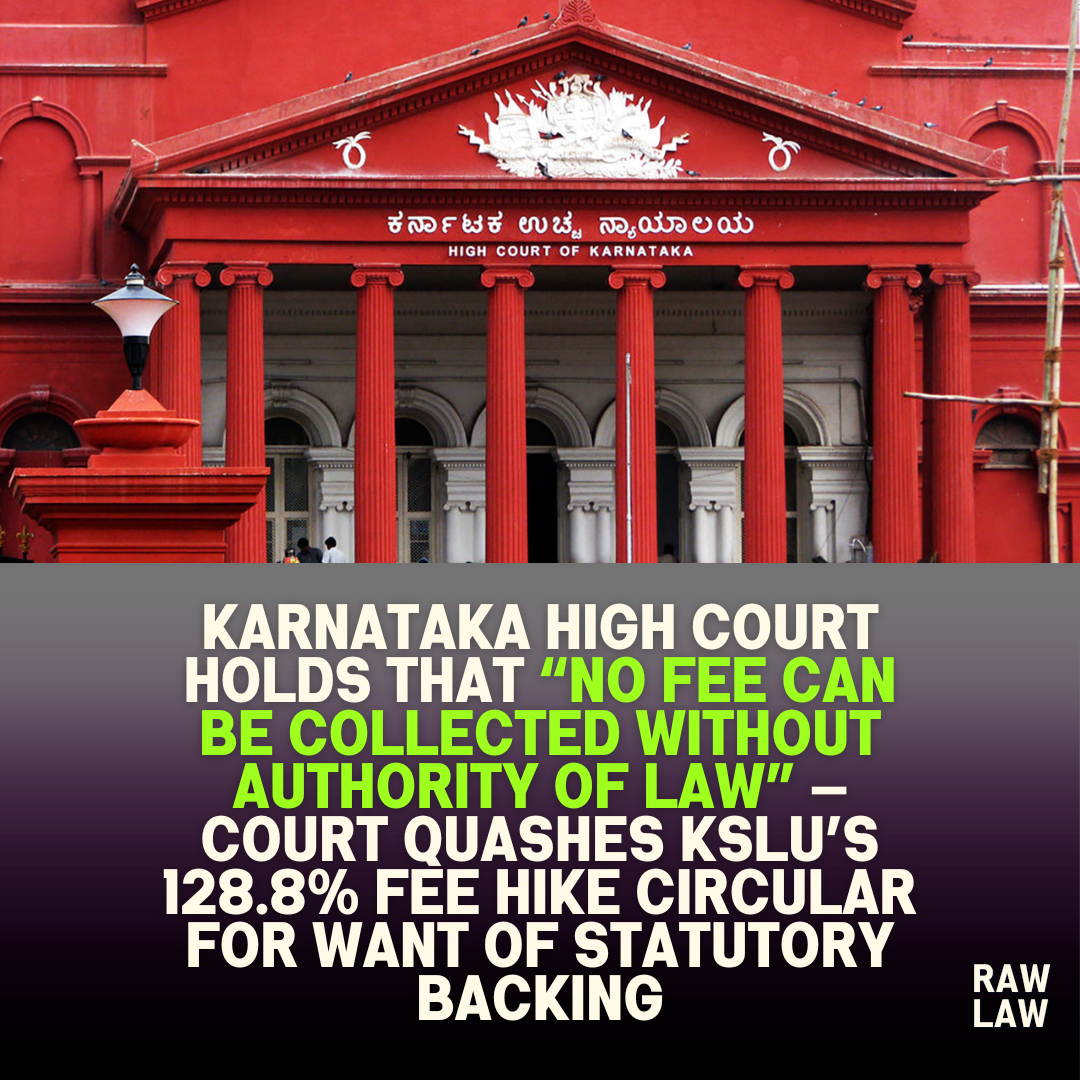
Karnataka High Court holds that “no fee can be collected without authority of law” — Court quashes KSLU’s 128.8% fee hike circular for want of statutory backing

Court’s decision
The Karnataka High Court, per Justice R. Devdas, allowed a batch of writ petitions filed by law students challenging the Karnataka State Law University’s circular dated 02.07.2025, which enhanced registration fees by 128.8%. The Court held that although Section 5 of the Karnataka State Law University Act, 2009 empowers the University to demand fees, such power can be exercised only when supported by Statutes, Regulations or Ordinances, which the University failed to produce. The Court ruled that the impugned circular, despite being approved by the Academic Council and Vice-Chancellor, lacked the legally required foundational authority.
The Court emphasized that Article 265 of the Constitution prohibits collection of any fee without authority of law, and the University’s drastic fee enhancement was unsupported by statutory instruments. It also noted that no material showed the existence of any Statute governing fee collection, nor any demonstration of quid pro quo or justification for the steep increase. Consequently, the Court quashed the circular and directed the University to refund all excess fees collected, irrespective of whether the affected students were petitioners.
Facts
The Petitioners were students enrolled in various law programmes under the Karnataka State Law University (KSLU). In the academic year 2025-26, KSLU issued a circular sharply increasing the registration fee from ₹3,700 to ₹8,580. Students immediately raised objections, asserting that the University had no statutory authority to impose such substantial enhancement. They contended that Section 5 of the Act required the University to regulate fee collection strictly through Statutes, Regulations, or Ordinances, which were admittedly absent.
The University defended the circular on the ground that the Academic Council approved it in its 37th meeting, following which the Vice-Chancellor granted approval. Since students had paid fees in prior years, the University argued that they were estopped from challenging the enhancement. Unsatisfied with this justification, the Petitioners approached the High Court seeking quashing of the circular and refund of excess fees.
Issues
The Court considered the following issues:
- Whether the University could enhance registration fees without support of Statutes, Regulations, or Ordinances under Section 5 of the Act.
- Whether approval of the Academic Council and Vice-Chancellor sufficed to validate a fee-enhancing circular.
- Whether Article 265 of the Constitution applies to fee collection by a statutory University.
- Whether the steep 128.8% fee increase was lawful absent demonstration of quid pro quo.
- Whether excess fees collected must be refunded to all students or only to the Petitioners.
Petitioners’ arguments
The Petitioners argued that Section 5 of the Act merely grants enabling power, but actual levy of fees requires express prescription through Statutes, Regulations, or Ordinances. Since KSLU failed to produce any such instrument, the circular stood on no legal footing. They invoked Article 265, asserting that “authority of law” is mandatory even for fee collection. They maintained that the increase of 128.8% was arbitrary, disproportionate, and unsupported by any reasoning or quid pro quo.
They further contended that approval of the Academic Council could never substitute the statutory mandates of Section 5. The Petitioners pointed out that no analysis, financial justification, or service-linked enhancement was reflected in the circular, rendering it unsustainable. They sought quashing and refund of all excess fee collected.
Respondents’ arguments
The Respondent-University argued that the Academic Council had the power to make regulations relating to courses of study and that the Vice-Chancellor’s approval rendered the circular valid. They relied on Section 34(2)(ii), asserting that Academic Council decisions could regulate aspects not covered by Ordinances. They also referred to Section 30(xxiii), which empowers the Syndicate to prescribe fees.
The University contended that students had previously paid fees without objection and therefore could not now challenge the enhancement. It maintained that the circular was issued after due deliberation and fell within the permissible administrative domain of University governance.
Analysis of the law
The Court examined Section 5 of the Act, emphasizing that fee collection must strictly adhere to “Statutes, Regulations, and Ordinances” contemplated by the Act. Since KSLU failed to produce any such document, its authority to levy the enhanced fees stood unproven. The Court further applied Article 265 to hold that even fee collection—not merely taxation—requires valid authority.
The Court rejected the contention that Academic Council approval could override statutory requirements. A circular, however well-intentioned, cannot substitute a Statute or Regulation. The Court reiterated that any levy must be accompanied by quid pro quo and transparency, neither of which was demonstrated by the University. Thus, the circular was found ultra vires.
Precedent analysis
Though the judgment did not cite specific case names, it relied on well-established principles from Supreme Court jurisprudence:
• Fee is distinct from tax but still requires statutory backing.
• Administrative convenience cannot override constitutional or statutory mandates.
• Public authorities must demonstrate quid pro quo when collecting fees.
• Actions without statutory authority are void ab initio.
The High Court applied these principles to underscore that Universities functioning under a statute cannot bypass procedural requirements while imposing financial burdens on students.
Court’s reasoning
Justice R. Devdas reasoned that KSLU’s circular failed the primary test of legality because it lacked any statutory framework. The Court observed that Section 5 empowers the University to demand fees, but that power is conditional upon existence of Statutes, Regulations, or Ordinances prescribing such fees. Since none existed, the University’s reliance on Academic Council approval was insufficient.
The Court further held that the increase of 128.8% was unreasonable, arbitrary, and unsupported by material demonstrating necessity or justification. The absence of quid pro quo reinforced the circular’s infirmity. The Court concluded that the Petitioners’ grievance was valid, and that the University acted without authority of law in demanding higher fees.
Conclusion
The High Court quashed the impugned circular and ordered refund of all excess fees collected from students across the University. It directed the Respondent to complete the refund process within two months of receiving the order. The decision underscores that statutory Universities must adhere strictly to legal frameworks and cannot impose financial burdens through administrative circulars unsupported by legislation.
Implications
This judgment has far-reaching implications for all statutory educational institutions in Karnataka. It reinforces the constitutional requirement that no fee can be collected without explicit statutory authority. The ruling ensures protection of students from arbitrary and excessive fee hikes. It also compels Universities to maintain transparency, accountability, and statutory compliance. Institutions must henceforth enact proper Statutes or Regulations before issuing fee-related circulars, failing which such actions will be liable to be struck down.