

HEADNOTE
Neelgiri Machinery through its Proprietor Mrs. Asha Devi v. Commissioner, Delhi Goods and Service Tax & Ors.
Court: High Court of Delhi
Bench: Justice Prathiba M. Singh and Justice Shail Jain
Date of Judgment: 10 December 2025
Citation: W.P.(C) 2727/2025
Laws / Sections Involved: Article 226 Constitution of India; Section 168A CGST Act, 2017; Section 73 CGST Act; Section 107 CGST Act
Keywords: GST limitation, Section 168A CGST, show cause notice, appellate remedy, High Court writ jurisdiction
Summary:
The Delhi High Court disposed of a writ petition filed by Neelgiri Machinery challenging a GST show cause notice, adjudication order, and the constitutional validity of extension notifications issued under Section 168A of the CGST Act. Taking note of conflicting High Court judgments and the pendency of the issue before the Supreme Court, the Court refrained from ruling on the vires of the notifications. Instead, it permitted the petitioner to avail the statutory appellate remedy under Section 107 of the CGST Act, directing that the appeal be entertained without limitation if filed within the stipulated time. The Court balanced judicial discipline with taxpayer rights, ensuring access to appellate remedies while keeping the outcome subject to the Supreme Court’s final decision.
Court’s decision
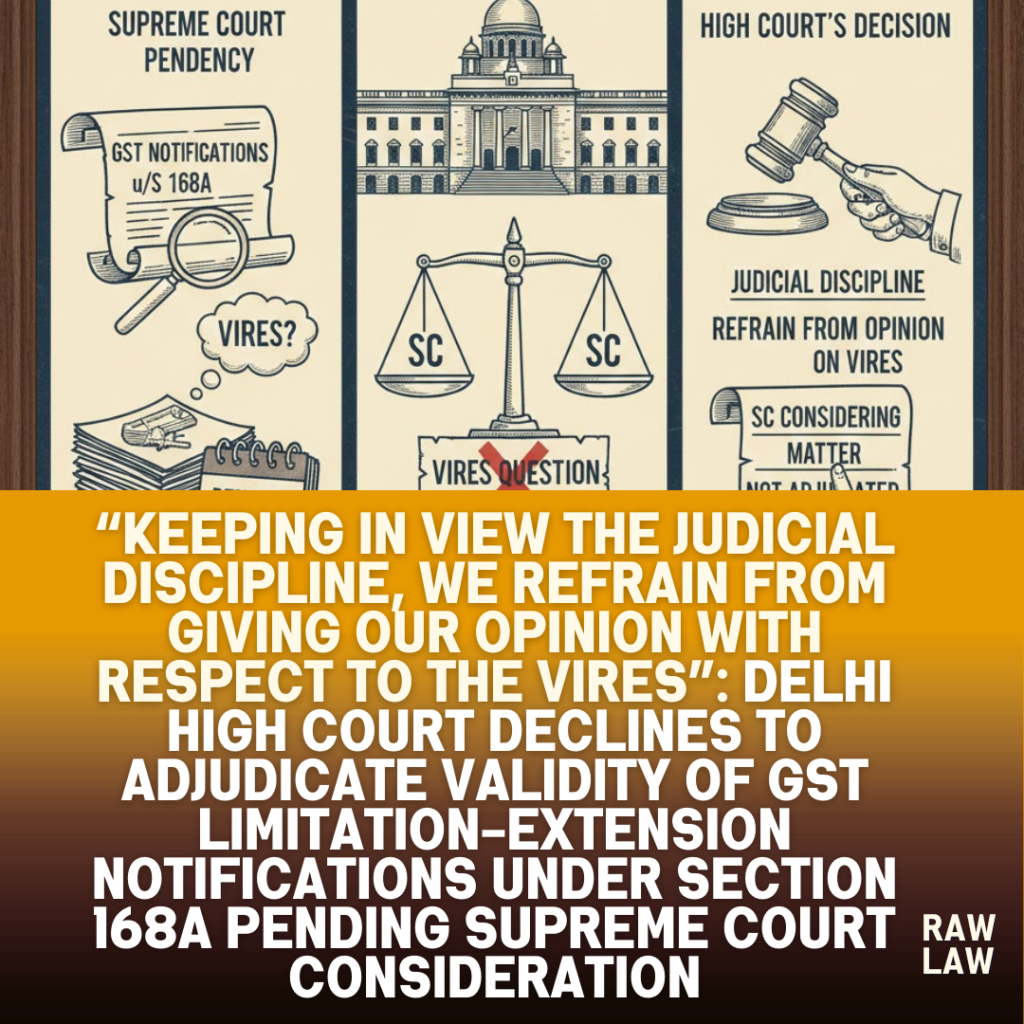
The Delhi High Court disposed of the writ petition by granting liberty to the petitioner to file a statutory appeal under Section 107 of the Central Goods and Services Tax Act, 2017. The Court declined to rule on the constitutional validity of the impugned notifications extending limitation for adjudication, noting that the issue was already pending consideration before the Supreme Court. It directed that if the appeal is filed within the prescribed extended timeline, it shall not be treated as barred by limitation and must be adjudicated on merits. The decision of the appellate authority was made expressly subject to the outcome of the pending Supreme Court proceedings.
Facts
Neelgiri Machinery, a proprietary concern, was issued a show cause notice dated 11 December 2023 by the GST Department for the tax period April 2018 to March 2019. The notice was issued pursuant to notifications extending limitation under Section 168A of the CGST Act. Subsequently, an adjudication order dated 30 April 2024 was passed by the Sales Tax Officer raising tax demands against the petitioner. Aggrieved, the petitioner approached the Delhi High Court under Article 226, challenging not only the show cause notice and adjudication order but also the constitutional validity of multiple Central and State notifications that extended statutory timelines for adjudication.
Issues
The principal issues before the Court were whether the impugned notifications extending limitation under Section 168A of the CGST Act were validly issued, and whether adjudication orders passed pursuant to such extensions could be sustained. A connected issue was whether the High Court should exercise writ jurisdiction to decide the validity of the notifications when the same question was already pending before the Supreme Court and different High Courts had taken divergent views. Additionally, the Court considered whether relief could be granted to the petitioner without entering into the vires of the notifications.
Petitioner’s arguments
The petitioner contended that the impugned show cause notice and adjudication order were barred by limitation and could not be sustained in law. It was argued that Section 168A mandates prior recommendation of the GST Council before extending timelines, and that certain notifications were either issued without such recommendation or were ratified retrospectively, rendering them ultra vires. The petitioner relied on judgments of High Courts that had struck down or questioned the validity of similar notifications. It was further submitted that the adjudication order was passed mechanically, depriving the petitioner of effective opportunity and causing serious prejudice.
Respondent’s arguments
The GST Department opposed the writ petition and submitted that the impugned notifications were validly issued under statutory authority. It was argued that the petitioner had, in fact, filed a reply to the show cause notice, which was duly considered before passing the adjudication order. The respondents pointed out that multiple High Courts had upheld the validity of the extension notifications and that the matter was sub judice before the Supreme Court. In such circumstances, it was urged that the petitioner be relegated to the statutory appellate remedy instead of invoking writ jurisdiction.
Analysis of the law
The Court examined the scheme of Section 168A of the CGST Act, which empowers the Government to extend timelines in extraordinary circumstances upon recommendation of the GST Council. It noted that the provision and the notifications issued thereunder have been the subject of extensive litigation across the country. The Court emphasised that when conflicting judicial opinions exist and the issue is seized of by the Supreme Court, principles of judicial discipline require High Courts to exercise restraint. At the same time, the Court recognised that taxpayers should not be left remediless merely due to pendency of constitutional challenges.
Precedent analysis
The Court referred to a batch of petitions led by DJST Traders Pvt. Ltd. v. Union of India, where similar challenges were raised. It noted divergent views of the Allahabad, Patna, and Gauhati High Courts on the validity of limitation-extension notifications. The Court also took note of the Telangana High Court’s observations and the fact that the Supreme Court had issued notice in M/s HCC-SEW-MEIL-AAG JV v. Assistant Commissioner of State Tax. Further reference was made to orders of the Punjab and Haryana High Court, which chose to dispose of matters subject to the Supreme Court’s final decision.
Court’s reasoning
The Bench reasoned that since the petitioner had already filed a reply to the show cause notice and an adjudication order had been passed, the appropriate course was to permit the petitioner to pursue the statutory appellate remedy. The Court held that deciding the vires of the notifications at this stage would risk inconsistency and undermine judicial discipline. At the same time, it sought to ensure that the petitioner’s right to appeal was not defeated by technical limitation. Accordingly, a balanced approach was adopted by preserving the petitioner’s appellate rights while keeping all issues open.
Conclusion
The Delhi High Court disposed of the writ petition without adjudicating on the validity of the impugned GST notifications. Liberty was granted to the petitioner to file an appeal under Section 107 of the CGST Act by the stipulated date, with a direction that the appeal shall be entertained on merits without being rejected on limitation grounds. The appellate authority was directed to decide the appeal expeditiously, and all findings were made subject to the final outcome of the Supreme Court proceedings on the validity of Section 168A notifications.
Implications
This judgment reflects a pragmatic and institutionally cautious approach adopted by the Delhi High Court in GST litigation involving nationwide implications. It underscores the Court’s reluctance to decide constitutional questions already pending before the Supreme Court, while simultaneously protecting taxpayer rights through procedural safeguards. The ruling provides a clear pathway for assessees facing adverse adjudication orders under extended limitation periods, ensuring access to appellate remedies without prejudice. It also signals that final clarity on Section 168A will ultimately emerge from the Supreme Court.
CASE LAW REFERENCES
• DJST Traders Pvt. Ltd. v. Union of India – Lead matter challenging GST limitation-extension notifications
• M/s HCC-SEW-MEIL-AAG JV v. Assistant Commissioner of State Tax – Supreme Court seized of Section 168A validity
• Engineers India Limited v. Union of India – Delhi High Court examining State GST notifications
FAQs
Q1. Did the Delhi High Court uphold the validity of GST limitation-extension notifications?
No. The Court refrained from deciding their validity as the issue is pending before the Supreme Court.
Q2. What relief was granted to the taxpayer?
The petitioner was allowed to file a statutory GST appeal without being barred by limitation.
Q3. Is the appellate decision final?
No. The appellate authority’s decision will be subject to the Supreme Court’s final ruling on Section 168A.


