Kerala High Court Denies Bail to Father Accused of Sexually Assaulting Minor Daughter; Holds Mother Cannot Compromise Incestuous POCSO Offences or Stifle Prosecution

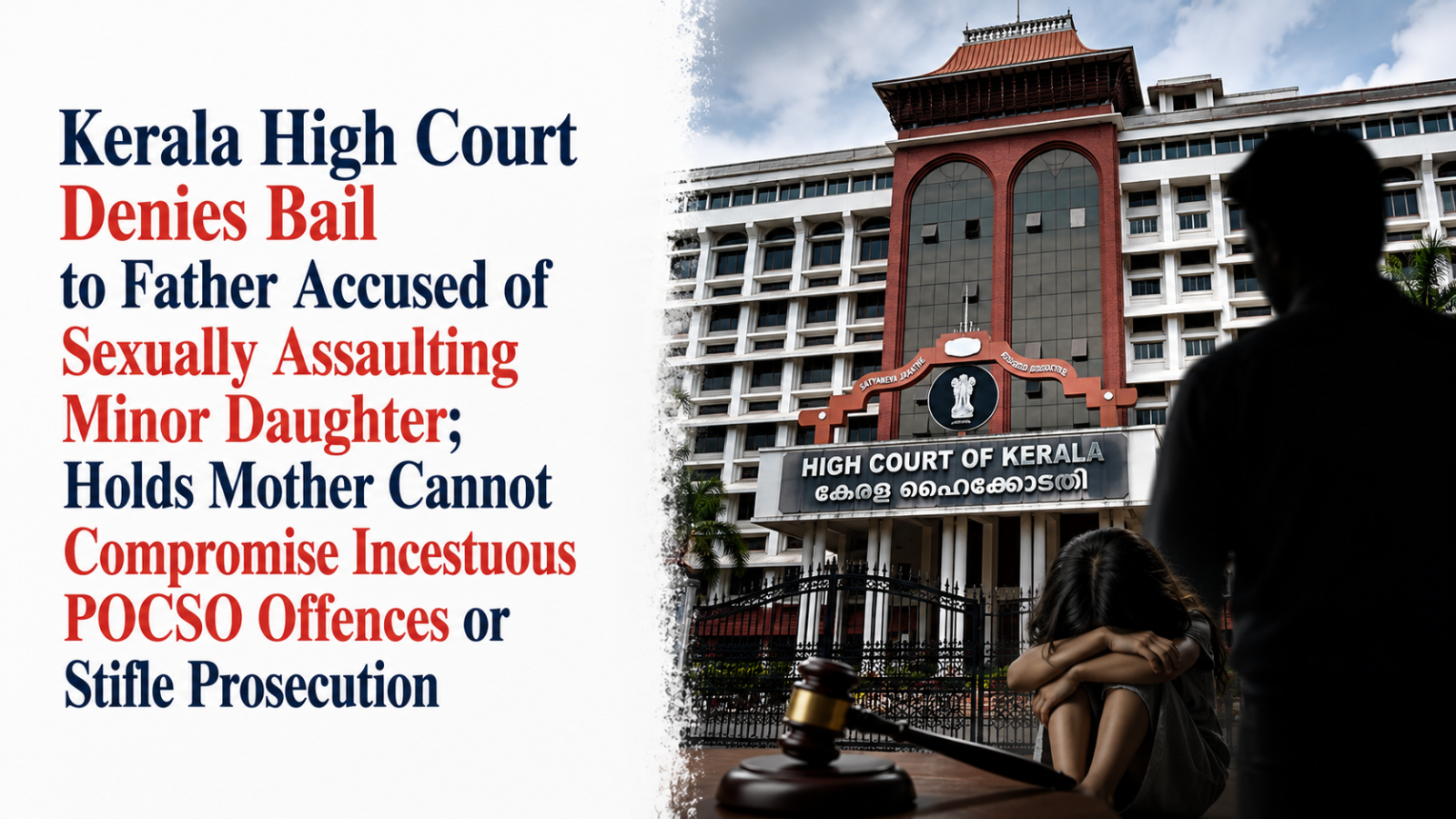
Kerala High Court Holds Parens Patriae Jurisdiction Requires Protection of Minor Sexual Assault Victims Even Where Parents Seek Settlement With Accused
Facts
The Kerala High Court considered the second application for regular bail filed by Shiju under Section 483 of the Bharatiya Nagarik Suraksha Sanhita, 2023. He was the sole accused in Crime No. 354/2026 of Chalakkudy Police Station, Thrissur, involving offences under Sections 10, 9(l), 9(n), 12 and 11(i) of the Protection of Children from Sexual Offences Act, 2012.
The prosecution alleged that the applicant, who is the father of the 17-year-old victim, sexually assaulted her on multiple occasions. On 10 April 2026, he allegedly touched her thighs with sexual intent, and during February and March 2026 he allegedly touched her breast and made sexually coloured remarks.
The applicant had been in judicial custody since 17 April 2026.
His earlier bail application had already been rejected. In the present second application, he relied substantially on a subsequent settlement with the victim’s mother, who filed an affidavit stating that the matter had been settled and that the victim had no objection to grant of bail.
Issues
The principal issues before the Court were:
- Whether a subsequent settlement between the accused father and the victim’s mother constituted a changed circumstance justifying regular bail.
- Whether the mother or guardian of a minor victim can compromise or withdraw allegations concerning incestuous sexual assault under the POCSO Act.
- Whether a no-objection affidavit by the mother could dilute the seriousness of the accusations.
- Whether the Court’s parens patriae jurisdiction required it to independently protect the interests of the minor despite the parent’s position.
- Whether the gravity of the allegations and the father-daughter relationship justified continued detention.
Petitioner’s Arguments
The applicant argued that he was innocent and had been falsely implicated.
His counsel submitted that there was no material connecting him with the alleged offences and that he was therefore entitled to bail.
The principal new circumstance relied upon was that, after dismissal of the first bail application, the dispute had allegedly been settled between the applicant and the victim’s mother.
The mother had expressed willingness for bail to be granted and had filed an affidavit stating that the victim did not wish to pursue the matter further.
Respondent’s Arguments
The prosecution opposed bail.
The learned Senior Public Prosecutor argued that the alleged acts were intentional criminal conduct and that the applicant was not entitled to bail at that stage.
The State maintained that the alleged sexual assault of a minor by her own father was grave and could not be neutralised by a subsequent family arrangement.
Analysis of the Law
Allegations Were Grave and Prima Facie Serious
The High Court described the case as involving the tragic plight of a 17-year-old girl allegedly subjected to repeated sexual exploitation by her own father.
It found that the accusations were grave and prima facie disclosed a premeditated criminal act.
The victim had given a statement narrating how she was allegedly subjected to sexual assault by the applicant.
The Court also noted that the first bail application had earlier been dismissed considering:
- the nature of the crime;
- the gravity of the allegations; and
- the relationship between the accused and the victim.
Mother’s Settlement Was Legally Ineffective
The central issue was the affidavit filed by the victim’s mother.
The affidavit stated that the matter had been settled between the applicant and the victim and that the victim did not wish to prosecute further or object to bail.
The High Court, however, found a crucial omission: the mother did not say that the alleged incident had never occurred.
Her entire case rested on a subsequent compromise.
That distinction was decisive.
POCSO Sexual Offences Against Minors Are Non-Compoundable
The Court held that offences involving sexual assault of a minor are not compoundable.
It relied upon Vishnu v. State of Kerala, 2023 (3) KLT 754 for the proposition that parents or guardians cannot compromise, withdraw, or give a binding no-objection in respect of an incestuous sexual assault prosecution involving a minor.
Accordingly, the mother could not legally settle the case against the father for the alleged sexual harassment or sexual assault of their minor daughter.
Out-of-Court Settlement Cannot Stifle Child Sexual Offence Prosecution
The Court went further and held that any compromise or out-of-court settlement entered into by the parents of a minor victim with the object of stifling the criminal prosecution cannot receive legal sanction.
Such an arrangement cannot override the State’s independent duty to prosecute offences committed against children.
Thus, the existence of a family settlement could not operate as a legitimate ground for bail in the circumstances.
Parens Patriae Duty of the Court
The judgment places considerable emphasis on the Court’s parens patriae jurisdiction.
The High Court held that courts have a bounden duty to safeguard the rights and welfare of minor victims of sexual assault even when the parents themselves fail to protect those interests.
This means that a parent’s consent, compromise or willingness to support the accused cannot substitute the Court’s independent obligation to protect the minor.
Precedent Analysis
Vishnu v. State of Kerala, 2023 (3) KLT 754
This was the principal precedent relied upon.
The Court applied Vishnu for the proposition that in cases involving incestuous sexual assault upon a minor, parents or guardians cannot legally:
- compromise the offence;
- withdraw the prosecution;
- give a binding no-objection; or
- neutralise the prosecution merely by supporting bail.
The rationale is that such offences are not private disputes between family members. They implicate the statutory protection of children and the State’s obligation to prosecute sexual offences against minors.
Court’s Reasoning
The Court found that the only significant development after rejection of the earlier bail application was the mother’s attempt to settle the matter.
That development did not favour the accused.
Instead, the Court considered it troubling that the person who had initially lodged the complaint was now seeking to compromise a serious allegation involving her minor daughter.
The Court observed that the mother had chosen to settle the matter without denying that the alleged incident had occurred.
Since the offence was non-compoundable, the settlement carried no legal weight.
The Court therefore held that the compromise could neither diminish the seriousness of the accusation nor justify release on bail.
Conclusion
The Kerala High Court held that the compromise relied upon by the applicant could not be accepted.
Considering the gravity of the allegations, the father-daughter relationship and the non-compoundable nature of the POCSO offences, the Court found no ground to release the applicant on bail.
The second regular bail application was accordingly dismissed.
Case Details
Case: Shiju v. State of Kerala & Ors.
Court: High Court of Kerala at Ernakulam
Case Number: Bail Application No. 4130 of 2026; Crime No. 354/2026, Chalakkudy Police Station, Thrissur
Judge: Dr. Justice Kauser Edappagath
Date: 3 August 2026
Result: Second regular bail application dismissed; mother’s compromise and no-objection held legally ineffective in an incestuous POCSO case involving a minor victim.