

Court’s decision
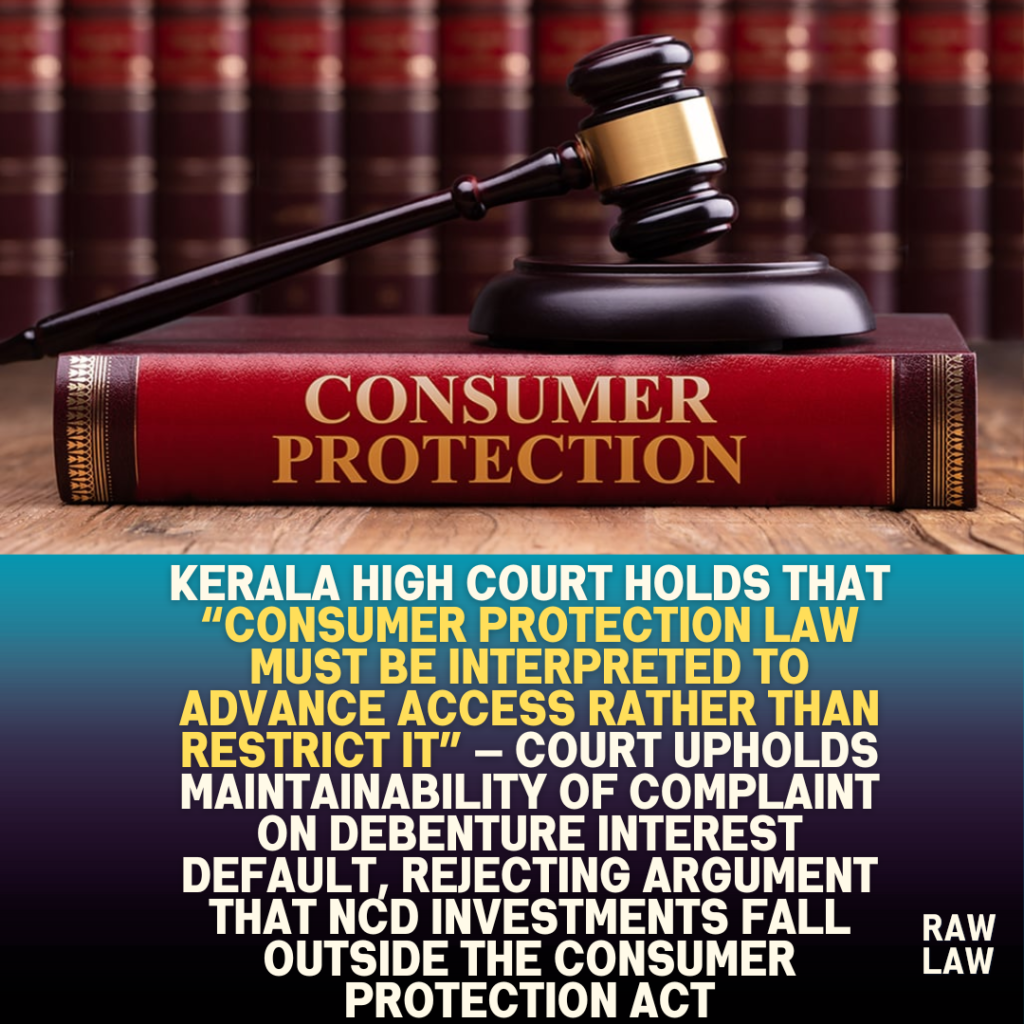
The Kerala High Court dismissed a writ petition filed by the Petitioner, who challenged orders of the District and State Consumer Commissions holding that a complaint concerning non-payment of interest under a non-convertible debenture (NCD) scheme was maintainable before the Consumer Commission. The Court found that the District Commission had correctly treated the transaction as a “service” under Section 2(42) of the Consumer Protection Act, 2019, and had rightly concluded that an individual investor availing a financial return scheme falls within the definition of “consumer” under Section 2(7).
The Court rejected the Petitioner’s argument that the investment constituted a commercial activity. It examined precedent, including Annapurna B. Uppin, AD Bureau Advertising, and Shrikant G. Mantri, and held that those cases involved investments made by entities or persons engaged in commercial activities, unlike the present case where the investment was made individually.
The Court also relied on Supreme Court decisions such as Standard Chartered Bank v. Dr. B.N. Raman, Vodafone Idea Cellular Ltd. v. Ajay Kumar Agarwal, Laxmi Engineering Works, Daimler Chrysler (India) Pvt. Ltd., and Lilavati Kirtilal Mehta Medical Trust. Based on these precedents, the Court reaffirmed that consumer law must be interpreted liberally to accommodate individuals seeking financial protection rather than exclude them through narrow readings of “commercial purpose.”
Accordingly, the writ petition was dismissed. However, the Court granted a ten-day protective period, keeping proceedings before the District Commission in abeyance to allow the Petitioner time to seek appellate remedies.
Facts
The Petitioner was the opposite party in a consumer complaint filed before the District Consumer Commission alleging deficiency of service relating to the payment of interest on NCDs issued by a financial company. The complainant, referred to as the Respondent, alleged that interest payments due under the agreed terms had not been disbursed. The Petitioner raised a preliminary objection asserting that the Respondent could not be considered a “consumer” under the Consumer Protection Act, arguing that NCDs neither constituted “goods” nor “services.”
The District Commission initially proceeded to decide the complaint without adjudicating the preliminary issue, prompting the Petitioner to file a writ petition. The High Court directed the Commission to decide the question of maintainability first. The District Commission later ruled that the complaint was maintainable, and this finding was affirmed by the State Commission. The Petitioner then filed the present writ petition challenging both orders and asserting that the transaction lacked consumer character.
Issues
The central issue was whether the purchase of non-convertible debentures and the entitlement to receive interest constituted “service” under Section 2(42) of the Consumer Protection Act, 2019. The Court also examined whether the individual investor could be excluded from the definition of “consumer” on the ground that the investment was motivated by profit and therefore amounted to a “commercial purpose.” A further issue was whether the lower Commissions correctly interpreted statutory provisions and precedent while determining maintainability.
Petitioner’s arguments
The Petitioner contended that the Respondent did not qualify as a consumer because the transaction involved purchase of financial instruments rather than hiring of services. According to the Petitioner, NCDs cannot be treated as “goods,” and even if considered a form of “service,” the transaction was undertaken for profit and therefore amounted to a commercial activity excluded under Section 2(7). The Petitioner argued that the Consumer Commission lacked jurisdiction since financial investments yielding fixed returns were inherently commercial.
The Petitioner relied on judgments such as Annapurna B. Uppin, AD Bureau Advertising, and Shrikant G. Mantri, asserting that investments made with expectation of interest fall outside the protective scope of consumer law. The Petitioner submitted that the Commissions erred in treating the transaction as a consumer-service relationship when the Respondent’s intention was financial gain rather than availing a personal service.
Respondent’s arguments
The Respondent argued that the Petitioner had received money under a financial return scheme and had an obligation to repay interest, thereby providing a definable service falling within Section 2(42). The Respondent submitted that the Commissions had correctly applied precedent, including Usha India Ltd. v. Manjul Kishore, which held that debenture-related activities constitute “service.” The Respondent also contended that the investment was made in an individual capacity and did not involve any commercial enterprise.
The Respondent argued that the statutory objective of consumer law is protective and must be interpreted expansively. The Respondent maintained that the Petitioner had defaulted on the agreed terms, thereby causing deficiency of service, and that maintainability could not be defeated by characterising a simple financial arrangement as a commercial transaction.
Analysis of the law
The Court noted that Section 2(7) covers individuals who hire or avail services for consideration, unless such services are availed for a commercial purpose. Section 2(42) defines “service” expansively and explicitly includes banking and financing activities, bringing financial return schemes squarely within consumer jurisdiction. The Court emphasised that Parliament deliberately adopted broad statutory language to protect individuals who place money with financial institutions expecting adherence to contractual terms.
The Court held that even if NCDs are not “goods,” the service element inherent in accepting funds and promising returns is sufficient to bring the transaction within consumer law. The Court’s analysis relied on Vodafone Idea Cellular to underscore that the definition of “service” is deliberately wide. It applied Laxmi Engineering Works and Daimler Chrysler to clarify that commercial purpose must be assessed based on dominant intention and factual context.
After analysing the facts, the Court concluded that the Respondent invested in his personal capacity and not as part of any business activity. Therefore, the exclusion for commercial purpose did not apply.
Precedent analysis
The Court examined several important decisions. Usha India Ltd. v. Manjul Kishore held that issuance of debentures amounts to provision of financial service. Standard Chartered Bank v. Dr. B.N. Raman affirmed a broad interpretation of “service.” Vodafone Idea Cellular Ltd. v. Ajay Kumar Agarwal reiterated that the definition includes services of “any description.”
The Court distinguished Annapurna B. Uppin and AD Bureau Advertising, noting that those cases involved commercial entities or profit-motivated business activities. Shrikant G. Mantri was distinguishable because the individual investor there acted in the course of business. Laxmi Engineering Works and Lilavati Kirtilal Mehta Medical Trust provided guiding principles on determining commercial purpose, which supported treating individual investments as non-commercial unless linked to business activity.
Court’s reasoning
The Court held that the consumer protection regime intends to secure relief for individuals dealing with financial institutions, and statutory interpretation must reflect that objective. Because the Respondent invested personally, the transaction could not be classified as commercial. The Court reasoned that “livelihood” includes efforts to generate financial stability and not merely subsistence income.
The Court also reaffirmed that consumer law applies only to “business-to-consumer” disputes and not “business-to-business” relationships. Since the Respondent acted individually and not on behalf of any business, he fell within the protective framework of consumer legislation. Consequently, the impugned orders required no interference. The Court declined to adjudicate the merits of the underlying dispute, limiting its decision to maintainability.
Conclusion
The High Court dismissed the writ petition and upheld the orders of the District and State Commissions holding that the complaint was maintainable. The Court confirmed that NCD-related transactions constitute financial service and that individuals investing for personal financial stability remain consumers under Section 2(7). The Court granted a brief suspension of further proceedings to allow the Petitioner to challenge the judgment before an appellate forum. The ruling reinforces expansive consumer rights in financial-service disputes.
Implications
The judgment strengthens the jurisprudence treating financial investment schemes as consumer services, ensuring enhanced protection for individual investors. It prevents companies from avoiding consumer liability by claiming that investments are commercial transactions. The Court’s analysis clarifies the meaning of “commercial purpose” and expands accessibility to consumer forums. This decision will guide future disputes involving debentures, financial returns, and similar schemes, affirming that consumer law protects individuals who enter investment arrangements in their personal capacity.


