

Court’s decision
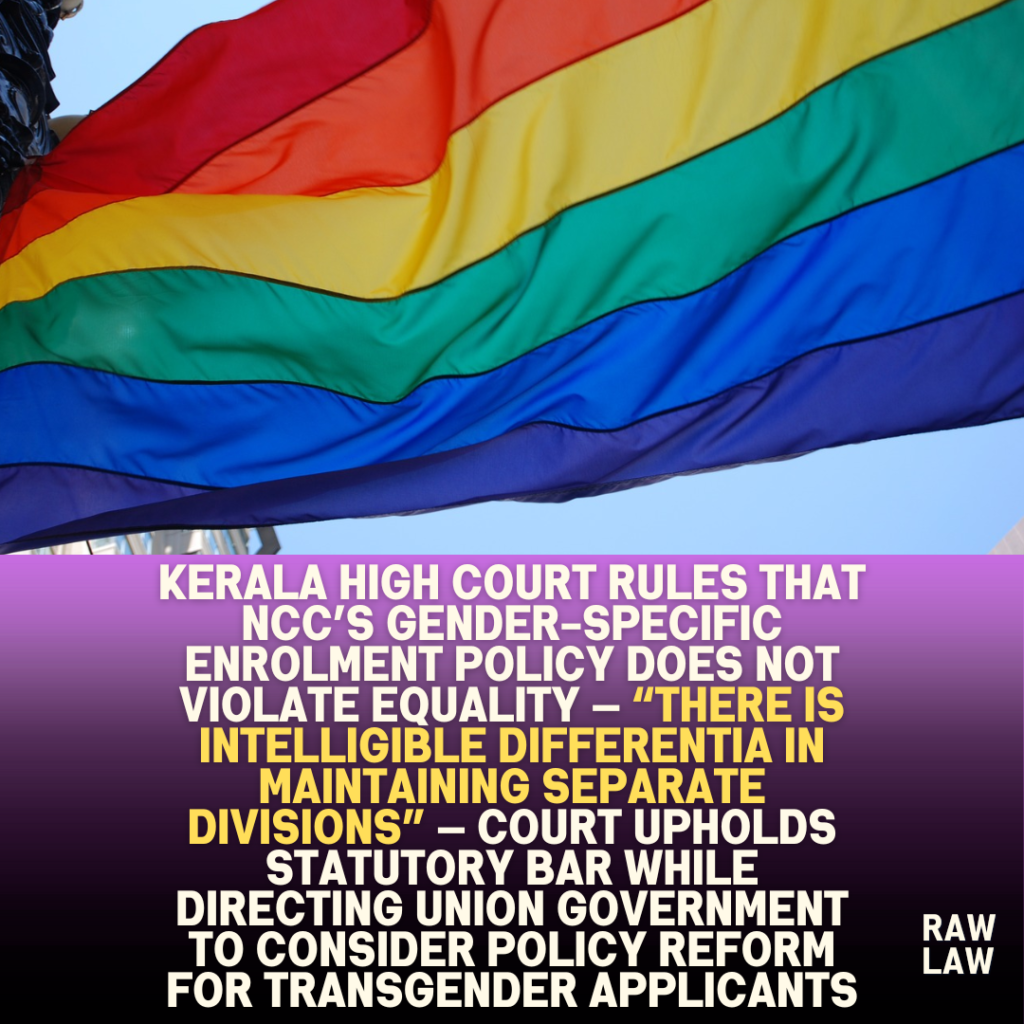
The Kerala High Court dismissed a challenge filed by a transgender student who sought enrolment in the National Cadet Corps (NCC) and was refused admission solely due to gender identity. The Court held that the National Cadet Corps Act, 1948, expressly permits enrolment only of students of the “male sex” and “female sex,” and contains no statutory space for a transgender category. The Court ruled that as long as the statute stands unamended, NCC is legally justified in following gender-specific divisions for practical and safety-based reasons arising from its training structure, camp conditions, and accommodation patterns.
The Court emphasised that the NCC’s organisational framework mirrors the Armed Forces and necessarily involves field conditions, shared accommodation, physical drills, and high-contact training exercises. Therefore, the Court held that maintaining gender-segregated divisions serves a rational purpose and has an intelligible differentia, satisfying Article 14 scrutiny.
While declining relief to the Petitioner, the Court acknowledged that transgender students ideally deserve equal opportunity to receive NCC training. Recognising the policy vacuum, the Court directed the Registry to forward the judgment to the Ministry of Defence and the Ministry of Law and Justice so that appropriate legislative and executive consideration may be initiated. The Court concluded that creating a transgender division would require deeper studies, sufficient enrolment numbers, and parliamentary action—all of which fall within the executive-legislative domain rather than the judiciary.
Facts
The Petitioner, identifying as transgender, applied for enrolment in an NCC battalion under a college unit. The Petitioner successfully met all eligibility criteria and participated in the selection process. However, during the interview stage, the Petitioner was informed that enrolment was not possible because the NCC divisions are strictly categorised into male and female units, with no recognised provision for transgender candidates.
The Petitioner contended before the Court that rejection based solely on gender identity amounted to unconstitutional discrimination under Articles 14, 15, 19, and 21. The Petitioner argued that NCC training is a vital pathway to developing leadership, discipline, and access to defence-related opportunities, and exclusion on the basis of gender identity violates equality and dignity.
The Respondents, including the Union of India and NCC authorities, submitted that Sections 6(1) and 6(2) of the NCC Act permit enrolment of only male or female students. NCC organisational structures, training methodologies, and accommodation systems operate entirely on binary gender segregation. Therefore, inclusion of transgender candidates is neither contemplated by law nor currently feasible within the infrastructure and policy norms.
Issues
The key issue before the Court was whether refusal to admit a transgender applicant to the NCC violates constitutional guarantees of equality, non-discrimination, freedom, and dignity. A connected issue was whether the judiciary could direct the NCC or Union Government to create a transgender division or modify statutory eligibility criteria. Another central issue concerned whether Section 6 of the NCC Act constitutes valid classification under Article 14 or results in arbitrary discrimination.
Petitioner’s arguments
The Petitioner argued that exclusion based purely on gender identity is discriminatory and unconstitutional. It was contended that transgender persons are legally recognised under constitutional jurisprudence and entitled to equal opportunities in all public institutions. The Petitioner stressed that NCC training is not limited to combat-oriented roles but also aims at character development, national service, and leadership—areas where transgender persons must not be excluded.
The Petitioner asserted that rigid gender-binary enrolment fails to account for contemporary understanding of gender and violates the spirit of equality. The Petitioner further argued that safety concerns or logistical challenges cannot justify categorical exclusion when reasonable accommodations are possible through policy modification and sensitive administration.
Respondent’s arguments
The Respondents contended that the NCC Act statutorily restricts enrolment to students of male or female sex. They submitted that as long as the statute remains unchanged, no NCC authority can create an additional category. The Respondents explained that NCC training requires shared accommodation, tentage living, overnight camps, and close-contact physical routines that depend on gender-segregated arrangements.
The Respondents argued that introducing a transgender division involves numerous policy, administrative, and infrastructural considerations, including the need for a sufficient number of transgender students to form a viable unit. They contended that such decisions fall squarely within the scope of the executive and legislature rather than the judiciary.
Analysis of the law
The Court analysed Section 6 of the NCC Act in detail, emphasizing that the legislature consciously created gender-specific divisions. The Court applied Article 14 tests and found that the gender-specific classification was based on intelligible differentia due to the unique nature of NCC operations. The Court noted that physical training, barracks-style accommodation, tentage, close-contact drills, and safety protocols necessitate gender-segregated management.
The Court reasoned that while transgender students deserve equal opportunities, statutory gaps cannot be judicially filled. It held that equality jurisprudence does not automatically override legislative text in a domain requiring expert policy input and resource planning.
Precedent analysis
The judgment did not directly reference specific prior Supreme Court or High Court decisions by name. However, the underlying constitutional analysis reflects established equality jurisprudence recognising that reasonable classifications are permitted if they satisfy rational nexus. The judgment also aligns with administrative law principles limiting judicial intervention in areas requiring executive expertise, especially defence-related training and national uniformed structures.
Court’s reasoning
The Court held that although exclusion of transgender students appears inequitable, judicial relief is limited by statutory language. The NCC Act explicitly recognises only male and female categories, and therefore transgender candidates cannot be force-fitted into existing divisions. The Court accepted that NCC training demands gender-specific arrangements for safety, logistics, and discipline.
However, the Court recognised the legitimacy of the Petitioner’s grievance and stated that transgender youth should ideally be able to join NCC. The Court thus directed the Registry to forward the judgment to Union Ministries to consider whether legislative reform or a new policy enabling transgender inclusion could be developed in future.
Conclusion
The Court dismissed the writ petition, holding that the NCC authorities acted within the confines of the statute and the existing policy. At the same time, the Court highlighted the need for legislative and executive reforms so that transgender students may obtain equal access to NCC enrolment in the future. The Court therefore invoked its administrative jurisdiction to ensure that the matter receives governmental attention, even though judicial relief could not be granted.
Implications
The ruling carries substantial implications for gender policy, defence-related educational institutions, and future claims of transgender inclusion. It underscores that statutory barriers must be addressed through legislative amendment rather than judicial innovation. At the same time, the Court’s direction compelling government ministries to consider the matter signals strong institutional support for inclusive reform.
The decision is likely to stimulate national debate on integrating transgender students into uniformed training ecosystems and may lead to formal creation of transgender divisions within NCC once feasibility studies and statutory reforms are undertaken.


