

Court’s Decision
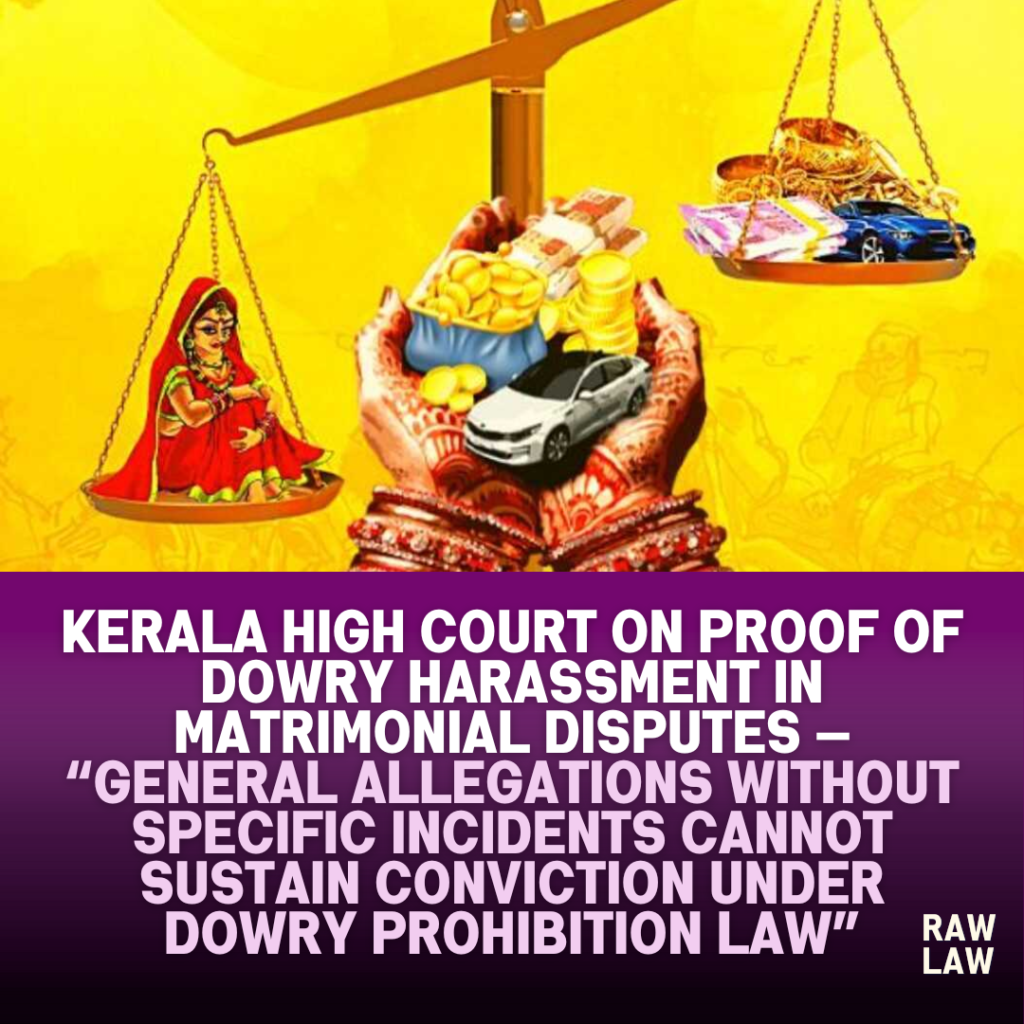
The Kerala High Court set aside the conviction of the accused under Section 498A of the Indian Penal Code and Sections 3 and 4 of the Dowry Prohibition Act, holding that the prosecution had failed to prove specific acts of cruelty or harassment directly connected to dowry demand. The Court emphasized that “mere general allegations of harassment without proving specific overt acts will not be sufficient to sustain conviction” and acquitted the accused, extending the benefit of doubt.
Facts
The prosecution alleged that the accused subjected his wife to cruelty and harassment on account of dowry demands soon after their marriage. The marriage was solemnized in accordance with customary rites, and it was alleged that certain amounts in cash and gold ornaments were handed over at the time of marriage. The wife later claimed that she was continuously harassed, insulted, and ill-treated because of non-fulfillment of additional dowry demands, ultimately forcing her to leave the matrimonial home and initiate criminal proceedings. The trial court convicted the accused under Section 498A IPC and Sections 3 and 4 of the Dowry Prohibition Act. The conviction was confirmed by the appellate court, leading to the revision petition before the High Court.
Issues
- Whether general and omnibus allegations of cruelty and harassment in connection with dowry, without proving specific overt acts, are sufficient for sustaining conviction under Section 498A IPC and the Dowry Prohibition Act.
- Whether the courts below erred in appreciating evidence that lacked corroboration and specific details of dowry demand.
- Whether the benefit of doubt should be extended to the accused when the prosecution fails to establish clear and cogent evidence of harassment.
Petitioner’s Arguments
The petitioner argued that the entire prosecution case was based on vague and omnibus allegations without any specific incident being proved. It was contended that the complainant’s testimony was full of general statements and lacked corroboration from independent witnesses. The petitioner further argued that the courts below failed to appreciate that the prosecution had not proved any exact date, manner, or nature of the alleged harassment. The defense maintained that the criminal case was an afterthought filed only to harass the petitioner and that the essential ingredients of Section 498A IPC and Sections 3 and 4 of the Dowry Prohibition Act were not satisfied.
Respondent’s Arguments
The prosecution contended that the complainant’s testimony should be believed in its entirety since it reflected the consistent conduct of the accused. It was argued that the cruelty in dowry-related offences often occurs within the four walls of the matrimonial home, and hence, corroboration should not be insisted upon as a rigid rule. The prosecution further maintained that the very fact that the complainant was driven out of her matrimonial home established the cruelty and harassment, and the courts below had rightly convicted the accused based on her testimony.
Analysis of the Law
The Court examined Section 498A IPC, which penalizes cruelty inflicted upon a woman by her husband or his relatives. Cruelty is defined to include both physical and mental harassment, particularly where such harassment is linked to dowry demands. Similarly, Sections 3 and 4 of the Dowry Prohibition Act criminalize the giving, taking, or demanding of dowry. The Court reiterated that while conviction under these provisions does not always require direct corroboration, there must be cogent and specific evidence establishing the nexus between the alleged cruelty and the dowry demand. The law does not permit conviction on the basis of broad, unsubstantiated, and omnibus allegations.
Precedent Analysis
The Court relied upon several precedents while analyzing the case:
- Kans Raj v. State of Punjab (2000) – The Supreme Court held that in dowry harassment cases, vague allegations without specific evidence of harassment cannot form the basis of conviction.
- Preeti Gupta v. State of Jharkhand (2010) – The Supreme Court cautioned against misuse of Section 498A IPC and emphasized that courts must carefully scrutinize evidence before convicting.
- State of West Bengal v. Orilal Jaiswal (1994) – The Court highlighted that suspicion, however strong, cannot take the place of proof.
These cases collectively underscored the principle that clear, cogent, and specific evidence is indispensable for sustaining conviction under dowry harassment laws.
Court’s Reasoning
The Court reasoned that while cruelty and dowry harassment often occur in private spaces where independent witnesses are absent, the prosecution must at least establish specific instances of harassment with credible evidence. In the present case, the complainant’s allegations were found to be omnibus and lacking in particulars. No independent witnesses corroborated her testimony, and the prosecution failed to prove any specific overt act of harassment connected to dowry demand. The Court observed that “general allegations without substantive proof will not suffice to hold a person guilty of such serious offences” and held that the courts below had erred in sustaining the conviction. Therefore, the accused was acquitted.
Conclusion
The High Court set aside the concurrent findings of the trial and appellate courts and acquitted the accused. It held that the prosecution had failed to establish its case beyond reasonable doubt and that the accused was entitled to the benefit of doubt. The Court reinforced that while dowry-related offences must be dealt with firmly, the law also requires that convictions must be based on specific, credible, and cogent evidence rather than on vague allegations.
Implications
The ruling has significant implications in matrimonial litigation, particularly in cases involving allegations under Section 498A IPC and the Dowry Prohibition Act. It reiterates the need for courts to adopt a balanced approach, ensuring that genuine cases of cruelty are punished while also preventing miscarriage of justice due to vague and omnibus allegations. This judgment strengthens the principle that the criminal law must be applied with caution in matrimonial disputes, where allegations are often sweeping and motivated by personal differences. It also highlights the importance of producing specific evidence of harassment to sustain conviction.
FAQs
Q1: Can a conviction under Section 498A IPC be sustained solely on general allegations of harassment?
No. The Court has reiterated that general and omnibus allegations are insufficient. Conviction requires proof of specific acts of cruelty directly linked to dowry demand.
Q2: What role do precedents like Kans Raj and Preeti Gupta play in dowry harassment cases?
They caution courts against convicting accused persons on vague allegations, stressing that clear and cogent evidence of harassment is necessary to sustain conviction under dowry laws.
Q3: Does the absence of independent witnesses always weaken the prosecution’s case in dowry harassment matters?
Not always. However, even without independent witnesses, the complainant’s testimony must be credible and specific. Vague, uncorroborated statements cannot sustain conviction.


