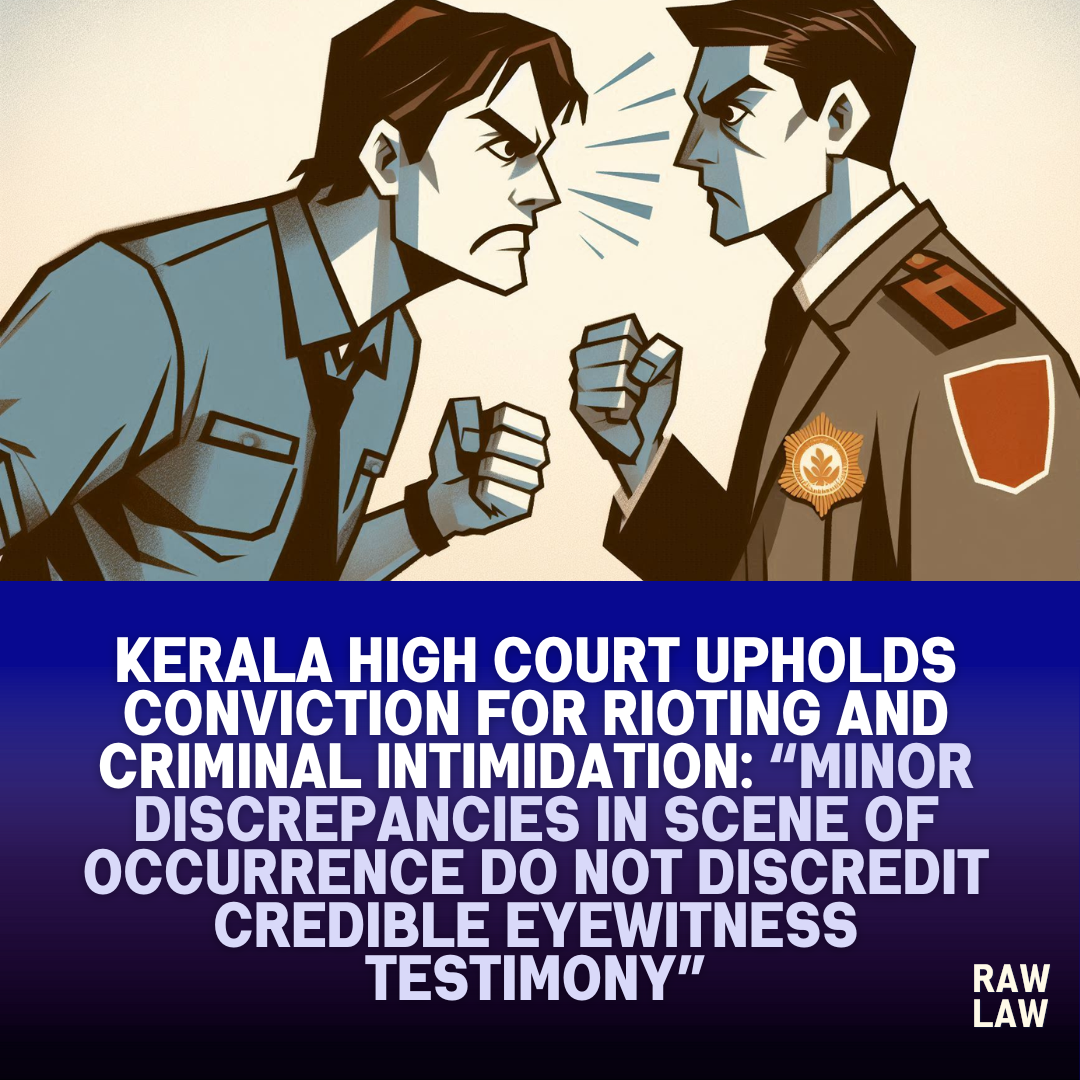
Kerala High Court Upholds Conviction for Rioting and Criminal Intimidation: “Minor Discrepancies in Scene of Occurrence Do Not Discredit Credible Eyewitness Testimony”

Court’s Decision
The Kerala High Court dismissed a criminal revision petition filed by eight accused persons convicted for offences under Sections 143, 147, 323, and 506(1) read with Section 149 of the Indian Penal Code, thereby affirming the concurrent findings of the trial court and the appellate court.
Justice A. Badharudeen held that the discrepancies pointed out regarding the exact place of occurrence were minor and did not affect the core of the prosecution case, since all essential elements of unlawful assembly, rioting, hurt, and intimidation were conclusively proved through credible and consistent evidence.
In the words of the Court:
“No serious anomaly could be noticed in the prosecution evidence to suggest that the place of occurrence was different from what was alleged. The testimony of the eyewitnesses is cogent and consistent; hence the conviction stands.”
The Court further noted that the Sessions Court had already shown leniency by restricting the punishment to fine alone, with half the amount directed to be paid as compensation to the injured complainant under Section 357(1) of Cr.P.C.
Facts
The case arose from an incident that occurred at 9:15 PM on 29 March 2010 in Vadakara, Kozhikode District. The prosecution alleged that the accused persons, acting in furtherance of a common object, formed an unlawful assembly armed with deadly weapons, and attacked the complainant near the EMS Memorial Building.
According to the prosecution, the complainant (PW1) was walking towards his residence along with his friend (PW3) when the accused, hiding nearby, hurled firecrackers towards them, followed by a violent assault. PW1 was beaten with an iron rod on the head and shoulder, kicked and punched by several persons, and sustained multiple injuries.
The police registered an FIR under Sections 143, 147, 148, 323, 324, and 506(1) read with 149 IPC. After a full trial, the Judicial First Class Magistrate, Vadakara convicted the accused for rioting, unlawful assembly, voluntarily causing hurt, and criminal intimidation, while acquitting them of the charges under Sections 148 and 324 IPC.
The Additional Sessions Judge, Kozhikode, in appeal, upheld the conviction but reduced the punishment to fine only, imposing ₹5,000 each under Sections 143 and 147 IPC, ₹1,000 each under Section 323 IPC, and ₹4,000 each under Section 506(1) IPC. 50% of the total fine was ordered to be paid as compensation to PW1.
Issues
- Whether inconsistencies regarding the exact place of occurrence rendered the prosecution version unreliable.
- Whether the courts below erred in appreciating evidence, thereby warranting interference under the revisional jurisdiction of the High Court.
- Whether the sentence of fine alone required further modification in view of the accused being government employees.
Petitioners’ Arguments
Counsel for the petitioners contended that both the trial and appellate courts had failed to appreciate the evidence properly, leading to a miscarriage of justice. It was argued that there were serious anomalies concerning the location of the incident, as the scene mahazar and the depositions of the witnesses did not match.
PW1 stated that the incident occurred at the basement of PW2’s house, while PW2 and PW3 placed it on the road in front of the house near the EMS Memorial Building. The defence contended that this discrepancy created a reasonable doubt about the prosecution’s narrative, which should have enured to the benefit of the accused.
It was further urged that the accused were government servants, and therefore, leniency should be shown to avoid adverse service consequences. The petitioners prayed for acquittal or, in the alternative, modification of the sentence.
Respondent’s Arguments
The Public Prosecutor countered that the prosecution evidence was fully consistent regarding the manner of occurrence and the involvement of the accused. The minor variation in identifying the exact physical location did not affect the substance of the case, since all witnesses were consistent that the attack took place near the EMS Memorial Building in front of PW2’s and PW3’s houses.
The State pointed out that PW1, PW2, and PW3 were eyewitnesses, and their depositions corroborated each other on material aspects — the identity of the assailants, the sequence of assault, and the injuries sustained.
The scene mahazar (Ext. P4), prepared by the Investigating Officer (PW7), confirmed the location as the cut road near EMS Memorial Building. PW4, the doctor who issued the wound certificate (Ext. P2), corroborated the medical evidence, testifying to lacerated wounds and contusions consistent with the assault.
Thus, the State contended that the concurrent findings of both lower courts were well-reasoned and evidence-based, leaving no scope for revisional interference.
Analysis of the Law
The Court began by reiterating the scope of revisional jurisdiction under Sections 397 and 401 of the Code of Criminal Procedure, holding that such powers are limited to correcting patent errors of law or perversity of findings. The revisional court does not re-appreciate evidence or act as a second appellate forum.
Justice Badharudeen emphasized:
“Revisional jurisdiction can be exercised where there is palpable error, non-compliance with law, or an entirely erroneous decision. The power is confined to testing the correctness, legality, or propriety of the order of the subordinate court.”
On factual analysis, the Court compared the testimonies of PW1, PW2, PW3, and PW7. It held that while PW1 mentioned being beaten at the basement of PW2’s house, PW2 and PW3 consistently stated that the attack took place on the road abutting their houses, corroborated by the scene mahazar. This, the Court found, was not a material contradiction, as the two locations were adjacent and part of the same scene.
Precedent Analysis
- State of Kerala v. Puttumana Illath Jathavedan Namboodiri (1999) 2 SCC 452 – The Supreme Court held that revisional power is limited to correcting manifest errors; courts cannot reappreciate evidence. Applied here to restrict interference.
- Sanwat Singh v. State of Rajasthan (1961 AIR 715) – Cited to emphasize that concurrent findings on facts should not be disturbed unless they cause miscarriage of justice.
- State of Rajasthan v. Kashi Ram (2006) 12 SCC 254 – Relied on to underline that minor inconsistencies in witness accounts do not undermine the overall reliability of the prosecution.
- K. Anbazhagan v. State of Karnataka (2015) 6 SCC 158 – Quoted to stress that revisional jurisdiction should not substitute the trial court’s factual findings unless they are grossly perverse.
These precedents guided the Court in holding that the concurrent findings below were based on credible and corroborative evidence, and no interference was justified.
Court’s Reasoning
The Court carefully analyzed the eyewitness testimonies and the scene mahazar (Ext. P4). PW1’s version of the attack was corroborated by PW3, who witnessed the assault and named specific accused. PW2, an independent witness, confirmed hearing an explosion, rushing out with a torch, and witnessing the beating.
The Investigating Officer (PW7) confirmed that the location mentioned in Ext. P4 matched the witnesses’ accounts, and the doctor (PW4) verified injuries consistent with blunt-force trauma.
Justice Badharudeen concluded that the discrepancy regarding whether the attack occurred on the basement or road was inconsequential, as both descriptions referred to the same vicinity. Hence, there was no ground to doubt the prosecution case or disturb the concurrent findings.
The Court noted that the Sessions Court had already shown leniency by imposing only fines. Therefore, no further modification was warranted, and the revision petition was dismissed in full.
Conclusion
The High Court affirmed the conviction of all eight accused under Sections 143, 147, 323, and 506(1) read with 149 IPC, holding that the prosecution had successfully proved the case beyond reasonable doubt.
It further held that the minor inconsistencies regarding the scene of occurrence did not vitiate the findings of guilt, since the eyewitness testimonies were natural, consistent, and corroborated by medical and documentary evidence.
The sentence of fine only was upheld, and the Court declined to grant further leniency, observing that the trial and appellate courts had already adopted a liberal approach.
Implications
This judgment reinforces the principle that minor inconsistencies in prosecution evidence do not automatically invalidate criminal convictions, provided the core narrative remains consistent.
It also reiterates the limited revisional powers of the High Court — confined to correcting glaring legal or procedural errors, not to re-assessing evidence. The ruling underscores judicial discipline in criminal revisions and affirms the primacy of credibility over precision in witness testimonies.
FAQs
1. Can minor contradictions in witness statements lead to acquittal?
No. Only contradictions affecting the core of the prosecution case are material; minor discrepancies in location or sequence are not fatal.
2. What is the scope of the High Court’s power in criminal revision?
Revisional power is limited to correcting errors of law, illegality, or perversity. The High Court cannot reappreciate evidence as in an appeal.
3. Can leniency be claimed by government servants after conviction?
No. Employment status does not entitle an accused to special consideration if the offence is otherwise proved beyond reasonable doubt.