

1. Court’s decision
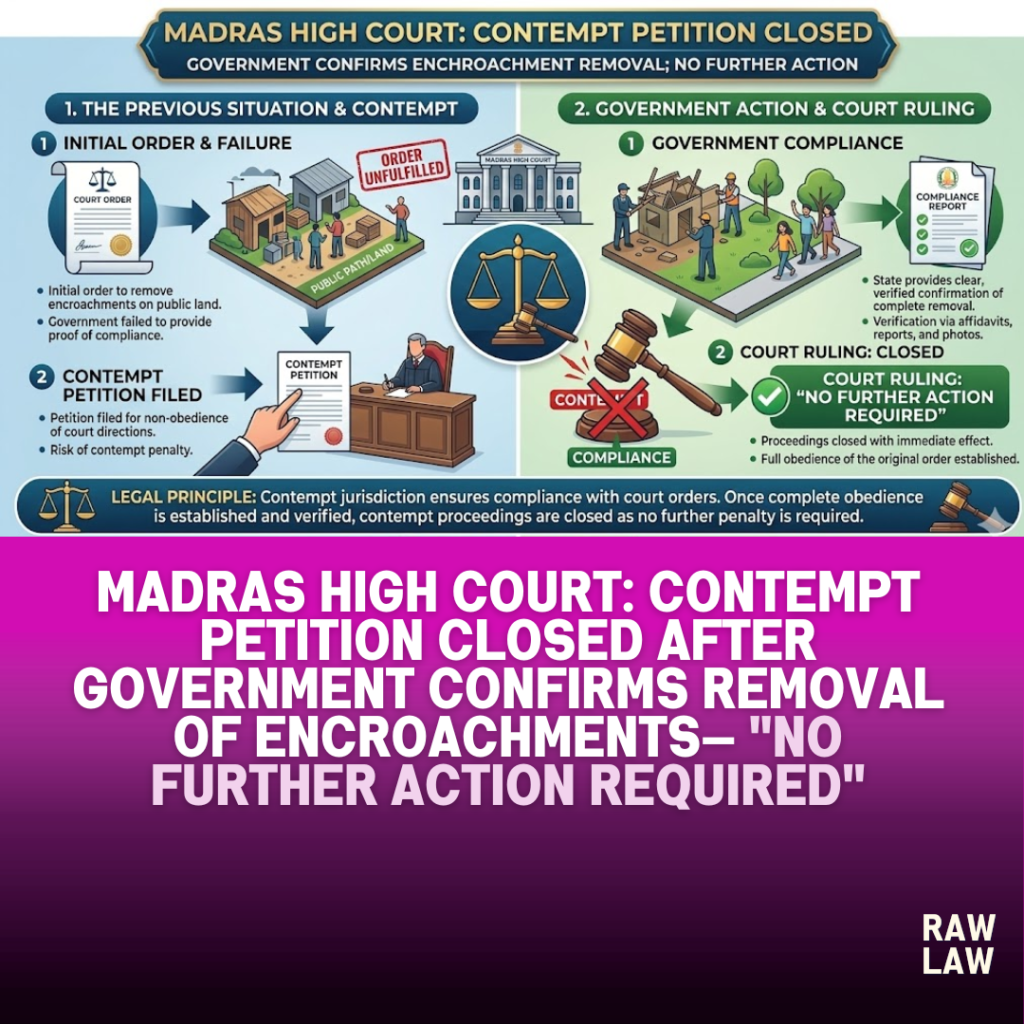
A Division Bench of the Madras High Court closed contempt proceedings initiated against district and revenue officials after the State informed the Court that encroachments had already been removed in compliance with an earlier judicial direction.
The Bench held that once compliance with the earlier order was confirmed, the continuation of contempt proceedings was unnecessary. Accordingly, the Court closed the contempt petition without imposing costs or penalties on the officials concerned.
2. Facts
The petitioners had earlier approached the High Court by filing a writ petition seeking removal of encroachments. The High Court had issued directions in that writ petition requiring the concerned authorities to take action in accordance with law.
Alleging that the authorities failed to comply with those directions, the petitioners subsequently filed a contempt petition under the Contempt of Courts Act. The petition sought punishment for alleged willful disobedience of the court’s earlier order.
The respondents in the contempt proceedings included district administrative and highway authorities responsible for removing the encroachments.
3. Issues
The principal issue before the Court was whether the respondent authorities had willfully disobeyed the High Court’s earlier order directing removal of encroachments.
The Court also examined whether contempt jurisdiction should be invoked when the authorities subsequently comply with the order during the pendency of the contempt proceedings.
4. Petitioner’s arguments
The petitioners contended that the authorities had failed to comply with the directions issued by the High Court in the earlier writ proceedings.
It was argued that despite the order dated 5 March 2024 directing action against encroachments, the authorities had not taken timely steps to remove them. The petitioners therefore requested the Court to initiate contempt proceedings and punish the officials responsible for non-compliance.
5. Respondent’s arguments
The Special Government Pleader appearing for the respondent authorities submitted that the directions issued by the High Court had already been complied with.
Based on written instructions provided by the concerned highway authority, the government informed the Court that the encroachments referred to in the earlier order had been removed.
The respondents therefore argued that there was no willful disobedience warranting contempt action.
6. Analysis of the law
The Court examined the scope of contempt jurisdiction under the Contempt of Courts Act. Contempt proceedings are intended to ensure compliance with court orders and to punish willful disobedience that undermines the authority of the judiciary.
However, courts have consistently held that the objective of contempt jurisdiction is primarily to secure compliance rather than to impose punishment. When the directions issued by the court are complied with, the purpose of contempt proceedings stands fulfilled.
Therefore, if authorities demonstrate that the order has been implemented, courts typically refrain from pursuing punitive contempt proceedings.
7. Precedent analysis
Indian courts have repeatedly emphasized that contempt jurisdiction must be exercised cautiously and only in cases of deliberate and willful disobedience.
Where compliance with the court’s order is achieved, even if belatedly, courts often close contempt proceedings unless there is clear evidence of intentional disregard for judicial authority.
This approach ensures that contempt jurisdiction remains a tool for enforcing compliance rather than merely punishing officials after compliance has already been achieved.
8. Court’s reasoning
After hearing the submissions of the government counsel and reviewing the written instructions placed before it, the Court noted that the encroachments had already been removed.
Since the earlier order had been complied with, the Court concluded that the purpose of the contempt petition had been served. Continuing the proceedings would therefore serve no practical purpose.
The Court accordingly recorded the submission of the government and proceeded to close the contempt petition.
9. Conclusion
The High Court held that once the authorities confirmed removal of the encroachments in compliance with the earlier order, no further action in contempt jurisdiction was necessary.
The contempt petition was therefore closed and all connected applications were disposed of without costs.
10. Implications
The judgment reiterates a well-established principle of contempt law: the purpose of contempt proceedings is to secure compliance with judicial orders, not merely to punish officials.
Once compliance is achieved, courts typically close contempt petitions unless there is evidence of deliberate and persistent disobedience.
The ruling also highlights the importance of government authorities promptly implementing court directions to avoid prolonged litigation and potential contempt action.
Case Law References
- Principle governing contempt jurisdiction under the Contempt of Courts Act
Courts exercise contempt powers primarily to ensure obedience to judicial orders and maintain the authority of the judiciary. - Doctrine of Compliance in Contempt Proceedings
If the directions of a court are complied with during the pendency of contempt proceedings, courts often close the case as the purpose of the proceedings has been fulfilled.
FAQs
1. What happens if authorities comply with a court order during contempt proceedings?
If compliance is achieved, courts usually close the contempt petition since the objective of the proceedings—ensuring compliance—has been fulfilled.
2. Can government officials be punished even after complying with a court order?
Punishment is generally imposed only when there is clear evidence of willful and deliberate disobedience. If compliance occurs, courts often close the proceedings.
3. What is the purpose of contempt jurisdiction in Indian courts?
Contempt jurisdiction exists to ensure that court orders are obeyed and to protect the authority and dignity of the judiciary.


