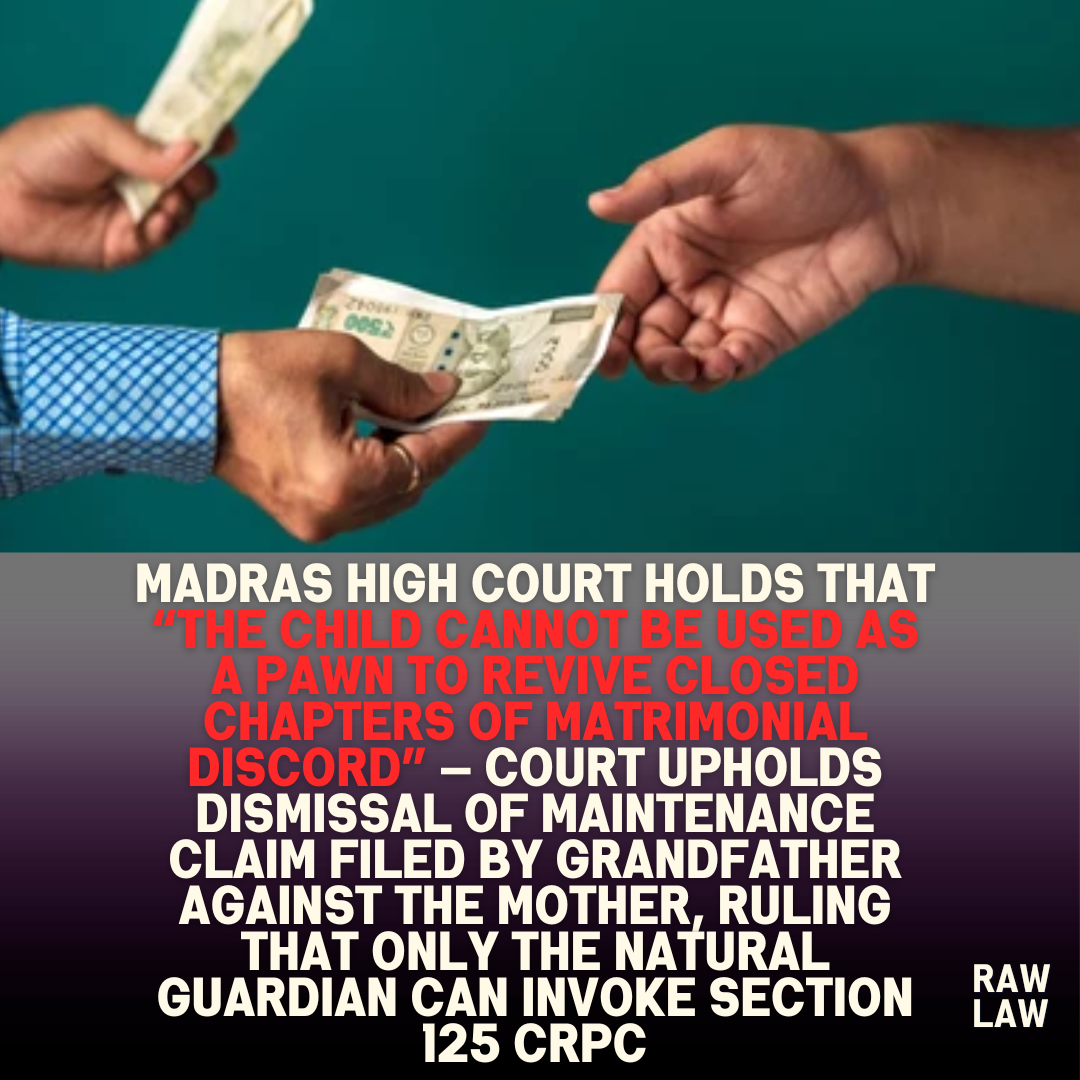
Madras High Court holds that “the child cannot be used as a pawn to revive closed chapters of matrimonial discord” — Court upholds dismissal of maintenance claim filed by grandfather against the mother, ruling that only the natural guardian can invoke Section 125 CrPC

Court’s decision
The Madras High Court dismissed a criminal revision petition filed on behalf of a minor child challenging the Family Court’s refusal to grant maintenance against the child’s mother. The Court held that the petition was legally unsustainable because the grandfather, who initiated the proceedings, lacked locus standi when the child’s father—the natural guardian—was alive, financially capable, and legally obligated under a mutual consent divorce decree to maintain the child. The Court emphasised that Section 125 CrPC, which provides a swift remedy against neglect, cannot be misused to reopen long-settled matrimonial arrangements, particularly where the proceeding appears to be motivated by hostility rather than child welfare.
The Court also noted the mother’s right to rebuild her life free from harassment after her lawful remarriage. Stressing the constitutional protection accorded to her dignity under Article 21, the Court observed that litigation should not serve as a tool to disrupt her independent family life. The Court reiterated that co-parenting after divorce must be guided by cooperation and respect for judicially recorded undertakings. Finding no legal infirmity in the Family Court’s reasoning, the High Court confirmed the dismissal of the petition and held that the revision was devoid of merit.
Facts
The case arose after the Petitioner, a minor represented by his paternal grandfather, sought maintenance from the mother under Section 125 CrPC. The minor’s parents had married in 2009 and divorced by mutual consent in 2014. As part of the consent decree, custody of the child was vested with the father, who expressly undertook to maintain him, while the mother renounced any maintenance claims. After the divorce, both parents remarried and began living independently. The child lived with his paternal grandparents in Karur.
The father, employed with the Airport Authority of India, regularly contributed to the child’s welfare. The records showed that he paid monthly maintenance, deposited ₹1,60,000 in the child’s name, and maintained a life insurance policy. Despite this, the grandfather initiated maintenance proceedings against the mother, claiming she was gainfully employed and should contribute financially. The Family Court dismissed the petition for lack of locus standi and in view of the binding consent decree. The grandfather then filed the present revision.
Issues
- Whether a grandfather, who is neither a natural guardian nor court-appointed guardian, has locus standi to initiate proceedings under Section 125 CrPC on behalf of a minor child.
- Whether a mutual consent divorce decree, wherein the father undertook to maintain the minor, precludes reopening maintenance liability against the mother.
- Whether the proceedings constituted misuse of maintenance provisions intended to disturb the mother’s remarried life.
- Whether the High Court should exercise revisional jurisdiction to interfere with a well-reasoned Family Court order.
Petitioner’s arguments
The Petitioner argued that both parents, having remarried, had neglected the minor’s day-to-day expenses and that the father’s occasional contributions were insufficient for education and medical needs. It was asserted that the mother, being employed in a bank and earning a substantial salary, had a continuing obligation to contribute to the child’s welfare irrespective of earlier divorce terms. The grandfather claimed that his limited pension could not sustain the minor’s growing financial needs and argued that the Family Court erred in refusing maintenance merely because the father was still alive.
The Petitioner’s counsel contended that Section 125 CrPC embodies a social justice provision aimed at preventing destitution and that its protections must be liberally construed. According to the Petitioner, the mother’s remarriage did not extinguish her duties toward her biological child. The revision petition therefore sought reversal of the Family Court’s findings to ensure that the mother was legally compelled to share in the responsibility of raising the child.
Respondent’s arguments
The Respondent opposed the revision, asserting that the proceedings were a deliberate attempt to harass her and interfere with her settled matrimonial life. It was emphasised that the mutual consent divorce decree expressly vested custody with the father and recorded that he would maintain the child. As the natural guardian under Section 6 of the Hindu Minority and Guardianship Act, the father remained alive, employed, solvent, and fully capable of caring for the child. Consequently, there was no basis for the grandfather to invoke Section 125 CrPC against the mother.
The Respondent further argued that the grandfather did not even implead his own son, thereby concealing the father’s financial sufficiency. The petition, she submitted, was a veiled attempt to disturb her peace and autonomy after her remarriage. She urged the Court to uphold the Family Court’s findings, warning that entertaining such petitions would destabilise settled divorce arrangements and burden women with repeated litigation long after marital disputes had ended.
Analysis of the law
The Court examined Section 125 CrPC and noted that while it grants minors a statutory right to claim maintenance, the petition must ordinarily be instituted by a natural guardian unless the Court has formally appointed another person. Under Section 6 of the Hindu Minority and Guardianship Act, the father is the natural guardian of a minor boy during his lifetime. Because the father in this case was alive and financially sound, the grandfather lacked legal authority to represent the minor absent a guardianship order. This defect alone justified dismissal of the proceedings.
The Court also emphasised that a mutual consent divorce decree carries binding contractual and judicial force. When both parents voluntarily agreed that the father would maintain the child, neither the father nor his relatives can later circumvent this arrangement to target the mother. Section 125 CrPC cannot be used to unsettle final judicial determinations or undermine mutually agreed parenting frameworks. The Court warned that misuse of welfare-oriented provisions erodes the credibility of maintenance proceedings and diverts attention from genuinely neglected dependents.
Precedent analysis
While the judgment did not cite external precedents, its reasoning mirrored established jurisprudence affirming that:
- maintenance proceedings cannot be used as a forum to revive matrimonial hostilities;
- decrees passed with mutual consent attain finality and must be given full effect; and
- Section 125 CrPC operates within the framework of guardianship law, meaning that only legally authorised persons may represent minors.
The Court’s approach aligns with leading decisions emphasising protection of remarried women from intrusive litigation and underscoring that welfare claims must be genuine, bona fide, and legally sustainable.
Court’s reasoning
The Court found that the revision petition was not motivated by child welfare but by the grandfather’s animosity toward the respondent. Noting that the father was neither impleaded nor shown to be unable to maintain the child, the Court concluded that the petition was a tactical attempt to disturb the respondent’s remarried life. The Court held that parental responsibilities cannot be manipulated to weaponize legal proceedings against one parent, particularly when the other parent is financially capable and bound by a court-recorded undertaking.
The Court observed that co-parenting after divorce demands mutual respect, not confrontation. The mother’s right to peaceful remarriage and privacy is a constitutionally protected facet of dignity under Article 21. Allowing former in-laws to litigate repeatedly would violate this protection. Hence, the Court affirmed the Family Court’s dismissal and condemned the misuse of maintenance laws to reignite matrimonial discord.
Conclusion
The High Court dismissed the revision petition, confirming that the grandfather lacked locus standi, the father was financially competent, and the mutual consent decree barred reopening maintenance liability against the mother. The Court denounced the proceedings as an attempt to destabilise the respondent’s life post-divorce and reiterated that Section 125 CrPC cannot be used to weaponise family disputes. No costs were awarded.
Implications
This ruling reinforces essential principles of maintenance jurisprudence: guardianship hierarchy must be respected; mutual consent divorce decrees cannot be casually undermined; and remarried mothers are entitled to protection from intrusive litigation. It also clarifies that Section 125 CrPC is a remedy against neglect—not a mechanism to pursue vendettas or reopen settled marital disputes. The judgment strengthens the jurisprudence supporting stable post-divorce family structures and prevents weaponisation of children in inter-family conflicts.