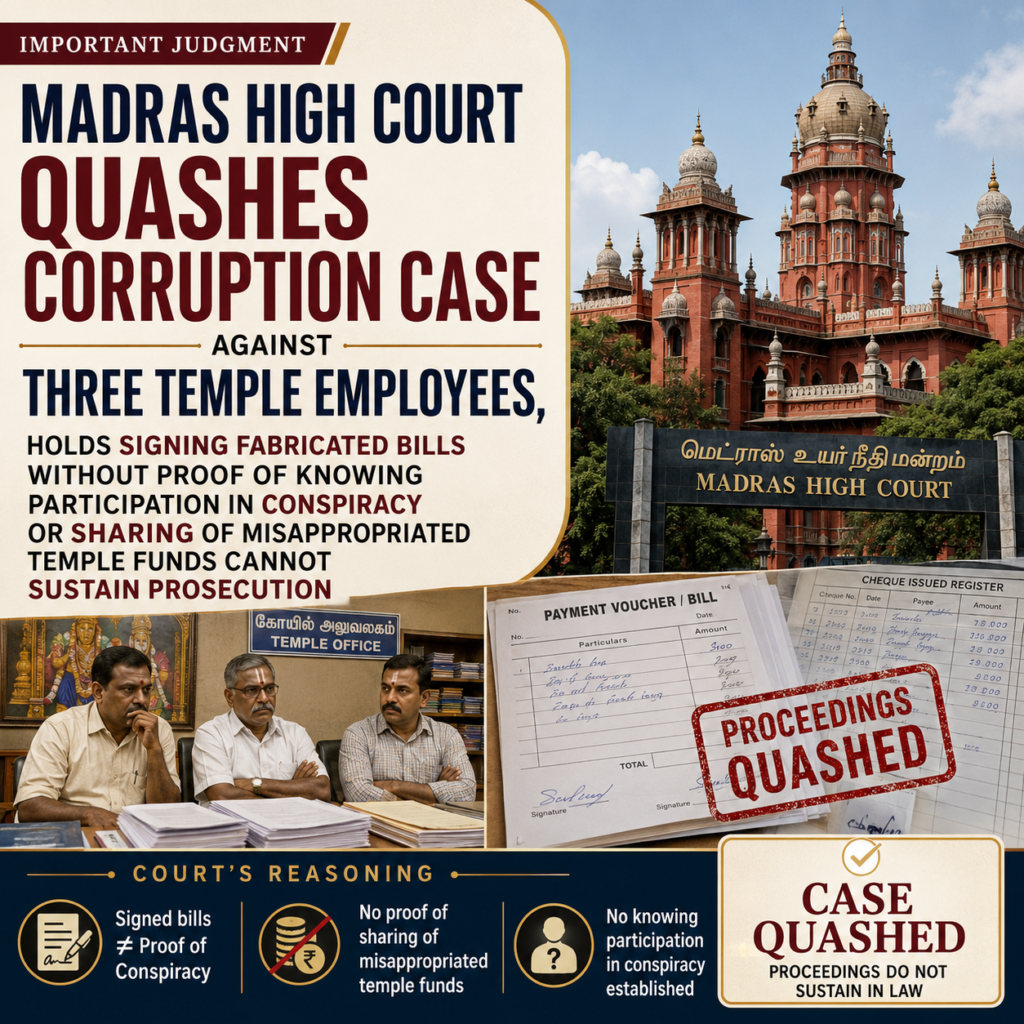
Madras High Court Quashes Corruption Case Against Three Temple Employees, Holds Signing Fabricated Bills Without Proof of Knowing Participation in Conspiracy or Sharing of Misappropriated Temple Funds Cannot Sustain Prosecution

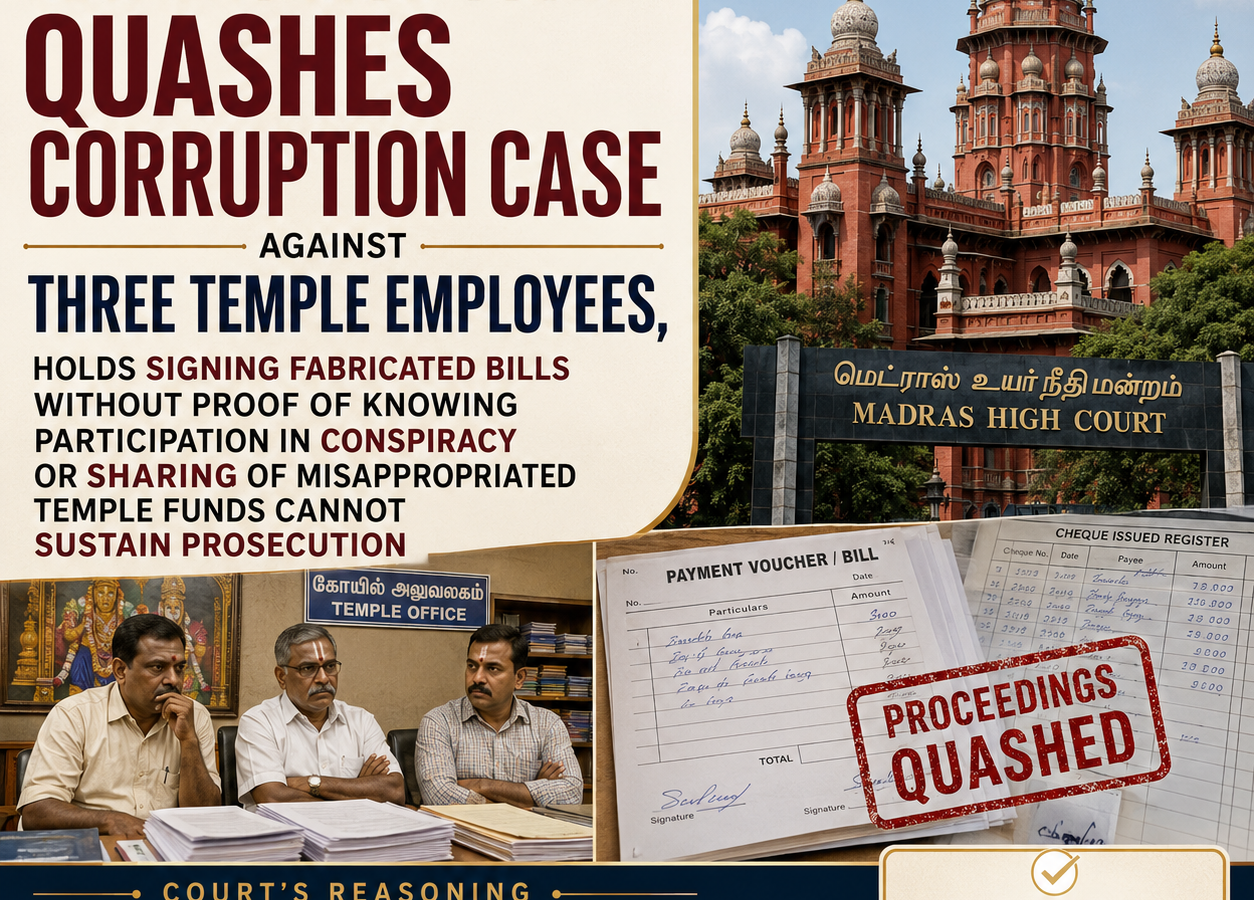
No Proof Temple Employees Shared ₹2.96 Lakh Misappropriated Funds: Madras High Court Quashes Proceedings Against Three Accused
Facts
Three employees connected with the Hindu Religious and Charitable Endowments Department approached the Madras High Court under Section 482 of the Code of Criminal Procedure seeking quashing of the criminal proceedings pending before the Chief Judicial Magistrate, Nagercoil.
The petitioners were:
- N. Kuttalam, arrayed as Accused No. 5 and working as a cashier;
- S. Rameshkumar, arrayed as Accused No. 8 and serving as a Special Watcher; and
- A. Mohana Kumar, arrayed as Accused No. 12 and working in different temple-related posts.
The case involved 13 accused. The principal accused, Accused No. 1, was serving as Deputy Commissioner/Executive Officer in the HR & CE Department at Suchindram, Kanyakumari District.
The prosecution alleged that between 2004 and 2006, Accused No. 1 and the other accused conspired to misappropriate ₹2,96,017 from temple funds by producing fabricated bills relating to Paditharam and festival expenses.
Following an audit objection and preliminary inquiry, an FIR was registered on 27 March 2018. The petitioners were subsequently charge-sheeted for offences under:
- Sections 13(2) read with 13(1)(c) of the Prevention of Corruption Act;
- Sections 409, 465, 468, 471, 477-A and 120-B of the Indian Penal Code.
The prosecution alleged that fabricated expense bills were submitted, cheques were issued on their basis, the petitioners countersigned the cheques and the cashier encashed them. It was further alleged that the misappropriated amount was later shared among the accused.
However, the statement of a departmental witness indicated that Accused No. 1 had prepared the bills and documents and had called Accused Nos. 6 to 13 to his office, where they were compelled and threatened to sign them.
The statements of three shop owners also established that the bills attributed to their establishments had not been issued by them.
Issues
- Whether the charge-sheet disclosed sufficient material connecting the three petitioners with the alleged conspiracy and misappropriation of temple funds.
- Whether the petitioners’ signatures on the disputed bills and cheques were sufficient to prosecute them for forgery, breach of trust, falsification of accounts, conspiracy and corruption offences.
- Whether there was any oral or documentary evidence showing that the petitioners had fabricated the bills, dishonestly retained the money or shared the misappropriated amount.
- Whether continuation of the criminal trial against the petitioners would amount to an abuse of the process of law.
- Whether the High Court should exercise its inherent powers under Section 482 Cr.P.C. to quash the proceedings against the petitioners while permitting the trial to continue against the remaining accused.
Petitioner’s Arguments
The petitioners argued that the principal allegations were directed against Accused No. 1, who had allegedly prepared the fabricated bills and arranged for their processing.
They relied heavily on the statement of the Deputy Commissioner of the HR & CE Department, who stated that Accused No. 1 had prepared the bills and called the other employees to his office, where they were compelled and threatened to sign them.
The petitioners submitted that their signatures on the documents did not establish that they had knowingly participated in any conspiracy or fraudulent activity.
Accused No. 5, the cashier, contended that his role was limited to encashing the cheques presented to him and handing over the amount. There was no material showing that he retained or shared any part of the money.
The petitioners further argued that:
- No witness had attributed any independent act of fabrication to them;
- No documentary evidence established that they had prepared the false bills;
- There was no evidence that they received or shared the alleged misappropriated amount;
- The statements of the shop owners only proved that the bills were fabricated, not that the petitioners had fabricated them; and
- Continuing the criminal proceedings without evidence of their individual involvement would amount to harassment and abuse of process.
Respondent’s Arguments
The State opposed the petitions and argued that the accused had not disputed their signatures appearing on the bills and connected documents.
According to the prosecution, the petitioners had submitted expense claims, countersigned the cheques and participated in the encashment process.
The State contended that Accused No. 5 encashed the cheques and returned the amount to Accused No. 1, after which the money was allegedly shared among the accused.
It was argued that the petitioners had been charged with criminal conspiracy under Section 120-B IPC and that the evidence had to be considered cumulatively rather than by isolating the role of each accused.
The State maintained that the material collected during the investigation disclosed a prima facie case and that the petitioners’ defence—that they were compelled to sign the documents—could be tested only during trial.
It therefore submitted that quashing the proceedings at the preliminary stage would be premature.
Analysis of the Law
Section 482 Cr.P.C. preserves the inherent power of the High Court to prevent abuse of judicial process and to secure the ends of justice.
At the stage of considering a petition for quashing, the Court does not ordinarily conduct a detailed trial or assess the reliability of every witness. However, it may examine whether the allegations and collected material, even if accepted at face value, disclose the essential ingredients of the offences alleged against the particular accused.
In a case involving multiple accused, criminal liability cannot be imposed merely because an individual signed a document or held an official position. There must be material indicating:
- Knowledge of the fraudulent nature of the transaction;
- Intentional participation in the unlawful act;
- A specific role in preparing, using or benefiting from the fabricated records;
- Agreement or meeting of minds sufficient to constitute conspiracy; or
- Dishonest receipt, retention or distribution of the misappropriated money.
The Court found that the prosecution’s own material showed that the disputed bills and records had been prepared by Accused No. 1.
The relevant witness statement further indicated that the other employees had been summoned to Accused No. 1’s office and compelled or threatened to sign the documents.
The shop owners’ statements established that the bills were not genuine. However, those witnesses did not attribute their fabrication to the present petitioners.
The Court therefore distinguished between proof that the bills were forged and proof that the petitioners had knowingly participated in their fabrication or dishonest use.
It found no sufficient oral or documentary evidence demonstrating that the petitioners had shared the money, gained financially or independently participated in the alleged conspiracy.
Precedent Analysis
The judgment does not cite or analyse any earlier judicial precedent by name.
The Court decided the petitions by directly examining:
- The allegations in the charge-sheet;
- The statements of the listed witnesses;
- The individual roles attributed to the petitioners;
- The absence of evidence regarding receipt or sharing of the money; and
- The principles governing exercise of inherent jurisdiction under Section 482 Cr.P.C.
The order therefore applies the settled principle that criminal proceedings may be quashed where the prosecution material does not disclose a legally sustainable case against the accused and continuation of the trial would serve no meaningful purpose.
Court’s Reasoning
The Court noted that the principal prosecution witness stated that Accused No. 1 had prepared the entire set of bills and records.
According to that witness, Accused Nos. 6 to 13 were called to Accused No. 1’s office and compelled or threatened to sign the documents as though they had incurred expenditure for the temple festival.
The Court also noted that the cheques were countersigned and handed to the cashier, Accused No. 5, who encashed a total amount of ₹2,96,017 and handed the entire amount to Accused No. 1.
The prosecution alleged that the amount was subsequently shared among the accused. However, the Court found no oral or documentary material substantiating that allegation against the three petitioners.
The statements of the shop owners established only that the bills had not been issued by their shops. They did not disclose any specific overt act by the petitioners in preparing or fabricating those bills.
The Court consequently found that:
- The bills were allegedly prepared by Accused No. 1;
- The petitioners were stated to have signed under compulsion or threat;
- No witness specifically established that the petitioners fabricated the bills;
- No evidence showed that they received a share of the money; and
- No independent material connected them with the alleged conspiracy.
In the absence of such evidence, forcing the petitioners to undergo a full criminal trial would serve no useful purpose and would amount to an abuse of process.
Conclusion
The Madras High Court allowed all three criminal original petitions.
It quashed the entire proceedings in Special C.C. No. 2 of 2024 only insofar as Accused Nos. 5, 8 and 12 were concerned.
The Court held that there was no sufficient oral or documentary evidence establishing their participation in the fabrication of the bills, conspiracy or sharing of the alleged misappropriated temple funds.
The trial court was directed to continue the proceedings against the remaining accused in accordance with law.
The connected miscellaneous petitions were also closed.
Case Details
Case: S. Rameshkumar v. State, with N. Kuttalam v. State and A. Mohana Kumar v. State
Court: High Court of Judicature at Madras
Case Number: Crl.O.P. Nos. 15692, 17436 and 17442 of 2024, with connected miscellaneous petitions
Judge: Justice G.K. Ilanthiraiyan
Date: 16 June 2026
Result: Criminal proceedings quashed against Accused Nos. 5, 8 and 12 for lack of sufficient evidence; trial directed to continue against the remaining accused