

1. Court’s decision
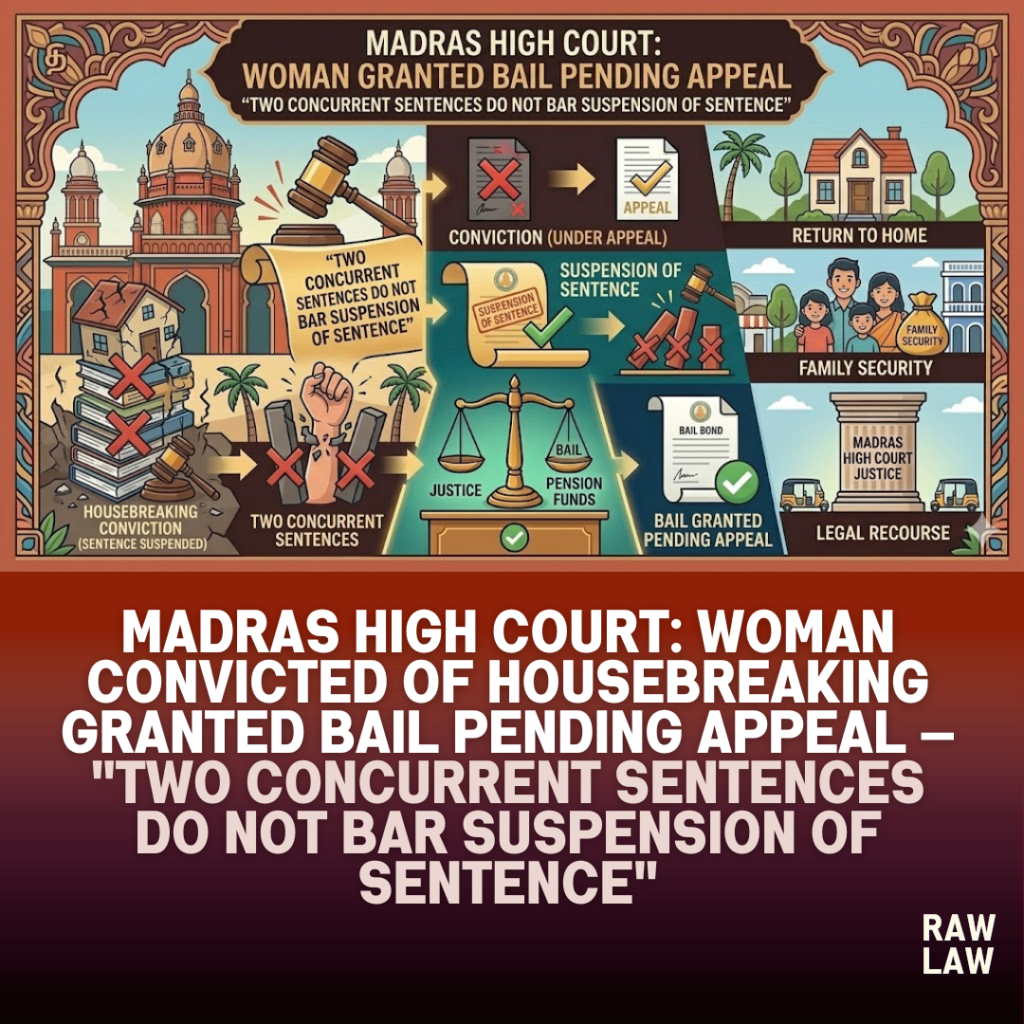
The Madras High Court allowed a petition filed by a convicted woman seeking suspension of sentence pending appeal.
The Court set aside the order of the Sessions Court that had rejected her application for suspension of sentence and directed that she be released on bail during the pendency of her criminal appeal.
The Court held that the lower courts had failed to properly consider the legal position regarding suspension of sentence and had also overlooked relevant circumstances relating to the petitioner’s personal situation.
2. Facts
The petitioner was convicted by a trial court in November 2025 for offences of housebreaking and theft under Sections 454 and 380 of the Indian Penal Code, 1860.
The trial court sentenced her to three years’ simple imprisonment for each offence along with a fine of ₹5,000 for each count. The sentences were ordered to run concurrently.
Following the conviction, the petitioner filed an appeal before the Sessions Court and simultaneously sought suspension of sentence. However, the Sessions Court dismissed the suspension of sentence application.
Aggrieved by this refusal, the petitioner approached the High Court by filing a criminal original petition seeking to set aside the order of the Sessions Court.
3. Issues
The High Court considered whether the Sessions Court had correctly refused suspension of sentence pending appeal.
The Court also examined whether the existence of two convictions with concurrent sentences prevented the court from granting suspension of sentence under criminal procedure law.
Additionally, the Court considered the petitioner’s personal circumstances, including the fact that she was in prison along with her infant child.
4. Petitioner’s arguments
The petitioner submitted that the Sessions Court had wrongly refused suspension of sentence without properly considering the legal position governing such applications.
It was argued that the trial court had imposed two sentences of three years each but had directed them to run concurrently. Therefore, there was no legal bar to suspending the sentence pending appeal.
The petitioner also highlighted her personal circumstances, stating that she had a nine-month-old infant who was lodged with her in prison and who had since turned one year old during the pendency of the proceedings.
On these grounds, the petitioner sought suspension of the sentence and release on bail.
5. Respondent’s arguments
The State opposed the petition and informed the Court that the petitioner was allegedly involved in several other criminal cases of a similar nature.
According to the prosecution, the petitioner had multiple prior cases registered against her, which indicated a pattern of criminal conduct.
However, it was acknowledged that in the other cases the petitioner had already been granted bail and those matters were still pending trial.
6. Analysis of the law
The Court examined the legal framework governing suspension of sentence under criminal procedure law.
It noted that the power to suspend a sentence pending appeal is intended to ensure that a convict is not unnecessarily kept in custody while the appellate court examines the validity of the conviction.
The Court also clarified that the mere existence of multiple convictions does not automatically bar suspension of sentence where the sentences are directed to run concurrently.
7. Precedent analysis
While addressing the issue of suspension of sentence, the Court relied on principles governing the exercise of judicial discretion under the Code of Criminal Procedure, 1973 provisions relating to suspension of sentence.
The Court noted that appellate courts must evaluate factors such as the nature of the sentence, the circumstances of the convict, and whether continued incarceration during appeal would cause undue hardship.
These principles guided the Court in determining that the petitioner’s case warranted suspension of sentence.
8. Court’s reasoning
The High Court found that the trial court had sentenced the petitioner to two terms of imprisonment of three years each, but specifically directed that the sentences should run concurrently.
Therefore, the Sessions Court’s reasoning that two sentences barred suspension of sentence was incorrect.
The Court also noted that although the petitioner was said to be involved in several other cases, she had already been granted bail in those cases and the trials were still pending.
Considering these factors, along with the fact that the petitioner had a young child living with her in prison, the Court held that suspension of sentence was justified.
9. Conclusion
The High Court set aside the order of the Sessions Court rejecting the application for suspension of sentence.
The Court directed that the sentence imposed on the petitioner be suspended pending disposal of the criminal appeal and ordered her release on bail subject to certain conditions.
These conditions included execution of a bond of ₹10,000 with two sureties and regular appearance before the police twice a week until the appeal is decided.
10. Implications
The ruling underscores that courts must carefully examine the nature of sentences before rejecting applications for suspension of sentence pending appeal.
It also highlights the importance of considering humanitarian factors, such as the presence of young children with incarcerated mothers, when exercising judicial discretion in bail matters.
The judgment reinforces that procedural discretion must be exercised in a balanced manner, particularly when a conviction is under appellate scrutiny.
Case Law References
While the judgment primarily addressed procedural errors by the lower court, it reaffirmed general principles governing suspension of sentence under the criminal procedure framework, particularly the discretionary powers of appellate courts in granting bail pending appeal.
FAQs
1. Can a convicted person get bail after conviction while an appeal is pending?
Yes. Courts can suspend the sentence and grant bail pending appeal if circumstances justify such relief.
2. Does having multiple convictions automatically prevent suspension of sentence?
No. If the sentences are ordered to run concurrently, courts can still suspend the sentence pending appeal.
3. Do courts consider humanitarian factors in suspension of sentence cases?
Yes. Courts may consider factors such as health conditions, family circumstances, or the presence of young children while deciding suspension of sentence.


