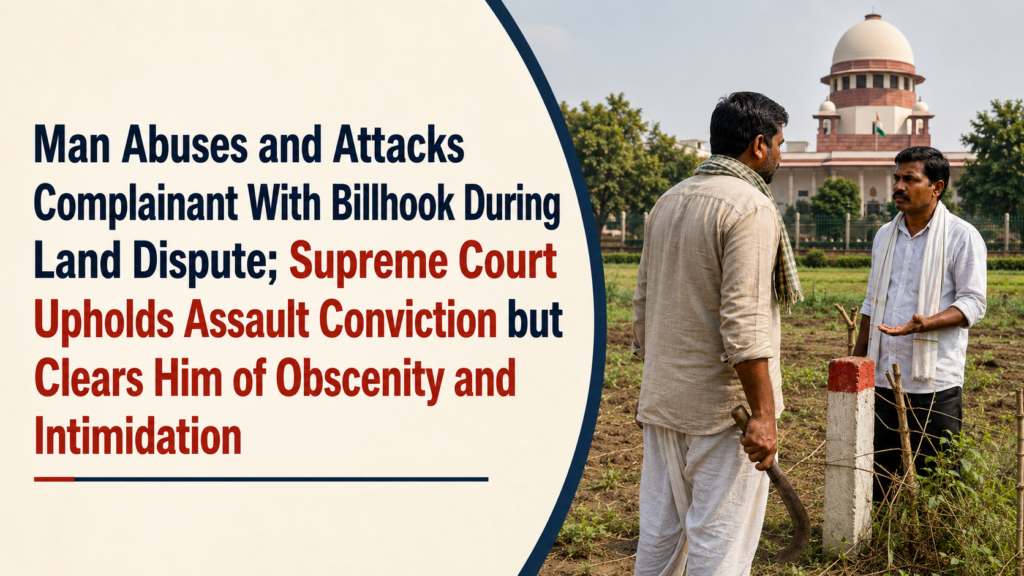
Man Abuses and Attacks Complainant With Billhook During Land Dispute; Supreme Court Upholds Assault Conviction but Clears Him of Obscenity and Intimidation

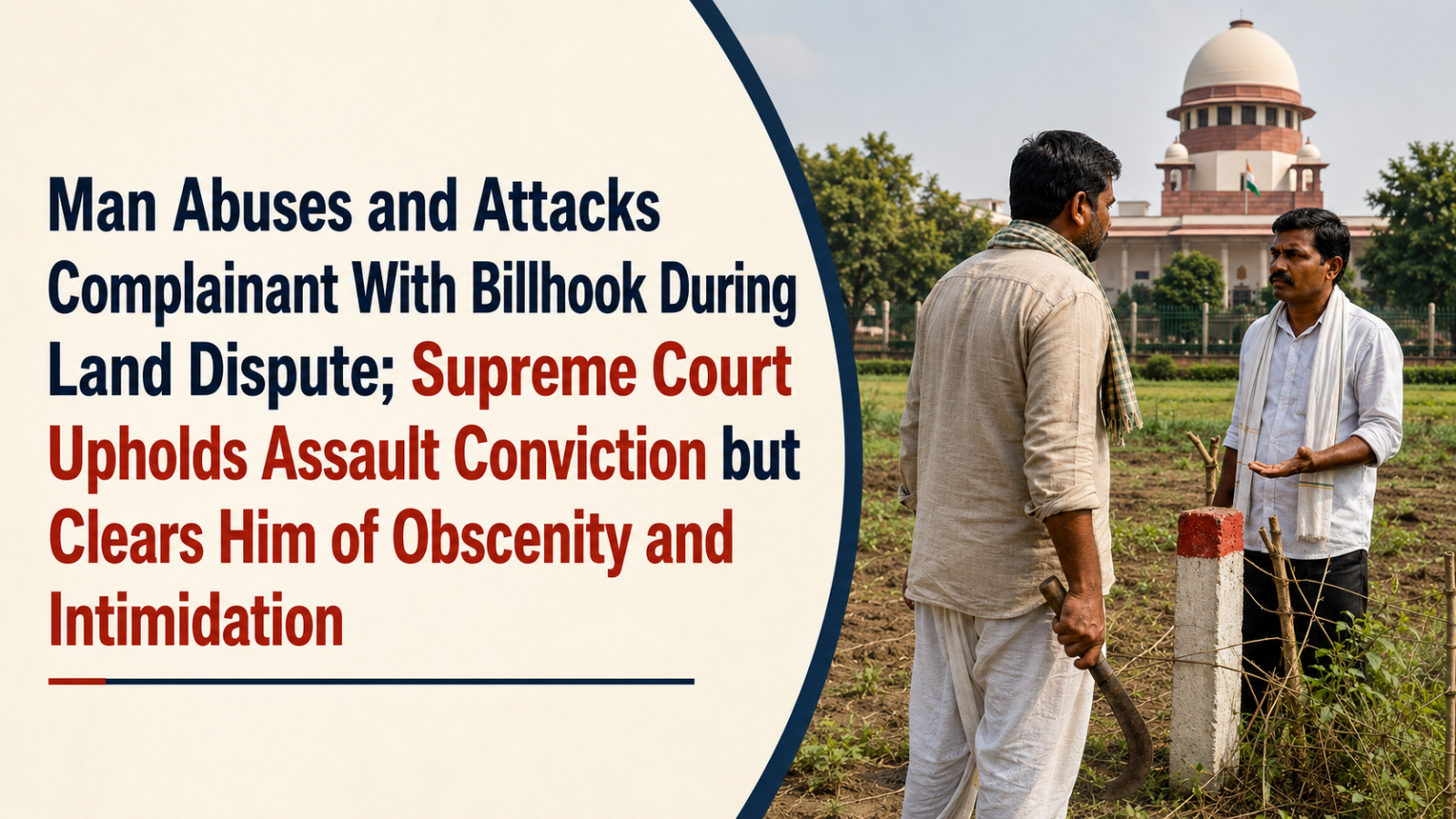
Land Dispute Turns Violent: Supreme Court Clears 70-Year-Old Man of Obscenity and Intimidation but Upholds Assault Conviction
Facts
The dispute arose from an altercation concerning land between the appellant, Mani alias Subramaniyam, and the complainant’s family.
On 22 August 2017, an altercation allegedly occurred between the appellant and Ramasamy, the complainant’s brother-in-law. Two days later, on 24 August 2017, the appellant allegedly quarrelled with the complainant’s nephew over the same land dispute.
When the complainant intervened, the appellant allegedly used abusive and caste-related words against him. The prosecution further alleged that the appellant brought a billhook from his house and assaulted the complainant on his forehead, nose and left thumb.
The complainant was taken to the Government Hospital at Bhavani. A subsequent CT scan revealed a fracture of his nasal bone.
An FIR was registered under Sections 294(b), 324 and 506(ii) of the Indian Penal Code and Sections 3(1)(r), 3(1)(s) and 3(2)(va) of the Scheduled Castes and Scheduled Tribes (Prevention of Atrocities) Act. In the charge sheet, the offence under Section 324 IPC was altered to Section 326 IPC because the injury was classified as grievous.
The Trial Court convicted the appellant of offences under Sections 294(b), 326 and 506(ii) IPC and the relevant provisions of the SC/ST Act.
In appeal, the Madras High Court acquitted the appellant of the offences under the SC/ST Act but maintained his conviction under Sections 294(b), 326 and 506(ii) IPC. It reduced the sentences imposed for the offences under Sections 326 and 506(ii) IPC.
The appellant thereafter approached the Supreme Court.
Issues
- Whether the abusive and vulgar words allegedly used by the appellant amounted to “obscene words” punishable under Section 294(b) IPC.
- Whether the prosecution established that the alleged utterances caused annoyance to others in or near a public place.
- Whether threatening words spoken during the altercation constituted criminal intimidation under Section 506(ii) IPC.
- Whether the prosecution proved that the appellant voluntarily caused grievous hurt to the complainant by using a dangerous weapon, thereby attracting Section 326 IPC.
- Whether the appellant’s age, health and the circumstances surrounding the land dispute justified modification of the sentence.
Petitioner’s Arguments
The appellant maintained that he was innocent and challenged the sustainability of his conviction under Sections 294(b), 326 and 506(ii) IPC.
Regarding Section 294(b), it was contended that the words attributed to him, even if accepted, were merely abusive or vulgar and did not legally amount to obscenity.
Regarding Section 506(ii), the appellant disputed the existence of the necessary ingredients of criminal intimidation, particularly any intention to cause alarm to the complainant.
The appellant also contended that Section 326 IPC was not attracted because the complainant’s injuries were not incised wounds of the kind expected to be caused by a billhook.
The appellant further sought leniency concerning the sentence, considering his advanced age and health condition.
Respondent’s Arguments
The judgment does not separately reproduce the detailed submissions advanced by the State.
The prosecution’s case was that the complainant’s testimony was corroborated by eyewitnesses and medical evidence. The statements of the complainant and other prosecution witnesses established that the appellant abused, threatened and assaulted the complainant with a billhook.
The State relied on the nasal bone fracture and the medical opinion classifying the injury as grievous. It also relied on the doctor’s evidence that the possibility of the injuries being caused by a billhook could not be ruled out.
Thus, the prosecution sought to sustain the conviction based on the consistent eyewitness accounts, medical evidence and recovery or production of the weapon.
Analysis of the Law
Section 294(b) IPC: Obscene Words in a Public Place
For an offence under Section 294(b) IPC, the prosecution must establish:
- The accused sang, recited or uttered an obscene song, ballad or words in or near a public place; and
- Such conduct caused annoyance to others.
The Supreme Court clarified that obscenity is not synonymous with vulgarity, abuse or profanity. An expression does not become legally obscene merely because it is rude, insulting, offensive, uncivil or distasteful.
For words to be considered obscene, they must:
- Be lascivious;
- Appeal to prurient interests; or
- Tend to deprave and corrupt persons exposed to them.
The Court found that the words attributed to the appellant were undoubtedly abusive and vulgar. However, they did not appeal to sexual or lustful interests and did not possess the tendency to deprave or corrupt impressionable minds.
There was also no evidence that the words caused annoyance to other persons in a public place, which is an essential ingredient of Section 294(b) IPC.
Accordingly, the offence under Section 294(b) IPC was not established.
Section 506(ii) IPC: Criminal Intimidation
To establish criminal intimidation, the prosecution must prove:
- A threat of injury to a person, reputation or property;
- An intention to cause alarm; or
- An intention to compel the person threatened to do something he was not legally required to do, or omit something he was legally entitled to do.
The Court held that mere use of threatening words during a heated altercation is insufficient. The prosecution must prove that the accused intended to cause alarm or compel the complainant to act or refrain from acting in a particular manner.
Although the appellant allegedly waved the billhook and threatened to attack the complainant in the future, the record did not establish the necessary intention to cause alarm. The conviction under Section 506(ii) IPC was therefore set aside.
Section 326 IPC: Grievous Hurt by a Dangerous Weapon
Section 326 IPC requires proof of:
- Voluntary causing of hurt;
- The hurt being grievous; and
- The hurt being caused through a dangerous weapon or means.
Under Section 320 IPC, fracture or dislocation of a bone or tooth constitutes grievous hurt.
The complainant had suffered a fractured nasal bone. His evidence was supported by two prosecution witnesses and the medical testimony. The doctor confirmed the fracture and stated that such injuries could have been caused with the billhook.
The Court rejected the argument that Section 326 IPC could not apply because the injuries were not incised wounds. The nasal bone fracture fell squarely within the statutory definition of grievous hurt, while the billhook was undoubtedly a dangerous weapon.
The conviction under Section 326 IPC was therefore upheld.
Precedent Analysis
Ranjit D. Udeshi v. State of Maharashtra
The Constitution Bench explained that material may be considered obscene when it has the tendency to deprave and corrupt susceptible minds. It also recognised the need to balance freedom of speech and expression against public decency and morality.
Chandrakant Kalyandas Kakodkar v. State of Maharashtra
The Court held that the concept of obscenity depends on the morality and standards of contemporary society. The assessment may also be influenced by local customs, traditions and social background.
Aveek Sarkar v. State of West Bengal
The Supreme Court adopted the contemporary community standards test instead of the earlier Hicklin test. Obscenity must be assessed from the perspective of an average person and in the context of the material as a whole.
Samaresh Bose v. Amal Mitra
This decision drew a clear distinction between vulgarity and obscenity. Vulgarity may cause disgust, revulsion or boredom, whereas obscenity tends to deprave and corrupt those exposed to it.
S. Khushboo v. Kanniammal
The decision was relied upon to reinforce the principle that material or expression cannot be criminalised as obscene merely because some individuals find it distasteful or offensive.
Madhanagopal v. Lalitha
The Court held that an offence under Section 294(b) IPC requires words containing a lascivious element capable of arousing sexual thoughts or feelings. It must also be proved that the utterance caused annoyance to others.
Apoorva Arora v. State (NCT of Delhi)
The Court reiterated that vulgarity and profanities do not by themselves amount to obscenity. Words must be considered in their context and from the perspective of an ordinary person of common sense and prudence.
Om Prakash Ambadkar v. State of Maharashtra and Sivakumar v. State
These decisions were cited in support of the distinction between abusive or vulgar language and legally punishable obscenity.
Naresh Aneja v. State of Uttar Pradesh
The Court relied on this decision to identify the ingredients of criminal intimidation. A threat must be accompanied by the intention to cause alarm or compel the person threatened to act or omit to act in a particular manner.
Mathai v. State of Kerala
This decision was relied upon to explain the ingredients of voluntarily causing grievous hurt by a dangerous weapon under Section 326 IPC.
Court’s Reasoning
The Supreme Court held that the High Court had erred in sustaining the appellant’s conviction under Section 294(b) IPC. The words attributed to the appellant were abusive and vulgar but did not satisfy the legal test of obscenity. Further, the prosecution failed to prove that the words caused annoyance to others in a public place.
The conviction under Section 506(ii) IPC was also found unsustainable. A threat spoken during an altercation cannot constitute criminal intimidation unless the prosecution establishes an intention to cause alarm or compel the complainant to do or omit a particular act. No such intention was proved.
However, the Court found sufficient evidence to uphold the conviction under Section 326 IPC. The testimonies of the complainant and eyewitnesses were corroborated by medical evidence. The complainant’s nasal bone fracture constituted grievous hurt, and the injury was proved to have been caused with a dangerous weapon.
While sustaining the conviction under Section 326 IPC, the Court considered that the incident arose from a land dispute and that the appellant was approximately 70 years old and suffering from health problems. It therefore reduced the substantive sentence to imprisonment till the rising of the Court on a date fixed by the concerned court and enhanced the fine to ₹50,000.
Conclusion
The Supreme Court partly allowed the appeal.
It set aside the appellant’s convictions under Sections 294(b) and 506(ii) IPC, holding that abusive or vulgar words do not automatically amount to obscenity and that a threat does not constitute criminal intimidation without proof of an intention to cause alarm.
The conviction under Section 326 IPC was upheld because the complainant’s fractured nasal bone constituted grievous hurt and the evidence established that it was caused with a billhook, a dangerous weapon.
Considering the appellant’s age, health and the background of the land dispute, the sentence was modified to imprisonment till the rising of the Court. The appellant was directed to pay a fine of ₹50,000 within two months.
Case Details
Case: Mani @ Subramaniyam v. State represented by the Deputy Superintendent of Police
Court: Supreme Court of India
Case Number: Criminal Appeal arising out of SLP (Criminal) No. 4516 of 2025; 2026 INSC 719
Judge: Justice Sanjay Karol and Justice Vipul M. Pancholi
Date: 17 July 2026
Result: Appeal partly allowed. Convictions under Sections 294(b) and 506(ii) IPC set aside; conviction under Section 326 IPC upheld. Sentence reduced to imprisonment till the rising of the Court, with a fine of ₹50,000 payable within two months.