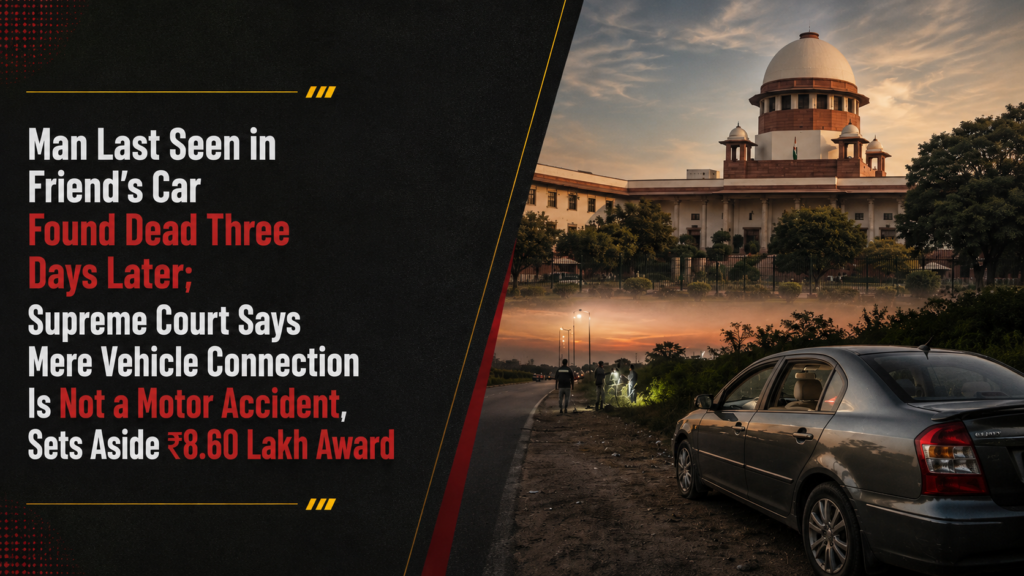
Man Last Seen in Friend’s Car Found Dead Three Days Later; Supreme Court Says Mere Vehicle Connection Is Not a Motor Accident, Sets Aside ₹8.60 Lakh Award

Family Alleged Man Was Killed Inside Friend’s Car; Supreme Court Finds No Evidence Linking Vehicle to Death, Cancels Compensation but Protects Amount Already Paid
Facts
On 29 November 2009, Anand entered a car driven by his friend, Dilip Agarwal. Three days later, on 3 December 2009, Anand was found dead near Binjkot village.
Anand’s wife, Rajshri Agarwal, registered FIR No. 963 of 2009. The charge-sheet alleged that Dilip and two other accused had conspired to kidnap Anand, murder him and dispose of his body.
Dilip was convicted by the Sessions Court under Sections 365, 302, 201 and 120-B of the IPC. However, the High Court acquitted him on 18 November 2015 because the prosecution failed to prove the “last seen together” theory.
Separately, Anand’s widow and three children filed a compensation claim under Section 166 of the Motor Vehicles Act, seeking approximately ₹26 lakh. They alleged that Anand was killed inside Dilip’s car and that the vehicle was used in committing the offence.
Although the Motor Accident Claims Tribunal found that rashness and negligence were not proved, it held that the death arose out of the use of the vehicle. The Tribunal awarded ₹5.64 lakh with 7% interest.
The High Court affirmed the finding of liability and enhanced the total compensation to ₹8,60,832, with 6% interest on the enhanced amount.
Issues
- Whether Anand’s death “arose out of the use of” Dilip’s motor vehicle, thereby attracting liability under the Motor Vehicles Act.
- Whether an alleged murder can be treated as an accident for the purpose of motor accident compensation.
- Whether the mere presence of the car in the chain of events leading to Anand’s death was sufficient to impose liability.
- Whether Dilip’s acquittal in the criminal case automatically defeated the compensation claim.
- Whether the claimants established the necessary connection between the vehicle and the death on the civil standard of preponderance of probabilities.
Petitioner/Appellant’s Arguments
The judgment does not separately reproduce the oral submissions of the advocates. However, the appellant’s case, as apparent from the appeal and the Court’s discussion, was:
- There was no evidence showing that Anand was assaulted, injured or killed inside Dilip’s car.
- No blood, hair, skin cells or other forensic material was recovered from the vehicle.
- The car was not involved in any collision or conventional road accident.
- The medical evidence merely showed injuries caused by hard and blunt objects. It did not connect those injuries with the car.
- The criminal prosecution’s “last seen together” theory had failed, resulting in Dilip’s acquittal.
- Even under the lower civil standard of proof, the claimants had failed to establish that Anand’s death arose out of the use of the vehicle.
- The mere fact that Anand had entered the car before his death could not create liability under the Motor Vehicles Act.
Respondents’ Arguments
The respondents’ position, as reflected in their claim and the findings of the courts below, was:
- Anand had entered Dilip’s vehicle and was subsequently found dead.
- The vehicle was allegedly used in committing the kidnapping and killing.
- A motor accident claim is decided on the preponderance of probabilities and not on the stricter criminal standard of proof beyond reasonable doubt.
- Claimants in motor accident cases are not required to prove the precise manner in which the accident or injuries occurred.
- The expression “arising out of the use of a motor vehicle” has a wider meaning than an injury directly “caused by” the vehicle.
- Dilip’s acquittal in the criminal proceedings did not automatically bar the independent compensation claim.
- Dilip’s alleged failure to specifically deny their version was treated by the Tribunal as supporting the claimants’ case.
Analysis of the Law
The Supreme Court explained that the existence of an accident and the involvement of a motor vehicle are not, by themselves, sufficient to impose liability under the Motor Vehicles Act.
The words “arising out of” provide the necessary causal connection between the vehicle’s use and the injury or death. Although this expression is wider than “caused by” and does not require an immediate or direct connection, some real relationship of cause and consequence must still be established.
A motor vehicle may remain “in use” even when it is stationary. Similarly, an accident may occur without negligence on the part of the driver. However, the claimant must still demonstrate that the death or injury arose from or was sufficiently connected with the use of the vehicle.
The Court also recognised that a murder may, in limited circumstances, be treated as an “accidental murder.” This may happen where the dominant intention is to commit another offence connected with the vehicle and the death occurs incidentally in furtherance of that offence.
Conversely, where the dominant intention is to kill a particular person, the killing is ordinarily murder simpliciter and not an accident.
The Court further clarified that acquittal in a criminal trial does not automatically defeat a civil or motor accident claim. Criminal guilt must be proved beyond reasonable doubt, whereas a compensation claim is decided on the preponderance of probabilities.
Nevertheless, even the lower civil standard requires some reliable evidence. It does not permit liability to be imposed entirely on assumptions or speculation.
Precedent Analysis
- Bruhat Bangalore Mahanagara Palike v. K.K. Umesh Kumar, 2026 SCC OnLine SC 1111
The Court considered a case where a passenger sitting in an autorickshaw parked on the side of the road was injured when a tree branch fell on the vehicle.
The decision explained that the expression “arising out of” is wider than “caused by.” It does not require the vehicle to be the immediate or direct cause of the injury.
However, there must still be a causal relationship between the use of the vehicle and the injury. The Supreme Court applied this principle in the present case and held that the wider meaning of “arising out of” did not eliminate the requirement of establishing some link between Dilip’s car and Anand’s death.
- Shivaji Dayanu Patil v. Vatschala Uttam More
This decision held that the word “use” in relation to motor vehicles must be understood broadly.
A vehicle does not cease to be in use merely because it is stationary, parked, immobilised due to a breakdown or unable to move because of an accident.
The Supreme Court relied upon this decision to explain the wide scope of “use.” However, it found that the present claim failed not because the car was stationary or moving, but because there was no evidence connecting the car with Anand’s fatal injuries.
- Government Insurance Office of New South Wales v. R.J. Green
This Australian decision distinguished between injuries “caused by” the use of a vehicle and injuries “arising out of” its use.
“Caused by” requires a direct or proximate relationship. “Arising out of” permits a less immediate relationship, but it must still carry a sense of consequence.
The Supreme Court applied this distinction and held that, even though a remote connection may sometimes be sufficient, the present case disclosed no proven connection between the car and the death.
- National Insurance Co. Ltd. v. Swaran Singh, (2004) 3 SCC 297
This judgment explained that an accident may occur for several reasons and that the driver may not necessarily be negligent in every case.
An accident may arise from an unforeseen situation, the victim’s conduct, the condition of the road or the act or omission of another person.
Therefore, absence of driver negligence was not, by itself, decisive. Nevertheless, the claimants were still required to prove that the death arose out of the use of the vehicle. That essential requirement was not satisfied.
- Rita Devi v. New India Assurance Co. Ltd., (2000) 5 SCC 113
In Rita Devi, an autorickshaw driver was murdered in furtherance of the theft of the autorickshaw. The dominant intention of the offenders was to steal the vehicle, while the driver’s murder occurred in furtherance of that theft.
The Court held that such a killing could be treated as an “accidental murder” because the death arose out of a felonious act directly connected with the vehicle.
The Supreme Court distinguished Rita Devi in the present case. There was no evidence establishing the circumstances in which Anand was killed or demonstrating that his death occurred in furtherance of an offence connected with the use of Dilip’s car.
- ICICI Lombard General Insurance Co. Ltd. v. Rajani Sahoo, (2025) 2 SCC 599
This decision reiterated that the standard of proof in motor accident claims is the preponderance of probabilities and not proof beyond reasonable doubt.
A criminal acquittal does not automatically result in the dismissal of a compensation claim because criminal and civil proceedings apply different standards of proof.
The Supreme Court applied this principle and independently examined whether the claimants’ case was more probable than not. It found that even this lower standard had not been satisfied.
- Mathew Alexander v. Mohd. Shafi, (2023) 13 SCC 510
This judgment similarly recognised that the result of criminal proceedings is not conclusive in a motor accident claim.
The Tribunal must independently assess the evidence on the civil standard of preponderance of probabilities.
In the present case, the Supreme Court did not treat Dilip’s acquittal as automatically defeating the claim. The claim failed because the evidence itself did not connect the vehicle with the death.
- N.K.V. Bros. (P) Ltd. v. M. Karumai Ammal, (1980) 3 SCC 457
The Court held that an acquittal for a criminal offence involving rashness or negligence does not necessarily defeat civil liability.
Criminal culpability involves a higher and more stringent standard than negligence under civil or tort law.
Therefore, Dilip’s acquittal was not conclusive. However, the claimants were still required to establish the basic facts necessary to impose civil liability.
- Bimla Devi v. Himachal Road Transport Corporation, (2009) 13 SCC 530
This decision held that claimants are not required to prove the occurrence of a motor accident with the same strictness demanded in a criminal trial.
The Tribunal must take a holistic view of the evidence and decide the matter on the preponderance of probabilities.
The Supreme Court clarified that this relaxation does not permit the Tribunal to presume that injuries were sustained inside a vehicle without supporting evidence.
- Dulcina Fernandes v. Joaquim Xavier Cruz, (2013) 10 SCC 646
This judgment reaffirmed that strict proof of the precise manner in which a motor accident occurred is not always necessary.
The claimant may establish the case through the overall circumstances and surrounding evidence.
However, the present claimants failed to produce even circumstantial or forensic evidence connecting Anand’s fatal injuries with Dilip’s car.
- N.G. Dastane v. S. Dastane, (1975) 2 SCC 326
This judgment explained that a fact in a civil proceeding is proved when the Court considers its existence more probable than its non-existence.
The probabilities must first be identified and then weighed. The gravity of the allegation may require closer scrutiny, although the applicable standard remains the preponderance of probabilities.
Applying this test, the Supreme Court found that the evidence did not make it probable that Anand was assaulted or sustained fatal injuries inside Dilip’s car.
Court’s Reasoning
The Supreme Court found that the MACT and the High Court had effectively assumed that Anand’s fatal injuries were inflicted while he and Dilip were inside the car. There was no evidentiary basis for that assumption.
The Court emphasised that:
- The “last seen together” theory had not been proved in the criminal proceedings.
- No forensic material such as blood, hair, skin cells or other biological traces was recovered from the car.
- The vehicle was not alleged to have been involved in any collision.
- The medical evidence only established that Anand suffered injuries from hard and blunt objects.
- Nothing showed that those objects formed part of the car or that the injuries were inflicted inside the vehicle.
- The claimants were not required to establish the precise manner in which Anand died, but they were required to establish at least some connection between the car and his death.
- The mere appearance of the car somewhere in the chain of events was insufficient to attract the Motor Vehicles Act.
The Court concluded that even on the comparatively lighter standard of preponderance of probabilities, the essential causal link had not been established.
Conclusion
The Supreme Court held that although the case involved an alleged accidental murder and a motor vehicle, the relationship between the two had not been proved.
Anand’s death could not, therefore, be treated as arising out of the use of Dilip’s vehicle.
The Court consequently:
- Allowed the appeals;
- Set aside the judgments of the MACT and the High Court;
- Held that no liability could be imposed under the Motor Vehicles Act; and
- Directed that any compensation already paid to Anand’s family should not be recovered from them.
Case Details
Case: Dilip Agarwal v. Rajshri Agarwal & Ors.
Court: Supreme Court of India, Civil Appellate Jurisdiction
Case Number: Civil Appeal Nos. ___ of 2026, arising out of SLP(C) Nos. 9002–03 of 2026
Neutral Citation: 2026 INSC 736
Judges: Justice Sanjay Karol and Justice Augustine George Masih
Judgment authored by: Justice Sanjay Karol
Date: 22 July 2026
Result: Appeals allowed; MACT and High Court judgments set aside. No liability under the Motor Vehicles Act, but any compensation already paid was protected from recovery.