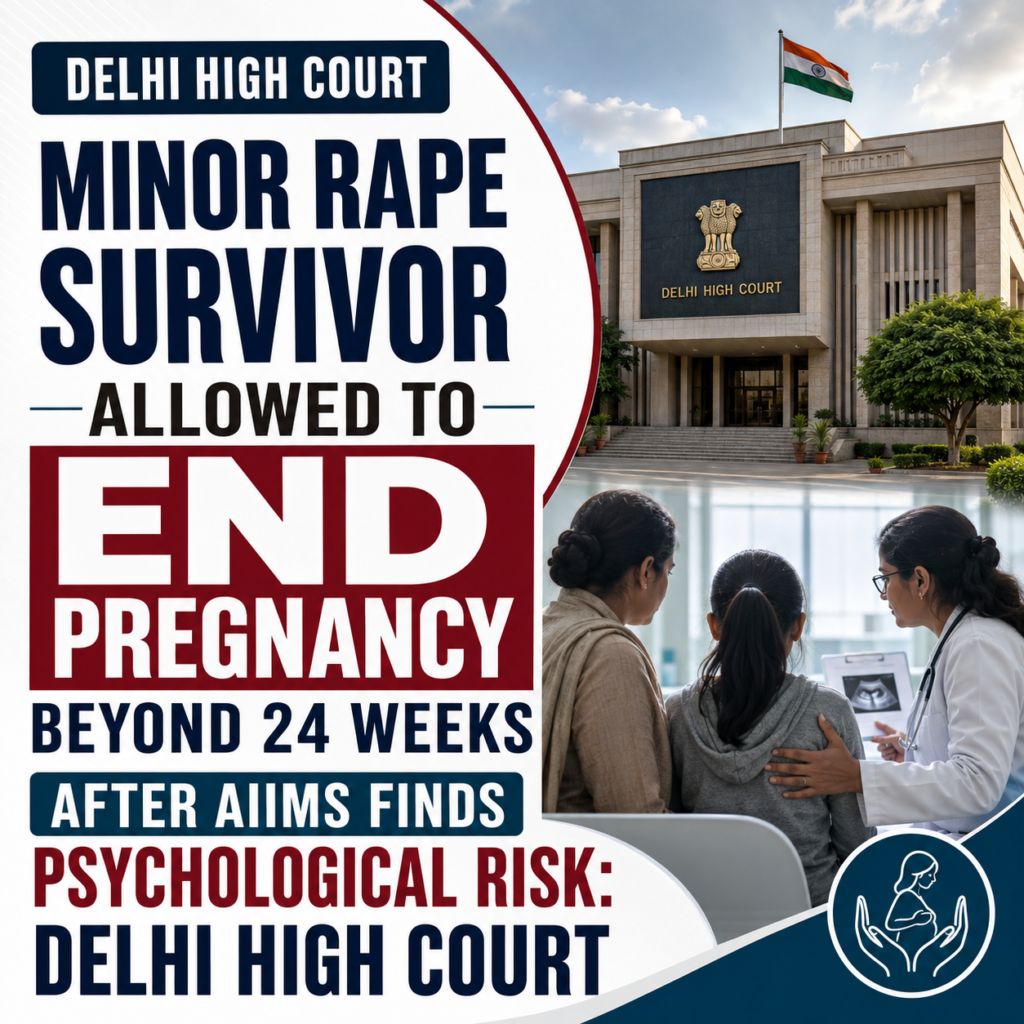
Minor Rape Survivor Allowed to End Pregnancy Beyond 24 Weeks After AIIMS Finds Psychological Risk: Delhi High Court

Delhi High Court Allows Medical Termination of Advanced Pregnancy After Minor and Father Seek Relief
Facts
The petitioner was a 15-year-old minor rape survivor who approached the Delhi High Court through her father seeking permission to terminate her pregnancy.
The pregnancy was approximately 26–28 weeks old and had crossed the ordinary statutory limit under the Medical Termination of Pregnancy Act, 1971.
The minor and her father both wished to terminate the pregnancy, contending that its continuation would cause grave mental and psychological injury.
The AIIMS Medical Board examined the minor through obstetric, psychiatric and psychological assessment. It found her medically fit for termination and stated that continuation of the pregnancy was likely to adversely affect her psychological health.
The Government of NCT of Delhi did not oppose the request.
Issues
- Whether a minor rape survivor could be permitted to terminate a pregnancy beyond 24 weeks.
- Whether the statutory limit under the MTP Act prevented the High Court from exercising jurisdiction under Article 226.
- Whether forcing the minor to continue the pregnancy would violate her rights under Article 21.
- Whether the AIIMS Medical Board’s opinion justified medical termination.
- What safeguards were required for the procedure, preservation of evidence and possible live birth.
Petitioner’s Arguments
The petitioner argued that:
- the pregnancy resulted from rape and was unwanted;
- continuation would cause grave mental, emotional and psychological trauma;
- reproductive autonomy, dignity and bodily integrity are protected under Article 21;
- the High Court could exercise constitutional jurisdiction even though the pregnancy had crossed 24 weeks;
- the AIIMS Medical Board had found her medically fit for termination; and
- both the minor and her father had clearly consented to the procedure.
Respondent’s Arguments
The Government of NCT of Delhi stated that it had no objection to termination in view of the AIIMS Medical Board’s report.
AIIMS did not appear when the matter was called, but its medical opinion was already placed before the Court.
The State requested the Court to pass appropriate orders with necessary safeguards.
Analysis of the Law
The Court held that the MTP Act ordinarily restricts termination beyond 24 weeks, except in specified situations.
However, the absence of a statutory remedy does not eliminate the constitutional remedy available under Article 226.
The right to make decisions concerning one’s body, pregnancy and reproduction forms part of:
- personal liberty;
- privacy;
- dignity;
- bodily integrity; and
- decisional autonomy under Article 21.
In cases of rape, an unwanted pregnancy may itself cause grave mental injury.
The Court held that the minor’s wishes and welfare must be given primacy, particularly when medical experts confirm that termination can be undertaken and that continuation may cause psychological harm.
Precedent Analysis
The Court relied upon decisions where constitutional courts had permitted termination beyond 24 weeks, particularly in cases involving rape survivors and minors.
These included:
- Minor J Through Mother P v. State;
- S v. State;
- A (Mother of X) v. State of Maharashtra;
- Venkatalakshmi v. State of Karnataka;
- C v. State (NCT of Delhi);
- S v. Union of India;
- X v. Health and Family Welfare Department; and
- Suchita Srivastava v. Chandigarh Administration.
These judgments recognised that reproductive choice and bodily autonomy are protected under Article 21 and that courts may grant constitutional relief even where the statutory framework does not directly provide a remedy.
Court’s Reasoning
The Court noted that:
- the petitioner was a minor rape survivor;
- the pregnancy was unwanted;
- both the minor and her father wanted termination;
- the AIIMS Medical Board found her medically fit;
- continuation of pregnancy was likely to adversely affect her mental health; and
- the State did not oppose the request.
The Court held that the gestational limit could not be applied mechanically when doing so would violate the minor’s dignity, autonomy and mental well-being.
It therefore permitted termination subject to medical and evidentiary safeguards.
Conclusion
The Delhi High Court allowed the petition and permitted the minor to undergo medical termination of pregnancy at AIIMS, New Delhi.
The Court directed that:
- the procedure be conducted by competent doctors;
- complete medical records be maintained;
- fetal tissue be preserved for DNA testing in the criminal case;
- the State bear all medical, hospitalisation and post-operative expenses;
- appropriate medical support be provided in case of a live birth; and
- any child born alive may be placed for adoption in accordance with law, as desired by the minor and her father.
Case: Minor R, Through Her Father R v. State NCT of Delhi & Anr.
Court: High Court of Delhi at New Delhi
Case Number: W.P.(CRL.) 1804 of 2026
Judge: Justice Mini Pushkarna
Date: 24 June 2026
Result: Petition allowed; the minor rape survivor was permitted to terminate her approximately 26–28 week pregnancy at AIIMS, with the State directed to bear the expenses and preserve fetal tissue for DNA testing.