Karnataka High Court Doubles Compensation to ₹32.11 Lakh for Family of Woman Killed in Husband-Driven Car, Rejects Insurer’s Spousal Exclusion Claim

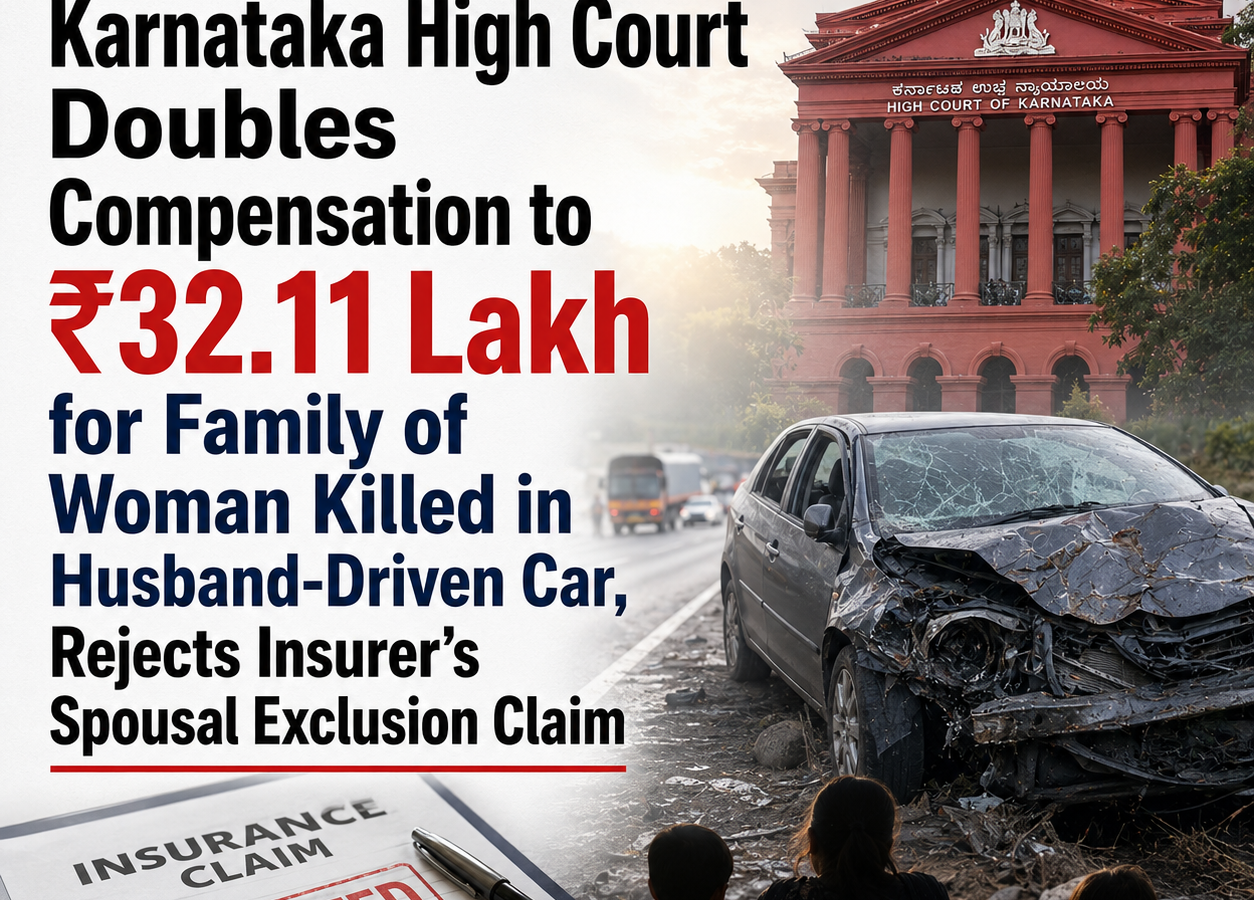
Motor Accident Award Doubled After Tribunal Wrongly Used Net Salary and Deducted Half as Personal Expenses
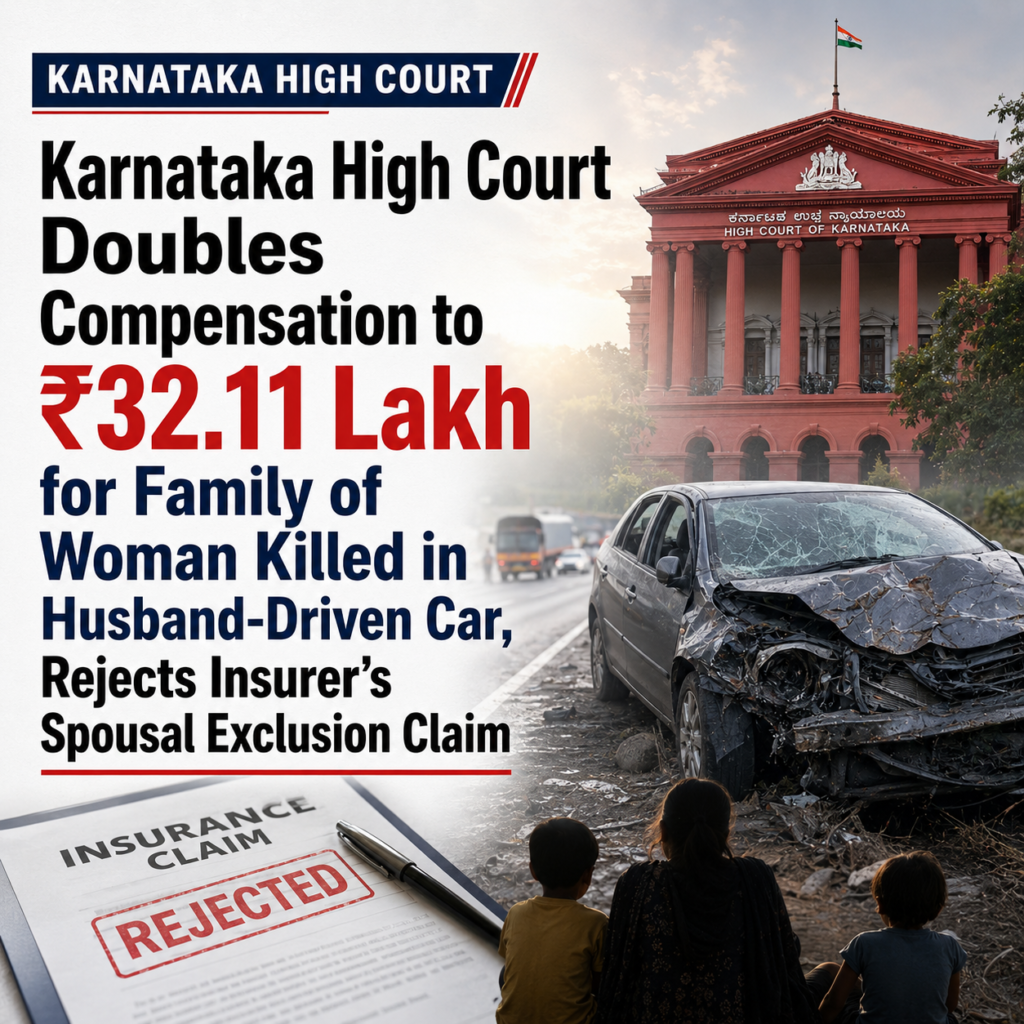
The Karnataka High Court enhanced motor accident compensation from ₹16,06,020 to ₹32,11,519 for the family of a woman who died after a car driven by her husband fell into a roadside ditch while attempting to avoid a cow.
A Division Bench of Justice Jayant Banerji and Justice Tara Vitasta Ganju rejected Oriental Insurance Company’s contention that the comprehensive policy did not cover liability arising from negligence between spouses. The Court held that the policy contained no exclusion for such liability and that the deceased, being a passenger in the insured car, was entitled to compensation through her legal representatives.
The Court recalculated the award by considering the deceased’s proved gross salary, adding 25% future prospects, deducting one-third toward personal expenses, and granting consortium to her husband and two children.
Facts
On 23 June 2013, Zubera Begum was travelling with her husband and children in a Tata Indica car bearing Registration No. KA-04-ME-1577 on the Bengaluru-Hyderabad Highway.
When the vehicle reached Tamminayanipalli Village in Gorantla Mandal, a cow suddenly crossed the road.
Zubera Begum’s husband, Shaik Nisar Ahmed, who was driving the vehicle, turned the steering sharply to the left in an attempt to avoid hitting the cow.
The driver lost control of the car, and it fell into a roadside ditch.
Zubera Begum sustained serious injuries, including a head injury. She was admitted to Sagar Apollo Hospital in Bengaluru, where she remained under treatment for nine days.
She died from the accident-related injuries on 1 July 2013.
Her two minor sons filed a claim petition under Section 166 of the Motor Vehicles Act, 1988, seeking ₹50 lakh in compensation. They were represented through their maternal or family guardian.
The claimants stated that the deceased was 44 years old and employed as a Junior Assistant with Amanath Co-operative Bank Limited. Her monthly gross salary was shown as ₹18,580.55.
The Motor Accident Claims Tribunal found that the accident occurred due to the rash and negligent driving of the deceased’s husband, who was also the owner-cum-driver of the insured car.
Since Zubera Begum was a passenger in the vehicle, the Tribunal held that the claim against the insurer was maintainable.
The Tribunal awarded ₹16,06,020 with interest at 6% per annum.
Oriental Insurance Company challenged both its liability and the amount awarded.
The claimants filed a separate appeal seeking enhancement of compensation.
The appeals had earlier been decided in 2021, but the judgment was subsequently recalled after an application pointed out calculation errors concerning deduction toward personal expenses and omission of medical expenses.
The matters were therefore reheard and decided afresh.
Issues
The principal issues before the High Court were:
- Whether the accident occurred due to the negligence of the owner-cum-driver of the insured car.
- Whether the legal representatives of a passenger could maintain a claim against the insurer when the negligent driver was the deceased passenger’s husband.
- Whether the insurance policy excluded liability arising between spouses or close family members.
- Whether the Tribunal correctly calculated the deceased’s income for determining loss of dependency.
- Whether deductions such as provident fund, loan repayments, insurance premium and other personal deductions could be excluded from the deceased’s income.
- Whether 25% future prospects had to be added to the deceased’s income.
- Whether one-third or one-half of the income should be deducted toward the deceased’s personal expenses.
- Whether the husband and children were each separately entitled to consortium.
- Whether the compensation awarded by the Tribunal required enhancement.
Petitioner’s Arguments
Oriental Insurance Company’s Arguments
Oriental Insurance Company argued that the Tribunal had failed to properly determine negligence.
It contended that the accident claim was doubtful because the complaint had been lodged nine days after the accident.
The insurer argued that the accident occurred because of the negligent driving of the deceased’s husband and not merely because a cow crossed the road.
It further contended that the insurance policy did not cover liability toward the insured’s “kith and kin.”
According to the insurer, a tortious claim between husband and wife was not covered under the policy.
The insurer relied upon academic material concerning interspousal immunity and tort actions between spouses.
It therefore sought to avoid liability for payment of compensation.
The insurer also challenged the quantum awarded by the Tribunal.
Claimants’ Arguments
The minor children argued that the Tribunal had already specifically framed and decided the issue of negligence.
They pointed out that the insurer had not raised any effective ground in appeal challenging the Tribunal’s finding that the accident occurred due to the husband’s negligent driving.
The claimants submitted that the deceased’s gross salary of ₹18,580.55 had been proved through a salary certificate and the oral evidence of an official from Amanath Co-operative Bank.
They argued that the Tribunal had wrongly adopted the net salary of ₹13,400.55 after deducting amounts such as provident fund contribution, staff loan, consumer loan and LIC premium.
According to them, these were not statutory taxes and could not be deducted while assessing income for compensation.
The claimants further submitted that:
- 25% had to be added toward future prospects;
- only one-third should be deducted toward personal expenses;
- the multiplier of 14 was applicable;
- medical expenses of ₹4,45,375 had to be included; and
- consortium had to be separately awarded to the husband and both children.
They sought enhancement of the total compensation.
Respondent’s Arguments
In the insurer’s appeal, the claimants opposed any reduction or denial of compensation.
They argued that the policy was a comprehensive motor insurance policy and contained no clause excluding liability merely because the deceased passenger was the wife of the driver.
They contended that the deceased was a third-party passenger for the purpose of the claim and that her legal representatives were entitled to recover compensation from the insurer.
The claimants also relied upon the FIR, charge sheet, Motor Vehicle Inspection Report and post-mortem report to establish negligence and causation.
In the claimants’ appeal, the insurer opposed enhancement and defended the Tribunal’s calculation.
However, it did not dispute that the medical bills had been produced or that the deceased’s salary certificate had been proved through the employer’s witness.
Analysis of the Law
Negligence Under Section 166 of the Motor Vehicles Act
A claim under Section 166 requires proof that the accident arose from the use of a motor vehicle and was caused by rash or negligent driving.
The Court examined:
- the complaint;
- the First Information Report;
- the charge sheet;
- the Motor Vehicle Inspection Report;
- the post-mortem report; and
- the evidence recorded before the Tribunal.
The charge sheet stated that although a cow had suddenly crossed the road, the driver was travelling at high speed and turned sharply to the extreme left, lost control and caused the car to fall into a ditch.
The Motor Vehicle Inspection Report confirmed that the accident did not result from any mechanical defect. The braking and steering systems were found to be intact.
The Court therefore held that negligence on the part of the owner-cum-driver stood proved.
The fact that the cow suddenly crossed the road did not absolve the driver when the evidence showed that excessive speed and loss of control contributed to the accident.
Claim by Passenger Against Insurer
The deceased was travelling as a passenger in the insured vehicle.
Although the negligent driver was her husband, the Court held that this relationship did not defeat the claim.
The Court examined the insurance policy and found that it was a comprehensive policy covering both own damage and third-party liability.
The listed exclusions related to matters such as:
- use for hire or reward;
- carriage of goods;
- organised racing;
- speed testing;
- reliability trials; and
- use connected with motor trade.
There was no exclusion for liability arising from injury or death caused to the spouse or other family member of the insured.
The Court held that liability could not be denied on the basis of academic articles concerning interspousal immunity when the policy itself contained no such exclusion.
Determination of Income
The deceased’s salary certificate showed a gross monthly salary of ₹18,580.55.
The deductions included:
- employee provident fund;
- professional tax;
- staff loan;
- consumer loan; and
- LIC premium.
The Tribunal had adopted the net salary of ₹13,400.55.
The High Court instead relied upon the proved gross salary for calculating dependency, subject only to legally permissible deductions such as income tax.
Loan repayments, savings, insurance premiums and provident fund contributions could not be treated as reductions in earning capacity because many of those amounts ultimately benefited the employee or her family.
Future Prospects
The deceased was 44 years old and employed in a regular salaried position.
The Court added 25% to her income toward future prospects.
Her monthly income for computation was therefore increased from ₹18,580 to ₹23,225.
Personal Expenses and Multiplier
The deceased was survived by her husband and two minor children.
Although the two children were the formal claimants, the husband was also a surviving dependent and legal representative.
The Court applied a one-third deduction toward the deceased’s personal and living expenses.
Considering her age of 44 years, the Court applied the multiplier of 14.
The loss of dependency was calculated as:
₹18,580 + 25% future prospects = ₹23,225
After deducting one-third toward personal expenses, the monthly contribution was taken as approximately ₹15,483.
Applying the multiplier of 14, the total loss of dependency was fixed at ₹26,01,144.
Consortium
The Court held that consortium is not confined only to a surviving spouse.
It includes:
- spousal consortium;
- parental consortium; and
- filial consortium.
The two children were entitled to parental consortium for the loss of their mother’s care, protection, guidance and affection.
The husband was separately entitled to spousal consortium for loss of companionship, care, comfort and society.
The Court awarded a total of ₹1,32,000 under this head after applying the legally permissible enhancement.
Conventional Heads and Medical Expenses
The Court awarded:
- ₹16,500 toward loss of estate;
- ₹16,500 toward funeral expenses; and
- ₹4,45,375 toward medical expenses.
It held that a separate amount for loss of love and affection could not be awarded because that component is included within consortium.
Precedent Analysis
Sarla Verma v. Delhi Transport Corporation
The Supreme Court formulated standard principles for selecting the multiplier and determining deductions toward personal expenses.
The Karnataka High Court applied multiplier 14 based on the deceased’s age and adopted a one-third deduction considering the number of dependants.
Reshma Kumari v. Madan Mohan
The Supreme Court approved the multiplier table laid down in Sarla Verma to ensure uniformity and consistency in motor accident compensation.
This precedent reinforced the application of multiplier 14 in the present case.
National Insurance Co. Ltd. v. Pranay Sethi
The Constitution Bench held that future prospects must be added to the established income of the deceased.
It also clarified that income for this purpose means actual income after deduction of tax, rather than after deducting personal loan repayments or voluntary savings.
The decision recognised only three principal conventional heads:
- loss of estate;
- loss of consortium; and
- funeral expenses.
The High Court relied upon these principles while recalculating the award.
United India Insurance Co. Ltd. v. Satinder Kaur
The Supreme Court held that consortium includes spousal, parental and filial consortium.
It further held that loss of love and affection should not be separately awarded because it is already included within the broader concept of consortium.
The Karnataka High Court applied this decision to grant consortium separately to the husband and the two children.
Magma General Insurance Co. Ltd. v. Nanu Ram
The Supreme Court gave a broad meaning to consortium, recognising the loss of company, care, protection, comfort, guidance and affection suffered by different family members.
This principle supported the award of parental consortium to the children and spousal consortium to the husband.
Court’s Reasoning
The Court found that the Tribunal had expressly framed the issue of negligence and decided it after examining the evidence.
The FIR and charge sheet named the husband as the driver responsible for the accident.
The charge sheet specifically stated that he was driving at high speed and lost control after steering sharply to avoid a cow.
The Motor Vehicle Inspection Report ruled out mechanical failure.
The Court therefore rejected the insurer’s claim that negligence had not been proved.
On liability, the Court found that Oriental Insurance had issued a comprehensive policy.
Nothing in the policy excluded a claim merely because the deceased passenger was the wife of the negligent driver.
The insurer’s reliance upon articles discussing interspousal immunity was therefore irrelevant to the contractual terms of the policy and the statutory claim under the Motor Vehicles Act.
The Court further found that the Tribunal had undervalued the deceased’s income by using the net paid salary.
The salary certificate and employer’s evidence proved a gross salary of ₹18,580.55.
Amounts deducted toward provident fund, loans and LIC premium were not amounts that reduced her actual earning capacity.
The Court added 25% future prospects, applied the multiplier of 14 and deducted one-third toward personal expenses.
It also held that the husband’s entitlement to consortium could not be ignored merely because the two minor children were the principal claimants.
The Tribunal’s award of ₹16,06,020 was therefore found inadequate.
Conclusion
The Karnataka High Court dismissed the appeal filed by Oriental Insurance Company and partly allowed the appeal filed by the claimants.
The Court modified the Tribunal’s award as follows:
- Loss of dependency: ₹26,01,144
- Loss of consortium: ₹1,32,000
- Loss of estate: ₹16,500
- Funeral expenses: ₹16,500
- Medical expenses: ₹4,45,375
The total compensation was enhanced to ₹32,11,519.
Since the Tribunal had already awarded ₹16,06,020, the additional enhanced compensation payable was ₹16,05,499.
The entire amount would carry interest at 6% per annum from the date of the claim petition until realisation.
Oriental Insurance Company was directed to deposit the enhanced amount with interest within eight weeks.
The amount deposited before the High Court was directed to be transmitted to the Motor Accident Claims Tribunal and released to the claimants upon filing an appropriate application.
Case: Oriental Insurance Co. Ltd. v. Shaik Touseef Ahmed & Ors., connected with Shaik Touseef Ahmed & Anr. v. Oriental Insurance Co. Ltd. & Anr.
Court: High Court of Karnataka at Bengaluru
Case Number: Miscellaneous First Appeal No. 5646 of 2015 connected with Miscellaneous First Appeal No. 8670 of 2015
Judges: Justice Jayant Banerji and Justice Tara Vitasta Ganju
Date: 23 June 2026
Result: Insurer’s appeal dismissed; claimants’ appeal partly allowed; compensation enhanced from ₹16,06,020 to ₹32,11,519 with 6% annual interest, and Oriental Insurance directed to deposit the enhanced amount within eight weeks.
Karnataka High Court Doubles Compensation to ₹32.11 Lakh for Family of Woman Killed in Husband-Driven Car, Rejects Insurer’s Spousal Exclusion Claim
Motor Accident Award Doubled After Tribunal Wrongly Used Net Salary and Deducted Half as Personal Expenses
The Karnataka High Court enhanced motor accident compensation from ₹16,06,020 to ₹32,11,519 for the family of a woman who died after a car driven by her husband fell into a roadside ditch while attempting to avoid a cow.
A Division Bench of Justice Jayant Banerji and Justice Tara Vitasta Ganju rejected Oriental Insurance Company’s contention that the comprehensive policy did not cover liability arising from negligence between spouses. The Court held that the policy contained no exclusion for such liability and that the deceased, being a passenger in the insured car, was entitled to compensation through her legal representatives.
The Court recalculated the award by considering the deceased’s proved gross salary, adding 25% future prospects, deducting one-third toward personal expenses, and granting consortium to her husband and two children.
Facts
On 23 June 2013, Zubera Begum was travelling with her husband and children in a Tata Indica car bearing Registration No. KA-04-ME-1577 on the Bengaluru-Hyderabad Highway.
When the vehicle reached Tamminayanipalli Village in Gorantla Mandal, a cow suddenly crossed the road.
Zubera Begum’s husband, Shaik Nisar Ahmed, who was driving the vehicle, turned the steering sharply to the left in an attempt to avoid hitting the cow.
The driver lost control of the car, and it fell into a roadside ditch.
Zubera Begum sustained serious injuries, including a head injury. She was admitted to Sagar Apollo Hospital in Bengaluru, where she remained under treatment for nine days.
She died from the accident-related injuries on 1 July 2013.
Her two minor sons filed a claim petition under Section 166 of the Motor Vehicles Act, 1988, seeking ₹50 lakh in compensation. They were represented through their maternal or family guardian.
The claimants stated that the deceased was 44 years old and employed as a Junior Assistant with Amanath Co-operative Bank Limited. Her monthly gross salary was shown as ₹18,580.55.
The Motor Accident Claims Tribunal found that the accident occurred due to the rash and negligent driving of the deceased’s husband, who was also the owner-cum-driver of the insured car.
Since Zubera Begum was a passenger in the vehicle, the Tribunal held that the claim against the insurer was maintainable.
The Tribunal awarded ₹16,06,020 with interest at 6% per annum.
Oriental Insurance Company challenged both its liability and the amount awarded.
The claimants filed a separate appeal seeking enhancement of compensation.
The appeals had earlier been decided in 2021, but the judgment was subsequently recalled after an application pointed out calculation errors concerning deduction toward personal expenses and omission of medical expenses.
The matters were therefore reheard and decided afresh.
Issues
The principal issues before the High Court were:
- Whether the accident occurred due to the negligence of the owner-cum-driver of the insured car.
- Whether the legal representatives of a passenger could maintain a claim against the insurer when the negligent driver was the deceased passenger’s husband.
- Whether the insurance policy excluded liability arising between spouses or close family members.
- Whether the Tribunal correctly calculated the deceased’s income for determining loss of dependency.
- Whether deductions such as provident fund, loan repayments, insurance premium and other personal deductions could be excluded from the deceased’s income.
- Whether 25% future prospects had to be added to the deceased’s income.
- Whether one-third or one-half of the income should be deducted toward the deceased’s personal expenses.
- Whether the husband and children were each separately entitled to consortium.
- Whether the compensation awarded by the Tribunal required enhancement.
Petitioner’s Arguments
Oriental Insurance Company’s Arguments
Oriental Insurance Company argued that the Tribunal had failed to properly determine negligence.
It contended that the accident claim was doubtful because the complaint had been lodged nine days after the accident.
The insurer argued that the accident occurred because of the negligent driving of the deceased’s husband and not merely because a cow crossed the road.
It further contended that the insurance policy did not cover liability toward the insured’s “kith and kin.”
According to the insurer, a tortious claim between husband and wife was not covered under the policy.
The insurer relied upon academic material concerning interspousal immunity and tort actions between spouses.
It therefore sought to avoid liability for payment of compensation.
The insurer also challenged the quantum awarded by the Tribunal.
Claimants’ Arguments
The minor children argued that the Tribunal had already specifically framed and decided the issue of negligence.
They pointed out that the insurer had not raised any effective ground in appeal challenging the Tribunal’s finding that the accident occurred due to the husband’s negligent driving.
The claimants submitted that the deceased’s gross salary of ₹18,580.55 had been proved through a salary certificate and the oral evidence of an official from Amanath Co-operative Bank.
They argued that the Tribunal had wrongly adopted the net salary of ₹13,400.55 after deducting amounts such as provident fund contribution, staff loan, consumer loan and LIC premium.
According to them, these were not statutory taxes and could not be deducted while assessing income for compensation.
The claimants further submitted that:
- 25% had to be added toward future prospects;
- only one-third should be deducted toward personal expenses;
- the multiplier of 14 was applicable;
- medical expenses of ₹4,45,375 had to be included; and
- consortium had to be separately awarded to the husband and both children.
They sought enhancement of the total compensation.
Respondent’s Arguments
In the insurer’s appeal, the claimants opposed any reduction or denial of compensation.
They argued that the policy was a comprehensive motor insurance policy and contained no clause excluding liability merely because the deceased passenger was the wife of the driver.
They contended that the deceased was a third-party passenger for the purpose of the claim and that her legal representatives were entitled to recover compensation from the insurer.
The claimants also relied upon the FIR, charge sheet, Motor Vehicle Inspection Report and post-mortem report to establish negligence and causation.
In the claimants’ appeal, the insurer opposed enhancement and defended the Tribunal’s calculation.
However, it did not dispute that the medical bills had been produced or that the deceased’s salary certificate had been proved through the employer’s witness.
Analysis of the Law
Negligence Under Section 166 of the Motor Vehicles Act
A claim under Section 166 requires proof that the accident arose from the use of a motor vehicle and was caused by rash or negligent driving.
The Court examined:
- the complaint;
- the First Information Report;
- the charge sheet;
- the Motor Vehicle Inspection Report;
- the post-mortem report; and
- the evidence recorded before the Tribunal.
The charge sheet stated that although a cow had suddenly crossed the road, the driver was travelling at high speed and turned sharply to the extreme left, lost control and caused the car to fall into a ditch.
The Motor Vehicle Inspection Report confirmed that the accident did not result from any mechanical defect. The braking and steering systems were found to be intact.
The Court therefore held that negligence on the part of the owner-cum-driver stood proved.
The fact that the cow suddenly crossed the road did not absolve the driver when the evidence showed that excessive speed and loss of control contributed to the accident.
Claim by Passenger Against Insurer
The deceased was travelling as a passenger in the insured vehicle.
Although the negligent driver was her husband, the Court held that this relationship did not defeat the claim.
The Court examined the insurance policy and found that it was a comprehensive policy covering both own damage and third-party liability.
The listed exclusions related to matters such as:
- use for hire or reward;
- carriage of goods;
- organised racing;
- speed testing;
- reliability trials; and
- use connected with motor trade.
There was no exclusion for liability arising from injury or death caused to the spouse or other family member of the insured.
The Court held that liability could not be denied on the basis of academic articles concerning interspousal immunity when the policy itself contained no such exclusion.
Determination of Income
The deceased’s salary certificate showed a gross monthly salary of ₹18,580.55.
The deductions included:
- employee provident fund;
- professional tax;
- staff loan;
- consumer loan; and
- LIC premium.
The Tribunal had adopted the net salary of ₹13,400.55.
The High Court instead relied upon the proved gross salary for calculating dependency, subject only to legally permissible deductions such as income tax.
Loan repayments, savings, insurance premiums and provident fund contributions could not be treated as reductions in earning capacity because many of those amounts ultimately benefited the employee or her family.
Future Prospects
The deceased was 44 years old and employed in a regular salaried position.
The Court added 25% to her income toward future prospects.
Her monthly income for computation was therefore increased from ₹18,580 to ₹23,225.
Personal Expenses and Multiplier
The deceased was survived by her husband and two minor children.
Although the two children were the formal claimants, the husband was also a surviving dependent and legal representative.
The Court applied a one-third deduction toward the deceased’s personal and living expenses.
Considering her age of 44 years, the Court applied the multiplier of 14.
The loss of dependency was calculated as:
₹18,580 + 25% future prospects = ₹23,225
After deducting one-third toward personal expenses, the monthly contribution was taken as approximately ₹15,483.
Applying the multiplier of 14, the total loss of dependency was fixed at ₹26,01,144.
Consortium
The Court held that consortium is not confined only to a surviving spouse.
It includes:
- spousal consortium;
- parental consortium; and
- filial consortium.
The two children were entitled to parental consortium for the loss of their mother’s care, protection, guidance and affection.
The husband was separately entitled to spousal consortium for loss of companionship, care, comfort and society.
The Court awarded a total of ₹1,32,000 under this head after applying the legally permissible enhancement.
Conventional Heads and Medical Expenses
The Court awarded:
- ₹16,500 toward loss of estate;
- ₹16,500 toward funeral expenses; and
- ₹4,45,375 toward medical expenses.
It held that a separate amount for loss of love and affection could not be awarded because that component is included within consortium.
Precedent Analysis
Sarla Verma v. Delhi Transport Corporation
The Supreme Court formulated standard principles for selecting the multiplier and determining deductions toward personal expenses.
The Karnataka High Court applied multiplier 14 based on the deceased’s age and adopted a one-third deduction considering the number of dependants.
Reshma Kumari v. Madan Mohan
The Supreme Court approved the multiplier table laid down in Sarla Verma to ensure uniformity and consistency in motor accident compensation.
This precedent reinforced the application of multiplier 14 in the present case.
National Insurance Co. Ltd. v. Pranay Sethi
The Constitution Bench held that future prospects must be added to the established income of the deceased.
It also clarified that income for this purpose means actual income after deduction of tax, rather than after deducting personal loan repayments or voluntary savings.
The decision recognised only three principal conventional heads:
- loss of estate;
- loss of consortium; and
- funeral expenses.
The High Court relied upon these principles while recalculating the award.
United India Insurance Co. Ltd. v. Satinder Kaur
The Supreme Court held that consortium includes spousal, parental and filial consortium.
It further held that loss of love and affection should not be separately awarded because it is already included within the broader concept of consortium.
The Karnataka High Court applied this decision to grant consortium separately to the husband and the two children.
Magma General Insurance Co. Ltd. v. Nanu Ram
The Supreme Court gave a broad meaning to consortium, recognising the loss of company, care, protection, comfort, guidance and affection suffered by different family members.
This principle supported the award of parental consortium to the children and spousal consortium to the husband.
Court’s Reasoning
The Court found that the Tribunal had expressly framed the issue of negligence and decided it after examining the evidence.
The FIR and charge sheet named the husband as the driver responsible for the accident.
The charge sheet specifically stated that he was driving at high speed and lost control after steering sharply to avoid a cow.
The Motor Vehicle Inspection Report ruled out mechanical failure.
The Court therefore rejected the insurer’s claim that negligence had not been proved.
On liability, the Court found that Oriental Insurance had issued a comprehensive policy.
Nothing in the policy excluded a claim merely because the deceased passenger was the wife of the negligent driver.
The insurer’s reliance upon articles discussing interspousal immunity was therefore irrelevant to the contractual terms of the policy and the statutory claim under the Motor Vehicles Act.
The Court further found that the Tribunal had undervalued the deceased’s income by using the net paid salary.
The salary certificate and employer’s evidence proved a gross salary of ₹18,580.55.
Amounts deducted toward provident fund, loans and LIC premium were not amounts that reduced her actual earning capacity.
The Court added 25% future prospects, applied the multiplier of 14 and deducted one-third toward personal expenses.
It also held that the husband’s entitlement to consortium could not be ignored merely because the two minor children were the principal claimants.
The Tribunal’s award of ₹16,06,020 was therefore found inadequate.
Conclusion
The Karnataka High Court dismissed the appeal filed by Oriental Insurance Company and partly allowed the appeal filed by the claimants.
The Court modified the Tribunal’s award as follows:
- Loss of dependency: ₹26,01,144
- Loss of consortium: ₹1,32,000
- Loss of estate: ₹16,500
- Funeral expenses: ₹16,500
- Medical expenses: ₹4,45,375
The total compensation was enhanced to ₹32,11,519.
Since the Tribunal had already awarded ₹16,06,020, the additional enhanced compensation payable was ₹16,05,499.
The entire amount would carry interest at 6% per annum from the date of the claim petition until realisation.
Oriental Insurance Company was directed to deposit the enhanced amount with interest within eight weeks.
The amount deposited before the High Court was directed to be transmitted to the Motor Accident Claims Tribunal and released to the claimants upon filing an appropriate application.
Case: Oriental Insurance Co. Ltd. v. Shaik Touseef Ahmed & Ors., connected with Shaik Touseef Ahmed & Anr. v. Oriental Insurance Co. Ltd. & Anr.
Court: High Court of Karnataka at Bengaluru
Case Number: Miscellaneous First Appeal No. 5646 of 2015 connected with Miscellaneous First Appeal No. 8670 of 2015
Judges: Justice Jayant Banerji and Justice Tara Vitasta Ganju
Date: 23 June 2026
Result: Insurer’s appeal dismissed; claimants’ appeal partly allowed; compensation enhanced from ₹16,06,020 to ₹32,11,519 with 6% annual interest, and Oriental Insurance directed to deposit the enhanced amount within eight weeks.