Moving Excavated Earth Within Same IIT Campus Is Not Illegal Mining; Bombay High Court Quashes ₹54 Lakh Penalty and Imposes ₹5 Lakh Costs on State

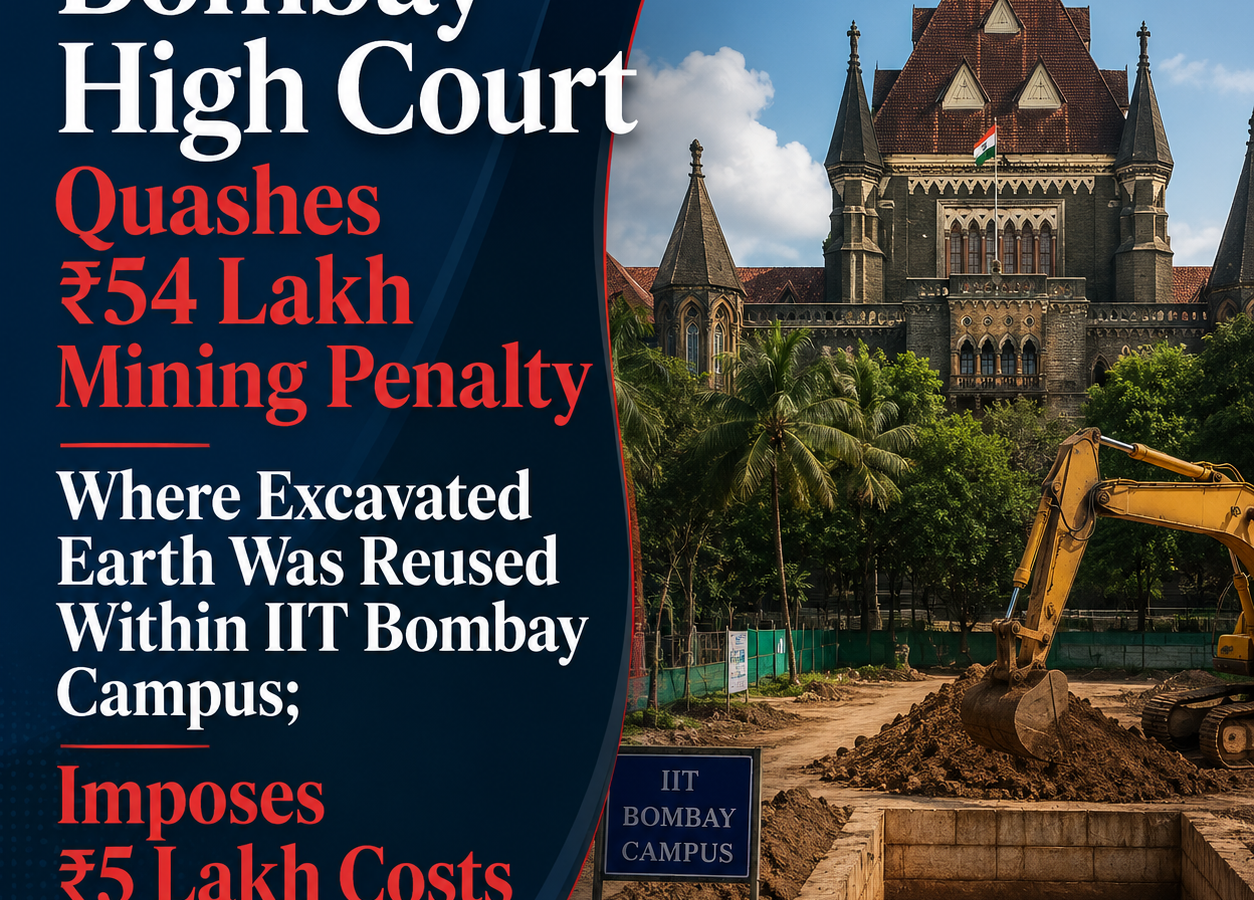
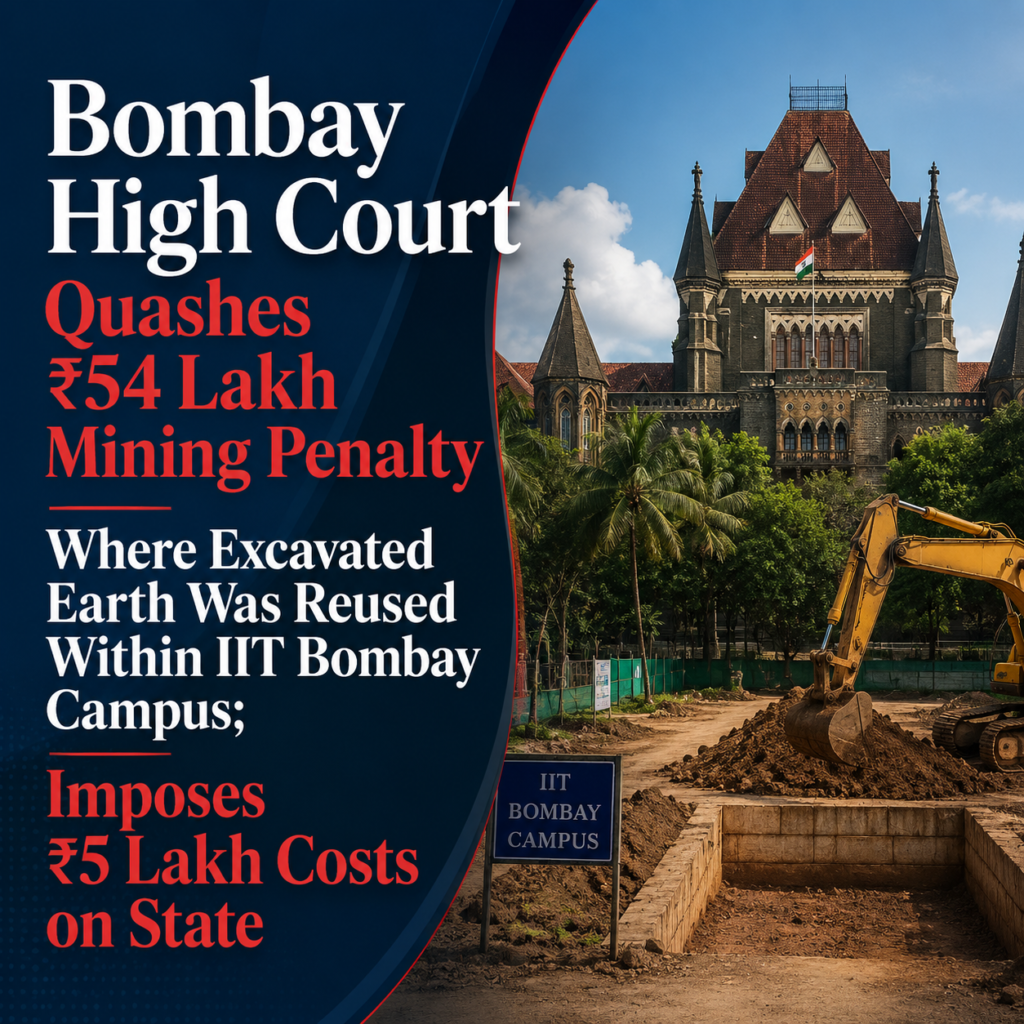
Bombay High Court Quashes ₹54 Lakh Mining Penalty Where Excavated Earth Was Reused Within IIT Bombay Campus
The Bombay High Court has held that earth excavated during construction and reused for levelling within the same institutional campus cannot be treated as unauthorised extraction of a minor mineral merely because it was moved from one survey number to another.
Justice Kamal Khata quashed a penalty of ₹54,08,811 imposed upon IVRCL Limited under Section 48(7) of the Maharashtra Land Revenue Code, 1966. The Court also imposed costs of ₹5 lakh upon the State of Maharashtra for compelling the company to pursue avoidable litigation for nearly a decade.
Facts
IVRCL Limited was awarded a work order by the Department of Atomic Energy for constructing the Computer Centre and Computer Sciences and Engineering Complex at IIT Bombay, Powai.
The work order required the contractor to dispose of surplus excavated material by transporting it to identified dumping pits and areas situated within the IIT campus.
During construction, IVRCL excavated earth for laying the foundation and shifted the surplus material to low-lying portions of the IIT campus for levelling.
The Sub-Divisional Officer issued a show-cause notice alleging that IVRCL had unauthorisedly excavated approximately 3,800 brass of minor minerals without obtaining permission.
The notice proposed action under Section 48(7) of the Maharashtra Land Revenue Code and referred to Section 29(4) of the “Mumbai Minor Minerals Act, 1955.”
The Sub-Divisional Officer subsequently imposed a penalty of ₹54,08,811.
The Collector and the Additional Commissioner upheld the penalty. IVRCL earlier approached the Bombay High Court, which remanded the matter for fresh consideration. However, the Additional Commissioner once again confirmed the demand.
IVRCL therefore filed the present writ petition challenging the order and the consequential demand notice.
The Senior Project Engineer of the Department of Atomic Energy had also issued a written confirmation that the entire excavated material had remained within the IIT campus.
Issues
The Court considered whether Section 48(7) of the Maharashtra Land Revenue Code could be invoked where earth excavated during construction was shifted between different survey numbers forming part of the same IIT campus.
The Court also examined whether:
- ordinary earth excavated and reused during the same development activity constituted a minor mineral;
- prior permission was required for shifting the earth within the same campus;
- the show-cause notice was valid despite invoking a non-existent enactment and provision; and
- the State’s conduct warranted the imposition of costs.
Petitioner’s Arguments
IVRCL submitted that the earth had been excavated solely for construction and was never removed from the IIT campus.
The company argued that the material was shifted and reused for levelling low-lying portions of the campus in accordance with the express terms of the government work order.
It contended that Section 48(7) was not attracted because there was no unauthorised extraction, commercial exploitation or removal of a minor mineral.
The petitioner argued that the existence of separate survey numbers within the same campus could not convert the internal movement of ordinary earth into illegal mining.
It was further submitted that the company was acting as a contractor under the instructions of the Department of Atomic Energy and IIT Bombay.
The petitioner relied upon the notification dated 11 May 2015, which provided that royalty would not be payable where earth excavated during development was reused on the same plot for levelling or other development work.
Respondent’s Arguments
The State defended the penalty on the ground that the excavated earth had been transported from one survey number to another.
It submitted that IVRCL had failed to obtain the required permission before undertaking the excavation.
The State argued that movement of the material between different survey numbers attracted the provisions governing unauthorised extraction and removal of minor minerals.
However, no substantive affidavit was filed by the respondents for more than eight years.
The State was also unable to identify any specific statutory provision requiring permission for moving excavated earth between survey numbers forming part of the same campus.
Analysis of the Law
Section 48(7) of the Maharashtra Land Revenue Code applies where a person, without lawful authority, extracts, removes, collects or disposes of a mineral from land over which the mineral rights vest in the State.
The Court observed that the provision could not be invoked merely because ordinary earth had been excavated during construction.
The authority was required to establish that the material constituted a mineral, that the activity was unauthorised and that the ingredients of Section 48(7) were satisfied.
In the present case, the excavated earth had neither been sold nor commercially exploited. It was retained within the IIT campus and used for levelling in connection with the same construction project.
The Court held that survey numbers are primarily assigned for identification and revenue assessment. The mere existence of different survey numbers within a single campus does not establish that the excavated material was removed from the development site.
The notification dated 11 May 2015 further recognised that no royalty was payable on earth excavated while developing a plot and reused on the same plot for levelling or development work.
Precedent Analysis
The Court relied upon the Supreme Court’s decision in Promoters and Builders Association of Pune v. State of Maharashtra, which held that the mere excavation of ordinary earth does not automatically attract Section 48(7).
The Supreme Court had clarified that liability depends upon the use and purpose of the excavated earth. Where the material is reused in the same development activity and is not commercially exploited, it does not become a minor mineral merely because it was excavated.
The Court also referred to AIGP Developers Pune Private Limited v. State of Maharashtra, in which the Bombay High Court held that earth extracted and redeployed on the same plot does not require excavation permission or payment of royalty.
Reliance was also placed on CEAT Speciality Tyres Ltd. v. State of Maharashtra, which recognised the exemption from royalty where earth excavated during development was reused on the same plot.
The Court referred to Tata Telecommunications v. State of Maharashtra to reiterate that statutory authorities are expected to know and follow binding decisions of constitutional courts.
It also relied upon decisions including Dilbagh Rai Jarry v. Union of India, State of Punjab v. Geeta Iron & Brass Works Ltd., Madras Port Trust v. Hymanshu International and Urban Improvement Trust, Bikaner v. Mohan Lal to emphasise that the Government must act as a model litigant and avoid frivolous or unnecessarily adversarial litigation.
Court’s Reasoning
The Court found that the entire basis of the penalty was contrary to law.
The revenue authorities had assumed that movement of excavated earth from one survey number to another automatically attracted Section 48(7). However, they failed to examine whether both survey numbers formed part of the same IIT campus.
The Court observed that the Collector ought to have directed a site inspection to determine the location and use of the excavated material.
Instead, the Sub-Divisional Officer’s order was mechanically affirmed without adequate reasons or application of the law to the facts.
The Court also found that the show-cause notice referred to Section 29(4) of the “Mumbai Minor Minerals Act, 1955.”
No such enactment existed. What existed was the Bombay Minor Mineral Extraction Rules, 1955, and Rule 29 did not contain any sub-rule (4).
The Court held that this was not merely an incorrect citation. The notice failed to disclose the actual statutory source of power and did not explain how shifting earth within the same campus amounted to unauthorised extraction or removal of a minor mineral.
The notice was therefore vitiated by a fundamental jurisdictional defect and complete non-application of mind.
The Court further criticised the respondents for failing to file a reply for more than eight years and for continuing to defend an order contrary to settled law.
It observed that the dispute could have been resolved at the initial stage through a site inspection, administrative clarification and proper legal advice.
Instead, IVRCL was compelled to incur substantial legal expenditure and pursue prolonged litigation.
The Court described the case as revealing misuse of statutory power, institutional indifference and absence of accountability.
Conclusion
The Bombay High Court allowed the writ petition and quashed the show-cause notice, penalty order, appellate orders and demand notice seeking recovery of ₹54,08,811.
The Court held that earth excavated during construction and reused for levelling within the same IIT campus could not attract penalty under Section 48(7) merely because it was shifted between different survey numbers.
The State of Maharashtra was directed to pay costs of ₹5 lakh to IVRCL Limited within four weeks.
The Court permitted the State to identify the officers responsible for initiating and continuing the litigation and to consider recovering the costs, wholly or partly, from them.
The Deputy Secretary of the Revenue and Forest Department was directed to file an affidavit setting out the measures adopted or proposed to prevent similar cases.
The Court directed the State to ensure that statutory authorities are trained in applicable local laws and binding judicial decisions, are able to obtain legal advice where necessary and are held accountable for arbitrary or negligent exercise of power.
Case: IVRCL Limited v. State of Maharashtra & Ors.
Court: Bombay High Court
Case Number: Writ Petition No. 1830 of 2015
Judge: Justice Kamal Khata
Date: 22 June 2026
Result: Writ petition allowed; penalty and demand of ₹54,08,811 quashed, ₹5 lakh costs imposed on the State of Maharashtra, and remedial directions issued to prevent similar arbitrary proceedings.