

HEADNOTE
Prabha Devi v. State & Ors.
Court: High Court of Delhi
Bench: Justice Chandrasekharan Sudha
Date of Judgment: 12 December 2025
Citation: FAO 165/2012
Laws / Sections Involved: Sections 63(c), 276, 278 and 299 Indian Succession Act, 1925; Section 68 Evidence Act, 1872; Section 45 Evidence Act, 1872
Keywords: Probate appeal, validity of Will, suspicious circumstances, expert evidence, testamentary capacity, Indian Succession Act
Summary:
The Delhi High Court dismissed an appeal challenging the grant of probate in respect of a Will executed by an unmarried woman in favour of her niece, reaffirming settled principles governing proof of Wills. The Court held that vague allegations of forgery and suspicious circumstances cannot displace a duly proved Will supported by the testimony of an attesting witness. It rejected reliance on an unproved private handwriting expert report, holding that expert opinion cannot extend to deciding the genuineness of a Will itself. The Court further ruled that physical ailments or old age do not negate testamentary capacity absent proof of mental incapacity, and that alleged adoption without legal proof cannot defeat a testamentary disposition. Upholding the trial court’s findings, the Court found no infirmity in the grant of probate and dismissed the appeal as meritless.
Court’s decision
The Delhi High Court dismissed the appeal filed under Section 299 of the Indian Succession Act and upheld the order of the trial court granting probate of the Will dated 30 March 1996. The Court found that the Will stood duly proved in accordance with statutory requirements and that the appellant-objector had failed to establish any suspicious circumstances warranting interference. It held that the trial court correctly appreciated the evidence on record, particularly the testimony of the surviving attesting witness, and that the appeal was devoid of merit. All pending applications were consequently closed.
Facts
The testatrix, Late Ms. Lakhmi Devi, an unmarried Hindu woman and a teacher with the Municipal Corporation of Delhi, died on 29 April 1996. She owned a residential property at Mochi Bagh, New Delhi, along with bank savings, GPF and National Savings Certificates. The petitioner in the probate proceedings was her niece, who claimed that the testatrix executed a Will dated 30 March 1996 bequeathing her entire estate exclusively in the petitioner’s favour out of love and affection.
The petitioner asserted that the testatrix was in a sound disposing state of mind and had handed over the original Will and property documents to her shortly before her death. After the testatrix’s demise, certain relatives, including the present appellant, continued to reside in the property, which later led to disputes and filing of the probate petition in 2011.
Issues
The principal issue before the High Court was whether the trial court erred in granting probate of the Will dated 30 March 1996. Ancillary issues included whether the Will was surrounded by suspicious circumstances, whether allegations of forgery and fabrication were substantiated, whether the testatrix possessed testamentary capacity at the time of execution, and whether reliance could be placed on a privately obtained handwriting expert report produced for the first time in appeal.
Appellant’s arguments
The appellant contended that the Will was forged and fabricated and surrounded by multiple suspicious circumstances. It was argued that the Will did not mention the place of execution, contained inconsistencies regarding the date of purchase of the property, and omitted full particulars of attesting witnesses. The appellant further claimed that she and another respondent had been treated as adopted children by the testatrix and that the exclusion of such close relations from the Will was unnatural.
Reliance was placed on a handwriting expert’s report annexed with the appeal, which opined that the Will was typed over a pre-signed paper. It was also argued that the testatrix was not in a sound disposing state of mind due to ill health, and that selective reliance on diary entries by the petitioner concealed the true nature of the relationship between the parties.
Respondent’s arguments
The respondent-petitioner supported the impugned judgment, submitting that the Will was duly proved by examining the surviving attesting witness and that no suspicious circumstances were established. It was contended that the expert report relied upon by the appellant was inadmissible, as it was neither proved nor obtained through court process and addressed a question beyond the scope of expert opinion under the Evidence Act.
The respondent further argued that allegations of adoption were unsupported by any legal proof, that mere illness or old age does not negate testamentary capacity, and that the appellant’s objections were vague, belated, and inconsistent with the evidence on record.
Analysis of the law
The Court undertook a detailed analysis of the legal principles governing proof of Wills under Section 63(c) of the Indian Succession Act and Section 68 of the Evidence Act. It reiterated that the propounder must establish due execution and attestation, after which the burden shifts to the objector to prove suspicious circumstances.
The Court emphasised that suspicious circumstances must be specific, pleaded, and proved, and cannot rest on conjectures or vague allegations. It further clarified the limited role of expert evidence under Section 45 of the Evidence Act, noting that expert opinion is confined to handwriting comparison or scientific matters, and cannot extend to opining whether a Will is “genuine” as a whole, which is a judicial determination.
Precedent analysis
The Court relied on established precedents holding that physical illness or old age does not undermine testamentary capacity unless mental incapacity is proved. Reference was made to decisions such as Gordhandas Nathlal Patel v. Bai Suraj, Chhanga Singh v. Dharam Singh, and Har Narain v. Budhram, which affirm that testamentary competence depends on mental awareness, not physical robustness.
The Court also referred to its recent judgment in Nirmal Batla v. State to reiterate that a testator need not be in perfect health to execute a valid Will, and that attesting witness testimony carries decisive weight in the absence of credible contrary evidence.
Court’s reasoning
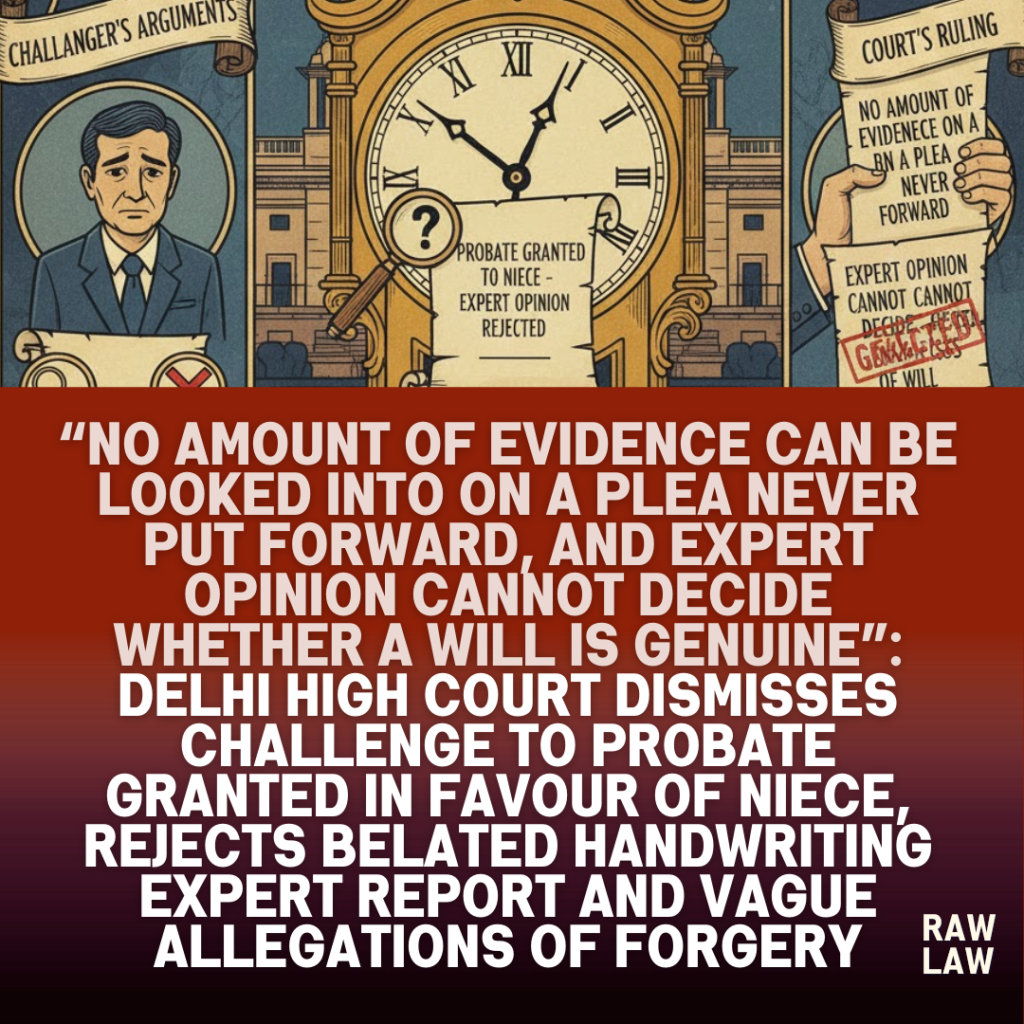
Justice Chandrasekharan Sudha observed that the appellant had not pleaded any specific case of forged signatures or blank signed papers in the objections. The theory of fabrication was introduced belatedly during cross-examination without foundational pleadings. The Court held that no amount of evidence can be considered on a plea never put forward.
The Court rejected the expert report outright, holding that it was privately procured, unproved, obtained after dismissal of an application for expert examination, and addressed an impermissible question. It also found that the appellant’s own suggestions during cross-examination presupposed the existence of the Will, thereby undermining the allegation of posthumous fabrication.
The testimony of the surviving attesting witness was found to be clear, cogent, and unshaken. Allegations of adoption were rejected due to complete absence of legal proof. Diary entries and medical material were found insufficient to establish lack of testamentary capacity.
Conclusion
The High Court concluded that the Will dated 30 March 1996 stood duly proved and that the appellant failed to establish any suspicious circumstances warranting interference. The appeal was dismissed as devoid of merit, and the grant of probate in favour of the petitioner was upheld in toto.
Implications
This judgment reinforces the strict evidentiary standards applicable in probate disputes and underscores that courts will not unsettle a duly proved Will on the basis of vague, belated, or unpleaded allegations. It clarifies the limited scope of expert evidence in succession matters and affirms that testamentary freedom cannot be defeated by unsupported claims of adoption or familial closeness. The ruling serves as a strong reaffirmation of certainty and discipline in probate jurisprudence.
CASE LAW REFERENCES
• Nirmal Batla v. State – Physical illness does not negate testamentary capacity
• Gordhandas Nathlal Patel v. Bai Suraj – Test of sound disposing mind
• Chhanga Singh v. Dharam Singh – Validity of Will despite physical infirmity
• Har Narain v. Budhram – Proof of Will and attesting witness testimony
FAQs
Q1. Can a Will be rejected on vague allegations of forgery?
No. Allegations must be specifically pleaded and proved; vague claims are insufficient.
Q2. Can a private handwriting expert decide whether a Will is genuine?
No. Experts cannot opine on the genuineness of a Will as a whole; that is for the court to decide.
Q3. Does old age or illness invalidate a Will?
No. Testamentary capacity depends on mental awareness, not physical health.


