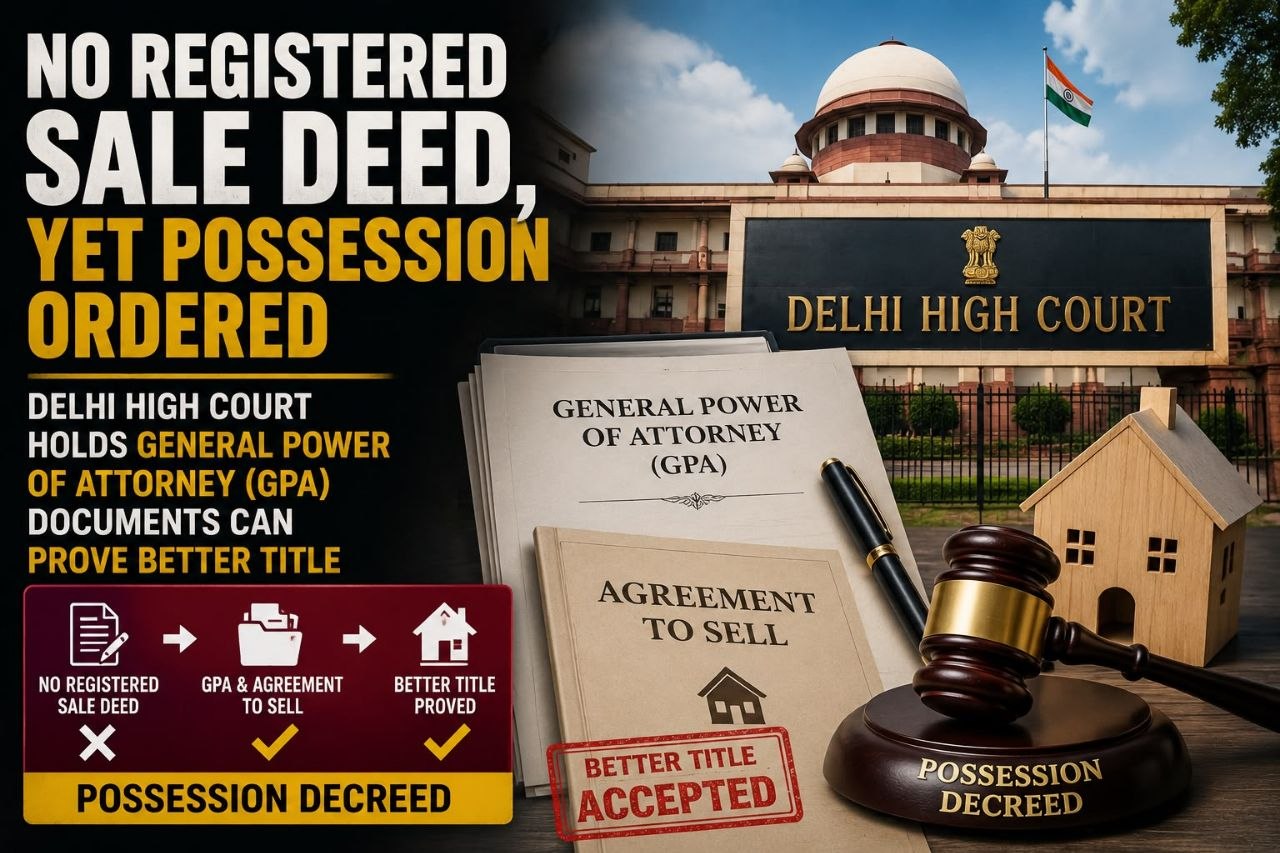
No Registered Sale Deed, Yet Possession Ordered: Delhi High Court Holds General Power of Attorney (GPA) Documents Can Prove Better Title

Court’s Decision
The Delhi High Court dismissed a Regular First Appeal filed by Smt. Sonu challenging an ex-parte judgment and decree dated 18 October 2019, by which the suit filed by Hukam Singh for possession and permanent injunction had been partly decreed.
The High Court held that the plaintiff had successfully proved the chain of documents showing transfer of the suit property in his favour through GPA, Agreement to Sell and allied documents dated 7 March 2004. While such documents may not make the plaintiff an absolute owner in the classical sense of having a registered sale deed, the Court held that they were sufficient to establish a better proprietary/possessory title than the appellant, who failed to prove any independent right, title or interest in the property.
The Court upheld the decree of possession and injunction against the appellant and dismissed the appeal.
Case Details
Case: Smt. Sonu v. Hukam Singh, since deceased, through LRs
Court: High Court of Delhi at New Delhi
Case Number: RFA 991/2023, CM APPL. 65697/2023, CM APPL. 65698/2023 and CM APPL. 65702/2023
Coram: Justice Neena Bansal Krishna
Reserved On: 16 March 2026
Pronounced On: 8 June 2026
Subject: Possession, Permanent Injunction, GPA/Agreement to Sell documents, Better Title, Allegation of Fraud, Ex-parte Decree
Facts
The dispute concerned property bearing No. F-215/19, old No. RZH-40A, Mittal Colony, Pul Prahladpur, New Delhi-110044, measuring 30 square yards.
The plaintiff, Hukam Singh, claimed that the suit property was originally owned by Sunil Kumar, who sold it to Munna Babu through Agreement to Sell and other documents dated 21 February 1990. Munna Babu thereafter sold the property to Smt. Vishan Devi through Agreement to Sell and allied documents dated 5 November 1993.
According to the plaintiff, Smt. Vishan Devi was his real sister. He purchased the suit property from her on 7 March 2004 through Agreement to Sell and other documents for a sale consideration of Rs. 2,35,000. He also claimed to have acquired peaceful and vacant possession of the property and got an electricity meter installed in his name on the same date.
The plaintiff stated that Smt. Vishan Devi continued to reside in the property because she was his sister and was suffering from age-related ailments. He and his family used to visit her frequently. Smt. Vishan Devi died on 10 June 2014.
The appellant, Smt. Sonu, came to attend the funeral and claimed herself to be the step-daughter of Smt. Vishan Devi. The plaintiff alleged that he permitted her to stay for one night and later allowed her to stay till the Tehrvi ceremony. However, after the ceremony, she allegedly refused to vacate the property despite repeated requests.
The plaintiff also alleged that Smt. Vishan Devi had severed all relations with Smt. Sonu and had debarred and disowned her from all properties through a public notice dated 27 November 2011 published in the newspaper Rashtriya Sahara.
The plaintiff filed a suit for possession, permanent injunction and damages for unlawful use and occupation. He claimed that the property could fetch rent of Rs. 10,000 per month.
Appellant/Defendant’s Stand
The appellant, Smt. Sonu, denied the plaintiff’s claim. She raised objections that the suit was barred by limitation and that the trial court lacked pecuniary jurisdiction because the value of the property was more than Rs. 24 lakh.
She asserted that Smt. Vishan Devi was her mother and had never sold the suit property to the plaintiff. According to her, she had been residing in the suit property since birth as the only legal heir of Smt. Vishan Devi and had full right, title and interest in the property.
She alleged that the plaintiff had fabricated documents to grab the property and had also conspired with BSES to get the electricity connection transferred in his name without her consent.
She further argued that if the plaintiff had genuinely purchased the property in 2004, he would have filed a suit during the lifetime of Smt. Vishan Devi. The filing of the suit after her death, according to the appellant, showed manipulation.
Trial Court Proceedings
The trial court framed issues regarding pecuniary jurisdiction, whether the appellant had inherited the property as legal heir of Smt. Vishan Devi, whether the plaintiff had purchased the property, whether the plaintiff was entitled to possession, whether he was entitled to permanent injunction, and whether he was entitled to damages.
The plaintiff examined himself as PW1. His sister Smt. Rani was examined as PW2, his brother Sh. Sonu as PW3, and Sh. Devender, a witness to the GPA documents dated 7 March 2004, as PW4.
The appellant did not lead evidence. Her opportunity to lead evidence was closed.
The trial court held that the plaintiff had purchased the property through GPA and allied documents dated 7 March 2004 from Smt. Vishan Devi. The court noted that such documents may not create absolute ownership, but they did confer possessory rights.
The trial court further held that the appellant failed to prove that she was the daughter of Smt. Vishan Devi or that she had any right to continue in possession of the property. Damages were denied because no cogent evidence was led by the plaintiff, but the suit for possession and permanent injunction was decreed. The appellant was directed to hand over peaceful possession of the suit property and was restrained from creating third-party rights.
Grounds Raised In Appeal
The appellant challenged the ex-parte judgment and decree dated 18 October 2019. She stated that some of the plaintiff’s witnesses could not be cross-examined because her counsel was unwell, and later her counsel met with an accident. She claimed that due to these circumstances, she could not properly participate in the proceedings or lead evidence.
She had earlier filed an application under Order IX Rule 13 CPC read with Section 151 CPC for setting aside the ex-parte judgment, but the application was dismissed on 16 August 2022.
In appeal, the appellant also alleged that the plaintiff had concealed pre-litigation mediation proceedings and that the title documents were forged and manipulated. She argued that a new municipal property number, F-215/19, was mentioned in the documents even though, according to her, this number had not been allotted at the time of execution of the alleged documents in March 2004.
She relied on judgments including A.V. Papayya Sastry v. Government of A.P., S.P. Chengalvaraya Naidu v. Jagannath and Indian Bank v. Satyam Fibres to argue that a decree obtained by fraud is a nullity.
She also relied on provisions of the Registration Act and argued that unregistered documents relating to transfer of immovable property for consideration above Rs. 100 could not create right, title or interest in favour of the plaintiff. She further relied on judgments including Suraj Lamp & Industries Pvt. Ltd. v. State of Haryana and Smriti Debbarma v. Prabha Ranjan Debbarma to contend that a plaintiff must establish legal title before seeking possession.
The appellant also referred to succession certificate proceedings relating to the service benefits of Smt. Vishan Devi. She claimed that her name had been deleted from those proceedings and that the succession certificate was later set aside after she challenged it.
Respondent/Plaintiff’s Stand
The respondents, being the legal representatives of Hukam Singh, supported the trial court judgment. They submitted that the learned Additional District Judge had given cogent reasons for decreeing the suit.
They pointed out that the appellant’s application under Order IX Rule 13 CPC had already been dismissed on 16 August 2022 and had not been further challenged.
They also explained that the first execution petition was dismissed because the decree sheet was not ready due to non-deposit of deficit court fee of Rs. 231. After depositing the deficit court fee, a second execution petition was filed.
The respondents maintained that the property was self-acquired by Smt. Vishan Devi and was sold by her to Hukam Singh. They argued that the appeal had no merit.
Issues Before The High Court
The central issues before the High Court were:
- Whether the plaintiff had proved a better proprietary/possessory right in the suit property on the basis of GPA, Agreement to Sell and allied documents.
- Whether the appellant had established any independent legal right, title or interest in the suit property.
- Whether the mention of the new municipal number in the documents was sufficient to prove fraud or fabrication.
- Whether the controversy regarding the appellant being the real daughter or step-daughter of Smt. Vishan Devi affected the plaintiff’s right to possession.
- Whether the trial court was justified in decreeing possession and injunction in favour of the plaintiff.
Analysis
The High Court examined the chain of documents relied upon by the plaintiff. The Court noted that the plaintiff had explained the chain of ownership from Sunil Kumar to Munna Babu, from Munna Babu to Smt. Vishan Devi, and from Smt. Vishan Devi to the plaintiff through GPA, Agreement to Sell and other documents dated 7 March 2004.
The plaintiff had proved these documents in evidence. He was cross-examined by the defendant, but no contradiction could be brought out in his cross-examination.
The appellant’s main challenge was that the documents mentioned the new municipal property number F-215/19, although she claimed that this number had not been allotted when the documents were executed. The High Court held that this objection was of little consequence because the identity of the property itself was not in dispute.
The Court also noted that the appellant had not led any cogent evidence to prove that the documents were fraudulent. Merely because a new property number was mentioned in the documents, the documents could not be rejected, especially when the property identity was clear and undisputed.
The Court held that the chain of documents was duly proved and established that the plaintiff had acquired proprietary rights and legal possession in the suit property through documents dated 7 March 2004.
Reasoning
The High Court reasoned that Smt. Vishan Devi may have continued to reside in the property after the documents were executed in favour of the plaintiff, but her possession became permissive after the plaintiff purchased the property.
The appellant had claimed that she had been living with Smt. Vishan Devi and that her marriage had taken place from the suit premises. The plaintiff had admitted that the appellant’s marriage took place at the suit premises. However, the Court held that even if the appellant had lived with Smt. Vishan Devi during her lifetime, she failed to show any legal right to continue in the property after it was sold to the plaintiff.
The Court further held that the controversy regarding whether the appellant was the real daughter or step-daughter of Smt. Vishan Devi was of little consequence in view of the proprietary documents proved in favour of the plaintiff.
The succession certificate proceedings relating to the movable/service benefits of Smt. Vishan Devi were also held to be of little consequence in the present suit, because the suit was based on the plaintiff’s proprietary right to claim possession of the immovable property.
Most importantly, the Court held that whatever may be the appellant’s status, she derived her claim only through Smt. Vishan Devi. Once it was proved that Smt. Vishan Devi had sold the suit property to the plaintiff, the appellant could not claim a superior right than Smt. Vishan Devi.
The Court concluded that the plaintiff may not be an absolute owner in the classical sense of having a registered sale deed, but he had a better proprietary title than the appellant, who failed to establish any right, title or interest in the suit property.
Precedent Discussed
The appellant relied on fraud-related precedents including:
- A.V. Papayya Sastry v. Government of A.P.
- S.P. Chengalvaraya Naidu v. Jagannath
- Indian Bank v. Satyam Fibres
She argued that a judgment or decree obtained by fraud is a nullity and that courts have inherent power under Section 151 CPC to recall orders obtained by fraud.
She also relied on the Registration Act, Suraj Lamp & Industries Pvt. Ltd. v. State of Haryana, Ramesh Chand v. Suresh Chand, and Smriti Debbarma v. Prabha Ranjan Debbarma to argue that unregistered documents do not create legal title and that a plaintiff seeking possession must prove better title.
However, on the facts of the case, the High Court found that the appellant had failed to prove fraud or fabrication. The plaintiff, on the other hand, had proved the chain of documents and established better proprietary/possessory title.
Conclusion
The Delhi High Court held that the trial court had rightly decreed the suit for possession and permanent injunction. The plaintiff had proved a better title to the suit property through the chain of GPA, Agreement to Sell and allied documents, while the appellant failed to prove any independent legal right in the property.
The Court dismissed the appeal and disposed of all pending applications.
Implications
This judgment is significant because it reiterates that in a suit for possession, the court may examine who has a better title or better possessory right to the property. Even where GPA and Agreement to Sell documents may not create absolute ownership like a registered sale deed, they may still be relevant to prove a better proprietary or possessory claim against a person who fails to establish any superior right.
The decision also makes clear that allegations of fraud must be supported by cogent evidence. A mere discrepancy regarding the municipal number of the property will not by itself defeat a claim when the identity of the property is not in dispute.
The ruling further clarifies that a person claiming through a previous owner cannot assert a better right than that previous owner once the transfer in favour of another party is proved.
Raw Law Takeaway
In property possession disputes, the real question is often not whether one party has the perfect title, but whether that party has a better title than the person in possession. Here, the Delhi High Court held that GPA and Agreement to Sell documents, supported by a proved chain of transfer, were enough to defeat the appellant’s claim when she could not prove any superior legal right in the property.