


HEADNOTE
Ramesh Kumar v. Delhi Transport Corporation
Court: High Court of Delhi
Bench: Justice Navin Chawla and Justice Madhu Jain
Date of Judgment: 12 December 2025
Citation: W.P.(C) 1798/2024
Laws / Sections Involved: Articles 226 and 227 Constitution of India; Section 47 Persons with Disabilities (Equal Opportunities, Protection of Rights and Full Participation) Act, 1995; Service Regulations of DTC
Keywords: DTC driver retirement, superannuation age, interim order effect, CAT service matter, disability employment, medical fitness
Summary:
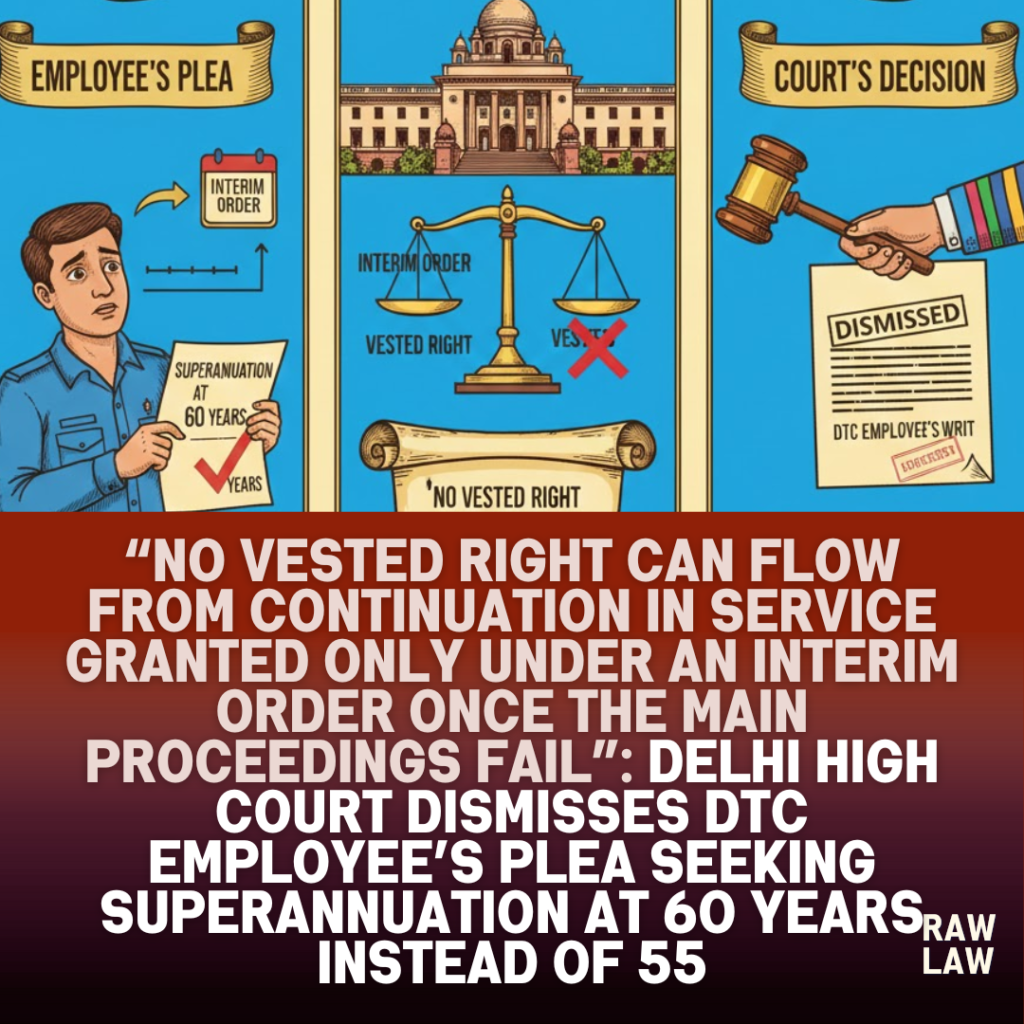
The Delhi High Court dismissed a writ petition filed by a Delhi Transport Corporation employee challenging his deemed retirement at the age of 55 years, holding that continuation in service under an interim order cannot confer a substantive right to extended service. The petitioner, initially appointed as a Driver and later redeployed as a Security Guard after being declared medically unfit, claimed that since he worked till August 2018, his superannuation should be reckoned accordingly. Upholding the Central Administrative Tribunal’s order, the Court ruled that once the original challenge to retirement at 55 years had been finally dismissed, all benefits flowing from the interim protection automatically lapsed. Relying on Supreme Court precedent, the Court reiterated that interim orders merge with final decisions and cannot be used to claim retrospective service benefits.
Court’s decision
The Delhi High Court dismissed the writ petition and affirmed the order of the Central Administrative Tribunal dismissing the petitioner’s challenge to his deemed retirement with effect from 31 March 2014, upon attaining the age of 55 years. The Court held that the petitioner was not entitled to claim superannuation from a later date merely because he continued to work pursuant to an interim order passed during earlier litigation. While rejecting the substantive claim, the Court clarified that the petitioner would be entitled to retain salary and allowances already paid for the period he actually worked, and no recovery could be made by the Delhi Transport Corporation.
Facts
The petitioner was appointed as a Driver with the Delhi Transport Corporation in January 1983. In the mid-1980s, he developed an eyesight defect and was eventually declared medically unfit for driving duties. In 1996, he was prematurely retired, which led to an industrial dispute. The Labour Court declared the premature retirement illegal and directed reinstatement with consequential benefits, a decision that was upheld up to the Division Bench of the High Court.
Pursuant to judicial directions, the petitioner was redeployed to alternative posts including Peon, Vehicle Examiner, and later re-designated as Security Guard, while being protected with the same pay scale and service benefits as a Driver. In 2014, upon nearing the age of 55 years, he was informed that he would be required to undergo a medical fitness test for continuation in service, failing which he would be retired.
Issues
The principal issue before the Court was whether the petitioner should be deemed to have superannuated on attaining the age of 55 years in March 2014, or whether his superannuation should be reckoned from August 2018, when he claimed to have last performed duties. A connected issue was whether continuation in service under an interim order passed by the Tribunal could confer a substantive right to extended service beyond the prescribed age of retirement.
Petitioner’s arguments
The petitioner contended that since he had been redeployed as a Security Guard—a post carrying a retirement age of 60 years—he could not have been subjected to the retirement age applicable to Drivers. He argued that he continued to discharge duties till 30 August 2018, and therefore his superannuation ought to be fixed accordingly. It was also submitted that the medical fitness requirement at 55 years was applicable only to Drivers and not to the post of Security Guard, making his retirement arbitrary and discriminatory.
Respondent’s arguments
The Delhi Transport Corporation argued that the issue of retirement at 55 years had already been conclusively decided against the petitioner in earlier proceedings before the Tribunal, which had attained finality. It was submitted that the petitioner’s continuation in service beyond 2014 was solely due to an interim order passed during litigation, and once the main application was dismissed, no benefit could accrue from such interim protection. The respondent relied on settled law that interim orders automatically lapse upon dismissal of the main proceedings.
Analysis of the law
The High Court analysed the legal effect of interim orders in service jurisprudence and reiterated that interim protection is always subject to the final outcome of proceedings. Once the main challenge fails, the parties must be restored to the position that would have prevailed but for the interim order. The Court emphasised that redeployment under disability protection laws does not automatically alter the age of superannuation applicable to the original cadre, unless specifically provided by statute or service rules.
Precedent analysis
The Court relied on the Supreme Court’s decisions in State of Uttar Pradesh v. Prem Chopra and Jagpal Singh v. State of Uttar Pradesh, which authoritatively hold that interim orders merge with final orders and confer no independent rights once the main case is dismissed. The Court also noted that benefits such as promotion or continued service granted only due to interim protection fall automatically when the underlying challenge fails, though salary already paid for work actually performed cannot be recovered.
Court’s reasoning
Justice Navin Chawla, writing for the Bench, observed that the petitioner’s claim for superannuation at 60 years had already been rejected by the Tribunal in earlier proceedings, and that decision had attained finality. The Court held that the petitioner could not re-agitate the same issue indirectly by relying on the period of service rendered under interim protection. It was further held that allowing such a claim would amount to conferring a substantive right on the basis of an interim order, which is impermissible in law.
Conclusion
The Delhi High Court found no merit in the writ petition and dismissed it. While upholding the petitioner’s deemed retirement from 31 March 2014, the Court protected the petitioner from recovery of salary and allowances already paid for the period he actually worked. No order as to costs was passed.
Implications
This judgment reinforces settled service law principles that interim judicial protection cannot override statutory retirement rules or confer enduring service rights. It provides clarity for public sector employers and employees alike that continuation in service during litigation is always provisional. The ruling also balances equity by safeguarding employees from recovery of salary earned during such interim periods, thereby maintaining fairness without diluting legal certainty.
CASE LAW REFERENCES
• State of Uttar Pradesh v. Prem Chopra – Interim orders merge with final orders
• Jagpal Singh v. State of Uttar Pradesh – No benefit can survive once interim protection lapses
• Dharam Pal v. DTC – Retirement of DTC drivers at 55 subject to medical fitness
FAQs
Q1. Can service rendered under an interim court order extend retirement age?
No. Interim continuation does not create a substantive right once the main case is dismissed.
Q2. Does redeployment due to disability change the age of superannuation?
Not automatically. Retirement age continues to be governed by applicable service rules.
Q3. Can salary paid during interim service be recovered?
No. Courts generally protect salary for work actually performed.