

HEADNOTE
Ramakrishna Teletronics Pvt. Ltd. v. Top Victory Investments Ltd.
Court: High Court of Delhi
Bench: Justice V. Kameswar Rao and Justice Vinod Kumar
Date of Judgment: 12 December 2025
Citation: FAO(OS) (COMM) 230/2019
Laws / Sections Involved: Section 37 Arbitration and Conciliation Act, 1996; Section 34 Arbitration and Conciliation Act, 1996; Section 13 Commercial Courts Act, 2015
Keywords: Arbitration appeal, Section 37 scope, settlement letter dispute, handwritten alterations, proof of settlement, limited judicial interference
Summary:
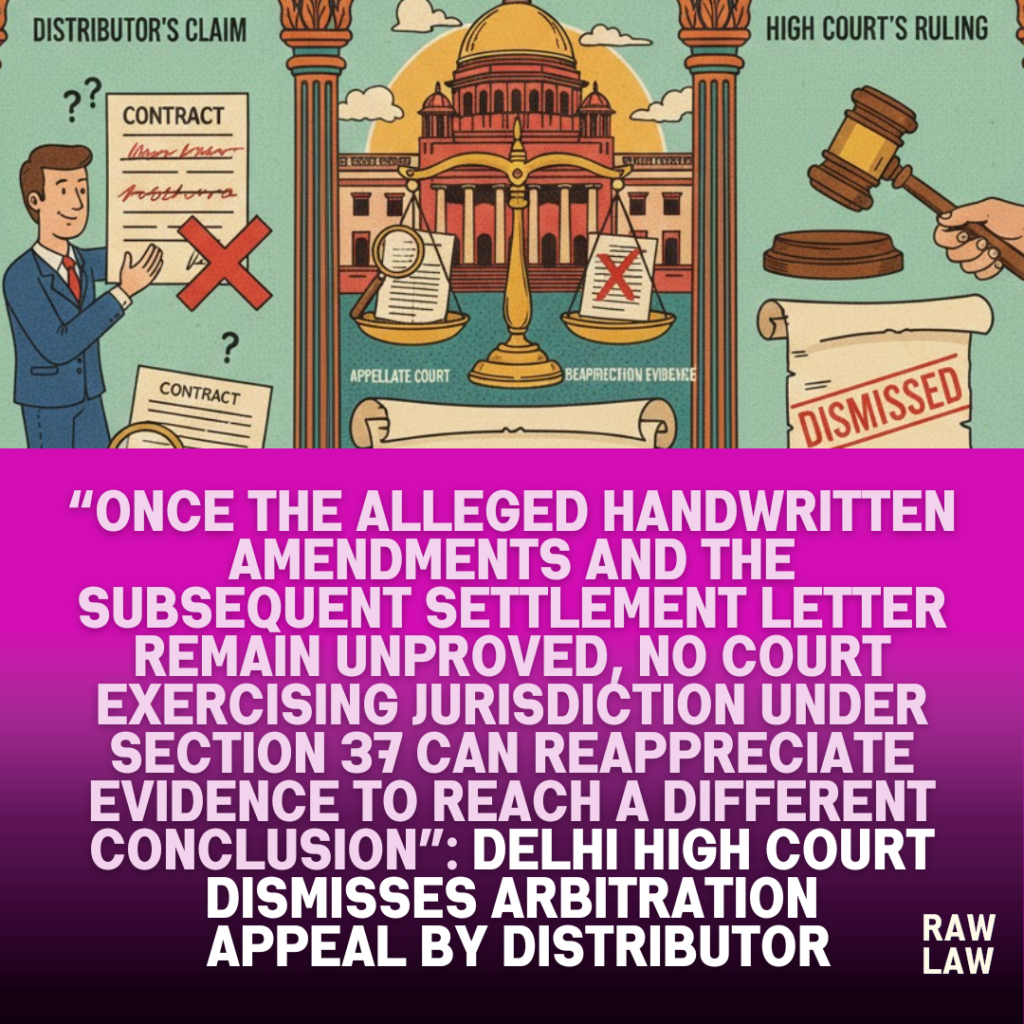
The Delhi High Court dismissed an appeal under Section 37 of the Arbitration and Conciliation Act, 1996, affirming concurrent findings of the Sole Arbitrator and the Single Judge that no full and final settlement had been proved between the parties. The appellant-distributor sought to resist counterclaims by relying on a settlement letter allegedly issued and later modified in handwriting, followed by a subsequent letter said to absolve it of liability. The Court held that both the handwritten amendments to the original letter dated 06.05.2013 and the subsequent letter dated 17.05.2013 remained unproved, unsupported by originals or reliable electronic evidence. Reiterating the extremely limited scope of interference under Section 37, the Court held that factual findings of the arbitrator, affirmed under Section 34, could not be reopened merely because an alternative interpretation was possible. The appeal was dismissed with no order as to costs.
Court’s decision
The Delhi High Court dismissed the appeal filed under Section 37 of the Arbitration and Conciliation Act, 1996, and upheld the order of the Single Judge dismissing the appellant’s Section 34 petition. The Court held that the arbitral award dated 16 June 2017 suffered from no perversity, patent illegality, or jurisdictional infirmity. It affirmed that the arbitrator had correctly rejected the appellant’s defence of full and final settlement and had rightly allowed the respondent’s counterclaims. Emphasising the narrow contours of appellate review under Section 37, the Court declined to interfere with concurrent factual findings.
Facts
The appellant, Ramakrishna Teletronics Pvt. Ltd., was appointed as a non-exclusive distributor for AOC-branded televisions and products in Andhra Pradesh, Karnataka, and Tamil Nadu under three distribution agreements dated 05 September 2012. Due to poor market response, the appellant claimed that unsold stock was returned and that the respondent, Top Victory Investments Ltd., proposed a settlement to address outstanding dues.
According to the appellant, a letter dated 06 May 2013 was issued by the respondent, which was later manually altered to include clauses absolving the appellant of liability for dealer dues and VAT losses. It was further claimed that a fresh settlement letter dated 17 May 2013, signed by a Director of the respondent, conclusively settled all claims. Disputes nevertheless arose, leading to termination of agreements, invocation of arbitration, filing of claims and counterclaims, and ultimately an arbitral award rejecting the appellant’s claims and allowing the respondent’s counterclaims.
Issues
The central issue before the High Court was whether the arbitral award, which rejected the appellant’s plea of a full and final settlement, warranted interference under Section 37 of the Arbitration and Conciliation Act. The Court also examined whether the arbitrator and the Single Judge had failed to consider the admitted original letter dated 06 May 2013, and whether alleged handwritten modifications and a subsequent letter dated 17 May 2013 constituted a binding settlement absolving the appellant of liability.
Appellant’s arguments
The appellant argued that the respondent had admittedly issued the letter dated 06 May 2013 proposing settlement and that the arbitrator and Single Judge erred in ignoring its legal effect. It was contended that handwritten additions to the letter, coupled with the subsequent letter dated 17 May 2013, evidenced a concluded settlement under which the respondent agreed to bear VAT losses and waive outstanding dues. The appellant submitted that the settlement was acted upon, stocks were returned, and receivables were taken over by the respondent, thereby extinguishing the appellant’s liability. It was urged that the courts below adopted an unduly technical approach to proof and failed to appreciate the commercial realities of the transaction.
Respondent’s arguments
The respondent contended that the original letter dated 06 May 2013 was never pleaded by the appellant as a settlement but merely as an offer outlining a mechanism for recovery of dues. It was argued that the handwritten alterations and the alleged letter dated 17 May 2013 were fabricated, unproved, and unsupported by originals or reliable electronic evidence. The respondent relied on detailed findings of the arbitrator, who had examined emails, witness testimony, and surrounding circumstances, and concluded that no waiver or novation of contractual liability had occurred. It was submitted that Section 37 does not permit reappreciation of evidence or substitution of factual findings.
Analysis of the law
The Court analysed the settled legal position governing interference with arbitral awards under Sections 34 and 37 of the Arbitration and Conciliation Act. It reiterated that arbitral findings of fact, based on appreciation of evidence, are immune from appellate review unless they are perverse, patently illegal, or shock the conscience of the court. The Court emphasised that even if two views are possible, the view taken by the arbitrator must prevail. Under Section 37, the scope of scrutiny is even narrower, being confined to examining whether the Section 34 court exceeded its jurisdiction or ignored settled principles.
Precedent analysis
The Division Bench relied on the Supreme Court’s decision in UHL Power Company Limited v. State of Himachal Pradesh, which reiterates that courts exercising jurisdiction under Section 37 cannot reassess evidence or correct mere errors of fact. The judgment aligns with a long line of authority holding that arbitration law prioritises finality, minimal judicial intervention, and respect for the arbitrator’s evaluation of evidence, particularly in commercial disputes.
Court’s reasoning
Justice V. Kameswar Rao, speaking for the Bench, held that the arbitrator had meticulously analysed the alleged handwritten amendments to the letter dated 06 May 2013 and the purported letter dated 17 May 2013, and found them unproved. The absence of original documents, unexplained gaps in email evidence, inconsistencies in witness testimony, and lack of proof of authorisation were all valid grounds for rejecting the appellant’s plea of settlement.
The Court further noted that the appellant’s own pleadings showed that the original letter dated 06 May 2013 was never relied upon as a concluded settlement. Once the amended letters were disbelieved, the defence of full and final settlement collapsed. The Single Judge had correctly treated these findings as factual determinations not open to interference under Section 34, and the appellate court found no reason to take a different view under Section 37.
Conclusion
The Delhi High Court concluded that the arbitral award and the order of the Single Judge were legally sound and based on cogent appreciation of evidence. Finding no perversity, patent illegality, or jurisdictional error, the Court dismissed the appeal and the accompanying application. No order as to costs was passed.
Implications
This judgment strongly reinforces the finality of arbitral awards and the narrow scope of judicial interference under Sections 34 and 37 of the Arbitration and Conciliation Act. It underscores that pleas of settlement must be strictly proved, particularly where liability waiver is alleged on the basis of handwritten alterations or informal correspondence. The ruling sends a clear message to commercial litigants that appellate courts will not re-evaluate evidence or rescue parties from adverse factual findings merely because an alternative narrative is suggested.
CASE LAW REFERENCES
• UHL Power Company Limited v. State of Himachal Pradesh – Extremely limited scope of interference under Section 37
• Associate Builders v. DDA – Boundaries of judicial review of arbitral awards
• Ssangyong Engineering v. NHAI – Patent illegality and arbitral deference
FAQs
Q1. Can High Courts reappreciate evidence in a Section 37 arbitration appeal?
No. Section 37 permits only very limited scrutiny and does not allow reappreciation of facts.
Q2. Are handwritten amendments to settlement letters sufficient to prove waiver of liability?
Only if strictly proved through originals and credible evidence; otherwise courts will reject such pleas.
Q3. What was the outcome of the appeal in this case?
The appeal was dismissed and the arbitral award in favour of the respondent was upheld.


