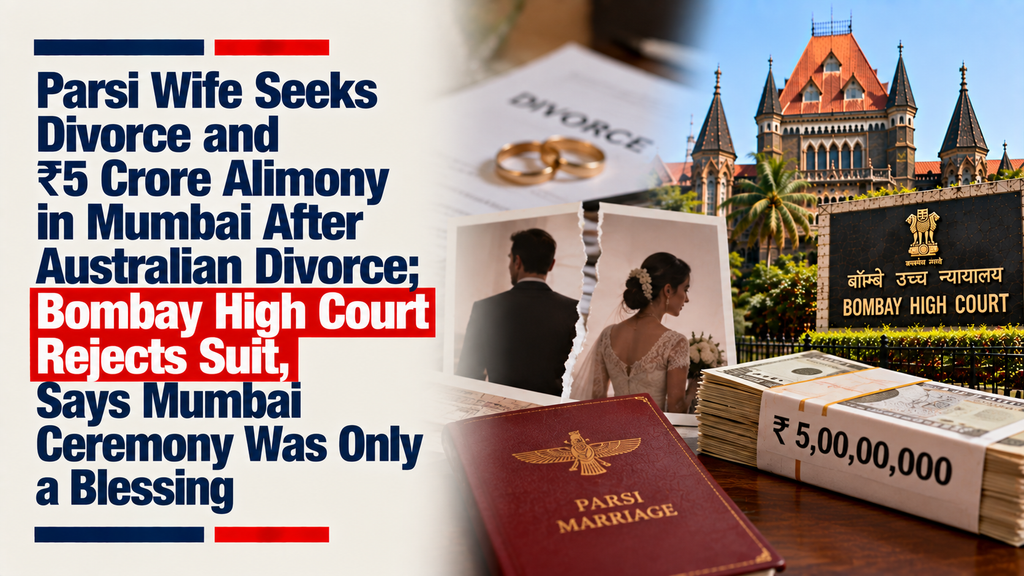
Parsi Wife Seeks Divorce and ₹5 Crore Alimony in Mumbai After Australian Divorce; Bombay High Court Rejects Suit, Says Mumbai Ceremony Was Only a Blessing

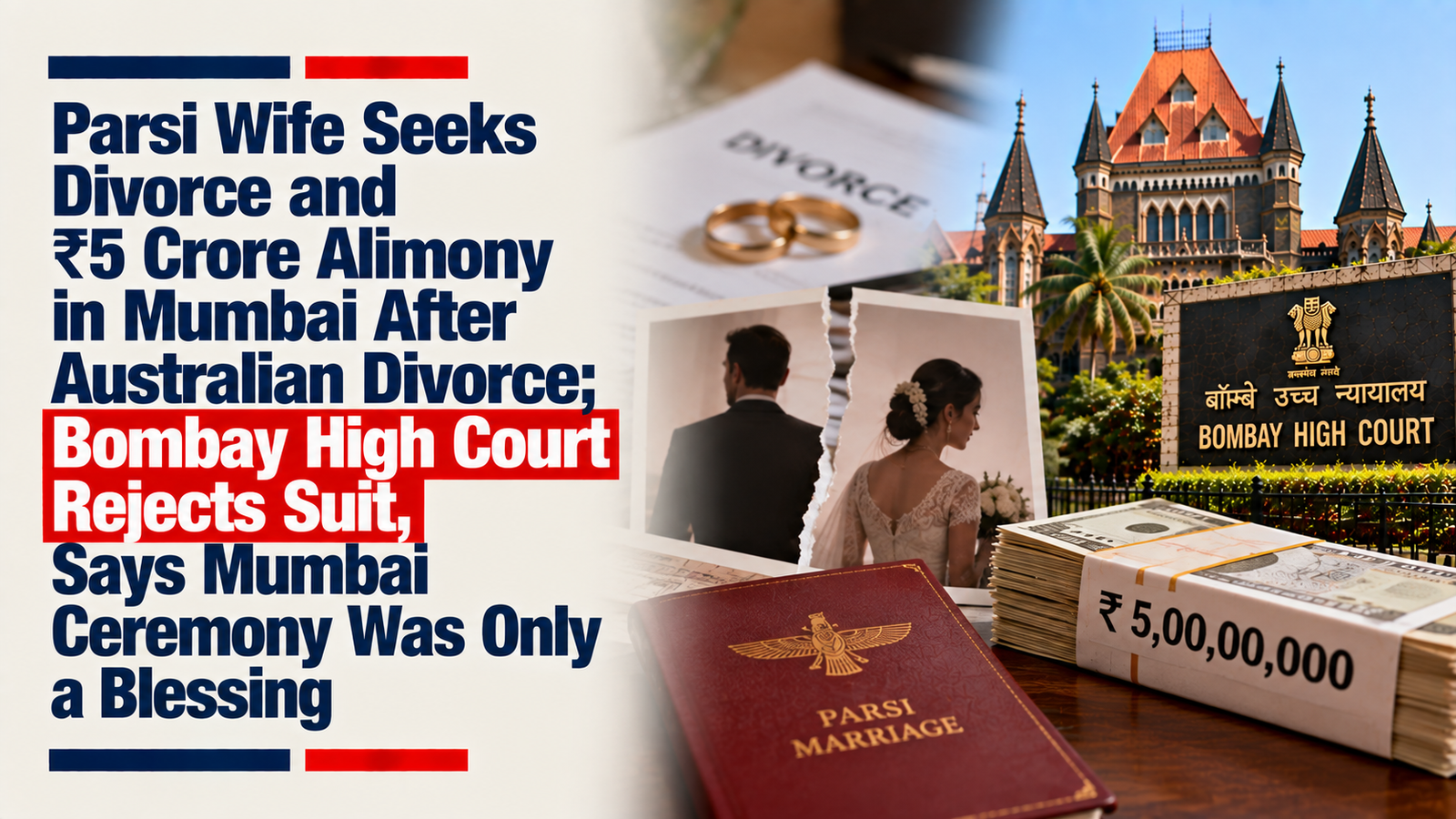
Wife Seeks ₹5 Crore Alimony in Mumbai Despite Australian Divorce; Bombay High Court Finds Mumbai Event Was Not a Parsi Marriage Ceremony
Facts
Scherezade Hormuz Mubarakai filed Parsi Suit No. 2 of 2018 before the Bombay High Court seeking dissolution of her marriage with Hormuz Kurush Mubarakai, ₹5 crore as permanent alimony, ₹1 lakh per month as interim maintenance and costs.
The husband sought rejection of the suit under Order VII Rule 11(d) CPC, contending that it was barred by law. The central dispute concerned an event held in Mumbai on 20 November 2010. The wife claimed it was the Parsi “Ashirvad” marriage ceremony, whereas the husband maintained that it was merely a “Tandoorasti” or blessing ceremony.
Importantly, the couple had already undergone a civil marriage in Perth, Western Australia on 22 August 2010, where they resided. Proceedings in Australia subsequently resulted in divorce, division of their assets and determination of custody of their son.
The husband therefore raised two principal objections: first, that no Parsi marriage had been solemnised in Mumbai so as to confer jurisdiction upon the Bombay High Court; and second, that the Australian proceedings had already finally resolved the matrimonial dispute.
Issues
The central question was whether the ceremony held in Mumbai on 20 November 2010 was an “Ashirvad”, thereby constituting solemnisation of a Parsi marriage in India, or merely a Tandoorasti/blessing ceremony after the couple’s Australian marriage.
This factual determination was critical because the parties admittedly resided in Perth. The Mumbai ceremony was effectively the only territorial connecting factor relied upon for invoking the Bombay High Court’s jurisdiction.
The Court also considered the role of Parsi delegates under Sections 19 and 46 of the Parsi Marriage and Divorce Act, applicability of the CPC to Parsi matrimonial proceedings, and whether the Australian adjudication operated as res judicata.
Husband’s Arguments
The husband argued that the couple had already married civilly in Australia and that the subsequent Mumbai event was merely a traditional blessing for relatives in India. No Ashirvad ceremony solemnising a marriage was performed in Mumbai.
He further relied upon the completed Australian proceedings concerning divorce, property division and custody and argued that the subsequent Mumbai proceedings were barred by principles of res judicata.
Wife’s Arguments
The wife maintained that the November 2010 event was actually an Ashirvad ceremony and that the question could not conclusively be determined at the interlocutory stage without a full trial.
She also argued that her husband was an Irani Zoroastrian and that differences in the rituals of that sub-denomination required evidence.
As regards the Australian proceedings, she argued that those proceedings had expressly left the Indian proceedings outside their consideration and therefore could not operate as res judicata.
Analysis of the Law
Section 3 of the Parsi Marriage and Divorce Act, 1936 provides that a Parsi marriage is not valid unless it is solemnised according to the Parsi form of ceremony called “Ashirvad” by a priest in the presence of two Parsi witnesses other than the priest.
Both sides agreed that, for the Bombay High Court’s jurisdiction to be attracted on the basis asserted in this case, it had to be established that a valid Ashirvad ceremony had been performed in Mumbai by a priest in the presence of the requisite Parsi witnesses.
The Court therefore treated the nature of the November 2010 ceremony as a jurisdictional fact: unless that factual issue was answered in the wife’s favour, the jurisdictional basis asserted for maintaining the suit in Mumbai would fail.
The Parsi Jury and the Wedding Video
This is the particularly unusual feature of the judgment.
With the parties’ consent, a video recording of the November 2010 event—produced by the wife herself—was shown to the Parsi delegates. The delegates unanimously concluded that what they saw was not a marriage ceremony but a Tandoorasti/blessing ceremony.
The delegates noted, among other things, that an important feature ordinarily associated with the Parsi/Irani marriage ceremony—the signing of a document by the couple with witnesses from both sides—was missing from the video. They concluded that the footage showed the type of blessing ceremony commonly conducted by Zoroastrian couples who had already married abroad.
The priests who had conducted the Mumbai event had also stated in 2017 that they had not performed an Ashirvad ceremony and had only performed a Tandoorasti ceremony.
Precedent / Statutory Analysis
The judgment closely examines the unusual statutory division of functions under the Parsi Marriage and Divorce Act.
Under Section 46, questions of law and procedure are decided by the presiding Judge, while factual questions are ordinarily determined by the majority of the Parsi delegates.
Section 19, however, excludes the mandatory assistance of delegates for interlocutory applications and proceedings other than the regular hearing of cases. The Court harmonised Sections 19 and 46 and held, in the peculiar circumstances here, that the parties had consensually adopted the procedure of obtaining the delegates’ assistance on the factual question concerning the ceremony.
The Court also rejected the argument that Order VII Rule 11 CPC could not operate merely because Parsi matrimonial proceedings are instituted through a petition rather than a conventional plaint. Section 45 expressly makes the CPC applicable, so far as applicable, to proceedings under the Parsi Marriage and Divorce Act.
Court’s Reasoning
The Court found that the wife herself had produced the video and had agreed to the delegates determining what ceremony it depicted. Once the delegates unanimously answered that factual question, she could not effectively disregard that process merely because its conclusion went against her.
The Court stressed that the delegates were not deciding legal procedure. Their limited task was to determine the factual and community-specific question: was the November 2010 event an Ashirvad or a Tandoorasti?
The delegates unanimously answered: Tandoorasti.
The Court declined to second-guess their determination concerning the community’s customs in the absence of perversity or some legal basis for doing so.
It also held that simply translating “Ashirvad” as “blessing” could not convert every blessing ceremony into the statutory Parsi marriage ceremony. The statutory concept involved the community’s particular rituals and customs, which was precisely why the Act gives Parsi delegates a special factual role.
Since the ceremony was not an Ashirvad, a fundamental requisite relied upon for establishing a Parsi marriage solemnised in Mumbai—and consequently the asserted jurisdictional link with the Bombay High Court—was absent.
On the separate res judicata argument, however, the Court did not accept the husband’s case: the Australian proceedings had expressly left the Indian proceedings outside their adjudicatory consideration.
Conclusion
The Bombay High Court ultimately held that the Mumbai event relied upon by the wife was not an Ashirvad marriage ceremony but a Tandoorasti/blessing ceremony. In the peculiar facts, the essential jurisdictional foundation for maintaining the Parsi matrimonial suit in Mumbai therefore failed, and the suit deserved dismissal.
The significant proposition emerging from the judgment is also procedural: under the Parsi Marriage and Divorce Act, the delegates retain a distinctive statutory role in deciding factual questions concerning Parsi customs, while questions of law and procedure remain for the presiding Judge.
Case: Scherezade Hormuz Mubarakai v. Hormuz Kurush Mubarakai
Court: Bombay High Court, Ordinary Original Civil Jurisdiction
Case: Interim Application (L) No. 30398 of 2023 in Parsi Suit No. 2 of 2018
Judge: Justice Somasekhar Sundaresan
Date: 23 September 2026
Citation: 2026:BHC-OS:20903
Result: Husband’s objection on lack of jurisdiction accepted; matrimonial suit dismissed.