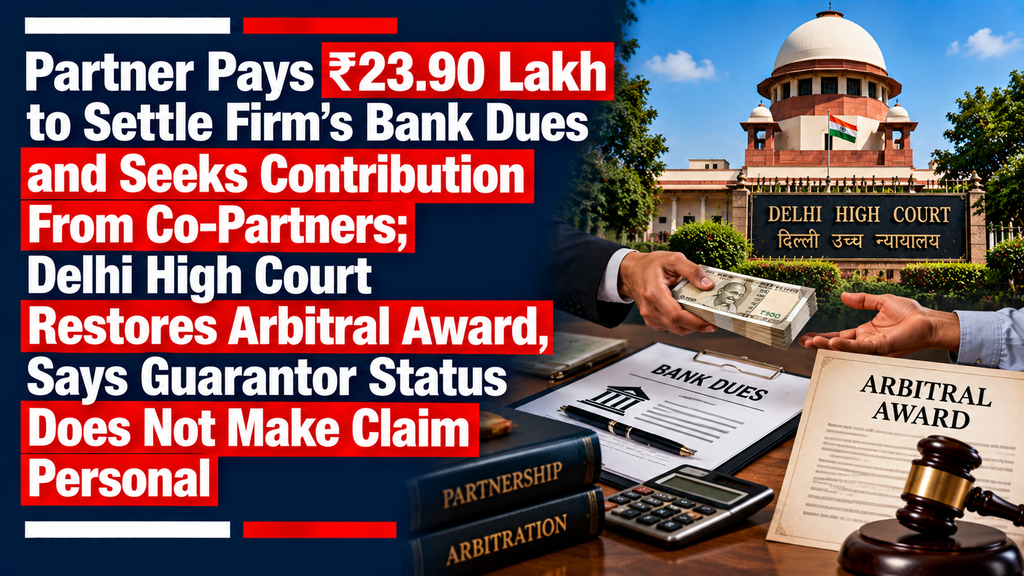
Partner Pays ₹23.90 Lakh to Settle Firm’s Bank Dues and Seeks Contribution From Co-Partners; Delhi High Court Restores Arbitral Award, Says Guarantor Status Does Not Make Claim Personal

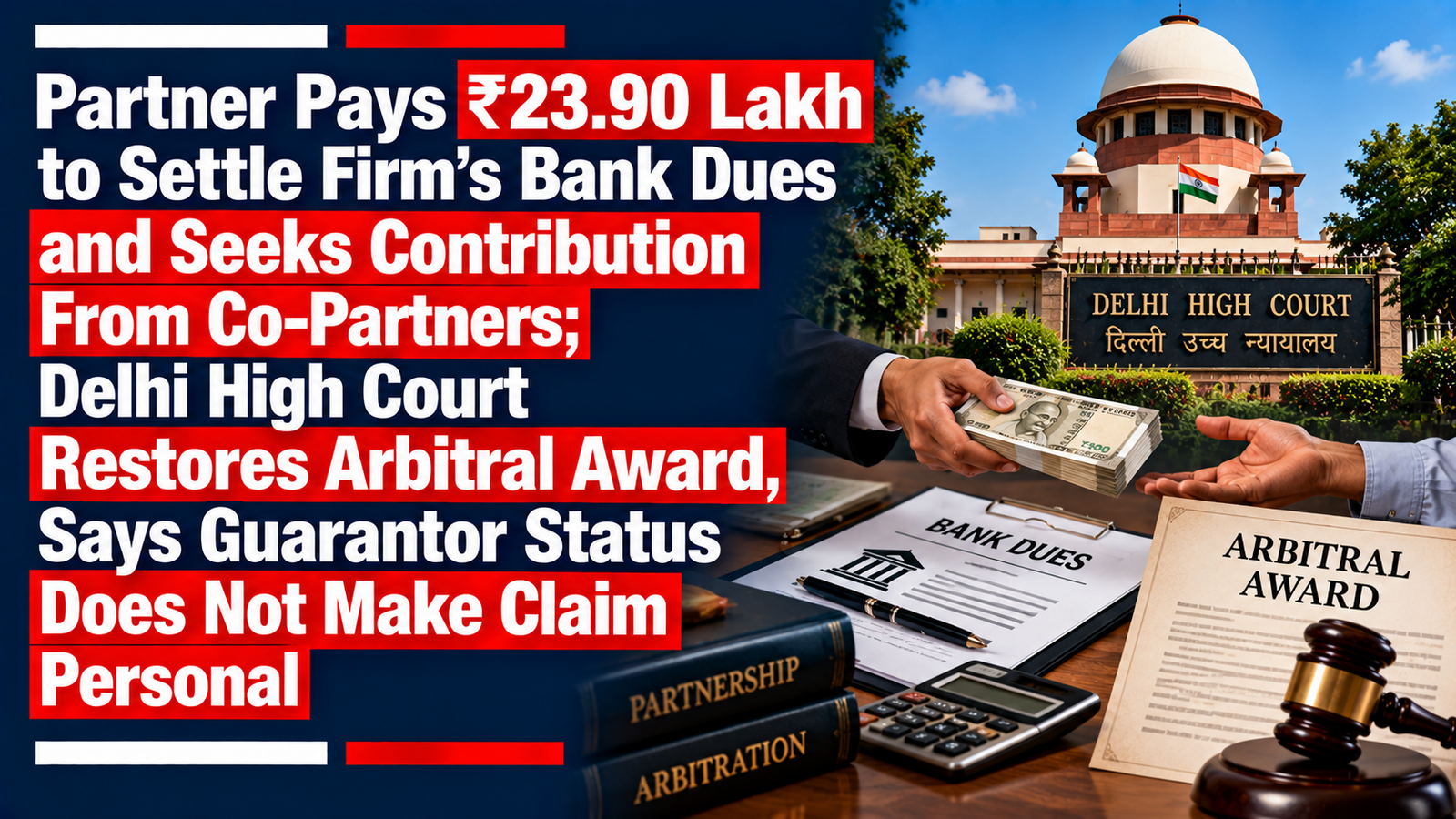
District Court Sets Aside Award Reimbursing Partner Who Cleared Firm’s Bank Liability; Delhi High Court Reverses, Says Parties Had Confined Arbitration to That Claim
Facts
On 15 September 2004, Yogesh Bansal and Balbir Singh Tyagi formed a partnership for retailing electronic goods under the name M/s Nova Electro World. Balbir Singh Tyagi brought his wife Mithlesh Tyagi into the firm as a sleeping partner, while Yogesh Bansal brought his father, Krishan Baldev Bansal, the present appellant, as a partner. Balbir Singh Tyagi and Mithlesh Tyagi together held 55% of the partnership, while Yogesh Bansal and the appellant together held 45%.
The partnership carried on business from rented premises in Dwarka, New Delhi. The business continued until September 2006, after which disputes arose regarding dissolution, rendition of accounts and settlement of the partners’ respective claims.
During the subsistence of the firm, M/s Nova Electro World availed a cash-credit facility of Rs.25 lakh from Union Bank of India. The appellant, who was a partner, also stood as guarantor and furnished his property as security.
The firm failed to discharge the cash-credit liability. Approximately Rs.23.76 lakh remained outstanding. After receiving notice from the Bank, the appellant paid Rs.23.90 lakh from his own funds in full and final settlement of the firm’s dues. Union Bank issued a settlement certificate dated 28 April 2008.
The appellant claimed reimbursement from the other partners. After deducting his own 10% partnership share of Rs.2.39 lakh, he sought contribution of the remaining Rs.21.51 lakh from the other partners in accordance with their respective partnership shares.
The dispute proceeded to arbitration. On 11 December 2023, the parties and their counsel stated before the Sole Arbitrator that the award could be passed only in respect of the appellant’s claim concerning the loan amount paid by him to the Bank as guarantor.
By award dated 23 December 2023, the Sole Arbitrator awarded Rs.21.51 lakh against the other partners in their respective shares: Rs.2.39 lakh against Balbir Singh Tyagi, Rs.10.75 lakh against Mithlesh Tyagi and Rs.8.365 lakh against Yogesh Bansal, together with interest at 18% per annum from 28 April 2008 until payment.
Balbir Singh Tyagi and Mithlesh Tyagi challenged the award under Section 34 of the Arbitration and Conciliation Act, 1996. On 28 November 2025, the District Judge set aside the award, holding principally that the Arbitrator had failed to decide the other reliefs and that the Bank-payment claim fell outside the arbitration agreement because the appellant had paid as guarantor.
The appellant challenged that order before the Delhi High Court under Section 37 of the Arbitration Act.
Issues
Whether the Sole Arbitrator committed a jurisdictional error by adjudicating only the appellant’s Bank-payment claim and not the other claims and counterclaims originally pleaded by the parties.
Whether the parties’ statement recorded on 11 December 2023 validly confined the scope of the remaining arbitral adjudication to the appellant’s claim concerning the amount paid to Union Bank of India.
Whether a partner’s claim for contribution from co-partners after paying the partnership firm’s Bank liability falls within the partnership arbitration clause merely because the paying partner was also a guarantor.
Whether the District Judge, exercising jurisdiction under Section 34 of the Arbitration Act, was justified in substituting his view of the evidence and the character of the payment for the findings of the Sole Arbitrator.
Appellant’s Arguments
The appellant argued that the District Judge wrongly proceeded on the basis that the Arbitrator was required to decide every relief originally contained in his counterclaim. The parties had expressly narrowed the scope of adjudication on 11 December 2023 and agreed that the award could be passed on the appellant’s Bank-payment claim.
He submitted that the Sole Arbitrator’s description in paragraph 55 of the award accurately recorded the parties’ understanding that only the claim regarding the amount paid to the Bank was to be adjudicated.
The appellant argued that Order XIV Rule 2 CPC had no application in the manner adopted by the District Judge because arbitration is governed by the parties’ agreed scope of reference and the parties themselves had narrowed that scope.
On arbitrability, he contended that the Rs.21.51 lakh claim was not a personal claim arising from his guarantee. The Bank account belonged to M/s Nova Electro World, and the settlement certificate expressly recorded that Rs.23.90 lakh had been paid towards full and final settlement of the firm’s dues.
He emphasised that he had deducted his own 10% share and sought only the balance attributable to the other partners, showing that the claim was an inter se partnership adjustment rather than an independent guarantor’s claim against the Bank.
He further argued that the Arbitrator’s factual findings were based on the settlement certificate, documentary evidence and admissions in cross-examination, and could not be displaced merely because the Section 34 court preferred another view.
Respondents’ Arguments
The respondents contended that the order-sheet dated 11 December 2023 merely stated that the award could be passed on the ‘claim made by respondent No.3’ and did not expressly confine adjudication to the Bank-payment component alone.
They argued that the appellant’s counterclaim contained several reliefs, including dissolution of the partnership, rendition of accounts and other monetary claims. The Arbitrator therefore could not select one monetary claim and leave the remaining reliefs undecided.
They submitted that if the other claims had genuinely been abandoned, a formal statement or application should have been placed on record.
On arbitrability, the respondents argued that the appellant paid the Bank in his independent capacity as guarantor and without consulting the other partners. There was no document showing that the firm had authorised him to make the payment.
They therefore contended that the reimbursement claim arose outside the arbitration clause in the Partnership Deed and that the District Judge correctly set aside the award.
Analysis of the Law
The Delhi High Court separated the controversy into two questions: first, what remained for adjudication after the parties’ statement dated 11 December 2023; and second, whether the Bank-payment claim was within the arbitration agreement.
On the first issue, the Court treated the contemporaneous order-sheet and the Sole Arbitrator’s explanation in paragraph 55 of the award as significant. The record showed that after arguments were heard, the parties agreed that the award could be confined to the appellant’s claim concerning the amount paid to the Bank.
The Court held that the absence of a separate application or statement on oath did not erase the submission actually recorded in the arbitral proceedings. Arbitration had to be examined in light of the record and the conduct of the parties before the Tribunal.
The relevant question was not whether an arbitrator may ordinarily leave pleaded reliefs unanswered, but whether those reliefs remained live for adjudication after the parties themselves narrowed the scope of the dispute. Once the parties confined the adjudication, the Arbitrator could not be faulted for not deciding abandoned or non-pressed claims.
On arbitrability, the Court distinguished the appellant’s relationship with the Bank from his subsequent inter se claim against his co-partners. Although the Bank could proceed against him as guarantor, the underlying borrowing was that of M/s Nova Electro World and the money was paid towards settlement of the firm’s dues.
The appellant’s reimbursement claim did not seek any relief against the Bank or challenge the guarantee. It sought contribution from the other partners after one partner had discharged a partnership liability.
The Court held that the substance of the claim, rather than merely the capacity in which the Bank recovered the amount, determined arbitrability. The claim concerned the firm’s financial liability and adjustment of the partners’ respective shares, bringing it within the partnership relationship and arbitration clause.
The absence of prior consultation with the other partners did not transform the firm’s liability into the appellant’s personal liability. As a partner, he was entitled to take steps for discharge of an existing liability of the partnership, and there was no evidence that the amount paid was unrelated to the firm’s dues.
Precedent Analysis
The Sole Arbitrator had considered S.N. Prasad v. Monnet Finance Ltd. & Ors. and distinguished it on facts. The Delhi High Court noted that the Arbitrator did not simply ignore the objection to arbitrability; the objection was noticed and a view was taken upon it.
The Court clarified that the fact that an arbitrability objection had not been pleaded in the written statement might not by itself answer every jurisdictional question. Nevertheless, the District Judge was required to examine the Arbitrator’s view within the limited parameters of Section 34 rather than proceeding as if the objection had never been considered.
The judgment principally applies the settled limits on Section 34 interference: a court may examine whether a statutory ground for setting aside exists, but it cannot overturn an arbitral factual determination merely because it would have characterised the evidence differently.
Court’s Reasoning
The Court found that the District Judge erred in construing the expression ‘claim made by respondent No.3’ as necessarily encompassing every relief originally pleaded by the appellant. The contemporaneous order-sheet, read with paragraph 55 of the award, showed that the parties intended the Arbitrator to decide the Bank-payment claim alone.
The Arbitrator’s decision not to adjudicate dissolution, rendition of accounts, goodwill, tenancy and other claims was therefore not a refusal to exercise jurisdiction over live disputes. Those matters had ceased to require adjudication because of the parties’ own statement.
On the second issue, the settlement certificate was decisive in demonstrating the nature of the underlying liability. It identified the account as that of M/s Nova Electro World and recorded that the appellant, described both as a partner and guarantor, had paid Rs.23.90 lakh in full and final settlement of the firm’s dues.
The Court emphasised that the same person could simultaneously be a partner and a guarantor. His guarantor status explained why the Bank could proceed against him, but did not determine the character of his later claim for contribution from the other partners.
The Arbitrator’s calculation further demonstrated the partnership character of the claim: the appellant’s own 10% share was deducted first, and the remaining Rs.21.51 lakh was apportioned amongst the other partners according to their partnership shares.
Clause 15 of the Partnership Deed referred disputes concerning the partnership deed or books of accounts to arbitration. A dispute concerning discharge of a firm liability by one partner and adjustment of the corresponding burden among co-partners was therefore within the inter se financial disputes of the partnership.
The Court also held that the Arbitrator’s factual findings were supported by the settlement certificate, evidence and admissions made during cross-examination. The District Judge could not set aside the award simply because he viewed the payment differently.
The District Judge thus erred on both foundational grounds: treating the unadjudicated reliefs as still requiring determination, and treating the Bank-payment claim as a personal guarantor claim lying outside the arbitration agreement.
Conclusion
The Delhi High Court allowed the appeal and set aside the District Judge’s order dated 28 November 2025 in OMP (COMM.) No.25/2024.
The arbitral award dated 23 December 2023 was restored.
The judgment establishes that where parties consciously narrow the scope of arbitral adjudication, an award confined to that agreed claim cannot be set aside merely because other reliefs appeared in the original pleadings. It further holds that a partner who pays the firm’s Bank liability may pursue an inter se contribution claim in partnership arbitration even though he also happened to be the guarantor for the Bank facility.
Case Details
Case: Shri Krishan Baldev Bansal v. Balbir Singh Tyagi & Ors.
Court: High Court of Delhi at New Delhi
Case Number: FAO(COMM) 64/2026 & CM APPL. 14176/2026
Bench: Justice Anil Kshetrapal and Justice Bharat Parashar
Judgment by: Justice Anil Kshetrapal
Reserved on: 23 September 2026
Pronounced on: 5 October 2026
Result: Appeal allowed; District Judge’s order dated 28 November 2025 set aside; arbitral award dated 23 December 2023 restored.