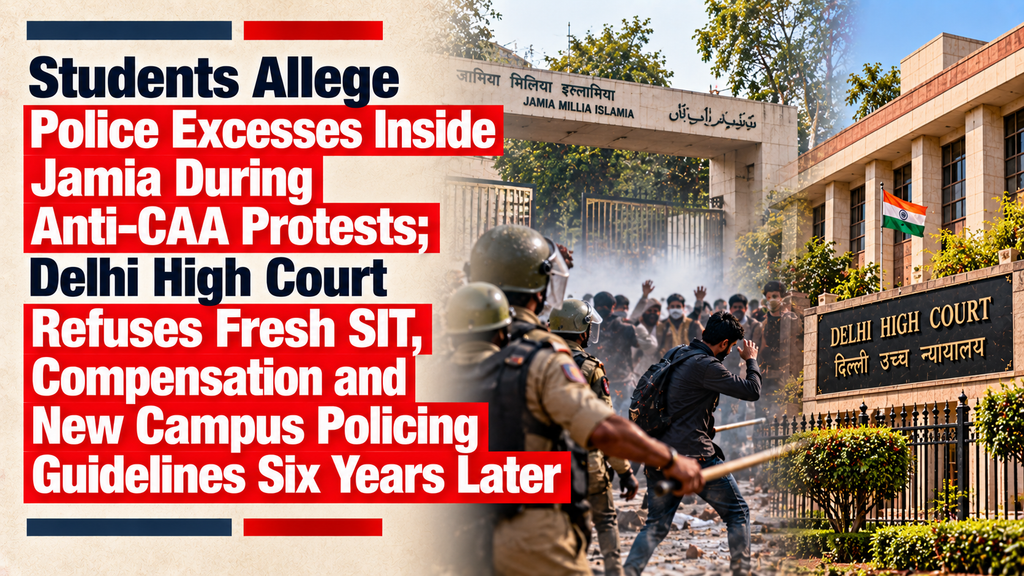
Students Allege Police Excesses Inside Jamia During Anti-CAA Protests; Delhi High Court Refuses Fresh SIT, Compensation and New Campus Policing Guidelines Six Years Later

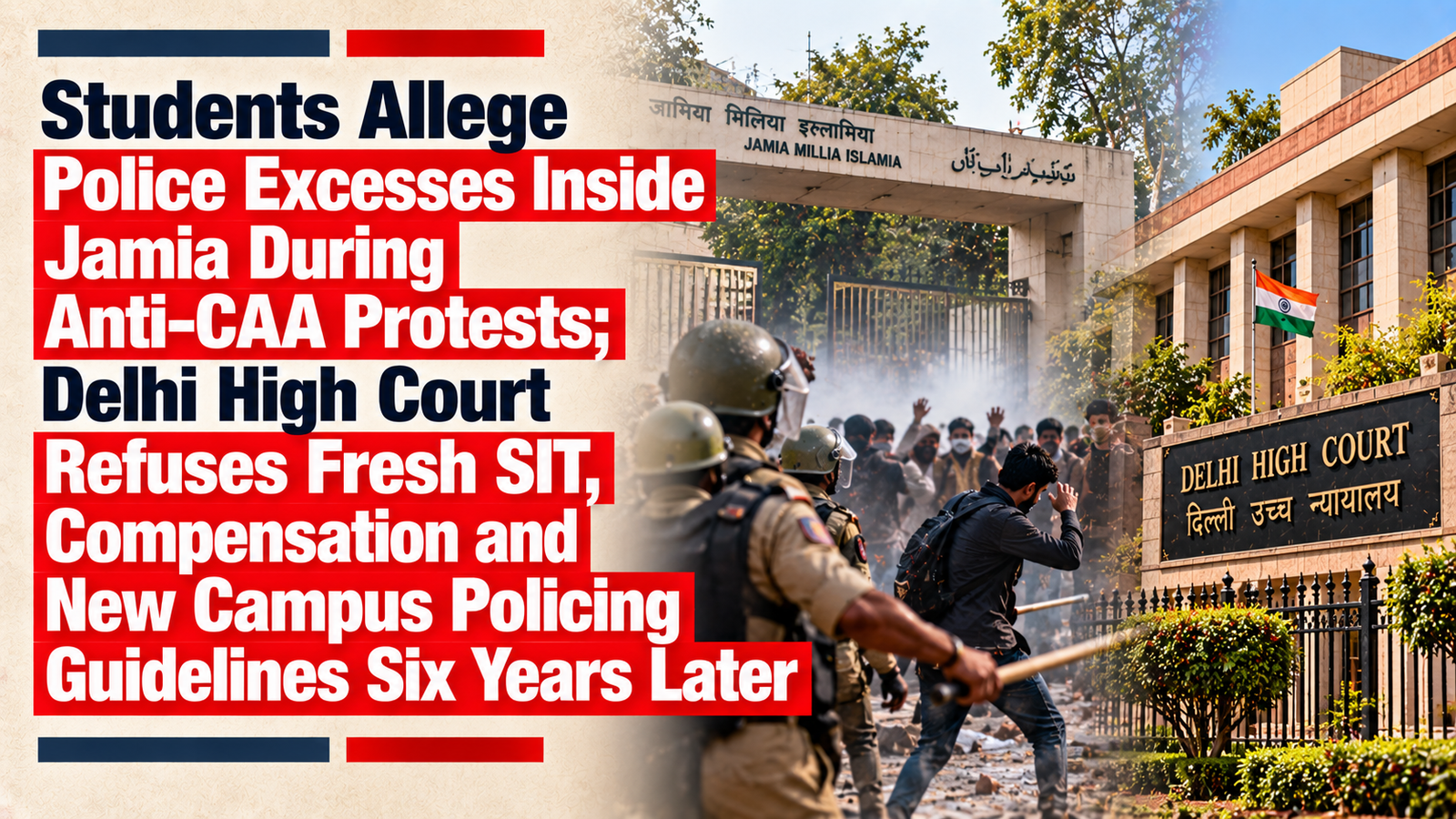
Jamia Protesters Seek Independent Probe and Compensation for December 2019 Police Action; Delhi High Court Says NHRC Inquiry, Crime Branch Investigation and Existing Remedies Make Fresh Writ Intervention Unwarranted
Facts
The batch of eight writ petitions arose from events at and around Jamia Millia Islamia University in December 2019, in the backdrop of protests against the Citizenship Amendment Act, 2019 and the proposed NRC. The petitioners alleged that police and paramilitary personnel used excessive force, entered the University campus without authorization, deployed tear gas in enclosed academic spaces including the library, assaulted students and staff, detained students, and interfered with access to legal assistance. The State maintained that the protests had escalated into violence, arson, damage to public and private property and attacks on police personnel, requiring intervention to restore public order.
During the pendency of the petitions, several original prayers became infructuous. The petitioners ultimately confined their case to four broad surviving areas: an independent judicial commission/SIT or other neutral inquiry into alleged police excesses; compensation and reimbursement of medical expenses; fresh safeguards regulating police action during protests in educational institutions; and preservation of CCTV footage and other evidence.
Two criminal cases, FIR Nos. 242/2019 and 298/2019, had been registered and transferred to a Special Investigation Team of the Crime Branch, which filed charge-sheets. Separately, the NHRC investigated complaints concerning the events of 15 December 2019. Its report dated 18 May 2020 found that the protests had at places turned violent and necessitated police intervention, while also recording lack of restraint in certain police/RAF actions, including use of force against students and tear gas in the library. The NHRC recommended compensation for injured students, accountability measures, police training and institutional reforms. Jamia Millia Islamia also pursued an application under Section 156(3) CrPC against police officials; it was dismissed on 3 February 2021, primarily for want of sanction under Section 197 CrPC, and that order was not challenged.
Issues
1. Whether the circumstances justified constitution of an independent judicial commission, court-monitored committee, SIT, fact-finding body or transfer/fresh investigation into alleged police excesses and criminal acts by public officials.
2. Whether compensation, reimbursement of medical expenses or other public-law monetary relief should be awarded under Article 226 for injuries and alleged rights violations.
3. Whether the Court should frame fresh guidelines specifically regulating police entry, use of force and intervention during protests within educational institutions.
4. Whether further directions were necessary for preservation of CCTV footage, electronic records and other evidence relating to the December 2019 incidents.
Petitioners’ Arguments
The petitioners contended that once the crowd had retreated into the University, there was no justification for police to pursue students into the campus, library and academic facilities. They relied on the Chief Proctor’s statement that permission had not been obtained before police entry, and argued that statutory safeguards governing dispersal of assemblies and use of force were not followed. Ramlila Maidan Incident and Anita Thakur were invoked to emphasize necessity, proportionality and restraint.
They stressed that the NHRC itself had found certain police action inside the library avoidable and lacking restraint. Since the allegations were substantially against police personnel, they argued that allowing the police machinery to examine its own conduct offended the principle that no person should be a judge in his own cause, warranting an independent inquiry or SIT.
On compensation, the petitioners relied on injuries allegedly suffered by students, including serious and permanent injuries, and submitted that private financial assistance could not substitute public-law compensation for violation of fundamental rights. Rudul Sah, Bhim Singh and Nilabati Behera were relied upon. They also sought specific policing safeguards for educational campuses and continued preservation of electronic evidence.
Respondents’ Arguments
The State raised a preliminary objection that most petitions were in the nature of PILs concerning criminal investigation even though the petitioners were not direct victims. It argued that the criminal-law machinery had already been activated: FIRs were registered, the Crime Branch SIT investigated, charge-sheets were filed and proceedings were pending before competent courts.
The State further relied on the completed NHRC inquiry, which had not been challenged, and the finality of the dismissal of Jamia’s Section 156(3) CrPC application. It submitted that no material demonstrated that the investigation was tainted, biased or incapable of inspiring confidence. On compensation, it argued that the NHRC had already recommended remedial measures and the petitioners had not pursued those avenues. It also maintained that existing constitutional, statutory and judicial safeguards sufficiently regulate police action and that CCTV/electronic material had already been preserved.
Analysis of the Law
The Court emphasized that Article 226 undoubtedly empowers a High Court to direct an independent investigation, but such power is extraordinary and must be exercised sparingly. A transfer or fresh independent investigation is ordinarily justified only in rare and exceptional cases where credibility, fairness, public confidence or enforcement of fundamental rights demonstrably requires it. Once investigation has substantially progressed and charge-sheets have been filed, superior courts ordinarily should not reopen the investigative process without compelling material.
The Court also reiterated that criminal law contains its own remedial hierarchy. Complaints about non-registration or deficient investigation ordinarily have remedies before superior police officers and the Magistrate. Although the Article 226 remedy is not mutually exclusive, the same grievance should not ordinarily be reopened constitutionally after the statutory route has been invoked and adjudicated, absent exceptional circumstances.
Public-law compensation remains available for an established infringement of fundamental rights, but the Court distinguished cases where such violation was proved or undisputed. Where the facts remain contested, a statutory human-rights body has already examined the matter and recommended remedies, and individual claimants retain ordinary remedies, Article 226 need not be used to bypass those mechanisms.
As to policing standards, the Court held that necessity, reasonableness, restraint and proportionality already govern State coercive action under the Constitution, statutes, police manuals and binding Supreme Court precedent. An alleged violation of an existing safeguard does not itself prove that the safeguard is inadequate or require creation of a new campus-specific legal regime.
Precedent Analysis
State of West Bengal v. Committee for Protection of Democratic Rights and K.V. Rajendran were applied for the proposition that constitutional courts may transfer an investigation, but only sparingly and in rare or exceptional situations. Romila Thapar reinforced that parties cannot demand an investigating agency of their choice merely by alleging bias. Sakiri Vasu was relied upon to stress statutory remedies under Sections 154(3), 36, 156(3) and 200 CrPC before resort to writ jurisdiction.
Janata Dal v. H.S. Chowdhary, Simranjit Singh Mann, Rajiv Ranjan Singh “Lalan” and Tehseen Poonawalla informed the Court’s caution against using PIL jurisdiction to supervise or supplant the ordinary criminal process without cogent material demonstrating institutional failure.
Ramlila Maidan Incident, Anita Thakur and D.K. Basu were treated as continuing safeguards requiring restraint, proportionality and lawful exercise of police power. However, they did not require a fresh set of rules exclusively for educational institutions. Rudul Sah, Bhim Singh and Nilabati Behera were distinguished on compensation because those cases involved established or undisputed constitutional violations requiring immediate public-law redress.
Court’s Reasoning
The Court found that the December 2019 allegations had not remained unexamined. The NHRC conducted an independent inquiry, made findings critical of aspects of police conduct and recommended remedial measures; its report remained unchallenged. Criminal cases were investigated by the Crime Branch SIT and charge-sheets were before competent courts. Jamia’s Section 156(3) application had also been adjudicated and allowed to attain finality. In that setting, no pervasive or fundamental failure of the existing mechanisms was shown so as to justify a fresh judicial commission, SIT or parallel investigation.
The Court declined to determine, in writ jurisdiction, whether force used at particular moments was necessary or excessive because that exercise required appreciation of evidence, the sequence of events, the perceived threat and conduct of persons present. Its refusal to order a fresh probe was expressly not a finding on the merits of individual allegations or culpability.
Compensation was refused because the factual basis remained disputed, the NHRC had already recommended compensation/remedial measures, the petitioners had not shown that those recommendations were pursued, individual remedies remained available, and more than six years had elapsed. The Court likewise declined fresh campus-policing guidelines: the incident arose from a rapidly developing situation in which protests around the University had escalated into violence, and one incident could not furnish a universal procedure for every educational institution. The Court expressly clarified that this did not approve every police act or dilute the right to peaceful protest and the duty to act proportionately.
No further preservation order was considered necessary because the State had stated on affidavit that CCTV footage and relevant electronic records were preserved and formed part of the investigative material, with no concrete material showing subsequent destruction or suppression. Questions of admissibility, authenticity and evidentiary value were left to the criminal courts.
Conclusion
The Delhi High Court dismissed the entire batch of writ petitions. It found no ground to constitute an independent inquiry mechanism or SIT, transfer or reopen the investigation, direct registration of criminal cases, award compensation in writ jurisdiction, frame fresh guidelines for police action in educational institutions, or issue additional directions for preservation of evidence. The Court nevertheless preserved the right of any individual to pursue remedies otherwise available in law, and clarified that competent authorities or courts could act on any specific offence or grievance where statutory requirements were independently satisfied. Pending applications were disposed of and there was no order as to costs
CASE DETAILS
Case: Manoj Dhiryan v. Union of India & Ors. and connected matters
Court: High Court of Delhi at New Delhi
Case Number: W.P.(C) 13468/2019 & connected matters
Judges: Justice Vivek Chaudhary and Justice Manoj Jain
Reserved On: 24 July 2026
Date: 5 October 2026
Result: Writ petitions dismissed; pending applications disposed of; no order as to costs.