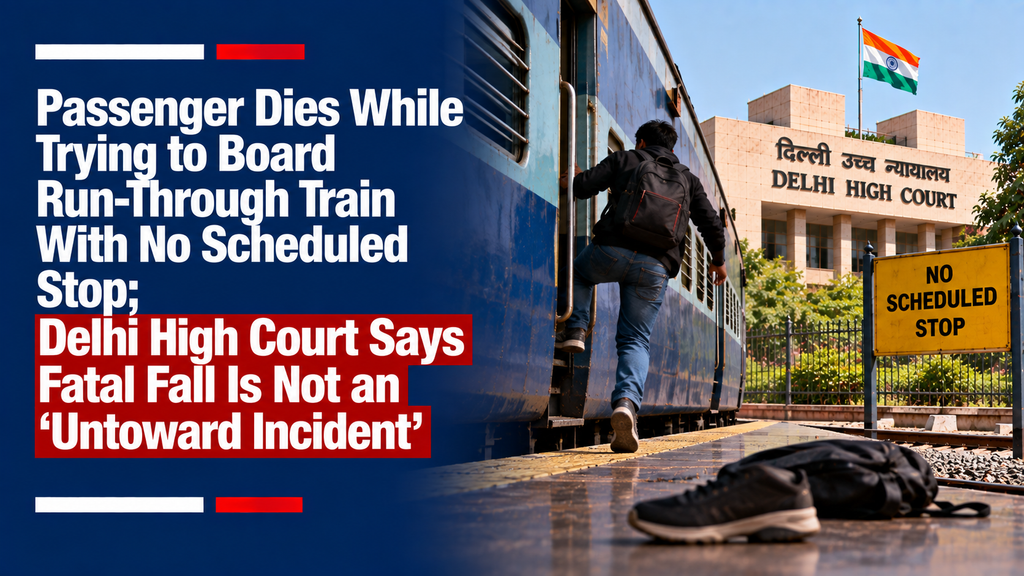
Passenger Dies While Trying to Board Run-Through Train With No Scheduled Stop; Delhi High Court Says Fatal Fall Is Not an ‘Untoward Incident’

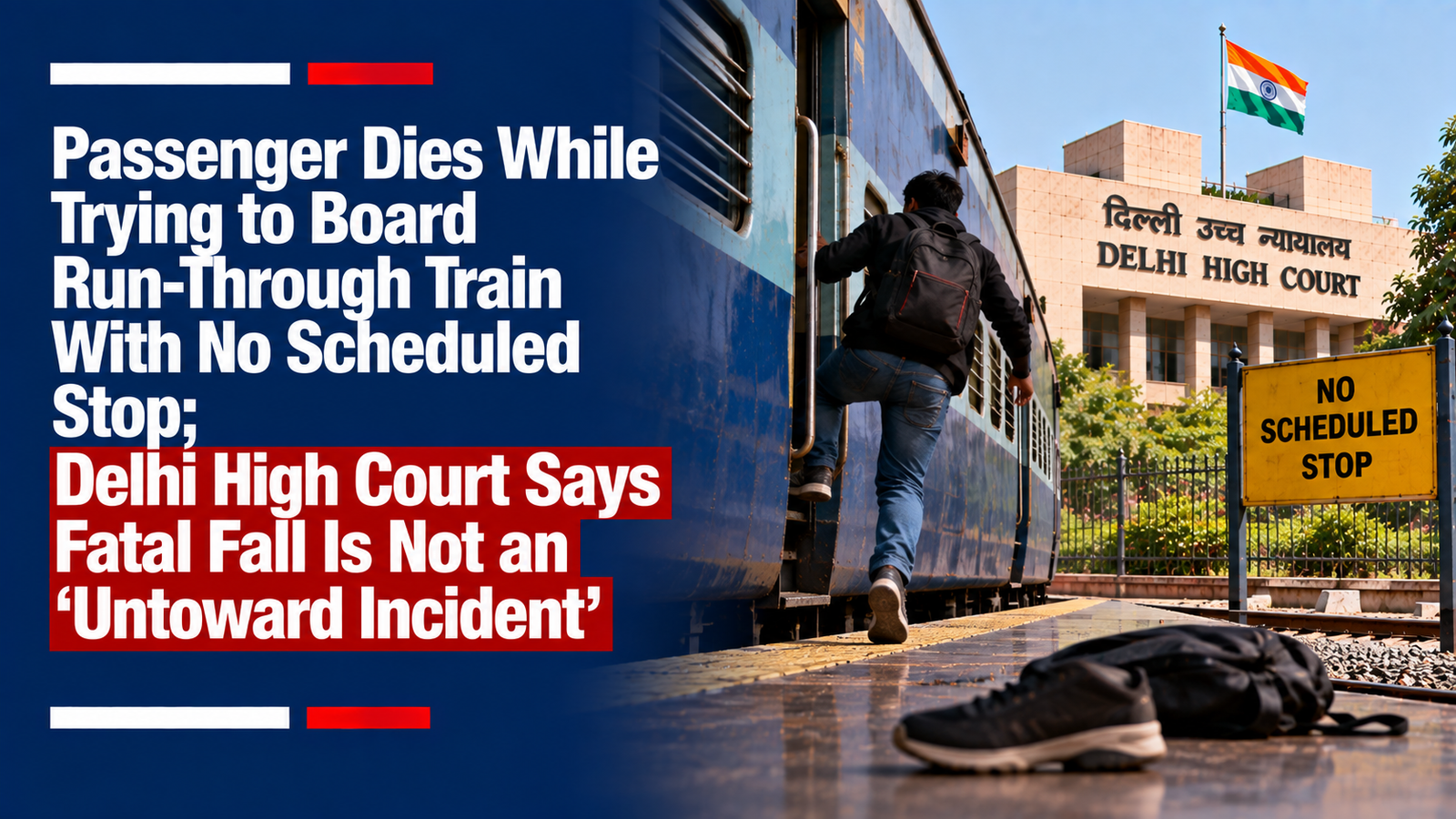
Fatal Fall While Boarding Run-Through Train Not an Accidental Fall During Normal Journey: Delhi High Court
Facts
The appellants sought compensation for the death of Ravi Parcha, who was travelling on 15 December 2016 from Shivaji Bridge to Ghaziabad.
According to the claim originally made before the Railway Claims Tribunal, when the train was approaching Tilak Bridge Railway Station, a sudden jerk caused Ravi Parcha to fall from the train, sustain grievous injuries and subsequently die.
However, the evidence revealed a materially different version of the occurrence.
The statement of Pawan Kumar, relied upon by the appellants themselves, recorded that Ravi Parcha was actually attempting to board the moving train at Tilak Bridge when his hand slipped and he fell between the train and the platform.
The train concerned—Train No. 14681—was a run-through train and had no scheduled stoppage at Tilak Bridge.
The Railway Claims Tribunal rejected the compensation claim.
The deceased’s family challenged that decision before the Delhi High Court under Section 23 of the Railway Claims Tribunal Act, 1987.
Issues
The central question was:
Does the death of a bona fide passenger while attempting to board a moving run-through train at a station where it has no scheduled stoppage constitute an “untoward incident” under Section 123(c)(2) of the Railways Act?
A related issue was whether such an occurrence could be treated as a normal “accidental falling of any passenger from a train carrying passengers”, attracting compensation under Section 124-A.
Appellants’ Arguments
The family argued that the Tribunal had wrongly treated the incident as a self-inflicted injury merely because the train was a run-through train.
They stressed that there was no evidence that Ravi Parcha intended to injure himself.
Their own witness, Pawan Kumar, stated only that the deceased was attempting to board the moving train when his hand slipped and he accidentally fell.
Accordingly, they sought to characterise the occurrence as an accidental railway fall rather than an excluded self-inflicted injury.
Respondent’s Arguments — Railways
The Railways argued that the deceased had attempted to board a fast-moving run-through train which was not scheduled to stop at Tilak Bridge.
According to the Railways, this was an imprudent and reckless act.
Since the deceased voluntarily attempted to board a train that was not supposed to halt at that station, the resulting injury was attributable to his own conduct and did not attract statutory compensation.
Analysis of the Law
Deceased Was a Bona Fide Passenger
Importantly, the Railways did not succeed on the ground that Ravi Parcha lacked a valid ticket.
The journey ticket from Shivaji Bridge to Ghaziabad was produced before the Tribunal.
The Railway’s own DRM report accepted the ticket as genuine.
The Tribunal therefore specifically found that Ravi Parcha was a:
bona fide passenger.
However, the High Court held that bona fide passenger status did not by itself resolve the compensation claim.
Valid Ticket Does Not Make Every Accident Compensable
This is the central proposition emerging from the judgment.
The Court held that:
“the mere fact that the deceased was a bona fide passenger would not, by itself, render every consequence of his conduct an ‘untoward incident’.”
Thus, two questions remain distinct:
Was the deceased a bona fide passenger?
Yes.
Was the particular occurrence an “untoward incident” contemplated by the Railways Act?
No, on the facts found by the Court.
Passenger Was Trying to Board — Not Falling From a Train During Journey
The evidence established that the deceased was not already travelling on the train and accidentally thrown out of it.
Rather, he was at Tilak Bridge attempting to board Train No. 14681.
That train:
- was a run-through train;
- had no scheduled stoppage at Tilak Bridge; and
- was moving when he attempted to board it.
His hand slipped during that attempt, causing him to fall between the train and platform.
The High Court therefore distinguished this occurrence from an ordinary accidental fall from a passenger train during the course of a normal journey.
Section 123(c)(2) Not Attracted
Section 123(c)(2) includes within “untoward incident” the accidental falling of any passenger from a train carrying passengers.
The Court held that the present incident did not fall within that statutory description.
The deceased had consciously attempted to board a run-through train at a station where it was not scheduled to stop.
The fatal fall occurred in the course of that attempt.
Consequently, it could not be characterised as an accidental fall from a train “during the course of a normal journey” so as to attract Section 123(c)(2).
Important Nuance — Court Did Not Base Decision Solely on “Self-Inflicted Injury”
The appellants specifically attacked the Tribunal’s reasoning that the occurrence amounted to a self-inflicted injury under the proviso to Section 124-A.
However, the High Court’s operative reasoning focused on a somewhat different point.
It held that the incident itself did not qualify as an “untoward incident” under Section 123(c)(2) because it arose while the deceased attempted to board a run-through train at a station where the train was not scheduled to halt.
Therefore, the stronger and more accurate proposition from the judgment is:
The occurrence fell outside the statutory definition of an “untoward incident.”
It would be too broad to present the judgment simply as holding that boarding a moving train always constitutes a “self-inflicted injury.”
Precedent Analysis
Naresh Kumar v. Union of India — 2026 SCC OnLine Del 6415
This was the principal precedent relied upon by the Court.
In Naresh Kumar, the deceased similarly attempted to board a run-through train at a station where it had no scheduled stoppage.
The Delhi High Court upheld the finding that such an occurrence was not covered as an “untoward incident.”
Justice Manoj Kumar Ohri found the present case to stand “on the same footing.”
The decisive factual combination was:
run-through train + no scheduled halt + conscious attempt to board + fatal fall during that attempt.
Court’s Reasoning
The Court found no factual controversy regarding how the accident occurred.
The appellants’ own evidence established that Ravi Parcha was trying to board the train when his hand slipped.
It was equally undisputed that the train was not scheduled to stop at Tilak Bridge.
Although the deceased possessed a valid ticket, his status as a bona fide passenger could not convert every consequence of his conduct into an “untoward incident.”
The Court therefore concluded that the fatal fall could not be treated as an accidental fall during a normal railway journey within Section 123(c)(2).
Accordingly, the Tribunal’s rejection of the compensation claim required no interference.
Conclusion
The Delhi High Court dismissed the appeal and upheld the Railway Claims Tribunal’s rejection of compensation.
The Court held that the deceased’s attempt to board a run-through train that was not scheduled to stop at Tilak Bridge, followed by his fatal fall during that attempt, did not constitute an “untoward incident” under Section 123(c)(2) of the Railways Act, 1989.
Key Takeaway
Possession of a valid railway ticket and status as a bona fide passenger do not automatically make every railway accident compensable. Where a passenger consciously attempts to board a moving run-through train at a station where it has no scheduled stoppage and suffers a fatal fall during that attempt, the Delhi High Court held that the occurrence is not an “untoward incident” under Section 123(c)(2).
Case Details
Case: Gyan Prakash @ Bhushan & Anr. v. Union of India
Court: High Court of Delhi at New Delhi
Case No.: FAO 52/2022
CNR: DLHC010091832022
Judge: Justice Manoj Kumar Ohri
Reserved: 2 September 2026
Pronounced: 16 September 2026
Result: Appeal dismissed; Railway Claims Tribunal’s rejection of compensation upheld.