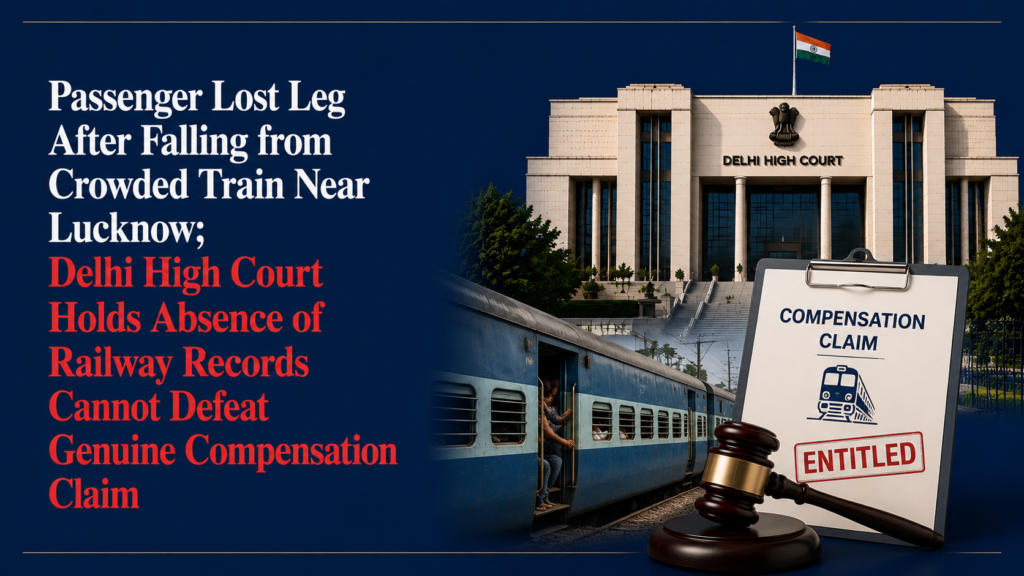
Passenger Lost Leg After Falling from Crowded Train Near Lucknow; Delhi High Court Holds Absence of Railway Records Cannot Defeat Genuine Compensation Claim

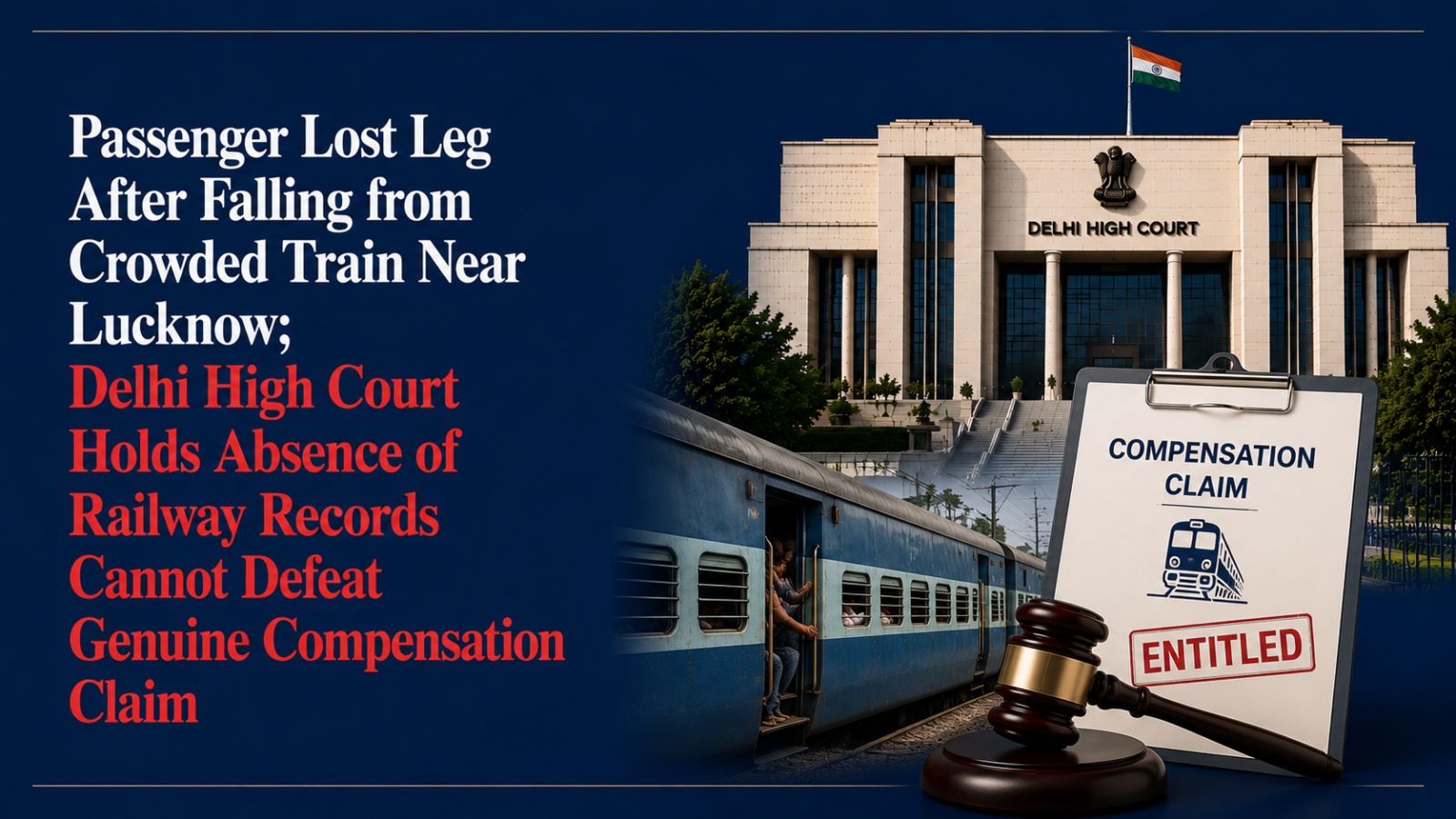
Railway Claims Tribunal Rejected Compensation Due to Absence of Official Records; Delhi High Court Holds Consistent Evidence Sufficient to Establish Untoward Incident
Facts
The appellant claimed that on 20 September 2017, he purchased a general class ticket from Darbhanga to New Delhi and boarded the Bihar Sampark Kranti Express. When the train halted at Lucknow Railway Station, he got down to drink water. After re-boarding, he was forced to stand near the entrance because of heavy crowding. Shortly after the train departed, he allegedly lost his balance due to a push from fellow passengers and fell from the moving train, sustaining grievous injuries. He was taken to Kasturba Gandhi Medical University, Lucknow, and was later shifted to Dr. Ram Manohar Lohia Hospital, New Delhi.
The Railway Claims Tribunal dismissed his compensation claim, holding that no record of the accident existed with the Station Master, Railway Protection Force (RPF), Government Railway Police (GRP), or other railway authorities, and that no independent eyewitness had been examined. Challenging that decision, the appellant approached the Delhi High Court.
Issues
- Whether the appellant established that he was a bona fide passenger.
- Whether the injuries resulted from an “untoward incident” under Sections 123(c) and 124-A of the Railways Act, 1989.
- Whether absence of contemporaneous railway or police records defeated the compensation claim.
- Whether the Tribunal adopted an unduly strict standard of proof while rejecting the claim.
Petitioner’s Arguments
The appellant submitted that he had consistently maintained from the beginning that he accidentally fell from the Bihar Sampark Kranti Express after being pushed in the crowded compartment. He produced the original railway journey ticket, medical records, discharge summary, disability certificate, and entered the witness box to support his case. According to him, this evidence sufficiently established that he was travelling as a bona fide passenger and had suffered injuries in an untoward railway incident.
He further argued that compensation claims under the Railways Act are civil proceedings and should be decided on the principle of preponderance of probabilities, not on the strict standard applicable in criminal trials. Therefore, the Tribunal erred in insisting upon eyewitnesses or contemporaneous official records before granting compensation.
Respondent’s Arguments
The Union of India contended that there was no official record of the alleged accident with the Station Master, RPF or GRP at Lucknow. It emphasized that the appellant had neither immediately reported the occurrence to railway authorities nor produced any independent eyewitness to corroborate his version. The complaints relied upon by him had also been submitted almost eleven months after the alleged accident.
According to the respondent, the absence of contemporaneous records cast serious doubt on the occurrence of the alleged untoward incident and justified dismissal of the compensation claim by the Tribunal.
Analysis of the Law
The High Court examined Sections 123(c) and 124-A of the Railways Act, 1989, governing compensation for untoward incidents. It reiterated that once a claimant establishes that he was travelling with a valid railway ticket, the initial burden regarding bona fide travel stands discharged. The burden then shifts to the Railway Administration to rebut the claim with credible evidence.
The Court further observed that proceedings under the Railways Act are compensatory in nature and arise under a beneficial legislation. Accordingly, claims must be assessed on the preponderance of probabilities rather than the strict evidentiary standards applicable in criminal prosecutions. Mere absence of official railway records or delay in lodging complaints cannot automatically defeat an otherwise credible claim supported by medical and documentary evidence.
Precedent Analysis
- Union of India v. Rina Devi (2019) 3 SCC 572 – Relied upon to hold that production of a valid railway journey ticket and credible testimony is sufficient to establish that a claimant was a bona fide passenger unless rebutted by the Railways.
Court’s Reasoning
The High Court first held that the appellant successfully established his status as a bona fide passenger by producing the original railway journey ticket and entering the witness box. Since the Railways failed to produce any contrary evidence, there was no justification for doubting that he had travelled on the train.
The Court attached considerable importance to the medical records. The discharge summary prepared only two days after the accident specifically recorded the history as “fall from train on 20.09.2017.” The medical documents also revealed that the appellant underwent multiple surgeries, including below-knee amputation of the left leg and amputation of all five toes of the right foot, resulting in 68% permanent disability. Importantly, the Railways never disputed the authenticity of these records or suggested any alternative cause of the injuries.
The Court found that the Tribunal had placed undue emphasis on the absence of railway or police records while ignoring the consistent testimony of the appellant and the contemporaneous medical evidence. The Divisional Railway Manager’s enquiry merely recorded that no official entry could be traced; it did not positively establish that no accident had occurred. Likewise, although there was delay in reporting the incident, the Court accepted the explanation that the appellant had suffered catastrophic injuries, remained hospitalised for nearly two and a half months, underwent repeated surgeries, and continued treatment for permanent disability. Viewing the evidence as a whole, the Court concluded that the appellant had established his claim on the standard of preponderance of probabilities.
Conclusion
The Delhi High Court allowed the appeal, set aside the Railway Claims Tribunal’s order, and held that the appellant had established that he was a bona fide passenger who suffered injuries in an untoward railway incident. The matter was remanded to the Tribunal to determine the compensation payable and direct its disbursement in accordance with law. The judgment reiterates that compensation claims under the Railways Act should be evaluated on a liberal and probabilistic approach consistent with the beneficial object of the legislation.
Case Details
- Case: Mohammad Kaleem v. Union of India
- Court: Delhi High Court
- Case Number: FAO 248/2021
- Judge: Justice Manoj Kumar Ohri
- Date: 28 July 2026
- Result: Appeal allowed; Tribunal’s order set aside and matter remanded for determination and disbursement of compensation.