

HEADNOTE
Raghvendra Singh & Ors. v. Union Public Service Commission & Ors.
(Along with connected matters including Teena Choudhary v. UPSC, Mayur Dasharath Auti v. UPSC and allied writ petitions)
Court: High Court of Delhi
Bench: Justice C. Hari Shankar and Justice Om Prakash Shukla
Date of Judgment: 10 December 2025
Citation: W.P.(C) 8304/2025 & batch
Laws / Sections Involved: Articles 14, 16(4) and 226 Constitution of India; Rule 21.2 CAPF (Assistant Commandants) Examination Rules, 2023 & 2024; DoPT Office Memorandum dated 08.10.2015
Keywords: OBC-NCL certificate, CAPF Assistant Commandant, UPSC recruitment, cut-off date, reservation in public employment, arbitrariness, legitimate expectation
Summary:
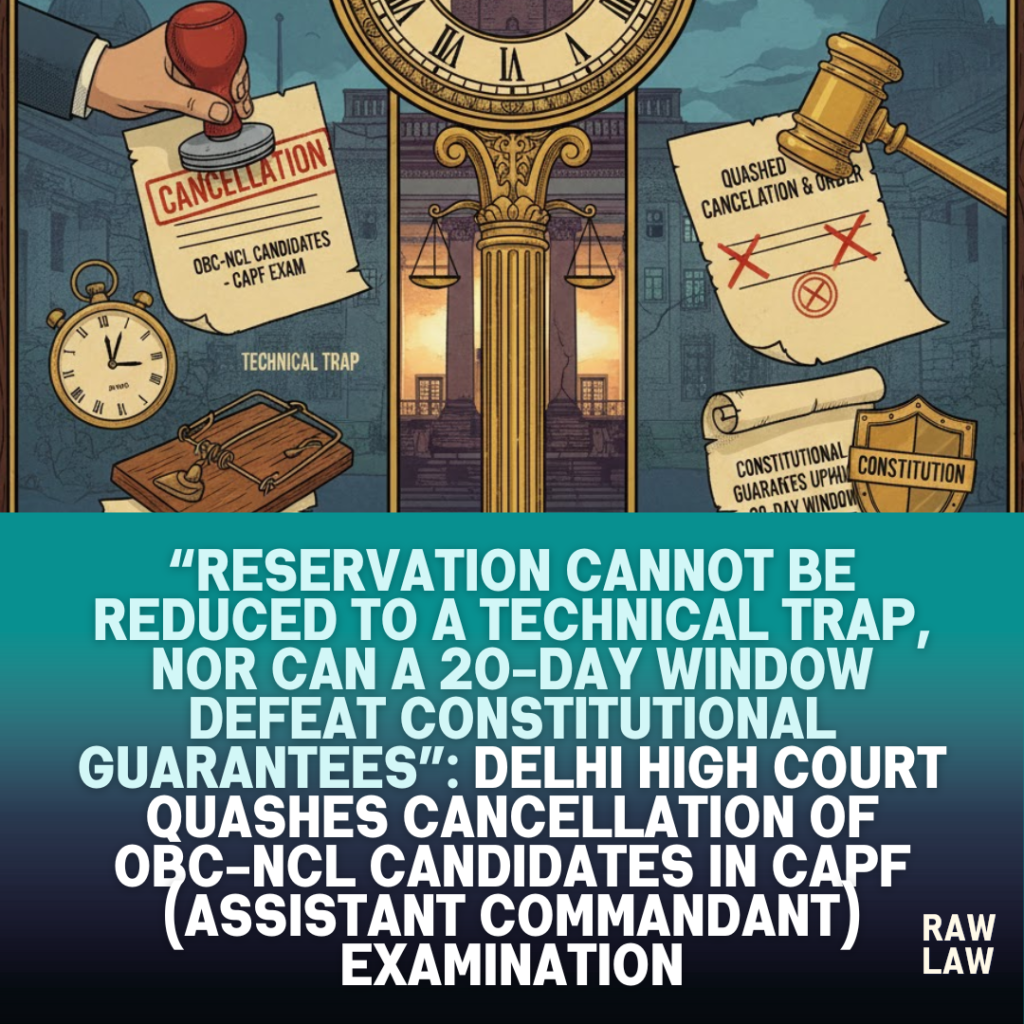
In a significant ruling impacting large-scale public recruitment, the Delhi High Court set aside the cancellation of candidature of multiple OBC–Non Creamy Layer candidates in the CAPF (Assistant Commandant) Examination 2023 and 2024, who were disqualified solely because their OBC-NCL certificates were not issued within a narrowly prescribed cut-off window. The Court held that strict insistence on a 20-day issuance window—introduced after the financial year had already commenced—was arbitrary and defeated the constitutional objective of reservation. Relying on the doctrine of legitimate expectation, DoPT instructions on provisional appointment, and settled precedent that caste status is by birth and not by certification date, the Court ruled that genuine OBC-NCL candidates cannot be denied appointment on technical grounds. The impugned cut-off condition was read down, and UPSC was directed to restore and process the petitioners’ candidature under the OBC category.
Court’s decision
The Delhi High Court allowed the entire batch of writ petitions and set aside the cancellation, forfeiture, or conversion of candidature of OBC–Non Creamy Layer candidates in the CAPF (Assistant Commandants) Examination 2023 and 2024. The Court held that Rule 21.2 of the Examination Rules, insofar as it mandated issuance of OBC-NCL certificates strictly within a narrow post-financial-year cut-off window, could not be applied in a rigid and mechanical manner. UPSC and the concerned forces were directed to treat the petitioners as OBC-NCL candidates, restore their candidature, and process their selection and appointment in accordance with merit, subject to verification of the genuineness of their OBC-NCL status.
Facts
The petitioners belonged to the OBC–Non Creamy Layer category and had applied for the CAPF (Assistant Commandant) Examination conducted by UPSC for the years 2023 and 2024. All petitioners cleared the written examination and several advanced to subsequent stages including PET/PST, medical examination and interviews.
Under Rule 21.2 of the CAPF Examination Rules issued by the Ministry of Home Affairs, OBC-NCL candidates were required to submit certificates issued after the end of the relevant financial year but before the last date of application. For 2023, the permissible window was 1 April 2023 to 16 May 2023; for 2024, it was 1 April 2024 to 14 May 2024.
The Rules and UPSC prospectus were notified only on 26 April 2023 and 24 April 2024 respectively, effectively leaving candidates with roughly 20 days to procure fresh certificates. Although all petitioners possessed valid OBC-NCL certificates either prior to or shortly after the cut-off, their candidature was cancelled, converted to unreserved category, or appointments were withheld solely on the ground that the certificates were not issued within the stipulated window.
Issues
The principal issue before the Court was whether candidature of admittedly genuine OBC-NCL candidates could be cancelled solely because their caste certificates were not issued within a narrowly prescribed cut-off period. The Court also examined whether Rule 21.2, as applied by UPSC, was arbitrary and violative of Articles 14 and 16 of the Constitution, and whether public authorities could deny reservation benefits on technical grounds despite candidates fulfilling substantive eligibility.
Petitioners’ arguments
The petitioners argued that the cut-off window was arbitrary, unreasonable, and impossible to comply with, especially since the Rules themselves were notified after the financial year had begun. It was contended that OBC status is a pre-existing fact by birth, and a certificate merely affirms that status. Denial of reservation benefits on the basis of issuance date, despite possession of valid certificates, was argued to be antithetical to the constitutional purpose of reservation.
Reliance was placed on DoPT Office Memorandum dated 08.10.2015 permitting provisional appointment of reserved candidates, and precedents holding that procedural requirements cannot defeat substantive rights. The petitioners also invoked the doctrine of legitimate expectation, contending that UPSC, as a constitutional body, was bound to act fairly and reasonably.
Respondents’ arguments
UPSC and the Union of India defended the cut-off requirement, arguing that fixation of dates is essential for administrative certainty in large-scale recruitment. It was contended that candidates were aware of the examination calendar well in advance and were expected to be vigilant. The respondents submitted that relaxation would lead to unequal treatment and open floodgates of litigation.
They further argued that once candidates participated in the examination under notified rules, they were estopped from challenging the same, and that courts should not interfere with policy decisions relating to eligibility and documentation.
Analysis of the law
The Court analysed the constitutional scheme of reservation under Articles 14 and 16(4), emphasising that reservation is an enabling provision aimed at achieving substantive equality. It held that while employers may prescribe eligibility conditions, such conditions cannot be arbitrary, disproportionate, or destructive of constitutional objectives.
The Court examined DoPT’s 2015 Office Memorandum, which expressly allows provisional appointment of SC/ST/OBC candidates unable to immediately furnish certificates and mandates verification by authorities in cases of genuine difficulty. The Court held that UPSC’s rigid approach ignored binding executive instructions and principles of fairness.
Precedent analysis
The Bench relied heavily on earlier decisions holding that caste status is by birth and certification is merely evidentiary. It referred to Tej Pal Singh v. GNCTD and Hari Singh v. Staff Selection Commission, where denial of appointment due to delayed caste certificates was held arbitrary. The Court also distinguished cases cited by UPSC relating to EWS and post-acquisition of eligibility, holding that OBC-NCL status is not acquired on the date of certificate issuance.
Court’s reasoning
The Court observed that the impugned cut-off window effectively reduced reservation to a procedural hurdle rather than a substantive right. It noted that candidates were given barely 20 days to obtain certificates from revenue authorities, a process often beyond the control of applicants.
Justice Om Prakash Shukla, speaking for the Bench, held that such mechanical insistence on dates “defeats the very purpose of reservation” and amounts to arbitrariness. The Court emphasised that no allegation of fraud or false claim was made against any petitioner, and their OBC-NCL status was undisputed. Denial of appointment on such technical grounds was held violative of Articles 14 and 16.
Conclusion
The Delhi High Court allowed all writ petitions, read down the rigid application of Rule 21.2, and directed UPSC and the concerned forces to restore the petitioners’ candidature under the OBC-NCL category. The authorities were directed to process selection and appointment based on merit, subject only to verification of the genuineness of caste status. All interim protections granted earlier were made absolute.
Implications
This judgment has wide ramifications for public recruitment across India. It reinforces that reservation benefits cannot be nullified by procedural rigidity and that administrative convenience cannot override constitutional guarantees. The ruling strengthens the rights of reserved category candidates and sends a clear message to recruiting authorities that fairness, proportionality, and substantive equality must guide eligibility and documentation requirements.
CASE LAW REFERENCES
• Tej Pal Singh v. GNCT of Delhi – Caste status by birth, certificate only evidentiary
• Hari Singh v. Staff Selection Commission – Provisional appointment despite delayed OBC certificate
• Sivanandan C.T. v. High Court of Kerala – Doctrine of legitimate expectation
• Punjab National Bank v. Anit Kumar Das – Limits on employer’s power to prescribe eligibility
FAQs
Q1. Can UPSC reject OBC candidates for late caste certificates?
Not if the candidate genuinely belongs to OBC-NCL and the delay is purely technical.
Q2. Is OBC status determined by certificate date?
No. Courts have repeatedly held that caste status is by birth; certificates only confirm it.
Q3. What relief did the Delhi High Court grant?
The Court restored candidature and directed consideration of petitioners under OBC category.


