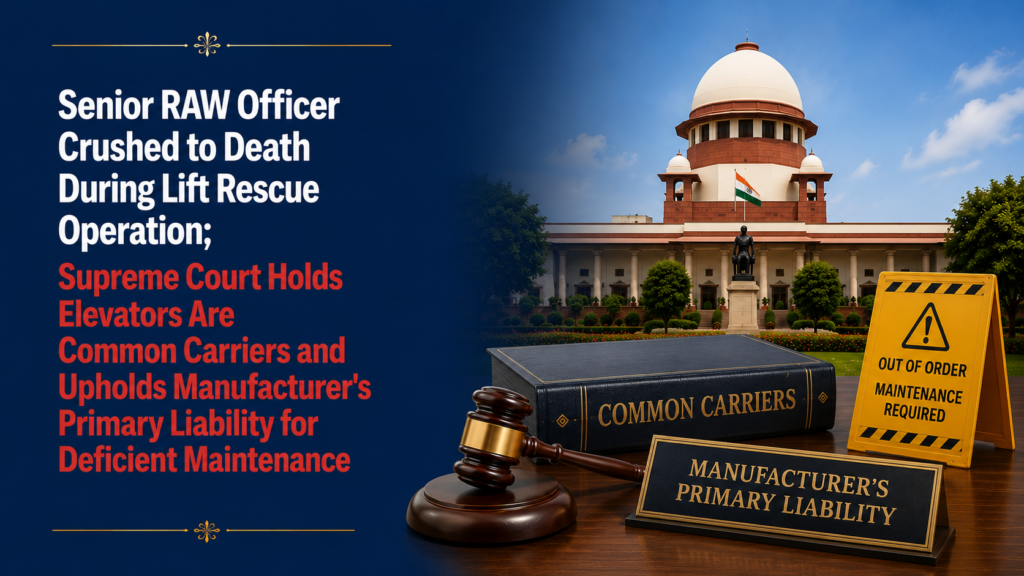
Senior RAW Officer Crushed to Death During Lift Rescue Operation; Supreme Court Holds Elevators Are Common Carriers and Upholds Manufacturer’s Primary Liability for Deficient Maintenance

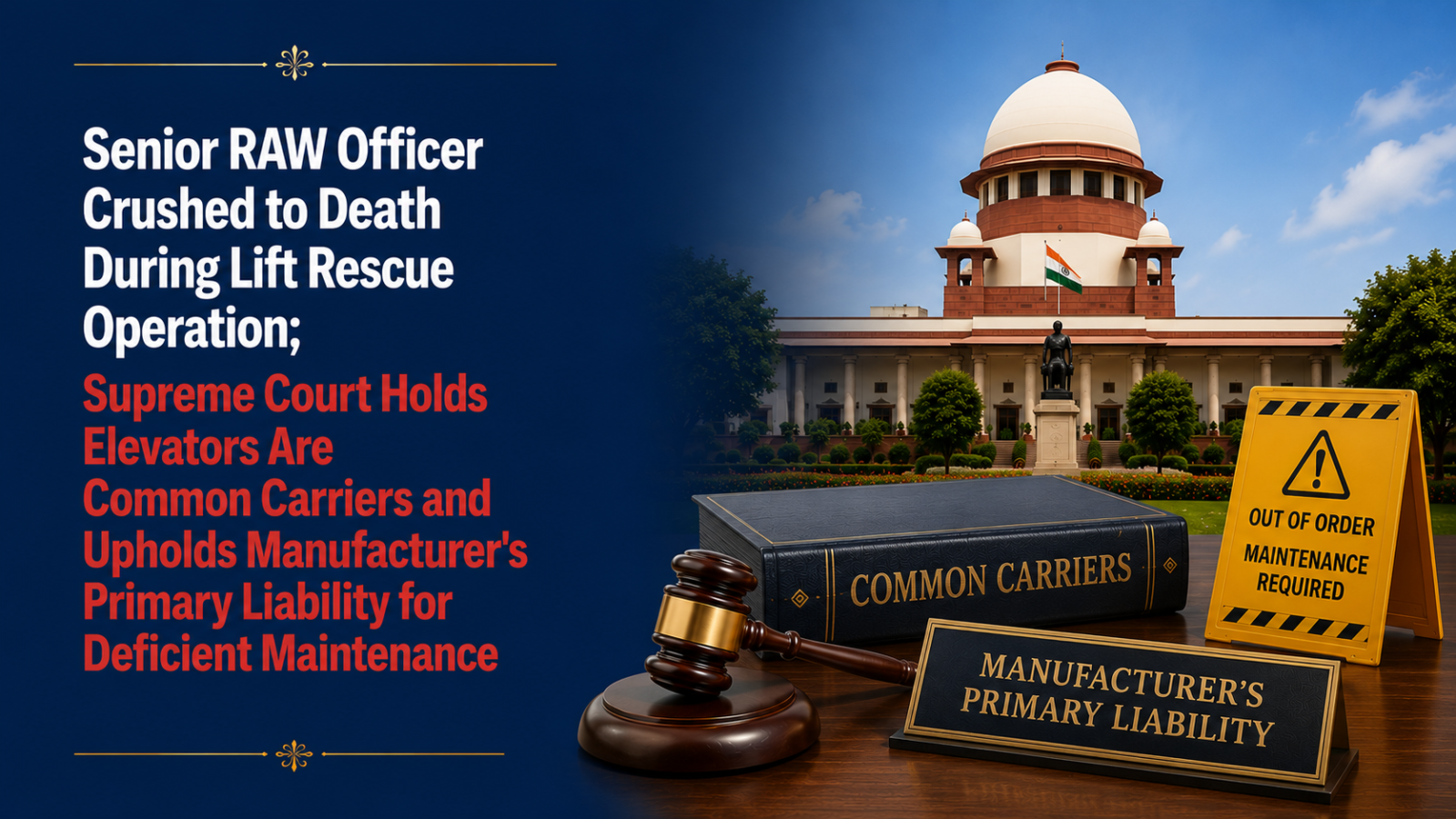
Lift Malfunction Trapped Senior RAW Officers Before Rescue Turned Fatal; Supreme Court Affirms OTIS’s Primary Liability for Deficient Maintenance.
Facts
The case arose from the death of a senior Research and Analysis Wing (RAW) officer during a lift rescue operation at the RAW headquarters in New Delhi. OTIS Elevator Company had installed the lift in December 2001 and subsequently entered into a comprehensive maintenance contract with the Military Engineering Service (MES) for its upkeep.
On 20 March 2003, thirteen senior officers entered the lift after a meeting on the 11th floor. During descent, the lift abruptly stopped between the sixth and seventh floors. After the electricity supply was switched off, rescue operations commenced. While the deceased officer was halfway out of the lift, the lift suddenly moved downward, crushing his neck and causing his death.
Following investigation, the deceased’s widow and children filed a consumer complaint before the National Consumer Disputes Redressal Commission (NCDRC), seeking compensation. The NCDRC held OTIS, MES and RAW jointly and severally liable, apportioning liability at 70% to OTIS, 25% to MES and 5% to RAW, and awarded compensation exceeding ₹3 crore. OTIS challenged that order before the Supreme Court.
Issues
The Supreme Court considered:
- Whether elevators should be treated as common carriers imposing a heightened duty of care upon manufacturers, maintenance contractors and owners.
- Whether OTIS could avoid liability by contending that the immediate cause of the accident was the manual release of the brake by MES personnel.
- Whether the NCDRC correctly apportioned liability among OTIS, MES and RAW.
- Whether the compensation awarded to the deceased’s family required interference.
OTIS’s Arguments
OTIS contended that the IIT Delhi technical investigation unequivocally established that the accident occurred because someone manually released the mechanical brakes using the Brake Release Key inside the machine room, which remained under the exclusive control of MES.
It further argued that it had already warned MES about voltage fluctuations months before the accident and had recommended installation of a voltage stabiliser. Since MES ignored that recommendation, OTIS could not be held responsible.
OTIS also submitted that its mechanic was not contractually required to be present at the time of the accident because the incident occurred outside the scheduled maintenance hours. It additionally relied upon the police chargesheet, which allegedly fixed responsibility upon MES personnel rather than OTIS.
Respondents’ Arguments
The deceased’s family argued that OTIS, as both the manufacturer and comprehensive maintenance contractor, owed a continuing contractual duty to keep the lift in a safe condition and prevent accidents.
They pointed to repeated complaints regarding breakdowns of the very same lift, failure to maintain attendance records of OTIS mechanics, failure to rectify persistent defects, and OTIS’s own admission that voltage instability endangered safe operation of the lift.
They submitted that OTIS neither ensured installation of the stabiliser nor suspended operation of the lift despite repeated breakdowns, thereby breaching its contractual and statutory duties.
Analysis of the Law
The Supreme Court delivered an important ruling on the legal status of elevators. Recognising the realities of modern urban life, the Court held that elevators constitute a form of vertical transportation and should be regarded as common carriers.
Consequently, manufacturers, maintenance contractors and owners of premises owe passengers a heightened duty of care comparable to that imposed upon common carriers. Since passengers exercise no control over the operation of elevators, the law requires those responsible for their operation to ensure the highest standards of safety.
The Court also held that from the perspective of consumer protection and public law, manufacturers, operators and building owners are joint tortfeasors who may be held jointly and severally liable. Consumers should not be burdened with determining the internal allocation of responsibility between these parties before receiving compensation.
Precedent Analysis
The Court relied upon principles governing common carriers and composite negligence. It observed that where several parties contribute to an injury, the victim may recover compensation from any or all of them, leaving questions of inter se liability to be determined separately.
Applying these principles to elevator accidents, the Court extended consumer protection by recognising elevators as common carriers and treating manufacturers, maintenance contractors and premises owners as jointly responsible for passenger safety.
Court’s Reasoning
The Supreme Court observed that the technical report correctly identified the immediate mechanical cause of the accident as the manual release of the brake. However, that did not conclude the legal inquiry into liability.
The Court distinguished between the immediate cause of the accident and the underlying cause of the deficiency in service. It found overwhelming evidence that Lift No. 6 had suffered repeated breakdowns over several months. OTIS had repeatedly received complaints, itself identified voltage fluctuation as a serious safety concern, recommended installation of a stabiliser, yet continued certifying the lift for operation without ensuring corrective measures.
Being both the manufacturer and comprehensive maintenance contractor, OTIS possessed exclusive technical knowledge regarding the lift’s safety systems. The Court held that OTIS ought either to have ensured implementation of the necessary safeguards, prevented continued operation, or taken effective steps to eliminate the danger.
The Court further found that OTIS failed to produce mandatory attendance registers or maintenance records demonstrating compliance with its contractual obligations or showing that trained personnel had been deployed. It also found no evidence that OTIS had trained RAW or MES personnel regarding safe rescue procedures during lift failures.
Although the Court accepted that MES personnel’s manual release of the brake contributed to the accident, it held that such intervention became necessary only because the lift had already malfunctioned owing to longstanding unresolved defects. Accordingly, OTIS remained primarily liable.
The Court agreed that RAW’s role was limited to supervisory oversight, while MES was responsible for inadequate monitoring and allowing access to the machine room during the rescue. Consequently, the NCDRC’s apportionment of 70% liability to OTIS, 25% to MES and 5% to RAW accurately reflected the comparative degree of responsibility borne by each party.
Conclusion
The Supreme Court dismissed OTIS’s appeal and affirmed the NCDRC’s findings.
The Court held that elevators are common carriers requiring the highest degree of care towards passengers. It ruled that OTIS’s repeated failure to rectify known defects, ensure safe operation and fulfil its maintenance obligations constituted the principal deficiency in service that ultimately resulted in the fatal accident.
The Court also allowed the deceased’s widow’s appeal against the execution order, directing the NCDRC to proceed with execution of the compensation decree.
Case Details
Case: M/s OTIS Elevator Co. (India) Ltd. v. Rashmi Handa & Others
Court: Supreme Court of India
Case Number: Civil Appeal No. 4081 of 2014 (with Civil Appeal No. 1602 of 2020)
Bench: Justice Pamidighantam Sri Narasimha and Justice Alok Aradhe
Date: 29 July 2026
Result: OTIS’s appeal dismissed. The Supreme Court upheld the NCDRC’s award, affirmed the finding of deficiency in service, recognised elevators as common carriers, maintained liability at 70% against OTIS, 25% against MES and 5% against RAW, and directed continuation of execution proceedings.