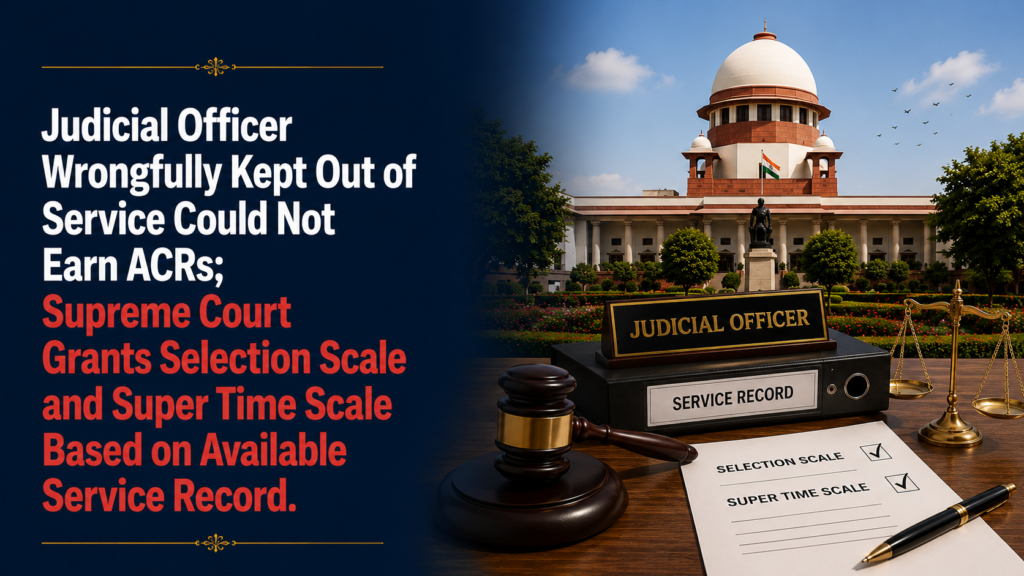
Judicial Officer Wrongfully Kept Out of Service Could Not Earn ACRs; Supreme Court Grants Selection Scale and Super Time Scale Based on Available Service Record.

Rajasthan High Court Denied Selection Scale Due to Missing ACRs Following Illegal Discharge; Supreme Court Holds Employer Cannot Take Advantage of Its Own Wrong
Facts
The case arose from a miscellaneous application filed by the Rajasthan High Court seeking clarification of an earlier Supreme Court judgment that had quashed the discharge of Judicial Officer Abhay Jain. In its 2022 judgment, the Supreme Court had directed his reinstatement with continuity of service, seniority, all consequential benefits, and 50% back wages after holding that his discharge was illegal.
Following reinstatement, Abhay Jain claimed Selection Scale and Super Time Scale under the Rajasthan Judicial Service Rules. However, the Rajasthan High Court declined to grant those benefits because six of the seven Annual Confidential Reports (ACRs) required for consideration were unavailable. Those ACRs could not exist because the officer had remained out of service from January 2016 until April 2022 pursuant to the illegal discharge.
The Rajasthan High Court therefore sought clarification whether the expression “all consequential benefits” in the earlier Supreme Court judgment automatically included grant of Selection Scale and Super Time Scale despite the absence of the required ACRs.
Issues
The Supreme Court considered:
- Whether a judicial officer wrongfully removed from service can be denied Selection Scale and Super Time Scale because the required ACRs were unavailable.
- Whether the employer can rely upon a deficiency created by its own illegal action to deny consequential service benefits.
- Whether reinstatement with continuity of service and “all consequential benefits” includes notional career progression to Selection Scale and Super Time Scale.
Judicial Officer’s Arguments
The Judicial Officer contended that the Supreme Court had already directed reinstatement with continuity of service, seniority and all consequential benefits. Since he was wrongfully kept out of service, he could not be blamed for the absence of ACRs during that period.
He argued that the employer could not derive any benefit from its own illegal action. Had he continued in service, he would have earned the required ACRs and become eligible for Selection Scale and Super Time Scale along with his batchmates. Reliance was placed upon decisions including K.V. Jankiraman, Dragendra Singh Jadon, Prabhu Dayal, and R.K. Jibanlata Devi, which recognise that employees wrongfully deprived of service cannot be denied promotions or career benefits merely because the employer’s illegal action prevented fulfilment of eligibility conditions.
Rajasthan High Court’s Arguments
The Rajasthan High Court argued that grant of Selection Scale and Super Time Scale was governed by the Rajasthan Judicial Service Rules and the Full Court Resolution of 15 January 2011. Those provisions required a specified number of “Good”, “Very Good” or “Outstanding” ACRs during the preceding years.
Since Abhay Jain possessed only four ACRs and remained out of service for the remaining period, the requisite eligibility criteria could not be satisfied. Accordingly, the Full Court concluded that he was not suitable for grant of either Selection Scale or Super Time Scale.
Analysis of the Law
The Supreme Court reaffirmed the settled principle that an employer cannot take advantage of its own wrongful act. Where an employee is illegally removed from service and later reinstated with continuity of service, the employer cannot rely upon the absence of service records created by its own illegal action to deny consequential benefits.
The Court relied upon K.V. Jankiraman, which recognised that an employee completely exonerated is entitled to all consequential benefits from the date he would ordinarily have earned them. It also relied upon Dragendra Singh Jadon, where the Court held that an employer cannot deny seniority, promotion or other benefits after wrongfully dismissing an employee.
The Court further observed that earlier decisions such as Prabhu Dayal and R.K. Jibanlata Devi had consistently held that where ACRs are unavailable due to circumstances beyond the employee’s control, the assessment must be made on the basis of the remaining valid ACRs instead of rejecting the employee outright.
Precedent Analysis
The Supreme Court harmonised several service law precedents.
K.V. Jankiraman established that employees fully exonerated are entitled to promotions and consequential benefits from the dates on which they would ordinarily have been promoted.
Central Bank of India v. Dragendra Singh Jadon reaffirmed that an employer cannot benefit from its own wrongful dismissal.
Prabhu Dayal Khandelwal and R.K. Jibanlata Devi clarified that where required ACRs are unavailable because of the employer’s fault or procedural irregularities, consideration for promotion or higher scale must proceed on the basis of the remaining valid ACRs rather than denying the benefit altogether.
Applying these principles, the Court held that the same rule governed Abhay Jain’s case.
Court’s Reasoning
The Court noted that in its earlier judgment it had already found that Abhay Jain’s discharge was illegal and that there was no material demonstrating unsatisfactory performance or misconduct. It had also held that the adverse 2015 ACR could not form the basis of his discharge and that its non-communication violated Article 14.
Since the wrongful discharge itself prevented the officer from earning subsequent ACRs, the employer could not rely upon that deficiency to deny career advancement. To permit such an approach would allow the employer to profit from its own illegal conduct.
The Court further held that the 2015 ACR itself could not be considered because it had never been communicated and had already been declared arbitrary in the earlier judgment. Consequently, only the valid ACRs for 2013 and 2014 (Parts I and II), containing “Very Good” and “Good” gradings with integrity certificates, could be considered.
On that basis, the Court held that Abhay Jain became entitled to Selection Scale from 16 July 2018 and Super Time Scale from 16 July 2021, the same dates on which officers of his batch and even juniors received those benefits. The Court directed refixation of pay and payment of consequential monetary benefits subject to its earlier direction limiting back wages to 50%.
Conclusion
The Supreme Court held that the absence of ACRs caused by an employee’s illegal discharge cannot be used to deny Selection Scale or Super Time Scale. Where the employer’s wrongful action itself prevented the employee from earning confidential reports, the employee’s entitlement must be assessed on the basis of the remaining valid ACRs.
Accordingly, the Court clarified its earlier judgment and directed grant of Selection Scale with effect from 16 July 2018 and Super Time Scale with effect from 16 July 2021, along with consequential revision of pay, seniority and monetary benefits in accordance with its earlier order.
Case Details
Case: High Court of Judicature for Rajasthan v. Abhay Jain
Court: Supreme Court of India
Case Number: Miscellaneous Application No. 2228 of 2026 (arising out of Civil Appeal No. 2029 of 2022)
Bench: Justice J.B. Pardiwala and Justice Manoj Misra
Date: 29 July 2026
Result: The Supreme Court clarified that reinstatement with continuity of service and consequential benefits entitled the judicial officer to Selection Scale from 16 July 2018 and Super Time Scale from 16 July 2021, holding that missing ACRs caused by the employer’s wrongful discharge could not defeat career progression.