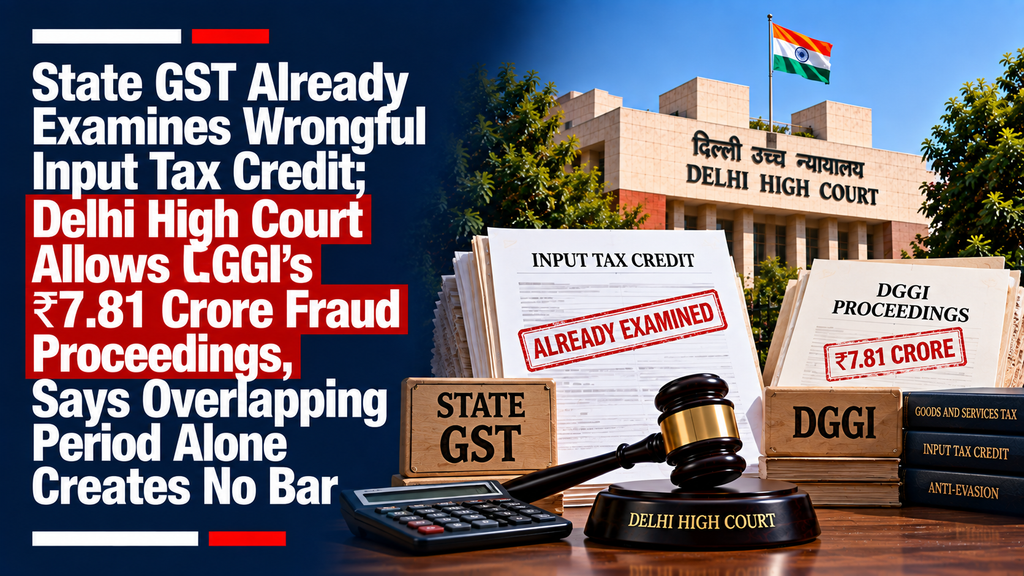
State GST Already Examines Wrongful Input Tax Credit; Delhi High Court Allows DGGI’s ₹7.81 Crore Fraud Proceedings, Says Overlapping Period Alone Creates No Bar

DGGI Raises ₹7.81 Crore Input Tax Credit Demand After State GST Proceedings; Delhi High Court Says Different Contraventions Can Be Investigated Separately
Facts
The petitioner, Sanskriti Exim Private Limited, is engaged in the export of readymade garments and has been registered under GST since 1 July 2017.
A joint intelligence exercise by the Directorate General of GST Intelligence (DGGI) and Directorate General of Revenue Intelligence (DRI) concerned alleged fraudulent availment of Input Tax Credit through invoices issued by non-existent/fictitious entities. The Department alleged that such ITC was utilised towards payment of IGST on exports, followed by claims for IGST refunds.
Searches were conducted in September and October 2019, and statements of a director of the petitioner were recorded under Section 70 of the CGST Act.
Meanwhile, State GST authorities separately initiated proceedings:
- 23 September 2023: Section 73 notice for FY 2017–18 concerning alleged ineligible ITC from cancelled/non-existent suppliers; demand confirmed on 22 December 2023.
- 11 December 2023: Section 73 notice for FY 2018–19 concerning allegedly wrongful ITC; demand confirmed on 9 April 2024.
- A further State notice under Section 74 was issued on 10 September 2024 for FY 2017–18.
In the meantime, DGGI issued a consolidated show-cause notice dated 29 July 2024 under Section 74, covering FY 2017–18 to FY 2019–20.
It proposed recovery of aggregate ITC of:
₹7,81,78,980, comprising ₹4,46,05,885 IGST and ₹1,67,86,547 each towards CGST and SGST.
The Order-in-Original dated 31 January 2025 confirmed the ₹7.81 crore demand with interest. It also imposed, inter alia, a ₹7.81 crore penalty concerning the alleged fraudulent ITC and another ₹6.51 crore penalty relating to the alleged fraudulent IGST refund.
Sanskriti Exim challenged the proceedings before the Delhi High Court.
Issues
The principal issues were:
1. Whether the DGGI proceedings were barred by Section 6(2)(b) of the CGST Act because State GST authorities had already initiated proceedings concerning wrongful ITC for overlapping periods.
2. Whether a consolidated show-cause notice under Section 74 covering multiple financial years is impermissible.
3. Whether the High Court should exercise Article 226 jurisdiction after the show-cause notice had already culminated in an appealable Order-in-Original.
Petitioner’s Arguments
The petitioner argued that State GST authorities had already initiated proceedings regarding allegedly wrongful ITC for the period July 2017 to March 2019 and had passed orders confirming demands.
The DGGI proceedings substantially covered the same period and the same broad allegation of wrongful availment/utilisation of ITC.
Accordingly, the petitioner invoked Section 6(2)(b), which prevents one GST authority from initiating proceedings on the same subject matter once proceedings have already been initiated by the other authority.
The petitioner also relied upon DGGI guidelines dated 8 February 2024 concerning coordination between Central and State investigating offices.
Separately, it argued that a single consolidated show-cause notice covering several financial years was impermissible because GST liability is statutorily determined financial-year-wise.
Respondents’ Arguments
The Department first raised the availability of an efficacious statutory appeal under Section 107 of the CGST Act.
On Section 6(2)(b), the respondents argued that the two proceedings were materially different.
The State proceedings concerned specific ITC discrepancies, including ITC allegedly availed from cancelled dealers.
The DGGI proceedings, however, arose from an independent investigation alleging:
fraudulent ITC from 20 non-existent suppliers → utilisation towards IGST liability on exports → consequential IGST refunds.
Thus, according to the Department, some factual overlap did not make the proceedings identical.
The Department also relied upon Ambika Traders to argue that Section 74 does not prohibit a consolidated notice covering more than one financial year.
Analysis of the Law
1. “Same Subject Matter” Does Not Mean Same Taxpayer or Period
The Court applied the Supreme Court’s ruling in Armour Security (India) Ltd. v. Commissioner, CGST.
It held that “subject matter” under Section 6(2)(b) refers to the particular:
tax liability, deficiency or obligation arising from the contravention sought to be assessed or recovered.
Therefore, two proceedings are not automatically identical merely because they:
- concern the same assessee;
- cover the same or overlapping financial years; or
- both relate generally to Input Tax Credit.
2. Supreme Court’s Two-Fold Test
The Delhi High Court specifically extracted a two-fold test from Armour Security for deciding whether proceedings involve the same subject matter:
First: Has an authority already proceeded on an identical tax liability or alleged offence against the assessee on the same facts?
Second: Is the demand or relief sought identical?
Both aspects must therefore be examined substantively rather than merely comparing the dates, sections or financial years.
3. State Proceedings and DGGI Investigation Were Materially Different
The State notices under Section 73 concerned alleged availment of ineligible ITC from cancelled/non-existent suppliers for FY 2017–18 and FY 2018–19.
The DGGI proceedings went further. They arose from an investigation alleging fraudulent ITC based on invoices from fictitious/non-existent entities and its subsequent utilisation for payment of IGST on exports and obtaining IGST refunds.
The Court therefore found a material distinction in the allegations underlying the respective proceedings.
Some transactions or ITC claims could conceivably feature in both sets of proceedings, but that alone did not prove that the proceedings concerned the identical liability or contravention.
4. Chronology Alone Does Not Trigger Section 6(2)(b)
The Court also rejected the proposition that DGGI was automatically barred merely because the State GST proceedings commenced first.
What matters is not simply who started proceedings first, but whether the later proceeding concerns the same subject matter.
Thus:
earlier State proceeding + later Central proceeding ≠ automatic Section 6(2)(b) violation.
Consolidated Show-Cause Notice for Multiple Years
This was the second important legal issue.
The petitioner argued that separate show-cause notices were mandatory for each financial year.
The Court relied upon its decision in Ambika Traders and rejected the proposition that a multi-year notice is inherently without jurisdiction.
It held:
The mere fact that a Section 74 show-cause notice covers more than one financial year does not, by itself, render it without jurisdiction.
Questions concerning limitation for a particular financial year, satisfaction of Section 74 ingredients and correct quantification remain open for adjudication.
Thus, the judgment should not be read as holding that every consolidated GST notice is necessarily valid. The narrower holding is that consolidation across financial years, by itself, does not invalidate the notice.
Alternative Remedy Under Section 107
The Court attached considerable importance to the fact that the proceedings had already culminated in an Order-in-Original.
Although the writ petition was initially instituted when the show-cause notice was pending, that circumstance changed once adjudication was completed.
The petitioner now had an efficacious statutory appeal under Section 107.
The issues concerning the suppliers, alleged fraud, overlap between proceedings, evidence and precise ITC liability required examination of factual and evidentiary material and were therefore more appropriately considered by the appellate authority.
The Court also rejected the argument that the statutory pre-deposit requirement was itself sufficient reason to bypass the appellate remedy.
Precedent Analysis
Armour Security (India) Ltd. v. Commissioner, CGST
This supplied the controlling interpretation of “same subject matter.” Identity must be assessed by examining the actual tax liability, contravention and demand—not merely the taxpayer, period or broad tax issue.
PEI Industries v. Union of India
The Court followed PEI Industries in holding that once Section 74 proceedings have culminated in an Order-in-Original, factual and evidentiary disputes concerning Section 6(2)(b) can appropriately be examined in the statutory appeal.
Ambika Traders v. Additional Commissioner
Relied upon for the proposition that a consolidated Section 74 show-cause notice covering multiple financial years is not invalid merely because it covers more than one financial year.
Toyota Kirloskar Motors, Rajesh Mittal and Aastha Apparels
The Court held that these decisions must be understood in their own factual contexts. None dispenses with the fundamental requirement of proving that the competing proceedings concern the same subject matter.
Court’s Reasoning
The Court’s reasoning can be reduced to three propositions:
First, Section 6(2)(b) does not prohibit every Central proceeding that overlaps factually with an earlier State GST proceeding.
Second, the taxpayer must establish identity of the underlying contravention, liability and demand. The material before the Court indicated materially different allegations between the State proceedings and DGGI’s broader fraud investigation.
Third, after the Section 74 notice had culminated in an Order-in-Original, the factual exercise necessary to determine actual duplication was better undertaken in the statutory appeal.
The Court therefore found no patent jurisdictional infirmity justifying Article 226 intervention.
Conclusion
The Delhi High Court dismissed the writ petition.
However, it expressly clarified that its observations concerning Section 6(2)(b) and the consolidated show-cause notice were confined to deciding whether writ interference was warranted.
Sanskriti Exim remains entitled to challenge the Order-in-Original under Section 107, including on all permissible grounds concerning overlap, duplication, liability and validity of the proceedings.
The appellate authority was directed to decide the appeal independently on its own merits and without being influenced by the High Court’s observations.
Case Details
Case: Sanskriti Exim Private Limited v. Directorate General of GST Intelligence, DZU & Ors.
Court: Delhi High Court
Case No.: W.P.(C) 929/2025 & CM APPL. 4550/2025
CNR: DLHC010025762025
Coram: Justice Anil Kshetrapal and Justice Shail Jain
Reserved: 7 August 2026
Pronounced: 18 September 2026
Result: Writ petition dismissed; Section 6(2)(b) bar not established for writ interference; consolidated multi-year notice not invalid merely for covering multiple years; statutory appeal under Section 107 remains available.