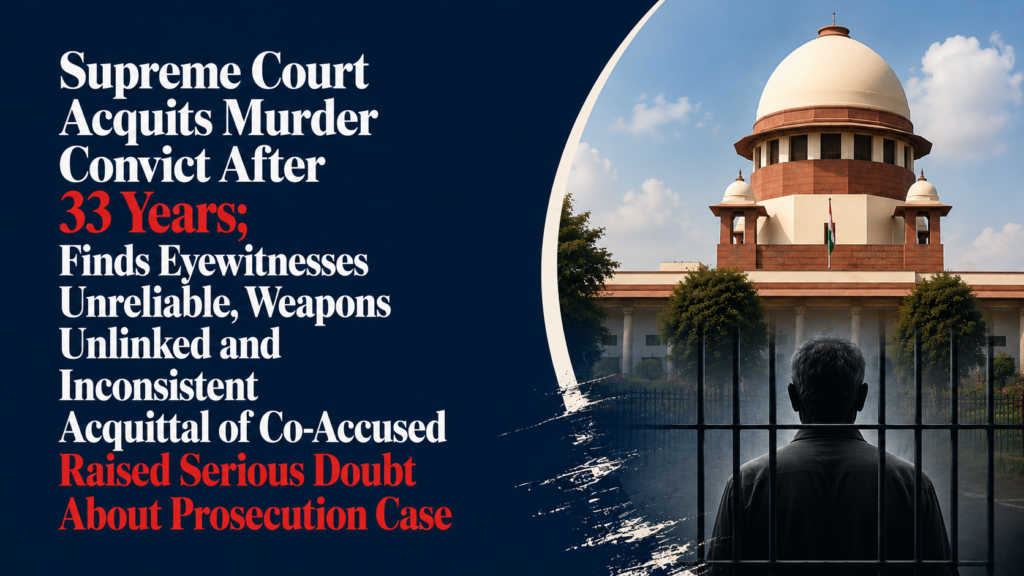
Supreme Court Acquits Murder Convict After 33 Years; Finds Eyewitnesses Unreliable, Weapons Unlinked and Inconsistent Acquittal of Co-Accused Raised Serious Doubt About Prosecution Case

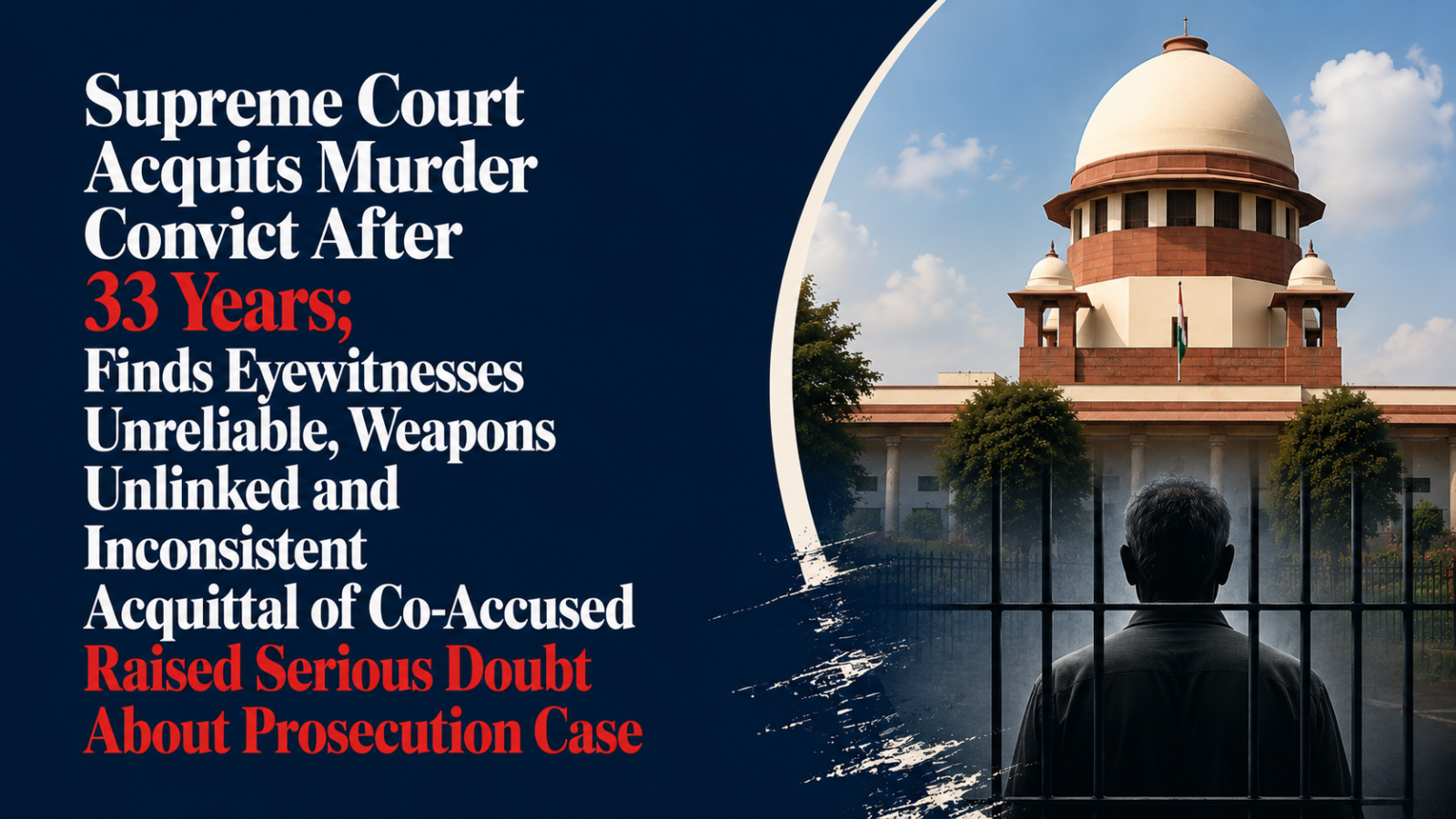
Supreme Court Sets Aside Murder Conviction in 1993 Land Dispute Clash; Finds Eyewitness Accounts Contradictory and Possibility of False Implication Cannot Be Ruled Out
Facts
The case arose from an incident dated 6 January 1993 in which the prosecution alleged that the accused formed an unlawful assembly with a common object and assaulted Gaflu and Bharat Singh. The assailants were also alleged to have rioted with deadly weapons. Gaflu subsequently died from the injuries sustained in the incident.
A charge-sheet was filed against 11 accused persons. The prosecution examined 17 witnesses. Five accused — Jhallu, Karodi, Sanju, Ujju @ Ujiyar and Hannu @ Hanumat — were acquitted, while five others, including appellant Nepal Singh, were convicted under Sections 148, 324/149 and 302/149 IPC. Another accused, Prakash Pateriya, died during the trial.
The State did not challenge the acquittal of the five co-accused. The convicted accused appealed, but the Madhya Pradesh High Court dismissed their appeals and affirmed the Trial Court’s findings.
Before the Supreme Court, Gaflu’s death from the injuries was not disputed. The central controversy was who had actually participated in the assault.
Issues
The principal issues before the Supreme Court were:
- Whether the prosecution had reliably established the appellant’s participation in the fatal assault.
- Whether the testimonies of PW-6, the injured alleged eyewitness, and PW-7, the deceased’s wife, were sufficiently credible to sustain the conviction.
- Whether recovery of weapons such as lathi, farsa and ballam could independently connect the appellant with the crime.
- Whether the conviction could stand when, on substantially the same evidence and similar roles, five co-accused had been acquitted.
Petitioner’s/Appellant’s Arguments
The appellant challenged the reliability of the prosecution’s identification evidence.
The defence relied particularly upon the contradictions emerging during cross-examination of the principal witnesses. PW-6 claimed to have witnessed the assault but also stated that he lost consciousness after receiving the first blow, creating doubt about his ability to accurately attribute subsequent blows and weapons to individual assailants. Most significantly, he admitted that he did not personally witness his father being struck by the farsa.
The defence case was further supported by evidence of previous hostility and a land dispute between the parties, creating a possible motive for false implication.
It was also material that several co-accused had been acquitted despite substantially similar allegations and evidence being presented against them.
Respondent’s Arguments
The State relied principally upon the testimony of PW-6, who was projected as an injured eyewitness, and PW-7, the deceased’s wife. Their examination-in-chief attributed the assault upon the deceased and PW-6 to the accused persons.
The prosecution also relied upon recovery of weapons including lathi, farsa and ballam as corroborative circumstances connecting the accused to the incident.
The prosecution case therefore sought to sustain the conviction on eyewitness testimony read together with the recoveries and the undisputed fact that Gaflu died from injuries suffered during the occurrence.
Analysis of the Law
The Supreme Court’s analysis centred on the fundamental criminal-law requirement that a conviction must rest upon credible and trustworthy evidence establishing the accused’s participation beyond reasonable doubt.
The Court distinguished between proof that an offence occurred and proof that a particular accused committed it. Although Gaflu’s homicidal death was established, the crucial question remained the identity and participation of the perpetrators.
On scrutinising the cross-examination of PW-6 and PW-7, the Court found their accounts to be mutually contradictory and full of embellishments, holding that they did not inspire confidence and were not worthy of credence.
The Court further held that mere recovery of ordinary weapons could not bridge serious deficiencies in the prosecution’s identification evidence.
Precedent Analysis
The judgment does not cite or undertake a detailed analysis of any earlier Supreme Court precedent. The decision turns primarily upon appreciation of the evidence and the inconsistencies in the findings of the courts below.
The important evidentiary principle emerging from the judgment is that a court cannot sustain a conviction merely because the occurrence and death are proved. The prosecution must reliably establish the involvement of the particular accused.
The Supreme Court also emphasised consistency in evaluating identically placed accused: where similar roles are attributed on the same evidence, a court must explain why that evidence is sufficient to convict some accused while being insufficient against others.
Court’s Reasoning
The Supreme Court identified several serious defects in the prosecution case.
First, PW-6’s testimony was internally inconsistent. He admitted prior disputes involving the parties, contradicted his earlier account regarding his mother’s presence, and stated that he lost consciousness because of his injuries. The Court questioned how, after claiming to have fallen unconscious upon receiving the first blow, he could accurately describe which accused delivered particular blows with particular weapons.
Second, PW-7 could not actually have witnessed the assault as claimed. She admitted in cross-examination that she was at home feeding her children when she heard about the assault and ran towards the spot. By the time she arrived, her husband had already been placed on a cot. This contradicted her examination-in-chief claim that she had witnessed the incident.
Third, the recovery of weapons such as lathi, farsa and ballam did not independently establish the appellant’s involvement. The Court observed that such articles are commonly found in rural households.
Fourth, there was an admitted land dispute between the parties, and evidence showed that the owner of the land cultivated by the convicts had previously been assaulted by the complainant party. The Court therefore held that the possibility of false implication could not be ruled out.
Finally, the Court found a fundamental inconsistency in the Trial Court’s approach. On the same depositions and where similar roles had been assigned to the accused, some were convicted while others were acquitted. The High Court had failed to explain why the reasoning used to acquit the co-accused should not equally apply to those convicted.
Conclusion
The Supreme Court held that the evidence was insufficiently reliable to sustain the appellant’s conviction.
Accordingly, it set aside the conviction, quashed the Madhya Pradesh High Court’s judgment dated 8 March 2018 and disposed of the appeals.
The Court further directed that the accused be released from custody if still in jail, and cancelled the bail bonds, if any.
Case Details
Case: Nepal Singh v. State of Madhya Pradesh
Court: Supreme Court of India
Case Number: Criminal Appeal Nos. 2239–2240 of 2026; 2026 INSC 869
Judge: Justice Sanjay Karol and Justice Augustine George Masih
Date: 17 August 2026
Result: Appeals allowed; conviction set aside; Madhya Pradesh High Court judgment quashed; accused directed to be released if in custody.