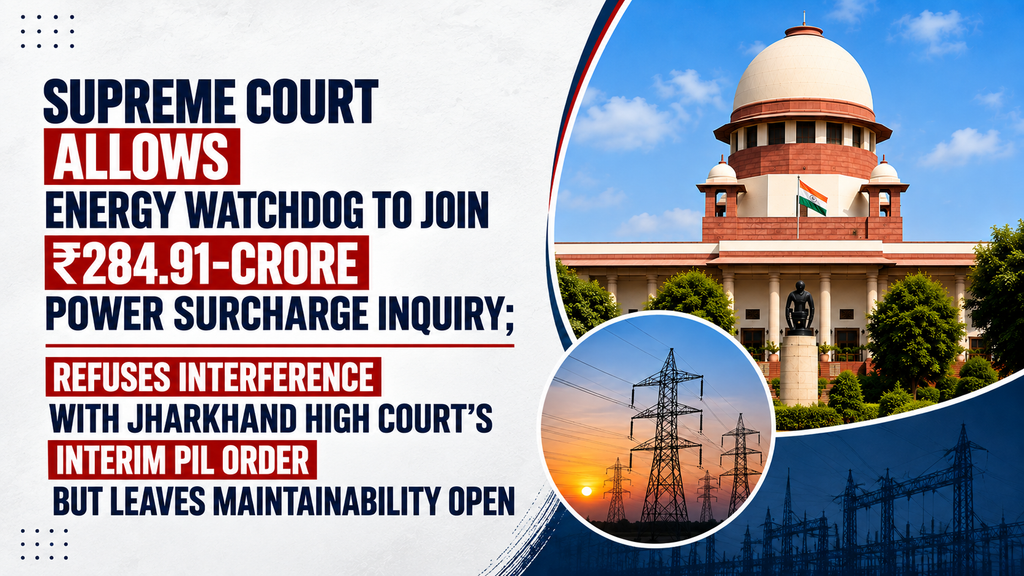
Supreme Court Allows Energy Watchdog to Join ₹284.91-Crore Power Surcharge Inquiry; Refuses Interference With Jharkhand High Court’s Interim PIL Order but Leaves Maintainability Open

Supreme Court Permits Energy Watchdog Hearing in Amalgam Steels Power Dispute; Clarifies JBVNL Inquiry Cannot Be Converted Into Court or Tribunal Proceedings
Facts
M/s Amalgam Steels and Power Ltd. entered into an agreement with Jharkhand Bijli Vitran Nigam Ltd. (JBVNL) on 17 May 2012 for supply of surplus electricity from its captive power plant to Petitioner No. 2. The agreement was subsequently renewed in 2017 and 2023.
Energy Watchdog lodged a complaint with the Additional Chief Secretary, Department of Energy, Jharkhand on 15 April 2024. It alleged that Petitioner No. 2 was consuming electricity generated by the captive power unit without possessing valid “captive user” status under Rule 3 of the Electricity Rules, 2005. It sought action under Section 135 of the Electricity Act, 2003. A fact-finding inquiry was thereafter initiated.
Energy Watchdog subsequently filed a PIL before the Jharkhand High Court seeking a declaration that the electricity supply was illegal and unauthorized because there was no Open Access Approval and the statutory conditions governing captive status had allegedly not been satisfied. It also sought investigation and recovery of losses allegedly caused to the State utility.
On 26 August 2025, JBVNL issued show-cause notices alleging breach of the CPP Agreement, unauthorized supply of electricity and violation of JBVNL’s right of first refusal.
It simultaneously raised cross-subsidy surcharge demands of:
- ₹176.74 crore against Petitioner No. 1; and
- ₹108.17 crore against Petitioner No. 2.
Thus, the combined demands were approximately ₹284.91 crore.
Amalgam Steels challenged the maintainability of Energy Watchdog’s PIL. On 5 February 2026, the Jharkhand High Court rejected the preliminary objection and held the PIL maintainable at that stage. It also permitted Energy Watchdog to be heard in the proceedings arising from JBVNL’s show-cause notices.
That interim order was challenged before the Supreme Court.
Issues
The principal questions were:
- Whether Energy Watchdog, being a stranger to the CPP Agreement, had locus to intervene in JBVNL’s proceedings.
- Whether the Jharkhand High Court could permit third-party participation in proceedings under the Electricity Act.
- Whether the Electricity Act, being a comprehensive statutory code, permitted such intervention outside its regulatory mechanism.
- Whether the Supreme Court should interfere under Article 136 with an interlocutory order while the PIL itself remained pending.
- Whether the question of PIL maintainability and third-party intervention should instead be finally determined by the High Court after considering the complete Electricity Act framework.
Petitioners’ Arguments
Senior Counsel Dr. A.M. Singhvi argued that Energy Watchdog was a stranger to the dispute, had suffered no legal injury and therefore could not be treated as a “person aggrieved.”
Accordingly, it lacked locus to maintain the writ petition.
The petitioners emphasized that the Electricity Act constitutes a comprehensive and self-contained statutory framework for regulation, adjudication and compliance in the electricity sector.
They argued that by permitting Energy Watchdog to participate in the JBVNL proceedings, the High Court had effectively created a tripartite procedure not contemplated by the Electricity Act.
Their position was that JBVNL should first complete the statutory proceedings independently. Energy Watchdog could thereafter pursue whatever remedy might be available to it if it remained aggrieved.
Energy Watchdog’s Arguments
Energy Watchdog argued that the petitioners had failed to pay cross-subsidy surcharge and that the proceedings against them had themselves arisen from multiple complaints made by Energy Watchdog.
It pointed out that demands had already been raised under the Jharkhand Open Access Rules and contended that there was no justification for the Supreme Court to interfere with the High Court’s interim arrangement.
Analysis of the Law
1. Electricity Act Is an Exhaustive Regulatory Code
The Supreme Court referred to the Constitution Bench judgment in PTC India Ltd. v. Central Electricity Regulatory Commission, which holds that the Electricity Act is an exhaustive code for matters concerning electricity.
It also relied upon Southern Power Distribution Company of Andhra Pradesh Ltd. v. Green Infra Wind Solutions Ltd., where the Court reiterated that after unbundling of the electricity sector and establishment of Central and State Regulatory Commissions, there is “no unallocated regulatory residue” outside the regulatory bodies.
The Court therefore recognized that the High Court, at final hearing, must carefully examine the regulatory framework created by the Electricity Act.
2. Regulatory Commissions Have Specific Statutory Functions
The Court noted that:
- Section 79 defines the Central Commission’s functions;
- Section 79(3) mandates transparency;
- Section 86 defines the State Commission’s functions;
- Section 86(1)(f) empowers the State Commission to adjudicate disputes between licensees and generating companies;
- Section 86(3) similarly mandates transparency; and
- Section 94(3) permits the Appropriate Commission to authorize a person to represent consumer interests.
These provisions were relevant because the High Court would ultimately have to decide whether, and to what extent, a third party such as Energy Watchdog could intervene.
3. Supreme Court Was Dealing Only With an Interim Order
The Supreme Court emphasized that the impugned order was merely an interlocutory order passed during the pendency of the Article 226 PIL.
The High Court had itself directed that the writ petition should proceed to further hearing. Before that could occur, however, the petitioners approached the Supreme Court, which had earlier directed maintenance of status quo.
This procedural posture was important: the Supreme Court was not finally deciding whether the PIL was maintainable.
4. High Court’s Concern About the Inquiry Was Not Baseless
The Supreme Court observed that the material placed by Energy Watchdog appeared to have created an impression before the High Court that “all is not well” with the JBVNL inquiry.
The High Court had specifically noticed circumstances suggesting that action had not been taken at the appropriate time despite longstanding complaints.
This explained why the High Court considered some third-party participation necessary as an interim measure.
5. Energy Watchdog Could Be Heard Despite Being Stranger to Contract
The Supreme Court expressly acknowledged that Energy Watchdog was not privy to the CPP Agreement.
Nevertheless, in the peculiar facts, the High Court considered it necessary that facts be placed before JBVNL by a party other than the petitioners so that the utility could reach an informed decision.
The Supreme Court held that such an interim arrangement could not be termed “perverse” so as to warrant interference under Article 136 at that stage.
6. Participation Is Only for Information Gathering — Not Adjudication
The Court imposed an important limitation.
JBVNL must independently deliberate upon the material and make its own decision. Energy Watchdog’s oral participation must not convert the administrative inquiry into a Court or Tribunal proceeding.
Its participation is essentially a mechanism for collecting relevant information so that JBVNL can determine whether further action is necessary.
7. PIL Maintainability and Third-Party Intervention Remain Open
The Supreme Court made clear that it had not expressed any opinion on the merits.
At final hearing, the Jharkhand High Court must examine all relevant questions, expressly including the scope and ambit of third-party intervention in proceedings under the Electricity Act.
Therefore, the decision should not be read as finally holding that Energy Watchdog possesses an unrestricted statutory right to participate.
Precedent Analysis
PTC India Ltd. v. Central Electricity Regulatory Commission, (2010) 4 SCC 603
A Constitution Bench held that the Electricity Act constitutes an exhaustive code governing electricity matters.
This principle supports the petitioners’ argument that disputes and regulatory functions must ordinarily operate within the statutory machinery created by the Act.
Southern Power Distribution Company of Andhra Pradesh Ltd. v. Green Infra Wind Solutions Ltd., 2026 SCC OnLine SC 479
The Supreme Court reiterated that after restructuring of the electricity sector and establishment of regulatory commissions, no unallocated regulatory residue remains outside those bodies.
The present Court treated this precedent as relevant to the issues the High Court must consider at final hearing.
Ayaaubkhan Noorkhan Pathan v. State of Maharashtra, (2013) 4 SCC 465
Relied upon by the petitioners on locus standi and “person aggrieved”, supporting their argument that a stranger without legal injury ordinarily cannot maintain proceedings challenging another party’s rights.
D.N. Jeevaraj v. Chief Secretary, Government of Karnataka, (2016) 2 SCC 653
Relied upon by the petitioners concerning the proper scope and maintainability of public interest litigation.
Kunga Nima Lepcha v. State of Sikkim, (2010) 4 SCC 513
Also cited by the petitioners in support of limitations governing PIL jurisdiction and judicial intervention.
Court’s Reasoning
The Supreme Court adopted a deliberately limited approach because it was examining an interim order rather than the final adjudication of the PIL.
Although Energy Watchdog was not a party to the CPP Agreement, the High Court had material before it suggesting that the JBVNL inquiry might benefit from facts supplied by an independent complainant.
Allowing Energy Watchdog to be heard was therefore treated as a temporary fact-gathering mechanism, rather than recognition of an absolute statutory right of intervention.
At the same time, the Supreme Court preserved the petitioners’ substantive objections by directing that the High Court must eventually consider the complete regulatory architecture of the Electricity Act and determine the permissible scope of third-party participation.
Thus, the judgment simultaneously:
- preserves Energy Watchdog’s interim participation;
- protects JBVNL’s independent decision-making authority;
- prevents the hearing from becoming quasi-judicial adjudication;
- leaves PIL maintainability and locus issues open; and
- requires the High Court to examine the Electricity Act’s exhaustive regulatory framework at final hearing.
Conclusion
The Supreme Court declined to interfere with the Jharkhand High Court’s interim order.
It clarified that Energy Watchdog’s participation before JBVNL is only intended to facilitate collection of information and must not transform the proceedings into those of a Court or Tribunal.
Most importantly, the Supreme Court expressly stated that it had not expressed any opinion on the merits. The Jharkhand High Court must finally determine all issues, including the scope of third-party intervention under the Electricity Act.
Case Details
Case: M/s Amalgam Steels and Power Ltd. & Anr. v. Energy Watchdog & Ors.
Citation: 2026 INSC 954
Court: Supreme Court of India
Case Number: Special Leave Petition (Civil) No. 10538 of 2026
Bench: Justice Pamidighantam Sri Narasimha and Justice Alok Aradhe
Date: 3 September 2026
Impugned Order: Jharkhand High Court order dated 5 February 2026 in W.P. (PIL) No. 3347 of 2025.
Result: SLP disposed of; Supreme Court declined interference with the interim order permitting Energy Watchdog to participate in the JBVNL inquiry, while leaving all merits and the scope of third-party intervention open for final determination by the High Court.