Supreme Court Enhances Accident Compensation to ₹3.77 Crore for Woman Left Blind With Permanent Stoma; Treats Disability as 100% Despite Continued Employment With Workplace Accommodations

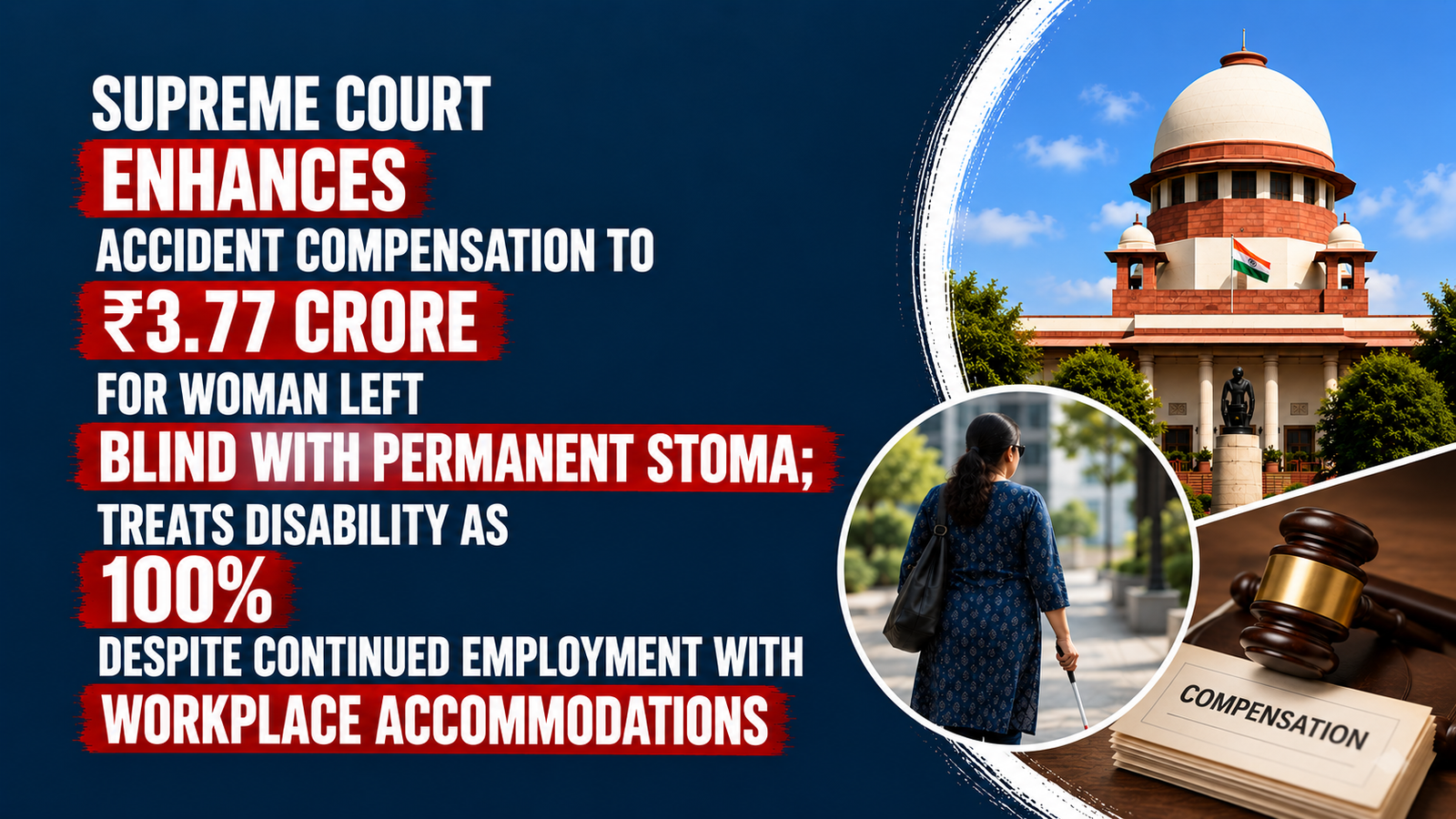
Supreme Court Treats Accident Survivor’s Disability as 100% Despite Continued Job; Enhances Compensation to ₹3.77 Crore Considering Blindness and Permanent Colostomy
Facts
The case arose from a serious road accident on 10 April 2011 near Brijghat Bridge. Sushant Prabhakaran was riding a motorcycle with Priyanka Das as pillion when a heavy goods vehicle insured by Reliance General Insurance Company hit them. Sushant was run over and died instantly, while Priyanka sustained grievous injuries.
The judgment contains two sets of connected appeals: the first concerning compensation arising from Sushant’s death, and the second concerning compensation for Priyanka’s catastrophic injuries. The latter is the principal part of the judgment for compensation enhancement.
Priyanka was initially admitted with pelvic fractures and blindness. She underwent prolonged treatment at several hospitals, including pelvic reconstruction and rectal/colostomy surgeries. AIIMS subsequently certified 100% visual disability, while gastrointestinal specialists confirmed that she would require a permanent colostomy stoma for life.
At the time of the accident, Priyanka was 35 years old and employed as Deputy Group Manager with IBM Daksh/Concentrix in Gurugram. She claimed ₹12 crore compensation.
The MACT assessed her functional disability at 60% and awarded ₹1,35,53,298. Although she had 100% physical visual disability, she continued working with specialised assistive software and her salary had increased.
The Punjab and Haryana High Court increased functional disability from 60% to 80%, granted 50% future prospects and enhanced the total award to ₹2,94,82,617.
The comparative table on page 15 shows the substantial enhancement by the High Court, including ₹1.93 crore towards physical disability/loss of future income, ₹19.20 lakh attendant charges, ₹10 lakh future medical expenses and ₹10 lakh for pain and suffering.
Issues
The principal questions before the Supreme Court were:
- Whether Priyanka’s continued employment meant that she had suffered no, or reduced, functional disability.
- Whether her functional disability should be assessed at 80% or 100%.
- Whether loss of earning capacity should be assessed by reference to her existing accommodated employment or her ability to compete in the open labour market.
- Whether the High Court correctly granted 50% future prospects.
- Whether attendant charges, future medical expenses and other heads required enhancement.
- Whether Reliance General Insurance’s challenge to the award had merit.
Insurer’s Arguments
Reliance General Insurance argued that Priyanka had suffered no corresponding loss of earning capacity because she continued as Deputy Group Manager and her CTC had actually increased from approximately ₹16 lakh to ₹19 lakh.
It challenged the application of Pappu Deo Yadav, the grant of 50% future prospects, ₹19.20 lakh attendant charges in the absence of proof of actual payments, and ₹10 lakh future medical expenses because her treatment was covered by her employer’s group insurance.
Even after the Supreme Court-appointed Medical Board assessed her at 100% permanent physical impairment, the insurer maintained that compensation should depend upon functional disability because she had neither lost her job nor her existing earnings.
Claimant’s Arguments
Priyanka sought further enhancement.
She argued that her functional disability should be treated as 100% because she was completely blind and permanently dependent upon a colostomy stoma.
She claimed that loss of future income should therefore be increased to ₹2,42,08,416, along with higher amounts for special diet, medical expenses and attendant charges. She also relied upon vouchers showing expenses of ₹10,000–₹12,000 per month for a maid and driver.
Analysis of the Law
1. Medical Board Found 100% Whole-Body Permanent Impairment
During the appeals, the Supreme Court directed Priyanka to undergo a fresh multidisciplinary medical examination at Vardhman Mahavir Medical College & Safdarjung Hospital, New Delhi.
The Medical Board comprised specialists from Neurology, Neurosurgery, Ophthalmology, General Surgery and Physical Medicine and Rehabilitation. Its report concluded that Priyanka suffered 100% total permanent physical impairment of the whole body.
The Court rejected the insurer’s attempt to discount this assessment. Since the insurer had participated in and invited the fresh medical evaluation, it could not rely on the report had it been favourable but disregard it because it established greater disability.
2. Continued Employment Does Not Mean Absence of Functional Disability
This is the most significant principle emerging from the judgment.
The Supreme Court held that functional disability must be assessed according to the victim’s earning capacity in the open competitive labour market, rather than merely whether a particular sympathetic employer has retained her.
Priyanka could continue working only because her employer provided:
- specially created assistive software;
- flexible working hours; and
- extraordinary workplace accommodations.
The Court described these accommodations as an act of “corporate compassion.”
Her continued salary therefore did not accurately reflect her true residual earning capacity.
3. Career Progression Was Seriously Destroyed
The employer’s Career Growth Letter showed that the accident adversely affected Priyanka’s normal career trajectory.
Although she remained employed, she lost opportunities for advancement to positions such as General Manager, Director or Vice President.
The Court therefore focused not merely on whether she could perform her existing job, but whether she could independently obtain, retain and advance in employment in the open market.
It concluded that this capacity had been entirely extinguished. Consequently, the High Court’s 80% assessment was increased to 100% functional disability.
4. Loss of Future Earning Capacity Increased to ₹2.42 Crore
The Court calculated the amount as follows:
- Monthly income: ₹84,057
- Annual income: ₹10,08,684
- Functional disability: 100%
- Future prospects: 50% = ₹5,04,342
- Total annual financial loss: ₹15,13,026
- Multiplier: 16
- Loss of future income: ₹2,42,08,416
5. Compensation Under Other Heads Enhanced
The Supreme Court reassessed the entire compensation package.
It awarded:
| Head | Amount |
| Loss of future earning capacity | ₹2,42,08,416 |
| Medical bills | ₹35,48,798 |
| Attendant charges for three attendants/24×7 care | ₹28,80,000 |
| Loss of income during treatment | ₹15,97,083 |
| Future medical expenses | ₹15,00,000 |
| Pain, suffering and mental agony | ₹15,00,000 |
| Loss of marriage prospects | ₹20,00,000 |
| Special diet | ₹2,00,000 |
| Loss of amenities and disfiguration | ₹2,00,000 |
| Transportation | ₹1,50,000 |
| Total | ₹3,77,84,297 |
These figures appear in the final compensation table on page 20 of the judgment.
6. ₹20 Lakh for Loss of Marriage Prospects
The Court separately awarded ₹20 lakh for loss of marriage prospects.
However, the Court expressly stated that this assessment was made in the peculiar facts and circumstances of Priyanka’s case and “shall not be treated as a precedent.”
Precedent Analysis
Sarla Verma v. Delhi Transport Corporation
The Court reaffirmed the standardised multiplier method. For a deceased/victim in the relevant age bracket, the prescribed multiplier is applied according to age rather than the age of dependants.
National Insurance Co. Ltd. v. Pranay Sethi
The Constitution Bench decision validating the standardised multiplier framework and principles concerning future prospects was relied upon.
Munna Lal Jain v. Vipin Kumar Sharma
Reaffirmed that the multiplier is determined according to the age of the deceased, rather than the age of dependent parents.
Pappu Deo Yadav v. Naresh Kumar
Important to the injury claim. It supports assessment of disability according to the actual impact upon income-generating capacity, rather than mechanically equating functional disability with the medical percentage assigned to a particular physical impairment.
Manjuri Bera v. Oriental Insurance Co. Ltd.
Relied upon in the connected death-compensation appeal concerning Priyanka’s entitlement despite the finding that she had failed to establish that she was the deceased’s legally wedded wife.
Court’s Reasoning
The Supreme Court’s central reasoning was that employment status and salary cannot be viewed in isolation while assessing functional disability.
Priyanka’s continued employment was possible because one particular employer had significantly adapted the workplace around her catastrophic disabilities. That circumstance could not be treated as proof that she retained equivalent earning capacity in the general employment market.
The Court considered her:
- complete and incurable blindness;
- permanent colostomy;
- pelvic and other severe injuries;
- numerous surgeries;
- dependence upon specialised workplace technology;
- need for flexible employment arrangements;
- lost promotional opportunities; and
- inability to independently secure and advance in alternative employment.
On that basis, her earning capacity in the competitive labour market was treated as completely extinguished, warranting 100% functional disability.
Conclusion
The Supreme Court enhanced Priyanka Das’s total compensation to ₹3,77,84,297, together with 7.5% interest per annum from the date of the claim petition until full realisation.
Reliance General Insurance Company’s Civil Appeal Nos. 12087–12088 of 2026 were dismissed, while Priyanka Das’s Civil Appeal No. 12089 of 2026 was partly allowed.
In the connected death-compensation appeals concerning Sushant Prabhakaran, the Supreme Court separately declined interference and dismissed both the insurer’s and Priyanka’s appeals.
Case Details
Case: Reliance General Insurance Company Limited v. Priyanka Das & Ors.
Citation: 2026 INSC 950
Court: Supreme Court of India
Case Numbers: Civil Appeal Nos. 12085–12086 of 2026 and Civil Appeal Nos. 12087–12089 of 2026
Bench: Justice S.V.N. Bhatti and Justice N.V. Anjaria
Judgment by: Justice S.V.N. Bhatti
Date: 3 September 2026
Result: Insurer’s appeals dismissed; claimant’s injury-compensation appeal partly allowed; compensation enhanced to ₹3,77,84,297 with 7.5% annual interest from the claim petition until realisation.